Daily reading
Paschal Time
Double · May 4 · Sanctoral
May 4, 2026
From Dom Guéranger’s The Liturgical Year.
A Double leads the weekday.Rubric
 |
May 4: St. Monica, Widow
IN the company of our Risen Lord there are two women, two mothers, of whom we have often had to speak during the last few weeks: they are Mary, mother of James the Less and Thaddeus, and Salome, mother of 'James the Great and John the beloved disciple. They went with Magdalen to the Sepulchre on the Resurrection morning; they carried spices to anoint the Body of Jesus; Angels spoke to them; and, as they returned to Jerusalem, our Lord appeared to them, greeted them, and allowed them to kiss his sacred feet. Since that day, he has repaid their love by frequently appearing to them; and on the day of his Ascension from Mount Olivet, they will be there, together with our blessed Lady and the Apostles, to receive his farewell blessing. Let us honour these faithful companions of Magdalen, these models of the love we should show to our Lord in his Resurrection; let us also venerate them as mothers who gave four Apostles to the Church.
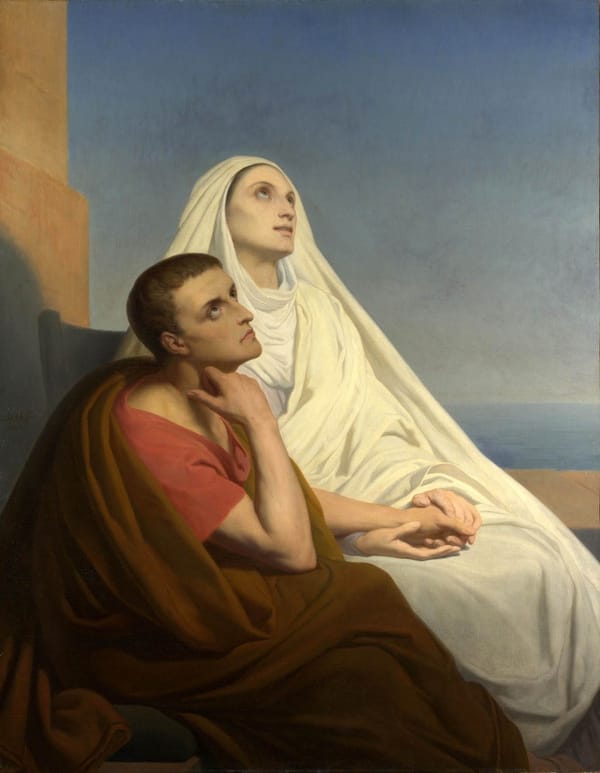
But lo! on this fourth morning of beautiful May, there rises, near to Mary and Salome, another woman, another mother. She, too, is fervent in her love of Jesus. She, too, gives to Holy Church a treasure—the child of her tears, a Doctor, a Bishop, and one of the grandest Saints of the New Law. This woman, this mother, is Monica, doubly mother of Augustine. This masterpiece of God's grace was produced on the desert soil of Africa. Her virtues would have been unknown till the day of judgement, had not the pen of the great bishop of Hippo, prompted by the holy affection of his filial heart, revealed to us the merits of this woman, whose life was humility and love, and who now, immortalized in men’s esteem, is venerated as the model and patroness of Christian mothers.
One of the great charms of the book of Confessions is Augustine’s fervent praise of Monica’s virtues and devotedness. With what affectionate gratitude he speaks, throughout his whole history, of the untiring constancy of this mother who, seeing the errors of her son, 1 wept over him more than other mothers weep over the dead body of their children.’1 Our Lord, who from time to time consoles with a ray of hope the souls he tries, had shown to Monica in a vision the future meeting of the son and mother; she had even heard a holy bishop assure her that the child of so many tears could never be lost: still the sad realities of the present weighed heavily on her heart; and both her maternal love and her faith caused her to grieve over this son, who kept away from her, yea, who kept away from her because he was unfaithful to his God. The anguish of this devoted heart was an expiation which would at a future period be applied to the guilty one; fervent and persevering prayer, joined with suffering, prepared Augustine’s second birth; and, as he himself says, ‘she went through more when she gave me my spiritual than when she gave me my corporal birth.’2
At last, after long years of anxiety, the mother found at Milan this son of hers who had so cruelly deceived her, when he fled from her roof to go and risk his fortune in Rome. She found him still doubting the truth of the Christian religion, but tired of the errors that had misled him. Augustine was not aware of it, but he had really made an advance towards the true faith. ‘She found me,’ says he, ‘in extreme danger, for I despaired of ever finding the truth. But when I told her that I was no longer a Manichean, and yet not a Catholic Christian, the announcement did not take her by surprise. She leaped for joy at being made sure that one half of my misery was gone. As to the other, she wept over me, as dead indeed, but to rise again; she turned to thee, O my God, and wept, and in spirit brought me and laid the bier before thee, that thou mightest say to the widow's son: Young man! I say to thee, arise! Then would he come to life again, and begin to speak, and thou couldst give him back to his mother! . . . Seeing then that although I had not yet found the truth, I was delivered from error, she felt sure that thou wouldst give the other half of the whole thou hadst promised. She told me in a tone of gentlest calm, but with her heart full of hope, that she was confident, in Christ, that before leaving this world, she would see me a faithful Catholic.’3
At Milan, Monica formed acquaintance with the great St Ambrose, who was the instrument chosen by God for the conversion of her son. ‘She had a very great affection for Ambrose,' says Augustine, ' because of what he had done for my soul; and he too loved her, because of her extraordinary piety, which led her to the performance of good works, and to fervent assiduity in frequenting the Church. Hence, when he saw me, he would frequently break out in her praise, and congratulate me on having such a mother.’4 The hour of grace came at last. The light of faith dawned upon Augustine, and he began to think of enrolling himself a member of the Christian Church; but the pleasures of the world, in which he had so long indulged, held him back from receiving the holy sacrament of baptism. Monica's prayers and tears won for him the grace to break this last tie. He yielded and became a Christian.
But God would have this work of his divine mercy a perfect one. Augustine, once converted, was not satisfied with professing the true faith; he aspired to the sublime virtue of continence. A soul favoured as his then was could find no further pleasure in anything that this world had to offer him. Monica, who was anxious to guard her son against the dangers of a relapse into sin, had been preparing an honourable marriage for him; but Augustine came to her one day, accompanied by his friend Alypius, and told her that he was resolved to aim at the most perfect life. Let us listen to the Saint's account of this interview with his mother; it was immediately after he had been admonished by the voice from heaven: ‘We (Augustine and Alypius) go at once to my mother's house. We tell her what has taken place; she is full of joy. We tell her all the particulars; she is overpowered with feelings of delight and exultation. She blessed thee, O my God, who canst do beyond what we ask or understand. She saw that thou hadst done more for me than she had asked of thee, with her many piteous and tearful sighs . . . . Thou hadst changed her mourning into joy even beyond her wishes, yea, into a joy far dearer and chaster than she could ever have had in seeing me a father of children.’5 A few days after this, and in the Church of Milan, a sublime spectacle was witnessed by angels and men: Ambrose baptized Augustine in Monica's presence.
The saintly mother had fulfilled her mission: her son was regenerated to truth and virtue, and she had given to the Church the greatest of her Doctors. The evening of her long and laborious life was approaching and she was soon to find eternal rest in the God for whose love she had suffered so much. The son and mother were at Ostia, waiting for the vessel that was to take them back to Africa. ‘I and she were alone,’ says Augustine, ‘and were standing near a window of our lodging, which commanded a view of the garden. We were having a most charming conversation. Forgetting the past, and stretching forward to the things beyond, we were talking about the future life of the Saints, which eye hath not seen, nor ear heard, nor hath it ascended into man's heart . . . . And whilst thus talking about it and longing for it, our hearts seemed to bound forward and reach it. We sighed, and left the first-fruits of our spirit there, and returned to the sound of our own voice . . . . Then my mother said to me: “ My son! as far as I am concerned, there is nothing now that can give me pleasure in this life. I know not what I can do, or why I should be here, now that I have nothing to hope for in this world. There was one thing for which I desired to live somewhat longer, and it was to see thee a Catholic Christian before my death. My God has granted me this and more, for I see that thou hast despised earthly pleasures and become his servant. What do I here?”’6
She had not long to wait for the divine invitation. She breathed forth her pure soul a few days after this incident, leaving an indelible impression upon the heart of her son, a name most dear and honoured to the Church, and a perfect example of the purest and holiest maternal affection to Christian mothers.
The life and virtues of St Monica are thus briefly portrayed in to-day’s Liturgy:
The Middle Ages have left us several liturgical pieces composed in honour of St Monica; but most of them are poor. The sequence we select is not without merit; it has even been attributed to Adam of Saint-Victor.
Sequence
Atque suæ piæ matris laudes et præconia
Decantemus, venerantes
Et optata celebrantes hodie solemnia.
Vita clara, Christo chara, hæc beata Monica
De profano propagatum,
Jam nunc parit suum natum in fide catholica.
Quo effulsit tam præclarum lumen in Ecclesia!
Multo fletu seminavit,
Germen ubi reportavit metens in lætitia.
O quam miro tunc gestivit Spiritus tripudio,
Cernens natum fide ratum,
Sed et Christo jam sacratum toto mentis studio!
Et in eis Christum pavit, mater dicta pauperum;
Curam gerens infirmorum,
Lavit, stravit, et eorum tersit sordes vuinerum.
Quam transfigunt amorosa crucifixi stigmata!
His accensa sic ploravit,
Lacrymis quod irrigavit pavimenti schemata.
Stat a terris elevata cubiti distantia;
Mente rapta exsultavit:
‘Volitemus,’ exclamavit, ‘Ad cœli fastigia.’
Advocata et patrona sis pro tuis filiis,
Ut dum carne exuemur,
Nato tuo sociemur paradisi gaudiis.
and of his holy mother.
Let us devoutly celebrate
the beloved solemnity of this day.
well instructed in the faith, edifying in her conduct, and dear to Christ.
Her son was born of a pagan father;
but she gave him a second birth—she brought him to the Catholic faith.
through which shone forth so bright a light within the Church!
Monica sowed in much weeping,
but she reaped her fruit in joy.
Oh! how grand was the gladness that filled her soul,
when she saw her son staunch in faith,
yea, and devoted with his whole heart to Christ!
for she ministered to them in their necessities, and gave to Christ the food she gave to them.
She took care of the sick,
washed them, nursed them, and dressed their wounds.
with compassion for the dear Wounds of her crucified Lord!
She wept for love when she thought upon them,
and her tears bedewed the spot on which she prayed.
she was raised from the ground
and in her rapture exclaimed with joy:
‘Let us fly to heaven above!'
be to us thy children an advocate and patroness,
that so, when we quit the flesh, we may be united to Augustine,
thy son, in the joys of paradise.
O thou model of mothers! Christendom honours thee as one of the most perfect types of human nature regenerated by Christ. Previous to the Gospel, during those long ages when woman was kept in a state of abjection, a mother’s influence on her children was feeble and insignificant; her duties were generally limited to looking after their bodily well-being; and if some mothers of those times have handed their names down to posterity, it is only because they taught their sons to covet and win the passing glory of this world. But we have no instance in pagan times of a mother training her son to virtue, following him from city to city that she might help him in the struggle with error and the passions, and encourage him to rise after a fall; we do not meet with one who devoted herself to continual prayer and tears, with a view to obtain her son's return to truth and virtue. Christianity alone has revealed a mother's mission and power.
What forgetfulness of thyself, O Monica, in thine incessant endeavour to secure Augustine's salvation! After God, thou livest for him, and to live for thy son in such a way as this, is it not living for God, who deigns to use thee as the instrument of his grace? What carest thou for Augustine's glory and success in this world when thou thinkest of the eternal dangers and of the eternal separation from God and thee to which he is exposed. There is no sacrifice which thy maternal heart is not ready to make in order to satisfy the divine justice: it has its rights and thou art too generous not to satisfy them. Thou waitest patiently, day and night, for God's good time to come. The delay only makes thy prayer more earnest. Hoping against all hope, thou at length feelest within thy heart the humble but firm conviction that the object of all these tears can never be lost. Moved with mercy towards thee, as he was towards the sorrowing mother of Naim, he speaks with that voice which nothing can withstand: ‘Young man! I say to thee, arise!’ and he gives him to his mother,’7 he gives thee the dear one whose death thou hadst so bitterly bewailed, but from whom thou couldst not tear thyself.
What a recompense of thy maternal love is this! God is not satisfied with restoring thee Augustine full of life; this son of thine rises at once from the very depths of error and sin to the highest virtue. Thou hadst prayed that he might become a Catholic and break certain ties which were both a disgrace and danger to him; when lo! one single stroke of grace has raised him to the sublime state of the Evangelical Counsels. Thy work is more than done, O happy mother! Speed thee to heaven; where till thy Augustine joins thee, thou art to gaze on the saintly life and works of this son, whose salvation is due to thee and whose glory, even while he sojourns here below, sheds a bright halo over thy venerated name.
From the eternal home where thou art now happy with this son who owes to thee his life both of earth and heaven, cast a loving look, O Monica, on the many Christian mothers who are now fulfilling on earth the hard but noble mission which was once thine. Their children are also dead with the death of sin; and they would restore them to true life by the power of their maternal love. After the Mother of Jesus, it is to thee that they turn, O Monica, whose prayers and tears were once so efficacious and so fruitful. Take their cause in hand; thy tender and‘devoted heart cannot fail to compassionate them in the anguish which was once thine own. Maintain their courage; teach them to hope. The conversion of these dear ones is to cost them many a sacrifice; procure them the generosity and fortitude to pay the price thus asked of them by God. Let them remember that the conversion of a soul is a greater miracle than raising a dead man to life; and that divine justice demands a compensation which they, the mothers of these children, must be ready to make. This spirit of sacrifice will destroy that hidden egotism which is but too frequently mingled with what seems to be affection of the purest kind. Let them ask themselves if they would rejoice as thou didst, O Monica, at finding that a vocation to the Religious life was the result of the conversion they have so much at heart. If they are thus disinterested, let them not fear; their prayers and sufferings must be efficacious; sooner or later, the wished-for grace will descend upon the prodigal, and he will return to God and to his mother.
Monday of the Fifth Week after Easter
JESUS bestows an inestimable gift upon his Apostles; and from this gift there proceed two sacraments. On the sixth day of the creation, the divine Word infused his breath into man, whose body he had formed out of the slime of the earth; and immediately this body was animated by a soul, bearing upon it the image of God. On the evening of the day of his Resurrection, the same divine Word, then made visible in the flesh he had assumed, suddenly appeared in the midst of his Apostles, and said to them: Peace be to you! As the Father hath sent me, I also send you.1 Then breathing upon them, he added, in a tone of command: Receive ye the Holy Ghost!2 What is this Breath, which is not given to all men but only to a few chosen ones? Jesus himself explains it, by the words he speaks: this Breath imparts the Holy Ghost to them that receive it. The Holy Ghost is given to the Apostles, because they are sent by Jesus, as Jesus is sent by the Father.
The Apostles, then, receive this divine Spirit, in order that they may communicate him to men, just as they themselves have had him given to them by Jesus. The Church's tradition fills up the brief account of the Gospel. Two sacraments, as we have already stated, take their origin from this act of our Risen Jesus, who afterwards instructed his Apostles as to the rites wherewith each of the two was to be administered.
The first of these two sacraments is Confirmation, for whose institution we will return our humble thanks to-day; the other is Holy Orders, which we will explain further on in the week; both of them belong, in their administration, to the episcopal character, which is the source whence flow the gifts conferred upon the Apostles for man’s sanctification.
Such is the importance of the sacrament of confirmation, that until such time as we have received it, we cannot be considered as perfect Christians. It is true that, by virtue of our baptism, we are children of God, members of Christ and his Church; but, as Christians, we are soldiers: we have to confess our faith, sometimes before tyrants, and even to the shedding of our blood; sometimes before the world, whose false seductive maxims are the occasion of so many apostasies; sometimes against Satan and his wicked angels, whose power is so justly feared by the servants of Christ. The seal of the Holy Ghost confers on us a degree of strength which baptism does not give. Baptism made us citizens of the Church; confirmation makes us soldiers of God and of his Christ. Again, it is true that we can fight and conquer with the armour of baptism; such is God’s will, who knows that the sacrament which perfects the Christian is oftentimes an impossibility; but, woe to them that neglect to receive the completion of their baptism I Hence, after administering the sacrament of regeneration on Holy Saturday, the bishop at once proceeded to give the Holy Ghost to all those who had been just bom in the Son, and had been adopted by the Father.
Yes, confirmation is administered by a bishop, it is for him to say to the baptized: Receive ye the Holy Ghost! It was just that this divine Spirit should be thus honoured. Even when, in cases of necessity, a priest is delegated, by the Pope, to administer this sacrament, he cannot validly do so except on the condition of his using chrism consecrated by a bishop: and thus the episcopal power is always uppermost in the conferring of the Holy Ghost.
What a solemn moment is that, wherein the Spirit of power, who strengthened the Apostles, descends upon the neophytes kneeling before the bishop! The pontiff stretches his hands over them: he pours out upon them the Spirit he has received in order to communicate him to others; and that he may give all possible solemnity to the gift he is about to bestow, he cites the words of Isaias, which prophesy the descent of the Spirit on the Branch that was to spring up from the root of Jesse—a prophecy which was fulfilled in our Jesus, when he received baptism in the river Jordan, from the hands of St John the Baptist:’ O Almighty and Eternal God! who hast vouchsafed to regenerate these thy servants by water and the Holy Ghost; send forth from heaven upon them thy sevenfold Spirit, the Holy Paraclete: the Spirit of wisdom and understanding; the Spirit of counsel and fortitude; the Spirit of knowledge and godliness; fill them with the Spirit of thy fear, and sign them with the sign of the Cross of Christ.’3
Then is brought the sacred chrism, of whose virtue we heard so much on Maundy Thursday. Confirmation was anciently called the Sacrament of Chrism—of chrism in which dwells the power of the Holy Ghost. The pontiff anoints with it the foreheads of the neophytes, and, at the same instant, the Holy Ghost imprints on their souls the sign of a perfect Christian. They are confirmed, and for ever. Let them but listen to the voice of the sacrament which is now within them, and no trial, no danger can master them. The holy oil wherewith the cross has been signed on their forehead has imparted to them that firmness of adamant which was given to the Prophet Ezechiel, and enabled him to withstand all his enemies.4
To a Christian, strength is salvation; for man's life on earth is a warfare.5 Glory, then, be to our Risen Jesus, who, foreseeing the attacks that would be made against us, has armed us for the battle, and, in this admirable sacrament of confirmation, has given us the divine Spirit, who proceeds from himself and the Father, that we might be strong and invincible! Let us thank him, with all our hearts, for his having thus completed the grace already given us in baptism. The Father, who so graciously adopted us, has delivered up his Only Begotten Son for us; the Son gives us the Spirit, that he may dwell within us; oh! how wonderful a creature is man, who is so loved by the Trinity! And yet man is a sinner and an unfaithful creature: and but too frequently, all these graces are rendered fruitless by his negligence or malice! Let us at least be faithful, by keeping ourselves closely united to Holy Church, and by devoutly celebrating, with her, the mysteries of God’s goodness which the liturgical year brings successively before us.
Let us adore our Risen Jesus, our divine Benefactor. In the name of his Church, enriched as she is by such precious gifts, let us offer him this beautiful Paschal canticle, taken from the ancient Missal of Saint Gall.
Sequence
Carmina comparibus
Ecclesia dilecto pangat suo,
Illius gaudens
Reditus triumpho.
Tergens gena lacrymulam,
Læta nunc excipiat regressum,
Quem nuper flebat
Ademptum.
Hujus et affectu ardens,
Tersit suo vulnere
Ab illa nævum
Parentis primulae.
Procul de nuptae gaudio
Synagoga pellatur,
Colore obfuscata nigerrimo.
Alta confixus crucis arbore
Sacravit lateris
Illam flumine.
Viri cum fabricatur a costa,
Et Noe arcula
Aquis levata.
Nuper tyrannus
Misere afflictam,
Atque suis a sedibus
Translatam,
Favens plorati,
Atque sternens Babylonem,
Revocasti Sion tuum
Ad montem.
Ovantem gaudiis
Gratia figurat
Mundi florentis,
Consortes nos esse
Fac Jesu redemptos
Tuo cruore;
Canopicos afflixisti
Morte principes,
Ut nos inde solveres,
Praesta in eremo
Hujus vitæ,
Viperas
Conteramus igneas.
Te duce, promissam
Veniamus ut ad terram.
rejoicing in the triumphant
return of her Beloved,
sing to him her canticles,
with voice well attuned.
from her beautiful cheeks,
and gladly welcome back her Jesus,
for whom she wept
when he was taken from her.
out of burning love for her;
and, by his Blood,
cleansed her
from the stain of Eve’s offence.
clad in robes of blackest hue,
is driven, by the Bridegroom’s piercing rays,
from the Marriage Feast.
Jesus was nailed to the lofty Tree of the Cross,
and he sanctified her by the stream
that flowed from his Side.
was a figure of the Church;
so, too, was Noe's Ark,
when it sailed on the waters.
cruelly treated thy Spouse,
O Christ,
and sent her
into exile:
on her sorrow,
and, destroying Babylon,
didst bring her back
to thy holy Mount of Sion.
decked in her flowers of spring,
is a figure of thy Church’s
triumphant joy.
to imitate her loveliness,
for thou hast redeemed us
by thy Blood.
and for our deliverance,
didst bring death
upon the princes of Egypt;
grant that we may safely walk through
the desert of this life
beneath our feet,
And, having thee
for our leader,
reach the Promised Land.
| Previous May 3 (the Same Day): Sts. Alexander I, Pope, Eventius and Theodulus, Martyrs, and Juvenal, Bishop and Confessor | Next Monday of the Fifth Week after Easter |