Daily reading
Paschal Time
Greater Double · May 6 · Sanctoral
May 6, 2026
From Dom Guéranger’s The Liturgical Year.
A Greater Double leads the weekday.Rubric

|
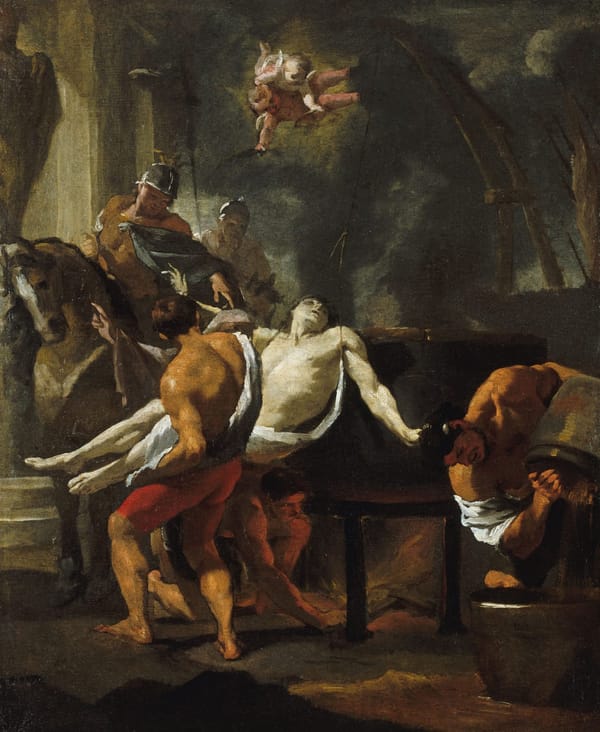
May 6: St. John before the Latin Gate
THE beloved Disciple John, whom we saw standing near the crib of the Babe of Bethlehem, comes before us again to-day; and this time he pays his delighted homage to the glorious Conqueror of death and hell. Like Philip and James, he is clad in the scarlet robe of martyrdom. The month of May, so rich in Saints, was to be graced with the palm of St John.
Salome one day presented her two sons to Jesus, and with a mother’s ambition asked him to grant them the highest places in his kingdom. The Saviour, in his reply, spoke of the chalice which he himself had to drink, and foretold that these two disciples would also drink of it. The elder, James the Great, was the first to give his Master this proof of his love; we shall celebrate his victory when the sun is in Leo: it was to-day that John, the younger brother, offered his life in testimony of Jesus’ divinity.
But the martyrdom of such an Apostle called for a scene worthy the event. Asia Minor, which his zeal had evangelized, was not a sufficiently glorious land for such a combat. Rome, whither Peter had transferred his Chair and where he died on his cross, and where Paul had bowed down his venerable head beneath the sword, Rome alone deserved the honour of seeing the beloved disciple march on to martyrdom, with that dignity and sweetness which are the characteristics of this veteran of the Apostolic College.
Domitian was then Emperor—a tyrant over Rome and the world. Whether it were that John undertook this journey of his own free choice, and from a wish to visit the Mother Church, or that he was led thither bound with chains, in obedience to an imperial edict—John, the august founder of the seven Churches of Asia Minor, appeared before the tribunal of pagan Rome. He was convicted of having propagated, in a vast province of the Empire, the worship of a Jew who had been crucified under Pontius Pilate. He was a superstitious and rebellious old man, and it was time to rid Asia of his presence. He was therefore sentenced to an ignominious and cruel death. He had somehow escaped Nero’s power: but he should not elude the vengeance of Caesar Domitian!
A huge cauldron of boiling oil is prepared in front of the Latin Gate. The sentence orders that the preacher of Christ be plunged into this bath. The hour is come for the second son of Salome to partake of his Master’s chalice. John’s heart leaps with joy at the thought that he—the most dear to Jesus, and yet the only Apostle that has not suffered death for him—is at last permitted to give him this earnest of his love. After cruelly scourging him, the executioners seize the old man, and throw him into the cauldron; but, lo! the boiling liquid has lost all its heat; the Apostle feels no scalding; on the contrary, when they take him out again he feels all the vigour of his youthful years restored to him. The Praetor’s cruelty is foiled, and John, a martyr in desire, is to be left to the Church for some few years longer. An imperial decree banishes him to the niggled Isle of Patmos, where God reveals to him the future of the Church, even to the end of time.
The Church of Rome, which counts among her most glorious memories the abode and martyrdom of St John, has marked with a Basilica the spot where the Apostle bore his noble testimony to the Christian faith. This Basilica stands near the Latin Gate, and gives a title to one of the Cardinals.
In honour of the great Apostle of love, we give the following Sequence, composed by Adam of Saint-Victor:
Sequence
Summum regem gloriæ
Videns mentis acie
Non repulsa,
Angelis parificat,
Spiritu qui indicat
Cœli summa.
Hic est potus recumbentis
Supra pectus Domini;
Hic expugnat vires ignis
Et ferventis olei.
Tormenti sævitia,
Quod martyr quis fiat
Et pœnas non sentiat.
O custos Virginis
Per quam mundo gloria,
Ex quo sunt, in quo sunt,
Per quem sunt omnia,
Per te det suffragia!
Christum, a quo diligeris,
Interpellans et exorans,
Nos ei concilia.
Tu qui collis, due ad montem;
Præsta Sponsum ad videndum,
Virgo totus gratia.
where the King of glory
is seen by the soul's
unfettered gaze,
and equality with the angels, to
John, whose revelations have made known
to men the mysteries of heaven.
that spring up to life eternal,
when he leaned on his Lord's breast.
have made him shine as a bright light in the Church.
He quenched the heat of the boiling oil.
for him are cruel beyond measure;
yet do they wonder within themselves,
how a man can be a martyr and feel no pain.
O guardian of the Virgin
by whom the world received him
who is its glory!
pray for us to Jesus, from whom, and in whom,
and by whom are all things.
by thine intercession and prayers,
render Jesus, by whom thou wast loved,
propitious unto us.
O thou that art a hill, lead us to the mountain!
O thou whom grace made wholly pure,
pray for us that we may see the Beloved.
We are delighted to meet thee again, dear disciple of our Risen Jesus! The first time we saw thee was at Bethlehem, where thou wast standing near the Expected of Nations, the promised Saviour, who was sweetly sleeping in his crib. We then thought of all thy glorious titles: Apostle, Evangelist, Prophet, highsoaring Eagle, Virgin, Doctor of charity, and above all, Jesus' Beloved Disciple. To-day we greet thee as martyr; for if the ardour of thy love quenched the fire prepared for thy torture, thy devotion to Christ had honestly and willingly accepted the chalice of which he spoke to thee in thy younger years. During these days of Paschal Time, which are passing so rapidly, we behold thee ever close to this divine Master, who treats thee with every mark of affection. Who could be surprised at his special love for thee? Wast thou not the only one of all the disciples who stood at the foot of the Cross? Was it not to thee that he gave the care of his Mother, making her thine? Wast thou not present when his Heart was opened on the Cross by a spear? When, on the morning of the great Sunday, thou didst repair with Peter to the Tomb, wast thou not, by thy faith, the first of all the disciples to honour Jesus' Resurrection? Oh, yes! thou hast a right to all the special love wherewith Jesus treats thee; but pray to him for us, O blessed Apostle!
We ought to love him for all the favours he has bestowed upon us; and yet we are tepid in his love—we humbly confess it. Thou hast taught us to know the infant Jesus, thou hast described to us the crucified Jesus; show us now the Risen Jesus, that we may keep close to him during these last few days of his sojourn on earth. And when he has ascended into heaven, procure us brave hearts, that like thee we may be prepared to drink the chalice of trials which he has destined for us.
Rome was the scene of thy glorious confession, O holy Apostle! She is most dear to thee; join, then, with Peter and Paul in protecting her. If the palm of martyrdom be in thy hand as well as the pen of the Evangelist, remember it was at the Latin Gate that thou didst obtain it. It was in the East that thou didst pass the greater part of thy life; but the West claims the honour of counting thee as one of her grandest martyrs. Bless our Churches, reanimate our faith, rekindle our love, and deliver us from the Antichrists against whom thou didst warn the faithful of thine own times, and who are causing such ravages among us. Adopted son of Mary! thou art now enjoying the sight of thy Mother's glory: present to her the prayers we are offering to her during this month, which is consecrated to her, and obtain for us the petitions which we presume to make to her.
Wednesday of the Fifth Week after Easter
WE now come to the fourth sacrament, which may be justly called the sacrament of mercy. Jesus knew the weakness of man. He knew that the great majority of Christians would not persevere in the grace they received at baptism; and that sin would in most cases spoil the beautiful plant which had been watered by the dew of heaven, and which, after growing and flowering, was to be transplanted into the garden of eternal life. Like grass that lies withered on the field, so would be this once fair plant. How could it ever revive, unless he that made it gave it life again? Thanks to his infinite mercy, this is what he has the will to do. Consulting the sinner's salvation rather than his own glory, he prepared, as the holy Fathers express it, a second plank after shipwreck. The first was baptism; but mortal sin came, and the soul was again plunged into the wild abyss. She had fallen once more into the hands of her enemy; she was fettered by chains which it was out of her power to break.
During his mortal life on earth, Jesus, who came not to judge the world, hut to save it,1 declared that these fetters, forged by the sinner’s malice, should be broken by a power which he would one day establish in his Church. Speaking to his Apostles, he told them that whatsoever they should loosen upon earth, should he loosed also in heaven.2 Since making that solemn promise, our Redeemer has offered his sacrifice on the Cross; his infinitely precious Blood has been shed for the superabundant expiation of the sins of the world. He that loved us to such a degree as this could never forget the promise he had made. On the contrary, he was most anxious to keep it, for he knew the fearful dangers to which our salvation is exposed. On the very day of his Resurrection, he appears to his Apostles, and his first words evince his eagerness to fulfil the promise he had previously made. It seems as though his mercy were impatient to break asunder the humiliating and terrible bonds of sin, which held us captives. No sooner has he breathed the Holy Ghost upon his Apostles, than he adds these words: Whose sins ye shall forgive, they are forgiven them.3 Observe here, as the holy Fathers have done, the strength of the words spoken by our Lord: They are forgiven. He says not, ‘they shall be forgiven;’ it is no longer the promise of a gift, but the gift itself. Before the Apostles have exercised the divine power conferred on them by Jesus, every absolution which they and their successors in this sacred ministry shall pronounce, even to the end of time, is already confirmed.
Glory, then, be to our Risen Jesus, who has removed the barriers of his justice, that his mercy might inundate the world! Let mankind unite and sing to him the sublime canticle of David, wherein, foreseeing the wondrous events that were to take place under the New Law, this royal psalmist prophesied the forgiveness of sins, which the Apostles were afterwards to teach us as an Article of our Creed.
Bless the Lord, O my soul! and let all that is within thee bless his holy Name. Who forgiveth all thine iniquities, who healeth all thy diseases, who redeemeth thy life from destruction.
Thy youth shall be renewed like the eagle's. The Lord is compassionate and merciful, long-suffering and plenteous in mercy. He will not always be angry. He hath not dealt with us according to our sins. As far as the east is from the west, so far hath he removed our iniquities from us.As a father hath compassion on his children, so hath the Lord compassion on them that fear him; for he knoweth our frame; he remembereth that we are dust. Man's days are as grass; as the flower of the field, so shall he flourish; for the spirit shall pass in him, and he shall not be, and he shall know his place no more. But the mercy of the Lord is from eternity and unto eternity upon them that fear him. O my soul! bless thou the Lord.4
And yet we, the children of the promise, know even better than David did the greatness of God’s mercy. Jesus was not content with giving us his assurance that if, after having sinned, we have recourse with humble repentance to the divine Majesty, we shall obtain pardon: as the sentence of God’s mercy would thus be without any outward sign, a cruel anxiety would have ever been upon us, leaving us in doubt of our forgiveness. Therefore did this loving Saviour ordain that men should give us pardon, in his name. That we might know that the Son of Man hath power on earth to forgive sins,5 he gave power to his delegates to pronounce over us a sentence of absolution which our very ears might hear, and which would convey to our souls the sweet confidence of pardon.
O ineffable sacrament, by whose means heaven is peopled by countless numbers who else had been lost, and who will for ever sing the mercies of the Lord!6 O irresistible power of the words of absolution, which, deriving their efficacy from the Blood of our Redeemer, take away all our iniquities, and plunge them into the abyss of divine mercy! The eternity of torments due to these iniquities would never have expiated them; and yet these few words of the priest: I absolve thee, have utterly annihilated them.
Such is the sacrament of penance. In return for the humble confession of our sins and the sincere sorrow for having committed them, we receive pardon, and this not once or twice only, but as often as we approach the sacred tribunal; not for this or that kind of sin only, but for every sin whatsoever. It is not to be wondered at that Satan should envy man this gift, and strive to throw such doubts and difficulties in the way as to prevent his profiting by it. What has not heresy said against this sacrament? It began by teaching that it takes from the glory of holy baptism; whereas on the contrary, it honours that first sacrament, by repairing the injuries done to it by sin. Later on, it exacted, as absolutely necessary for the sacraments, such perfect dispositions, that absolution would find the soul already reconciled with God. It was by this dangerous snare of Jansenism that so many were ruined, either by pride or by discouragement. And lastly, it has set up that Protestant dictum:’I confess my sins to God just as though God had not the right to lay down the conditions for pardon.
The sacraments being, as they are, such divine institutions, demand our faith; without faith they are simply impossibilities. Though this be true of all the seven, yet the sacrament of penance is especially welcome to a man of faith, because it so thoroughly humbles human pride. It sends man to ask of his fellow-man what God could have given directly himself. Jesus said to the lepers, whom he wished to cure: Go, show yourselves to the priests!7 Surely he has a right to act in the same manner when there is a question of spiritual leprosy.
Let us, as a homage to our generous Redeemer, offer him this Easter hymn; it is the one used by the Church in her Ferial Matins of Paschal Time.
Hymn
Rerum creator omnium,
Æqualis ante sæcula
Semper Parenti Filius.
Imaginem vultus tui
Tradens Adamo, nobilem
Limo jugasti spiritum.
Fædasset humanum genus,
Tu carne amictus perditam
Formam reformas artifex.
Nunc e sepulchro nasceris,
Tecumque nos a mortuis
Jubes sepultos surgere.
Aqua lavis baptismatis:
Hæc est lavacrum mentium,
Hæc est sepulcrum criminum.
Redemptor affixus cruci,
Nostræ dedisti prodigus
Pretium salutis sanguinem.
Paschale, Jesu, gaudium,
A morte dira criminum
Vitæ renatos libera.
Et Filio, qui a mortuis
Surrexit, ac Paraclito,
In sempiterna saecula.
Creator of all things!
Son co-equal with the Father,
before all ages!
thou gavest to Adam a resemblance to thine own divine Face;
and, to his body formed from slime,
thou joinedst a noble soul.
brought degradation upon mankind,
thou, our Maker, didst clothe thyself with flesh
and reform our lost race.
art now born from the sepulchre,
and biddest us rise with thee
from our death and burial.
who washest thy sheep in the waters of baptism:
it is the laver of our souls,
it is the grave of our sins.
upon the Cross that was due to us;
thou generously gavest us thy Blood,
as the ransom of our salvation.
Paschal joy to our hearts, free us,
who have been regenerated unto life,
from the dread death of sin.
and to the Son who rose
from the dead, and to the Paraclete,
for everlasting ages.
| Previous Tuesday of the Fifth Week after Easter | Next Wednesday of the Fifth Week after Easter |