Daily reading
Paschal Time
Double · May 7 · Sanctoral
May 7, 2026
From Dom Guéranger’s The Liturgical Year.
A Double leads the weekday.Rubric
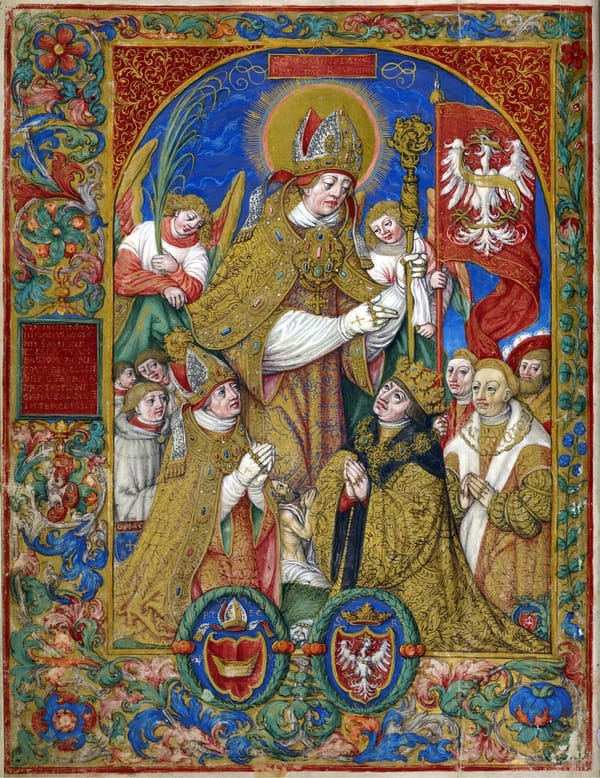 |
May 7: St. Stanislaus, Bishop and Martyr
THE eleventh century, the century of contest between the priests of the Church and Barbarism, gives to-day another martyr to our Risen Jesus. It is Stanislaus, beloved by noble Poland as one of her chief protectors. He was slain at the altar by a Christian prince whom he had reproved for his crimes. The blood of the courageous Pontiff was mingled with that of our Redeemer in the same sacrifice. What an invincible energy there is in these lambs whom Jesus has sent amidst the wolves!1 They seem to be straightway changed into lions, as Jesus himself was at his Resurrection. There is not a century that has not had its martyrs: some for the faith, others for the unity of the Church, others for her liberty, others for justice, others for charity, and others, like our great Saint of to-day, for the maintenance of morals. The nineteenth century, too, has had its martyrs; scarcely a year elapses without our hearing of some who have been added to the bright list in the far East. At the commencement of the eighteenth century there was little probability of its providing such an abundant harvest of martyrdom as it did. Of one thing we are quite sure: whatever persecutions may arise in the future, the Spirit of fortitude will not be wanting to the champions of truth. Martyrdom is one of the Church's characteristics and it has never failed her. The Apostles who are very close to Jesus during these days preceding his Ascension drank the chalice which he drank; and only yesterday we were honouring the martyrdom of the favourite disciple—yes, even he had to tread the path prepared for all.
Holy Church tells us, in the account we now subjoin, how the saintly bishop of Cracow was offered the glorious chalice, and how courageously he accepted it.
Thou wast powerful in word and work, O Stanislaus! and our Lord rewarded thee with a martyr’s crown. From thy throne of glory, cast a look of pity upon us; obtain for us from God that gift of fortitude which was so prominent in thee, and which we so much need in order to surmount the obstacles which impede our progress. Our Risen Lord must have no cowards among his soldiers. He took by assault the kingdom into which he is about to enter; and he tells us plainly that if we would follow him thither, we must prepare to use violence.2 Brave soldier of the living God! obtain for us brave hearts. We need them for our combat—whether that be one of open violence for the faith or unity of the Church, or one which is to be fought with the invisible enemies of our salvation. Thou wast indeed a good shepherd, for the presence of the world neither made thee flee nor fear; ask our heavenly Father to send us shepherds like thee. Succour Holy Church, for she has to contend with enemies in every part of the world. Convert her persecutors, as thou didst convert Boleslaus; he was thy murderer, but thy martyrdom won mercy for him. Remember thy dear Poland, which honours thee with such fervent devotion. Be with her now that she has regained her rank among nations. During the severe triads which her sins drew down upon her, she maintained the sacred link of Catholic Faith and unity; she was patient and faithful; our Risen Jesus has had pity on her, and rewarded her patience and fidelity by granting her a share in his own Resurrection.
Thursday of the Fifth Week after Easter
BY the first four sacraments, our Saviour provided for the several spiritual necessities of man during this mortal life. Baptism gives him spiritual birth, Confirmation arms him for the battle, the Eucharist is his food, Penance is his cure. But the last moment of life—that most important and terrible of all, on which depends eternity—does it not seem to require a special sacramental aid? Could it be that our Redeemer, after so lovingly supplying us with a sacrament to meet our other wants, would leave us unprovided when we are dying, that is, when we are passing from this to another life, and are weighed down with bodily and mental sufferings? No: he has provided a sacrament for the dying; the grace of redemption puts on a new form, that it may visit and fortify us in our last struggle.
Even before his Passion, he gave us some idea of the sacrament he intended to institute for the help of the dying. When he sent his disciples before him, that they might prepare the people for his preaching, he commanded them to anoint the sick with oil: they did so, and the result was the cure of them that were thus anointed.1 But after his Resurrection, when our Redeemer was preparing the dowry of his Church, he gave her a sacrament wherewith this Mother was to administer special grace and consolation to her children when in danger of death.
Oil is the symbol of strength; hence, the wrestlers of old used it as a means for acquiring activity and nerve. Our Saviour chose it as the matter of the sacrament of confirmation, whereby our souls, after being regenerated by baptism, are strengthened for their future combats. The hour of death is a combat, but one so terrible that it stands apart by itself. It is then that Satan, seeing how the long-coveted prey is soon to be beyond his reach, redoubles his efforts to make it his own for ever. The dying Christian, standing as he does on the brink of eternity, is exposed to two temptations: presumption and despair. In a few moments he will be before the Judge, whose sentence is irrevocable. The remnants of sin are still upon him, and clog his soul. How will he comport himself in that last combat, on which depends the final success of all the previous ones of his life? Is not this an occasion for a special sacrament, whereby our Jesus may provide his combatant with the help so urgently needed? Yes; and here again it is oil. The first anointing was that of confirmation, and it gave strength; and the last, or as it is called, extreme unction, is equally rich in power: it is the last application made to mankind of the Redeemer’s blood,’which flows in such abundance with this holy oil.’2
Let us consider the effects of extreme unction, of which the Apostle St James speaks to us in his Epistle. What he there tells us, he had received from Jesus’ own lips. First of all, this sacrament brings forgiveness of sins;3 forgiveness of those sins which the conscience, however diligent it may have been in its examination, had overlooked; but which, nevertheless, injure the soul: and forgiveness of those remnants of sin, which continue after the guilt of sin has been remitted; like wounds which, though cured, are not quite closed, and keep the patient weak. The holy oil anoints each of the senses; each has been the source of sin; each now receives its special purification. These doors, which up to this moment had been open to the world, are now closed; so that the soul can be all intent upon eternal things. Let the enemy come now, if he will; his attacks can do no harm. He expected to find his adversary the poor earthly-minded creature of old, on whom he had inflicted hundreds of wounds; but lo! he finds a soldier of Christ, vigorous and brave. It is extreme unction that has worked the change.
But the effects of this sacrament do not stop here. Though primarily instituted for imparting strength to the soul, yet it has the power of restoring health to the body too. We learn this from the Apostle St James. His words are these: Is any man sick among you? Let him bring in the priests of the Church, and let them pray over him, anointing him with oil in the name of the Lord. And the prayer of faith shall save the sick man, and the Lord shall raise him up.4 The sacred formula, which accompanies each anointing in this sacrament, has therefore the power of restoring bodily health, at the same time that it drives away the remnants of sin, which is the chief cause of all man's miseries, whether of soul or body. Such is the interpretation put by the Church on the words of St James; and we have continual proofs that our divine Master has not forgotten the promise of twofold efficacy which he gave to this sacrament. Hence it is, that after having anointed the several senses of the sick person, the priest addresses God in earnest prayer, that he would restore strength of body to him or her whose soul has received the efficacy of the heavenly remedy. Nay, the Church looks upon the restoration to bodily health as so truly a sacramental effect of extreme unction, that she does not consider as miracles, properly so called, the cures produced by its administration.
Let us, then, offer to the conqueror of death the homage of our thanks for this fresh proof of his compassionate love. He would himself experience all our miseries, not excepting even death or the agony that precedes it. When on his Cross, and enduring every anguish, as though he were a poor dying sinner, and not the Saint of saints, he thought of our deaths, and mercifully blessed our last agony with an outpouring of his precious Blood. This was the origin of the beautiful sacrament of extreme unction, which he gave to his Church, after his Resurrection, and for which we offer him to-day our humble thanks.
The following hymn—composed by St Ambrose, and used during Paschal Time in the Church of Milan—celebrates with the Saint's characteristic vigour of style the thoroughness of the salvation wrought by the Death of Christ, as was made evident in the conversion of the Good Thief.
Hymn
Sanctus sereno lumine,
Quo diluit sanguis sacer
Probrosa mundi crimina.
Cæcosque visu illuminans:
Quem non gravi solvet metu
Latronis absolutio?
Jesum brevi acquirit fide,
Justusque praevio gradu
Pervenit in regnum Dei.
Pænam videntes corporis,
Christoque adhaerentem reum
Vitam beatam carpere.
Ut abluat mundi luem,
Peccata tollit omnium,
Camis vitia mundans caro.
Ut culpa quærat gratiam,
Metumque solvat charitas,
Reddatque mors vitam novam?
Suisque se nodis liget:
Moriatur vita omnium,
Resurgat ut vita omnium.
Omnes resurgunt mortui:
Consumpta mors ictu suo
Perisse se solam gemit.
Qui surrexisti a mortuis,
Cum Patre et Sancto Spiritu,
In sempiterna sæcula.
holy with its unclouded light,
whereon the sacred Blood washed away
the world’s infamous crimes.
it gives sight to the blind.
Oh! who would not cease to despair at the thought
of the pardon granted to the Thief?
he gained Jesus by a brief act of faith;
and, being justified, was the first
to enter into the kingdom of God.
they behold the criminal suffering bodily tortures,
yet united with Christ, and culling
the flower of life everlasting.
Jesus takes upon himself the sins of the world,
that he may cleanse it from its filth:
Flesh washes away the sins of flesh.
—sin seeking for grace,
love expelling fear,
and death giving a new life.
let him be caught in his own net!
Let him but die, who is the Life of all,
and all will rise to life.
and all the dead rise again to life:
death’s blow falls on himself,
and none die but he.
who didst rise again from the dead!
and to the Father, and to the Holy Ghost,
for everlasting ages.
| Previous Wednesday of the Fifth Week after Easter | Next Thursday of the Fifth Week after Easter |