Daily reading
Paschal Time
Greater Double · May 8 · Sanctoral
May 8, 2026
From Dom Guéranger’s The Liturgical Year.
A Greater Double leads the weekday.Rubric

|
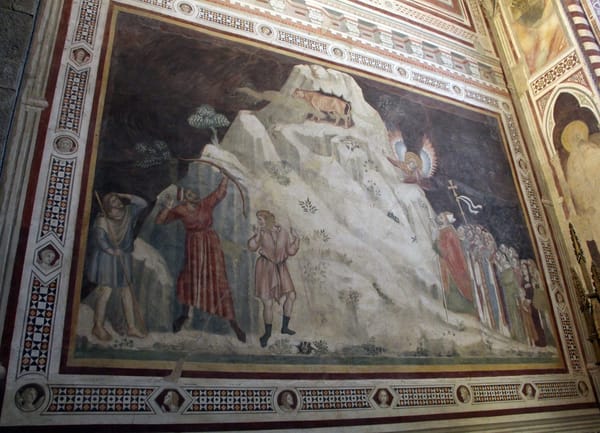
May 8: The Apparition of St. Michael the Archangel
DAVID foretold that Emmanuel's entrance into this world would be greeted by the angels and that they would humbly adore him on his first appearance among us.1 We saw this prophecy fulfilled on the ever blessed night when Mary brought forth the Fruit of her womb. The angelic choir sang one of their heavenly hymns, which led the shepherds to the stable; we blended our songs with theirs in homage to our infant God. The Resurrection of our Emmanuel was sure to be honoured by the presence of these blessed spirits, who had witnessed with amazement and trembling the humiliations and cruelties of his Passion. The moment he passed through the barrier that imprisoned him in his sepulchre, an angel, with a face bright as the sun, and garments white as snow, came and rolled back the stone, and proclaimed to the holy women that he whom they were seeking had risen. When they entered the cave of the sepulchre, two other angels, clad in white robes, appeared to them, and repeated the tidings of Jesus' triumph.
Let us reverently honour these princely heralds of our deliverance, and consider with what respect they cluster round Jesus their King and God during the forty days after his Resurrection. They adore this glorified humanity, which they are soon to see raised up to the highest heavens and enthroned at the Father's right hand. They rejoice with us in the happiness given by this Paschal feast, which restores immortality to us in the person of our Risen Saviour; and thus, as St Gregory told us a few days back, ‘it is the feast of the angels, because, by recalling us to heaven, it fills up their number,’2 It was but right, therefore, that one day in Paschal Time should be devoted to honouring the angelic spirits. On the day previous to the Annunciation we kept the Feast of St Gabriel, our Lady's honoured messenger; to-day it is St Michael, the Archangel and prince of the heavenly host, who is to receive our love and praise. He himself selected this day, by appearing on it and leaving us a pledge of his presence and protection.
The very name of Michael urges us to honour this glorious spirit; it is a cry of enthusiasm and fidelity, for it signifies: ‘Who is like unto God?’ Satan trembles at hearing this name, for it reminds him of the noble protest wherewith the bright Archangel answered the call of the rebel angels. Michael proved his strength and prowess when he fought the great battle in heaven. On that account, he was made the guardian and protector of God's people; first of the Jews, and afterwards of the Christian Church, for the Synagogue has forfeited all her honours. Michael now watches over Jesus' Spouse, our mother; he supports her in her trials and she wins no triumph in which he has not had some part.
But we are not to suppose that the holy Archangel is so engaged in attending to the general interests of Christ's kingdom on earth that he cannot listen to the prayers of each individual member of the Church. God has given him a compassionate love for men; and there is not a single soul that escapes his notice. He wields the sword in defence of the Spouse of Christ; he wars with the dragon, who is ever lying in wait for the Woman and her Child;3 but, at the same time, he is attentive to each one of us; for fter having confessed our sins to Almighty God, and to the Blessed Mary ever a Virgin, we acknowledge them likewise to Blessed Michael the Archangel and beseech him to pray for us to the Lord our God.
He assists at every death-bed, for his special office is to receive the souls of the elect on their quitting the flesh. With loving solicitude and princely bearing, he presents them to the Light Eternal and introduces them into the House of God’s glory. It is Holy Church herself that tells us, in the words of her Liturgy, of these prerogatives of the great Archangel. She teaches us that he has been set over Paradise, and that God has given him the charge of leading to heaven the souls of them that are to be received there. On the last day, when our Risen Jesus is to appear on the clouds of heaven to judge mankind, all of whom will then have resumed their bodies in the general resurrection, Michael with the rest of the angels will have to fulfil a ministry of awful import—that of separating the good from the bad. Our Catholic forefathers, in the Middle Ages, were fond of representing the holy Archangel engaged in this dread function, standing at the foot of Jesus’ judgement-seat, and holding a scale, in which he is weighing the souls of men and their works.
Devotion to St Michael was sure to spread through the Church, especially after the worship of idols had been banished from the various countries, and men were no longer tempted to give divine honour to creatures. Constantine built a celebrated Church called Michaelion in honour of the great Archangel, and at the time when Constantinople fell under the power of the Turks, there were no fewer than fifteen churches bearing the name of Saint Michael, either in the city or the suburbs. In other parts of Christendom this devotion took root only by degrees; and it was through apparitions of the holy Archangel that the faithful were prompted to have recourse to him. These apparitions were local and for reasons which to us might seem of secondary importance: but God, who from little causes produces great effects, made use of them whereby to excite Christians to have confidence in their heavenly protector. The Greeks celebrate the apparition that took place at Chone, the ancient Colosse in Phrygia. There was in that city a Church dedicated to St Michael, and it was frequently visited by a holy man named Archippus, who was violently persecuted by the pagans. One day, when Archippus was at his devotions in his favourite St Michael's, his enemies resolved to destroy both him and the Church. Hard by ran a brook which flowed into the river Lycus; they turned it aside and flooded the ground on which the church stood. Suddenly there appeared the Archangel St Michael holding a rod in his hand: the water immediately receded, and flowed into a deep gulf near Colosse, where the Lycus empties itself and disappears. The date of this apparition is not certain, but it occurred at the period when the pagans were numerous enough in Colosse to harass the Christians.
Another apparition, which encouraged devotion to St Michael in Italy, took place on Mount Gargano, in Apulia; it is the one honoured by to-day's feast. A third happened on Mount Tomba, on the coast of Normandy: we shall commemorate it on October 16.
The feast we are keeping to-day is not so solemn as the one of September 29; it is, however, more exclusively in honour of St Michael, inasmuch as the autumn feast includes all the choirs of the angelic hierarchy. The Roman Breviary gives us the following account of the apparition on Mount Gargano:
Holy Church tells us of the glories of St Michael in several portions of the Liturgy; but particularly in the following Responsory and Antiphons, taken from to-day's Office:
The first of the following hymns is used by the Church in the Vespers of the Feasts of St Michael. The second is taken from the Lauds. They speak the praises, not only of our great Archangel, but likewise of St Gabriel, St Raphael, and of all the blessed spirits in general. The Church has not instituted a feast for the collective celebration of the nine choirs of Blessed Spirits, but she includes all the members of the angelic host in her tribute of honour on the Feasts of St Michael.
First Hymn
Te vita, Jesu, cordium,
Ab ore qui pendent tuo
Laudamus inter Angelos.
Ducum corona militat:
Sed explicat victor crucem
Michael salutis signifer.
In ima pellit tartara,
Ducemque cum rebellibus
Coelesti ab arce fulminat.
Sequamur hunc nos principem,
Ut detur ex Agni throno
Nobis corona gloriæ.
Qui, quos redemit Filius,
Et sanctus unxit Spiritus,
Per Angelos custodiat.
who obey thee, we praise thee,
O Jesus, thou brightness and power of the Father,
thou life of our hearts!
this army of a thousand thousand princes,
at whose head is Michael, the Conqueror,
the standardbearer of salvation, who unfurls the Cross.
the cruel dragon into the depths of hell,
and drove the rebels, with their chief,
from the heavenly city.
that we may deserve to receive,
from the throne of the Lamb,
a crown of glory.
who, by means of the angels,
guards those whom the Son hath redeemed
and the Holy Spirit anointed.
Second Hymn
Gentis humanæ sator et redemptor,
Cœlitum nobis tribuas beatas
Scandere sedes.
Cœlitus nostras veniat; serenæ
Auctor ut pacis lacrymosa in orcum
Bella releget.
Pellat antiquos, et amica cœlo
Quæ triumphator statuit per orbem,
Templa revisat.
Adsit e cœlo Raphael, utomnes
Sanet ægrotos, dubiosque vitæ
Dirigat actus.
Et sacer nobis chorus Angelorum
Semper assistat, simul et micantis
Regia cœli.
Patris, ac Nati, pariterque Sancti
Spiritus, cujus resonat per omnem
Gloria mundum.
the Creator and Redeemer of mankind!
grant that we may ascend to the happy thrones
of the heavenly citizens.
come from heaven into this our temple,
bring us sweet peace,
and drive dismal war back again to hell.
come and rout our ancient foe;
may he often visit the heaven-loved temples
which the triumphant Jesus has placed throughout the world.
descend and visit us,
that he may heal all that are infirm
and direct our faltering steps in the path of life.
may the holy choir of angels;
may the bright court of heaven
ever assist and protect us.
Father, Son, and Holy
Ghost, whose glory is proclaimed through the whole world,
grant us this our prayer.
The following sequence is from the collection of the Monastery of Saint-Gall, and was composed by the monk Notker in the eleventh century:
Sequence
Rex cœlice, laudes Cuncta
Pangat jam canora
Caterva symphonia
Odas, atque solvat
Concio tibi nostra.
Michaelis inclyta valde festa,
Per quæ lætabunda
Perornatur machina Mundi tota.
Spirituum sunt agmina
Per te facta.
Facis hæc flammea
Per angelicas Officinas.
Sed cum simus nos ultima Factura,
Sed imago tua.
Nobis hæc ter tripartita
Per privata officia.
Phalanx et archangelica,
Principans turma.
Ac Potestas almiphona,
Dominantia numina,
Divinaque subsellia,
Cherubim ætherea,
Ac Seraphim ignicoma.
Vera dans Verbi nuntia, Atque Raphael,
Vitæ vernula, Transferte nos inter Paradisicolas.
Complentur mandata,
Quæ dat ejusdem Sophia,
Compar quoque Pneuma,
Una permanens in usia,
Cui estis administrantia Deo millia
Millium sacra.
Bis atque quingenta vestra
Centena millena
Assistunt in aula,
Ad quam Rex ovem centesimam verbigena,
Drachmamque decimam Vestra
Duxit ad agalmata.
Nos per rura terrea, pars electa,
Harmonica vota damus hinc
Per lyricas citharas.
Nostra Deo sint accepta auream super aram
Thymiamata, quo in coeva jam gloria
Condecantemus Alleluia.
may our whole assembly and choir
now sound forth
its instruments of sweet music
and sing hymns
in thy praise.
of Michael's most glorious feast,
which fills the whole earth
with great joy.
created by thee,
into nine choirs;
when thou wiliest
to seek their ministry.
whereas we are thy last,
but made after thine image.
according to their special offices,
reveals to us the mysterious design of God.
then the phalanx of Archangels;
then the host of the Principalities.
the sweet-sounding Powers,
The spiritual Dominations,
the divine Thrones,
the ethereal Cherubim,
the burning Seraphim.
messenger of the Incarnate Word! Raphael,
our guide through life! lead us to the company of the citizens of Paradise.
all the commands of the Father,
the Son who is his Wisdom,
and the co-equal Spirit,
the Three, One in essence,
the God before whom ye stand thousands
of thousands in number, as ministering spirits.
times a hundred thousand;
and hither did the King,
the Father of the Word,
bring the hundredth sheep,
and the tenth groat,
that they might share in your bliss.
and we the elect flock on earth,
give forth our tuneful praise
on sweetsounding harps.
when set on the golden altar, be acceptable to God;
Thus, when united in the same eternal glory,
may we sing together our Alleluia!
How beautiful art thou, O Michael. in thy heavenly armour, giving glory to the God whose enemy thou hadst overcome! Thine humble and fervent gaze is fixed on the throne of Jehovah, whose rights thou didst defend, and who gave thee the victory. Thy sublime cry: ‘Who is like unto God?’ roused the faithful legions and became thy name and thy crown. It will remind us for all eternity of thy fidelity to our Creator and thy triumph over the dragon. Meanwhile, we enjoy thy loving protection; we are thy happy clients.
Guardian angel of Holy·Church! now is the time for thee to exert all the might of thine arm. Satan is furious in his efforts against the noble Spouse of thy Master; brandish thy bright sword, and give battle to this implacable enemy. The kingdom of Christ is shaken to its very foundations. Is it that the reign of the Man of Sin is about to be proclaimed on the earth? Are we near that last day when, this guilty world is to be destroyed by fire, and thou art to exercise, in the name of the Sovereign Judge, the terrible office of separating the goats from the sheep? If this earth is still to exist; if the mission of the Church is not yet completed; is it not time for thee, O Michael! to show the dragon of hell that he may not, with impunity, insult on this earth the God who created it, who redeemed it, and whose name is King of kings and Lord of lords? The forces of error and crime are unceasingly dragging the world to the brink of the precipice; save it, O glorious Archangel, by confounding the dark plots which are laid for its destruction!
Thou, O Michael, art the protector of our souls in their passage from time to eternity. During this present life thine eye is upon our wants, and thine ear open to our prayers. Though awed by the brightness of thy glory, we love thee, dear prince of heaven! and we live happy and contented beneath the shadow of thy wings. In a few days, or at most years, our holy Mother the Church will be performing her last sacred rites over our lifeless remains; she will pray for us to our heavenly Father, that we may be delivered from the lion's mouth, and that the standard-bearer, St Michael, may bring us into the holy light.4 Watch over us now, O holy Archangel, lest we should then not deserve thy protection. The dragon is ever threatening us; he makes no secret of his wish to devour us. Teach us, O Michael, to repeat thy beautiful words: ' Who is like unto God?’ God’s honour, the rights he has over us, our obligation to be faithful to him, and serve him, and confess him as our Lord in all times and places—yes! these thoughts must be our shield in danger, and the armour wherewith we must fight, like thee, and win the battle. But we need the sturdy courage which resulted from the love thou hadst within thee. Oh! pray for us, that we, too, may love our common Lord and Master; then shall we be invincible. Satan cannot make head against a creature that is filled with the love of the great God.
God created thee, O Michael! and thou lovest him as thy Creator; but he has not only created us, he has redeemed us, yea, and at the price of his own Blood! What, then, should be the intensity of our love for him! Strengthen this love in our hearts; and since we are fighting under thy leadership, guide us, inspirit us; let thy look give us courage; ward off from us the blows of the enemy’s sword. We venture to hope that thou wilt be present at our last moments, O standard-bearer of our salvation! In return for our tender devotion towards thee, deign to keep guard round our deathbed, cover it with thy shield. If the dragon see the flash of thy sword, he will not dare to come near us. May our soul, on leaving the body, throw herself with affection into thine arms! Cast her not from thee, O holy Archangel, when she seeks to cling to thee; carry her to the judgement-seat, cover her beneath thy wings, calm her fears; and may the Lord, thy Master, bid thee bear her speedily to the kingdom of eternal bliss!
Friday of the Fifth Week after Easter
WE have reverently followed our Redeemer in his institution of the sacramental helps, whereby man is placed and kept in the state of sanctifying grace, from his first entrance into this life to his leaving it for the eternal enjoyment of the beatific vision. We must now speak of that sublime sacrament, which was instituted by Jesus as the source whence mankind is to receive the other sacraments.
This sacrament is Holy Orders, and it is so called because of its being conferred in several distinct degrees upon those who receive it. As in heaven the angels are arranged in different ranks according as they have been endowed with a greater or less degree of light and power, in such wise that they who are higher act upon those that are lower; so it is in the sacrament of Holy Orders; there is order in the several ranks, and the higher act upon the lower by the communication of light and power. It is this that constitutes the hierarchy of the Church. Hierarchy means Sacred Government. It comprises three degrees: the episcopate, priesthood, and diaconate, in which last are included the Orders below it. This is called the hierarchy of Order, to distinguish it from the hierarchy of Jurisdiction. This second, which is entrusted with the government of the Church, is composed of the Pope, of the bishops, and of the inferior clergy to whom the Pope and bishops delegate a part of their power of government. We have already seen how this hierarchy takes its origin from that sovereign act whereby our Lord Jesus, the shepherd of men, gave to Peter the keys of the kingdom of God. The hierarchy of Order is intimately connected with the second, and its object is the sanctification of men by the administration of the treasures of grace confided to its keeping.
As we have already said, Jesus appeared to his Apostles on the day of his Resurrection, and said to them: As the Father hath sent me, I also send you.1 Now the Father sent his Son that he might be the Shepherd of men; and we have heard Jesus bidding Peter to feed his lambs and his sheep. The Father sent his Son that he might be the Teacher of men; and we have seen Jesus entrusting to his Apostles the truths which were to be proposed to us as the object of our faith. But the Father sent the Son that he might also be the High Priest of men; Jesus must, therefore, leave this same priesthood on earth, that it may be continued among us to the end of time. Now what is a priest? He is the mediator between heaven and earth; he reconciles man to his God, by offering a sacrifice that gives infinite honour to God and atones for man's sin; he cleanses the sinner's conscience, and makes him a just man; he, in a word, unites man to his God by the mysteries of which he is the dispenser.
Jesus exercised all these functions of a priest agreeably to the mission given him by the Father; but the Father would have them to be continued, even after his Son should have ascended into heaven. For this it was necessary that Jesus should communicate his priestly character, by a special sacrament, to a few chosen men, just as by baptism he conferred upon all his faithful the dignity of being his members. Here again, it will be the Holy Ghost that will act, in each stage or degree of the sacrament. It was by his divine operation that the Incarnate Word entered into Mary's womb; it is his action that will imprint on the souls of them that are presented the priestly character of this same Jesus our Lord. Hence, after using the words just cited, Jesus breathed on his Apostles, and said to them: Receive ye the Holy Ghost! hereby showing that it is by a special infusion of him who is the Spirit of the Father and the Son, that men are fitted for being sent by the Son, as the Son was sent by the Father.
And yet the Apostles and their successors are to confer this sacrament, not by a breath—that is the prerogative of the Word, the author of life—but by the imposition of hands. It is at the solemn moment of the imposition of the bishop's hands over them who are to be ordained, that the Holy Ghost comes down upon them. Thus will be transmitted the heavenly gift from generation to generation. It will be conferred in its several degrees, according to the will of the hierarch, by and with whom the Holy Ghost acts. So that when Jesus comes on the last day to judge the world, he will find on earth the sacred character which he conferred upon his Apostles when he gave them the Holy Ghost.
Let us attentively and devoutly contemplate the mystic ladder of the hierarchy, established by our Jesus, whereby we might ascend to heaven. At the very summit is the bishop, having in himself the plenitude of Holy Orders and the power to produce other pontiffs, and priests, and deacons. He has the power of offering up the Holy Sacrifice; he holds the keys whereof our Lord speaks, when he says: Whatsoever ye shall bind upon earth, shall be bound also in heaven; and whatsoever ye shall loose upon earth, shall be loosed also in heaven;2 he can administer all the sacraments; the consecration of the Chrism and Holy Oils belongs to his office; he can not only bless, he can also consecrate.
Next comes the priest, who truly looks upon the bishop as his spiritual father, seeing that it was by the imposition of the bishop’s hands that he received the dignity and character of priesthood. The priest, however, does not possess the plenitude of Jesus’ priesthood. His hands, though most holy, have not the power to produce other priests; he blesses, but he does not consecrate;3 he must look to the bishop for holy Chrism, for he himself cannot make it. Notwithstanding this, his dignity is great, for he has power to offer the Holy Sacrifice, and his offering is the same as that of the bishop. He forgives the sins of those whom the bishop has put under his care. The solemn administration of baptism is entrusted to him, when the bishop himself does not perform it: and as to extreme unction, it is essentially a priest’s function.
The next lower order is that of deacon, who is, as the Greek name implies, the servant of the priest. Not having the priesthood, he cannot offer sacrifice, nor remit sins, nor give extreme unction to the dying: but he assists and serves the priest at the Altar, and stands by his side during the solemn moment of consecration. He reads the holy Gospel, from the ambo, to the people. The Blessed Sacrament is entrusted to his care, and, failing a priest, he is allowed to distribute it to the faithful. In similar circumstances, he could solemnly administer baptism. He has also the power of preaching the word of God to the people.
These are the three degrees of the hierarchy of Order. They correspond, as the great St Denis teaches, with the three degrees whereby man attains to union with God: namely, purification, illumination, and perfection. The deacon prepares the catechumen and the sinner, by instructing them in the word of God, which will purify their minds from error, and incite them to the repentance of their sins and to a desire of being freed from them. The priest enlightens these same by the illumination of holy baptism, by the remission of their sins, and by admitting them to partake of the Body and Blood of Christ. The bishop pours out upon them the gifts of the Holy Ghost, and raises them, by their seeing his own supereminent prerogatives, to union with Christ. Such is the sacrament of Holy Orders. It is the essential means established for the salvation of mankind, the channel through which God has ordained that the infinite graces of the Incarnation should flow upon the earth, and the medium whereby is perpetuated among us the presence and action of our Redeemer.
Let us give thanks to our Jesus for this unspeakable blessing. Let us honour the priesthood of the New Law; it is Jesus who inaugurated it in his own person, and who afterwards entrusted it to men, chosen by him for continuing the mission given to him by his Father. The sacraments are the true life of the world; but who are the ministers of these sacraments? The priests of the Church. Let us pray for those who are in Holy Orders; for their responsibilities are great, their dignity is divine, and yet they themselves are but men. They are not a tribe or a caste, as were the priests in the Old Law; but they are taken from every race and family. Finally, a priest, though inferior to the angels by nature, is, by the office he holds, superior to these blessed spirits.
Let us celebrate, to-day, the Resurrection of our eternal High Priest, by this joyous canticle of the ancient Missal of Liége:
Sequence
Quibus e terris
Nuncias gaudia,
Visitans patriam.
Dulci voce dixit: Alleluia.
Pia miracula.
Cecinit voce laudanda.
Volucris vacuas
Redii famulis,
Et novam regnare gratiam.
Christus hodie redemit nos a morte dira.
Ut interimerent pro salute nostra.
Ut nos redimeret morte ab aeterna.
Et frui vita perpetua.
Celebri laude sanctum Pascha.
from what land comest thou,
to the whole world.
more our country?
and sweet voice, saying: ‘Alleluia!
dear prodigies wrought by Christ:
that the Lord hath risen from the tomb.
and joyfully sped my way through the thin air:
servants of God!
and the New Law of grace hath begun its reign.’
‘This day hath Christ delivered us from cruel death.
that they might slay him for the sake of our salvation.
that he might redeem us from eternal death.’
and enjoy never-ending life.
the praise of this holy Pasch.
| Previous Thursday of the Fifth Week after Easter | Next Friday of the Fifth Week after Easter |