Daily reading
Paschal Time
Double · May 9 · Sanctoral
May 9, 2026
From Dom Guéranger’s The Liturgical Year.
A Double leads the weekday.Rubric
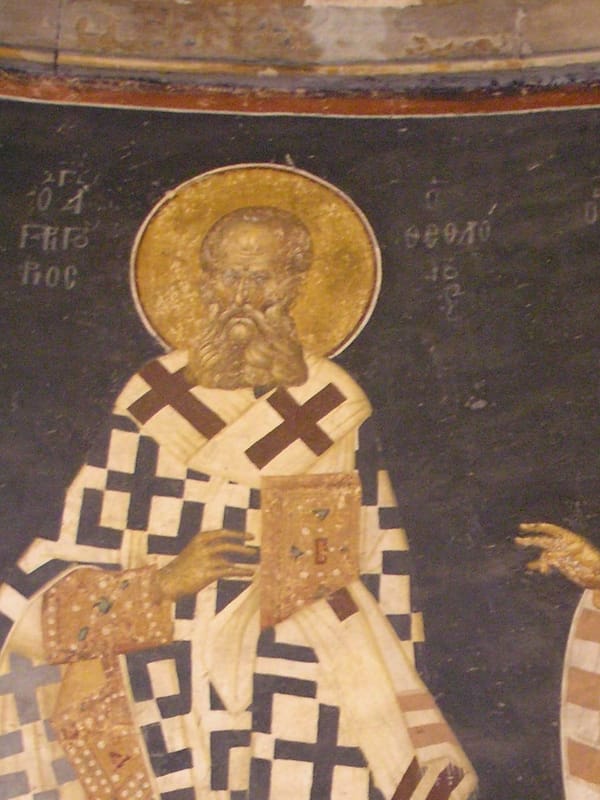 |
May 9: St. Gregory Nazianzen, Bishop, and Doctor of the Church
SIDE by side with Athanasius, another Doctor of the Church comes forward at this glad season to offer to the Risen Jesus the tribute of his learning and eloquence. It is Gregory of Nazianzum, the friend of Basil, the great orator, the admirable poet, whose style combines energy of thought with a remarkable richness and ease of expression; the one of all the Gregories who has merited and received the glorious name of Theologian, on account of the soundness of his teachings, the sublimity of his ideas, and the magnificence of his diction. Holy Church exults at being able to offer us so grand a Saint during Easter Time, for no one has spoken more eloquently than he on the Mystery of the Pasch. Let us listen to the commencement of his second Sermon for Easter; and then judge for ourselves:
I will stand upon my watch, says the admirable Prophet Habacuc.1 I, also on this day, will imitate him; I will stand on the power and knowledge granted me by the favour of the Holy Ghost, that I may consider and know what is to be seen, and what will be told unto me. And I stood and I watched: and lo! a man ascended to the clouds; and he was of exceeding high stature, and his face was the face of an angel, and his garment was dazzling as a flash of lightning. And he lifted up his hand towards the East, and cried out with a loud voice. His voice was as the voice of a trumpet, and around him stood, as it were, a multitude of the heavenly host, and he said: "To-day is salvation given to both the visible and the invisible world. Christ hath risen from the dead: do ye also rise. Christ hath returned to himself: do ye also return. Christ hath freed himself from the tomb: be ye set free from the bonds of sin. The gates of hell are opened, and death is crushed; the old Adam is laid aside, and the new one is created. Oh! if there be a new creature formed in Christ, be ye made new!”
Thus did he speak. Then did the other angels repeat the hymn they first sang when Christ was born on this earth, and appeared to us men: Glory be to God in the highest, and peace on earth to men of good will! I join my voice with them, and speak these things to you: oh! that I could have an angel’s voice, to make myself heard throughout the whole earth!
It is the Pasch of the Lord! the Pasch!—in honour of the Trinity, I say it a third time: the Pasch! This is our Feast of feasts, our Solemnity of solemnities. It is as far above all the rest, not only of those which are human and earthly, but of those even which belong to Christ and are celebrated on his account—yea, it as far surpasses them all as the sun surpasses the stars. Commencing with yesterday, how grand was the day with its torches and lights! . . . But how grander and brighter is all on this morning! Yesterday’s light was but the harbinger of the great Light that was to rise; it was but a foretaste of the joy that was to be given to us. But to-day we are celebrating the Resurrection itself, not merely in hope, but as actually come to pass, and drawing the whole earth to itself.2
This is a sample of the fervour and eloquence wherewith our Saint preached the mysteries of faith. He was a man of retirement and contemplation. The troubles of the world in which he had been compelled to live damped his spirits; the duplicity and wickedness of men fretted his noble heart; and leaving to another the perilous honour of the see of Constantinople, which he had reluctantly accepted a very short time previously, he retired to his dear solitude, there to enjoy his God and the study of holy things. And yet, during the short period of his episcopal government, notwithstanding all the obstacles that stood in his way, he confirmed the faith that had been shaken, and left behind him a light which continued even to the time when St John Chrysostom was chosen to fill the troubled Chair of Byzantium.
The holy Liturgy thus speaks to us of the virtues and actions of this great Saint:
The Greek Church, in her Menæa, gives the following magnificent encomium of St Gregory Nazianzen:
Hymn (Die XXV Januarii)
We salute thee, O glorious Doctor of the Church, on whom both East and West have conferred the title of Theologian! Illumined by the rays of the glorious Trinity, thou gavest us to share in the light thus imparted to thee—and a brighter was never granted to mortal eye. In thee was verified that saying of our Saviour: Blessed are the clean of heart, for they shall see God.3 The purity of thy soul prepared thee to receive the divine light, and thy inspired pen has transmitted to thy fellow-men something of thine own soul's enraptured knowledge. Obtain for us the gift of faith, which puts the creature in communication with its God; obtain for us the gift of understanding, which makes the creature relish what it believes. The object of all thy labours was to guard the faithful against the seductive wiles of heresy, by putting before them the magnificence of the divine dogmas. Oh! pray for us, that we may avoid the snares of false doctrines, and have our eye ever fixed on the ineffable light of the mysteries of faith; for, as St Peter tells us, it is as a lamp in a dark place, that shineth until the day dawn, and until the day-star arise in our hearts.4
There now seems to be a gleam of hope for the East, that has been, for so many long ages, a prey to error and slavery. Great changes are preparing for the unfortunate Byzantium, and politicians are studying how to profit by the crisis, and make her the prey of their respective Governments. Canst thou forget the city of which thou wast once the pastor, and where thy name is still held in veneration? Oh! help her to throw off the shackles of schism and heresy. Her being a slave to the infidel is the punishment of her having revolted against the Vicar of Christ! this yoke seems about to be broken; pray, O Gregory, that the more dangerous and humiliating one of error and schism may also be broken. A movement of return to the truth has already begun to show itself. Whole provinces are awakening to a knowledge of their misery, and are casting a look of hope towards the common Mother of all Churches, who opens her arms to receive them. Aid this long-desired conversion by thy prayers. Both East and West honour thee as one of the sublimest preachers of divine Truth; obtain by thy powerful intercession that East and West may be once more united in the one fold, and under the one shepherd, before our Risen Jesus returns to our earth to separate the cockle from the good seed, and lead back to heaven the Church, his Spouse and our Mother, out of whose pale there is no salvation.
Help us, during this season, to contemplate the glories of our Risen Lord. Oh! for something of the holy enthusiasm for this Pasch, which inebriated thee with its joys and inspired thee with such glowing eloquence! Jesus, the Conqueror of Death, was the object of thy fervent affections even from thy childhood; and when old age came, thy heart still beat with love for him. Pray for us, that we too may persevere in his service; that his divine mysteries may ever be our grandest joy; that this year’s Pasch may ever abide in our souls; that the renovation it has brought us may be visible throughout our lives; and that it may, each year as it returns, find us attentive and eager to receive its graces, until the eternal Easter comes with its endless joy!
Saturday of the Fifth Week after Easter
ON this day, which is sacred to Mary, let us open the holy Gospel according to St John. There, in the second chapter, we find these words: There was a marriage in Cana of Galilee, and the Mother of Jesus was there.1 The sacred text goes on to say that Jesus also and his disciples were among the guests; but the Holy Spirit, who guided the Evangelist's hand, would have him first make mention of Mary. It was to teach us that this our blessed Mother extends her protection to those who enter upon the married life with worthy dispositions, that is, with such dispositions as to draw down upon themselves the blessing of her divine Son.
Marriage is a sacred state, for it was instituted by God. The first marriage was celebrated in the earthly Paradise between Adam and Eve, when yet they were innocent. It was God himself who dictated the conditions of marriage. Unity was to be its very basis; in other words, the wife was to have but one husband, the husband was to have but one wife. It was the type of a still more glorious unity, which was not to be revealed till a later period. The mystery of unity typified by marriage being part of the Christian revelation, we deem it a duty to put it before our readers by the following considerations.
The angels were all created at one and the same time: but the members of the human race were to be bom, each indeed from their respective parents, but yet so as that Adam and Eve were to be the common parents to whom all were to owe their origin. Such was our Creator’s design, and marriage was the means he selected for its fulfilment. An immense multitude of the angels having fallen, the places destined for them in heaven were to be filled up by the elect of earth; again, it was marriage that was to provide these citizens for heaven. Hence, God blessed marriage at the very commencement of the world, and with a blessing which was to be permanent, for, as the Church teaches us in the Liturgy,’it was not recalled, either by the punishment inflicted on original sin, or by the sentence which destroyed the world by the deluge.’2
Even before this second great chastisement came upon the earth, all flesh hud corrupted its way,3 and marriage had fallen from the elevated dignity given to it by the Creator. The end for which he instituted it was forgotten; it was debased into a mere sensual gratification; it lost the sacred unity, which was its glory. Polygamy and divorce destroyed its primitive character, and two frightful evils ensued: family ties were at an end, and woman’s position was degraded into that of a being which must minister to man’s passions. The lesson intended to be conveyed by the Deluge was soon lost sight of; the world again became depraved, so much so indeed, that when the Mosaic Law came with its reforms, it had not power to restore to marriage the dignity of its first institution.
To effect this, it was requisite that God himself should descend upon the earth. When the miseries of humanity had reached their height, the Word, the second Person of the blessed Trinity, assumed our human nature, and dwelt amongst us. He called himself the Bridegroom.4 The prophets and the Canticle of Canticles had foretold that he would take to himself a Spouse from among mortals. This Spouse is the Church—that is, the human race purified by baptism and enriched with supernatural gifts. As a dowry, he gave her his own precious Blood and merits; and then united her to himself for ever. This Spouse is One: he affectionately calls her his Only One.5 On her part, she has no other but him. Here we have revealed to us the divine type on which marriage was formed, which, as the Apostle teaches us, derives its holiness and dignity from its resemblance to the union existing between Christ and his Church.6 The two unions are for the same end, and bear a mutual relation to each other. Jesus loves his Church with the tenderest affection; but his Church is the issue of human marriage, for it is marriage that provides the Church with her children, and thus perpetuates her existence upon the earth. Let us not be surprised, therefore, that Jesus restored marriage to its primitive condition, and that he honours it as being his powerful aid in the accomplishment of his designs.
We have already seen, on the second Sunday after the Epiphany, how he selected the nuptial feast at Cana as the occasion of his working his first public miracle. By his accepting the invitation to assist, in company with his blessed Mother, at the marriage, it is evident that he wished to honour, by his divine presence, the sacred engagement which was to unite the two spouses; it is evident that he intended to renew, in their persons, the ancient blessing given in Paradise. Having, by his miracle at Cana, proved himself to be truly the Son of God, he began his public life and preaching. His object being to reform fallen man to the noble end for which he had been created, he frequently made marriage the subject of his instructions. He spoke of its being divinely instituted on the basis of unity. He authoritatively repeated the command given at its first institution: They shall be two in one flesh:7 two, and only two. Speaking of the indissolubility of the marriage tie, he told his hearers that no power on earth, not even the unfaithfulness, however criminal, of the husband or wife, could sever the bond. These were his words: What God hath joined together, let no man put asunder.8 Thus did he restore marriage to its normal state; thus did he abrogate the degrading liberty, or more correctly, the libertinism, of polygamy and divorce—those sad proofs of the hardness of man’s heart,9 and of the need he had of a Redeemer. Thus did the New Law bring back to marriage its primal blessing, and make it once more a holy state, which, so far from being an obstacle, is a means to virtue, and peoples both earth and heaven with the elect.
But our Risen Jesus would do more than repair the injuries brought upon marriage by human frailty. He raised to the dignity of a sacrament the solemn and irrevocable contract whereby a man and woman take each other for husband and wife. The moment that two Christians are thus irrevocably united, a sacramental grace descends upon them, and cements their union, which there and then becomes a sacred thing. The Apostle, speaking of Christian marriage, says: It is a great sacrament; but I speak in Christ, and in the Church.10 The meaning of these words is that marriage is the type of the union which exists between Christ and his Spouse the Church. There is one and the same object and end in the two unions—in that of Christ with the Church, and in that of the husband with his wife: this object, this end, is to people heaven with the elect. Hence it is that the Holy Ghost puts his divine seal upon both these unions.
But the grace of the seventh sacrament does more than cement the indissoluble union of husband and wife. It gives them every help they stand in need of for the fulfilment of their sacred mission. First of all, it infuses into their hearts a mutual love, which is strong as death, and which many waters cannot quench,11 so long as they make religion the ruling principle of their lives. This love is mingled with a sentiment of chaste respect, which serves as a check upon evil concupiscence. It is a love which time, far from impairing, makes purer and stauncher. It is a love calm like that which is found in heaven. When sacrifices are to be made, it makes them almost without an effort, and is intensified by the making. The sacramental grace also fits the husband and wife for the great duty of educating their children. It gives them an untiring devotedness for their welfare; an affectionate patience with their faults; a supernatural discernment for treating them according to their age and dispositions; a ceaseless remembrance of the fact that these dear ones were created for heaven; and, finally, a deep-rooted sentiment that they belong to God more truly than to the parents, through whom he gave them life.
Thus was the married state transformed by the grace of the sacrament of matrimony. The Christian Law restored to it the dignity of which the vile egotism of pagan passion had deprived it. After so long a period of degradation, mankind was again brought to the knowledge of what marriage really is—namely, love surrounded by sacrifice, and sacrifice prompted and aided by love. Truly a sacrament was needed for bringing about such a change as this! The change came, and admirable indeed it was. Two centuries had not elapsed since the promulgation of the Gospel, and paganism was still powerful; and yet we find a writer of those days giving the following description of a Christian husband and wife.’How shall I find words to describe the happiness of a marriage, whose tie is formed by the hands of the Church, which is confirmed by the sacred oblation, sealed by the blessing, proclaimed by the angels, and ratified by the heavenly Father? How wonderful a yoke is that which is taken up by two of the faithful united together in the same hope, in the same law, in the same duty! They have the same God for their Father, they serve the same Master, they are two in one flesh, they are one heart and soul. They pray together, they prostrate together, they fast together; they instruct each other, they exhort each other, they encourage each other. You see them together in the Church, and at the holy Table. They share in each other's trials, persecutions, and joys. There are no secrets between them; no such thing as shunning each other, or being wearied of each other's company. They have not to hide from each other, in order to visit the sick or the needy. Their alms excite no disputes; they approve of each other’s sacrifices; they interfere not with each other’s practices of piety. They have no need to make the sign of the Cross stealthily; neither are they afraid to give way, in each other’s presence, to feelings of love and gratitude for their God. They sing together the psalms and canticles: and if there be any rivalry between them, it is which of them shall best sing the praises of God. Oh! these are the marriages which gladden the eyes and ears of Christ. These are the marriages to which he imparts his blessing of peace. He has said, that he would be where two are united together; therefore, he is in such a house as the one we are describing; and the enemy of man is not there.’12
What a picture! and how great must be the sacrament which can bring about such results as this! Here is the secret of the world’s regeneration: it was our Lord Jesus Christ himself who created the beautiful existence of a Christian family, and implanted it on our earth. Long ages passed, and this was the type which, in spite of human frailty, was the only one acknowledged either by the conscience of individuals or by the public laws of nations. But the pagan element, which may be repressed, but which never dies, strove to regain what it had lost; and at length the time came when it succeeded in falsifying, in the majority of Christian countries, the notion of marriage. Faith teaches us, that this contract, now become a sacrament, comes under the jurisdiction of the Church, in what regards the bond, which constitutes its very essence: but the modem world looks on the Church as a power incompatible with the progress of liberty and enlightenment; and therefore the State takes the Church’s place, as often as it is deemed good for society! and marriage has been debased into a civil act. The immediate consequence of this has been, that the State can legalize divorce, and therefore paganize Society. The influence exercised over the world by the long predominance of the Christian spirit has not been entirely removed by this iniquitous secularization of marriage; still, from the principles laid down by our modem Governments we have this logical and practical result: that a marriage may be indissoluble and sacramental in the eyes of the Church, and null in the eyes of the civil power; and again, a marriage held to be legal by the State may be counted as invalid by the Church, and therefore not binding on the conscience. The rupture between Church and State is, therefore, consummated.
And yet that which Christ has appointed cannot be effaced by man. What Jesus has instituted is to last to the end of time. Therefore let Christians fear not: let them continue to receive from their mother, the Church, the doctrine of the sacraments; let them continue to look upon marriage as a divine institution, such as we have been describing it to be; and thus, they may save Society and re-Christianize it, or, if that cannot be, they will save their own and their children's souls.
The close of this week, and these reflections upon the divine sacrament of matrimony, lead us to think of thee, dear Mother of Jesus! The marriage feast at Cana, which was honoured by thy presence and blessing, is one of the great facts of the holy Gospel. Why, O thou purest of Virgins, who wouldst have refused the dignity of being Mother of God had it called for the sacrifice of the treasure already conferred on thee—why wast thou present at these nuptials, if not to teach a sublime lesson? This lesson is that holy and perfect continency is a state far superior to that of marriage. It is a lesson which exercises an immense influence upon the married life, inasmuch as it secures to it its Christian dignity and happiness. Who, then, could have been more appropriately chosen by God than thou, to bless a union which is so holy in itself, and instituted for so sublime an end? Shield it with thy protection now more than ever, for the world's laws have legislated for its ruin, and sensualism has destroyed in thousands of Christians the sense of right and wrong. There are exceptions: there are some who receive this sacrament with the holiest of dispositions: upon these, O Mary, lavish thy blessing. They are the inheritance of thy divine Son; they are the salt of the earth, to keep it from universal corruption; they are the pledge of a better future. They are thy children, sweet Mother! then watch over them, add to their number, that so the world may not perish.
To Mary, the Virgin of virgins, and Protectress of Christian Marriage: to Mary, who was the Spouse of the Eternal Word before she became his Mother by the Incarnation: let us, to-day, offer this beautiful sequence of the Catholic Germany of the Middle Ages; let us devoutly present it to her as the ring of her chaste nuptials.
Sequence
Desponsari habilis
Summo Regi, annulum,
Arrhabonis titulum, Suscipe, Maria.
Paranympho credula,
Concipis, quam Jaspidis
Color monstrat viridis plenam fide pia.
Numquam in te labilis
Fuit neque veritas,
Signat ut serenitas cœlica Sapphiri.
Sed sub divo pulchrius,
Pandit te eximio
Charitatis radio fervide igniri.
Monstrat et viriditas,
Mente cunctis purior
Es, et elegantior actu virtuali.
Ruber, niger, candidus,
Te designat limpide
Conversatam placide gestu virginali.
Indicat apertius,
Mortis Christi gladium
Sauciasse nimium spiritum Mariae.
Præ fulgore inclytus,
Flammeis scintillulis,
Claram te miraculis ac dono sophiæ.
Sed nitenti fulgido,
Humilis in animo,
Et benigna proximo rite comprobaris.
Cunctis gemmis gratior,
Asserit Topazius,
Cunctis quod limpidius Deum contemplaris.
Guttas jacit aureas
Chrysoprasus, nimii
Æstu desiderii refert te fervere.
Se conformat aetheri,
Sic fers opem anxiis,
Tuis quos auxiliis cernis indigere.
Deo et hominibus,
Prædilectam, roseus
Color et purpureus probat Amethysti.
Margarita cœlica
Es mercantum omnium;
Felix qui commercium consequitur Christi!
Venis albis cingitur.
Qui te vere humilem
Hinc et acceptabilem reseret Achates.
Mixtus fert, quod
Dominus Piis te virtutibus
Adornavit omnibus, quam optarunt vates.
Adamas, qui firmiter
Cunctis obstat ictibus,
In adversis omnibus fortem, patientem.
Te Crystallus frigida
Mente, carne virginem,
Nostræque originem spei existentem.
Ac timoris gratia
Ornant, ut egregius
Aperit Ligurius similis Electro.
Attrahit celerius:
Virgo pœnitentium
Chordas tangit mentium pietatis plectro.
Lucens nocte oculus,
Longe, late, largiter
Laudis tuae jugiter famam dilatari.
Ornata virtutibus,
Munda nos a vitiis,
Et de tuis nuptiis facias laetari.
Exsultat Arabia,
Ophir, Saba pariter,
Tharsis dat similiter aurum affluenter.
Sit gemmatus annulus,
Quem oblatum hodie
Per nos, sponsa gloriae suscipe clementer.
called to be the Spouse of the great King!
Receive, O Mary, this ring
as the expression of our loving congratulation.
the angel’s word and conceive
Jesus, the fresh Flower.
The green-coloured Jasper shows thy fervent faith.
was changeless and unwavering.
Its emblem is the Sapphire,
with its heavenly blue.
whose beauty doubles in the light of day,
signifies the burning flame of charity
that glowed within thy heart.
tells us that thou surpassest all creatures
in the purity of thy soul
and in the loveliness of thy holy deeds.
with its veins of red and black and white,
bespeaks thy innocent
and peaceful and modest bearing.
plainly tells us that thy soul, O Mary,
was wounded through and through
by the sword of the death of Christ.
with its sparkling golden rays,
denotes thy admirable miracles,
and the wisdom wherewith thou wast gifted.
Beryl reminds us
aptly of thy humility,
and of thy love of thy neighbour.
that richest and loveliest of gems,
tells us that no creature enjoyed so clearly as thou
the contemplation of our God.
What say its red golden drops,
but that thy soul burned
with exceeding love?
which adapts its colour to the air around it,
thou helpest them
that are in trouble and need thy aid.
with its ruddy and purple colour,
symbolizes thy being beloved
by God and Man.
after which all are in search.
Oh! happy they that find
the merchandise of Christ!
a large black stone with white veins,
speaks to us of thy humility, which
makes thee so dear to God.
tells us that God enriched
thee with every virtue,
O thou whom the prophets longed to behold!
which is proof against every blow,
loudly proclaims thy courage
and patience in all adversities.
makes us think of thee,
who wast a Virgin in mind and body,
and the commencement of our hope.
reminds us of the grace
of temperance and fear
that beautified thy soul.
attracts iron to itself;
so thou, O Virgin! touchest with the wand of devotion
the heart-strings of them that repent.
like a bright eye glistening in the gloom,
tells us that, far and wide,
thy praise is loudly and ever proclaimed.
O rich in every virtue!
cleanse us from vice,
and give us to rejoice in thy nuptials.
Saba and Tharsis,
yield an abundance
of gold.
this jewelled ring.
O glorious Spouse of Jesus!
deign to accept the offering we this day present unto thee.
| Previous Friday of the Fifth Week after Easter | Next Saturday of the Fifth Week after Easter |