Daily reading
Paschal Time
Double · Movable from Easter · Temporal
May 10, 2026
From Dom Guéranger’s The Liturgical Year.

|
The Fifth Sunday after Easter
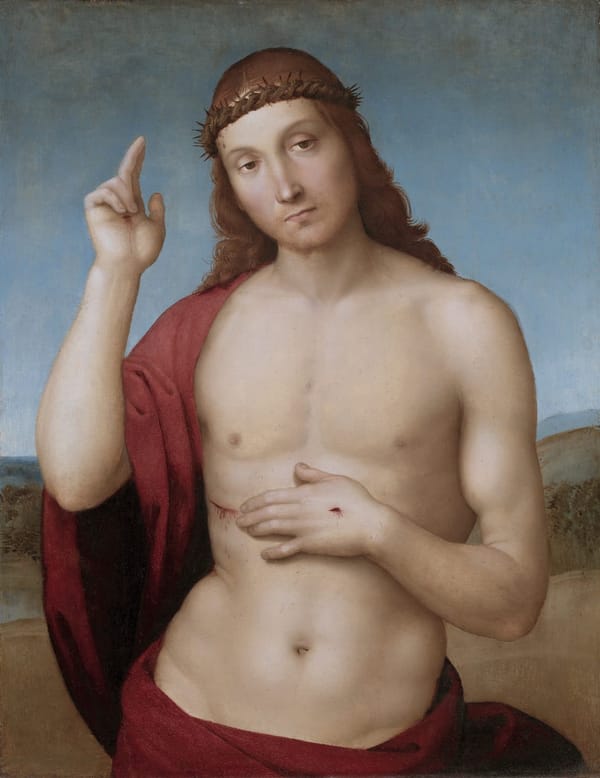
Yet four days, and our risen Jesus, whose company has been so dear and precious to us, will have disappeared from the earth. This fifth Sunday after Easter seems to prepare us for the separation. In a week’s time, we shall begin the long series of Sundays which are to pass before He returns to judge the world. This is a grief to the Christian; for he knows that he will not see his Saviour until after this life, and he feels something of the sorrow the apostles had at the last Supper, when Jesus said to them: ‘Yet a little while, and ye shall not see Me.’1
But, after His Resurrection, what must these privileged men have felt, when they perceived, as we do, that this beloved Master was soon to leave them! They had, so to speak, been living with Jesus glorified; they had experienced the effects of His divine condescension and intimacy; they had received from His lips every instruction they needed for the fulfilment of His will, that is, for founding on earth the Church He had chosen as His spouse. These happy forty days are fast drawing to a close. The apostles will then be deprived of Jesus’ visible presence, even to the end of their lives.
We, too, shall feel something of their sadness, if we have kept ourselves united to our holy mother the Church. From the very first day, when she recommenced, for our sakes, the ecclesiastical year, during which all the mysteries of our redemption, from the birth of our Emmanuel even to His triumphant Ascension into heaven, were to be celebrated,—have not we also been living in company with her Jesus, our Redeemer? And now that He is about to close the sweet intercourse which these seasons and feasts have kept up between Himself and us, are not our feelings very much like those of the apostles?
But there is one creature on earth, whom Jesus is leaving, and whose feelings at the approaching separation we cannot attempt to describe. Never had there been a heart so submissive to the will of her Creator; but, at the same time, there never was any creature so severely tried as she had been. Jesus would have His Mother’s love still increase; He therefore subjects her to the separation from Himself. Moreover, He wishes her to co-operate in the formation of the Church, for He has decreed that the great work shall not be achieved without her. In all this, Jesus shows how tenderly He loves His blessed Mother: He wishes her merit to be so great, that He may justly give her the brightest possible crown, when the day of her own ascension into heaven comes.
The heart of this incomparable Queen is not, indeed, to be again transfixed with a sword of sorrow: it is to be consumed by a love so intense that no language could describe it. Under the sweet, yet wearing, fire of this love, Mary is at length to give way, just as fruit falls from the tree, when its ripeness is complete, and the tree has nothing more to give it. But, during these last hours of Jesus’ presence, what must such a Mother have felt, who has had but forty days to enjoy the sight and the caresses of her glorified and divine Son? It is Mary’s last trial; and when her Jesus tells her of His wish that she should remain in exile, she is ready with her favourite answer: 'Behold the handmaid of the Lord! Be it done to me according to Thy word!’ Her whole life has been spent in doing God’s will; it was this that made her so great in His eyes, and so dear to His Heart. A holy servant of God, who lived in the seventeenth century, and was favoured with the most sublime revelations, tells us that it was left to Mary’s choice, either to accompany her divine Son to heaven, or to remain some years longer upon the earth to assist the infant Church; and that she chose to defer her entrance into eternal bliss, in order to labour, as long as it was God’s good pleasure, in the great work which was so closely connected with the glory of her Son, and so essential to the salvation of us her adopted children.
If this generous devotedness raised the co-operatrix of our salvation to the highest degree of sanctity, by giving completeness to her mission on earth, we may be sure that Jesus’ love for His Mother was increased by the new proof she thus gave Him of her uniformity with every wish of His sacred Heart. He repaid her, as He well knew how to do, for this heroic self-sacrifice, this prompt submission to His designs which destined her to be, here on earth, as the Church calls her, 'Queen of the apostles,’ and a sharer in their labours.
During these His last few hours on earth, our Lord’s affection for His apostles and disciples seemed to be redoubled. For several of them, the separation was to be a long one. The beloved disciple, John, was not to enjoy the company of his divine Master till more than fifty years had elapsed. It was to be thirty before the cross would carry Peter to Him who had entrusted to his keeping the keys of the kingdom of heaven. Magdalene, the fervent Magdalene, would have to wait the same length of time. But no one murmured at the divine appointment: they all felt how just it was, that Jesus, now that He had so fully established the faith of His Resurrection, should enter into His glory.2
On the very day of His Resurrection, our Saviour bade the disciples go into Galilee, for that there He would meet them. As we have already seen, they obeyed the order, and seven among them were favoured by Jesus’ appearing to them on the banks of Lake Genesareth: it is the eighth of the manifestations mentioned in the Gospel. The ninth also took place in Galilee. Our Lord loved Galilee: it gave Him the greater number of His disciples, it was Mary and Joseph’s country, and it was there that He Himself passed so many years of His hidden life. Its people were simpler and better than those of Judea; and this was another attraction. St. Matthew tells us, that the most public of all Jesus’ manifestations, after His Resurrection,—the tenth in reality, and the ninth mentioned by the evangelists,—took place on a hill in this same district.3
According to St. Bonaventure, and the learned and pious Denis the Carthusian, this hill was Mount Thabor, the same that was honoured by the mystery of the transfiguration. Upwards of five hundred of Jesus’ disciples were assembled there, as we learn from St. Paul:4 they were mostly inhabitants of Galilee, had believed in our Lord during His three years of public life, and merited to be witnesses of this new triumph of the Nazarene. Jesus showed Himself to them, and gave them such certitude with regard to His resurrection, that the apostle appeals to their testimony in support of this fundamental mystery of our faith.
Further than this, we know of no other manifestations made by our Saviour after His resurrection. We know that He gave order to His disciples to repair to Jerusalem, where they were to see Him once more before His Ascension. Let us, during these few days, follow the disciples to Jerusalem. Faithless city! how often has Jesus sought to gather together her children, as the hen gathereth her chickens under her wings, and she would not!5 He is about to re-enter her walls; but she is not to know it. He will not shew Himself to her, but only to those that love Him; and after this He will depart in silence, never to return until He comes to judge them that have not known the time of their visitation.
In the Greek Church, the fifth Sunday after Easter is called the Sunday of the man born blind, because her Gospel for the day contains the history of that miracle of our divine Lord. She also calls it Episozomene, which is one of the names given by the Greeks to the mystery of the Ascension, the feast of which is kept with them, as with us, during the course of this week.
Mass
The Introit is taken from Isaias, the sublimest of the prophets. It sweetly invites all the earth to celebrate the victory won by Jesus,—a victory which has purchased our deliverance.
Introit
Ps. Jubilate Deo omnis terra: psalmum dicite nomini ejus, date gloriam laudi ejus.℣. Gloria Patri. Vocem jucunditatis.
Ps. Shout with joy to God, all the earth: sing a psalm to his name, give glory to his praise.℣. Glory, &c. With the voice, &c.
In the Collect, holy Church teaches us that our thoughts and actions, to be made deserving of eternal life, stand in need of grace; the former that we may have the inspiration, the latter that we may have the will to do them.
Collect
Of the Blessed Virgin
Against the Persecutors of the Church
For the Pope
Epistle
Cap. i.Charissimi, estote factores verbi, et non auditores tantum, fallentes vosmetipsos. Quia si quis auditor est verbi, et non factor, hic comparabitur viro consideranti vultum nativitatis suæ in speculo: consideravit enim se, et abiit, et statim oblitus est qualis fuerit. Qui autem perspexerit in legem perfectam libertatis, et permanserit in ea, non auditor obliviosus factus, sed factor operis: hic beatus in facto suo erit. Si quis autem putat se religiosum esse, non refrænans linguam suam, sed seducens cor su um, hujus vana est religio. Religio munda, et immaculata apud Deum et Patrem, hæc est: Visitare pupillos et viduas in tribulatione eorum, et immaculatum se custodire ab hoc sæculo.
Ch. i.Dearly beloved: Be ye doers of the word, and not hearers only, deceiving your own selves. For if a man be a hearer of the word and not a doer; he shall be compared to a man beholding his own countenance in a glass. For he beheld himself and went his way, and presently forgot what manner of man he was. But he that hath looked into the perfect law of liberty, and hath continued therein, not becoming a forgetful hearer, but a doer of the work: this man shall be blessed in his deed. And if any man think himself to be religious, not bridling his tongue, but deceiving his own heart, this man’s religion is vain. Religion clean and undefiled before God and the Father, is this: to visit the fatherless and widows in their tribulation: and to keep one’s self unspotted from this world.
The holy apostle, whose instructions these are, had received them from our risen Jesus: hence the authoritative tone wherewith he speaks. Our Saviour, as we have already seen, honoured him with a special visit. This proves that he was particularly dear to his divine master, to whom he was related by the tie of consanguinity on his mother’s side, whose name was Mary. This holy woman went on Easter morning to the sepulchre, in company with her sister Salome, and Magdalene. St. James the Less is indeed the apostle of Paschal Time, wherein everything speaks to us of the new life we should lead with our risen Lord. He is the apostle of good works, for it is from him that we have received this fundamental maxim of Christianity, that though faith he the first essential of a Christian, yet without works it is a dead faith, and will not save us.
He also lays great stress on our being attentive to the truths we have been taught, and on our guarding against that culpable forgetfulness, which plays such havoc with thoughtless souls. Many of those who have this year received the grace of the Easter mystery, will not persevere; and the reason is, that they will allow the world to take up all their time and thoughts, whereas they should use the world as though they did not use it.6 Let us never forget, that we must now walk in newness of life, in imitation of our risen Jesus, who dieth now no more.
The two Alleluia-versicles celebrate the glory of the Resurrection; but they also contain an allusion to the approaching Ascension. Jesus was bom eternally from the Father; He came down to us; but now, in a few days, He is to return to his Father.
Gospel
Cap. xvi.In illo tempore: Dixit Jesus discipulis suis: Amen, amen dico vobis: si quid petieritis Patrem in nomine meo, dabit vobis. Usque modo non petistis quidquam in nomine meo: petite et accipietis, ut gaudium vestrum sit plenum. Hæc in proverbiislocutus sum vobis. Venit hora cum jam non in proverbiie loquar vobis, sed palam de Patre annuntiabo vobis. In illo die in nomine meo petetis: et non dico vobis quia ego rogabo Patrem de vobis: ipse enim Pater amat vos, quia vos me amastis, et credidistis quia ego a Deo exivi. Exivi a Patre, et veni in mundum: iterum relinquo mundum, et vado ad Patrem. Dicunt ei discipuli ejus: Ecce nunc palam loqueris, et proverbium nullum dicis: nunc scimus quia scis omnia, et non opus est tibi ut quis te interroget: in hoc credimus quia a Deo existi.
Ch. xvi.At that time: Jesus said to his disciples: Amen, amen, I say to you; if you ask the Father anything in my name, he will give it you. Hitherto you have not asked anything in my name. Ask and you shall receive; that your joy may be full. These things I have spoken to you in proverbs. The hour cometh when I will no more speak to you in proverbs, but will show you plainly of the Father. In that day you shall ask in my name: and I say not to you, that I will ask the Father for you. For the Father himself loveth you, because you have loved me, and have believed that I came out from God. I came forth from the Father, and am come into the world: again I leave the world and I go to the Father. His disciples say to him: Behold now thou speakest plainly, and speakest no proverb. Now we know that thou knowest all things, and thou needest not that any man should ask thee. By this we believe that thou camest forth from God.
When, at His last Supper, our Saviour thus warned His apostles of His having soon to leave them, they were far from knowing Him thoroughly. True, they knew that He came forth from God; but their faith was weak, and they soon lost it. Now that they are enjoying His company after His Resurrection, now that they have received such light from His instructions, they know Him better. He no longer speaks to them in proverbs; He teaches them everything they require to know in order to become the teachers of the whole world. It is now they might truly say to Him: We believe that thou camest forth from God! So much the more, then, do they understand what they are going to lose by His leaving them.
Our Lord begins now to reap the fruit of the word He has sown in their hearts: oh! how patiently has He waited for it! If He praised them for their faith, when they were with Him on the night of the last Supper, He may surely do so now that they have seen Him in the splendour of His Resurrection, and have been receiving such teaching from His lips. He said to them, at the last Supper: The Father loveth you, because ye have loved Me; how much more must the Father love them now, when their love for Jesus is so much increased! Let us be consoled by these words. Before Easter our love of Jesus was weak, and we were tepid in His service; but now that we have been enlightened and nourished by His mysteries, we may well hope that the Father loves us, for we love Jesus better than we did before. This dear Redeemer urges us to ask the Father, in His name, for everything we need. Our first want is perseverance in the spirit of Eastertide; let it be our most earnest prayer; let it be our intention now that we are assisting at the holy sacrifice, which is soon to bring Jesus upon our altar.
The Offertory is taken from the Psalms; it is an act of thanksgiving which the Christian, united with his risen Jesus, offers to God for having brought him to the new life, and made him the object of His choicest graces.
Offertory
In the Secret, the Church prays that this our earthly Pasch may introduce us to the feast of heavenly glory. The end of all the mysteries achieved by God in this world is, that we may be sanctified by them, and fitted for the eternal vision and possession of our Creator: it is this that the Church, adopting the style of the sacred Scriptures, calls glory.
Secret
Of the Blessed Virgin
Against the Persecutors of the Church.
For the Pope
The Communion-anthem, composed of the words of the royal prophet, is a canticle of gladness, expressive of the ceaseless joy of our Easter.
Communion
Holy Church teaches us, in her Postcommunion, how we should pray to God. We must desire the right thing; let us pray to have this desire, and then continue our prayer till the right thing is granted. Grace will then be given us: it will be our own fault if it be unproductive.
Postcommunion
Of the Blessed Virgin
Against the Persecutors of the Church
For the Pope
Vespers
Antiphon of the Magnificat
We will close our Sunday with the admonition wherewith the Gothic Church of Spain warned the faithful during Paschal Time. It is a season of joy; and yet we need to be cautious, for our enemy is sure to lay snares for us in the new life we have received.
Missa
(Feria V. post Pascha.)
May 10: St. Antoninus, Bishop and Confessor
THE Order of St Dominic, which has already presented to our triumphant Jesus Peter the Martyr and Catharine the seraph of Siena, offers him to-day one of the many bishops trained and formed in its admirable school. It was in the fifteenth century, a period when sanctity was rare on the earth, that Antoninus realized in his own person the virtues of the greatest bishops of ancient times. His apostolic zeal, his deeds of charity, his mortified life, are the glory of the Church of Florence, which was confided to his care. Heaven blessed that illustrious city with temporal prosperity on account of its saintly archbishop. Cosmo de Medici was frequently heard to say that Florence owed more to Antoninus than to any other man. The holy prelate was also celebrated for his great learning. He defended the Papacy against the calumnies of certain seditious bishops in the Council of Basle: and, at the General Council of Florence, he eloquently asserted the truth of the Catholic faith, which was assailed by the abettors of the Greek schism. How beautiful is our holy Mother the Church, who produces such children as Antoninus, and has them in readiness to uphold what is true and withstand what is false!
She thus speaks the praises of the Saint of to-day:
Disciple of the great Dominic, inheritor of his burning zeal, protect the holy order which he founded, and of which thou art so bright an ornament. Show that thou still lovest it. Give it increase, and procure for its children the holiness that once worked such loveliness and fruit in the Church. Holy Pontiff, be mindful of the faithful, who implore thine intercession at this period of the year.
Thy eloquent lips announced the Pasch, so many years, to the people of Florence, and urged them to share in the Resurrection of our divine Head. The same Pasch, the immortal Pasch, has shone once more upon us. We are still celebrating it; pray that its fruits may be lasting in us, and that our Risen Jesus, who has given us life, may, by his grace, preserve it in our souls for all eternity.
May 10 (the Same Day): Sts. Gordian and Epimachus, Martyrs
TWO more martyrs ascend from our earth on this day and are admitted to share in Jesus’ glory. Again it is Rome that deputes them to bear her homage to the Conqueror of Death. Gordian was one of the magistrates who were commissioned, under Julian the Apostate, to persecute the Christians. One day, whilst exercising his office, he suddenly descended from the tribunal and took his place among the criminals. He was soon called upon to shed his blood for the faith. His martyrdom, together with that of the illustrious brothers, John and Paul, whose feast we shall keep in June, closes the period of the pagan persecutions in the West. The fact of his being buried in the crypts on the Latin Way awakened the memory of another martyr, whose relics, half consumed by fire, had long before been brought thither from Alexandria. His name was Epimachus; and on this day the two martyrs were inseparably united in the devotion of the faithful. Neither the place nor the period of their combat was the same; but both of them fought for the one cause and won the same victory. The two conquerors are buried in peace in the Eternal City; but he, for whose name they delivered their bodies to death, is mindful of their precious remains. Yet a little while, and he will fulfil, in their regard, the promise he made when he said: I am the Resurrection and the Life. He that believeth in me, although he he dead, shall live.1
Sleep your sleep of peace, O holy martyrs! Rest yet a little time, till your fellow-servants and brethren, who are to be slain even as you, shall be filled up.2 The number has been added to in every century; but the world is now near its end, and its last period is to be rich in martyrdom. When the reign of the man of sin3 begins its course, and the final tempest rages against the bark of holy Church, then, O martyrs of Christ, protect the Christian people, in return for the yearly tribute of honour that it has paid to your venerable names. Pray also for those living during these sad times, whose miseries seem like the distant howling of the storm that is to precede the end of the world. Strengthen our hearts, O holy martyrs! and whatever may be the lot prepared for us by Providence, obtain for us that we may be faithful to him, who would be to us what he has been to you—the Resurrection and the Life.4
| Previous Saturday of the Fifth Week after Easter | Next May 10: St. Antoninus, Bishop and Confessor |