Daily reading
Paschal Time
Double of the II Class · May 1 · Sanctoral
May 11, 2026
From Dom Guéranger’s The Liturgical Year.

|
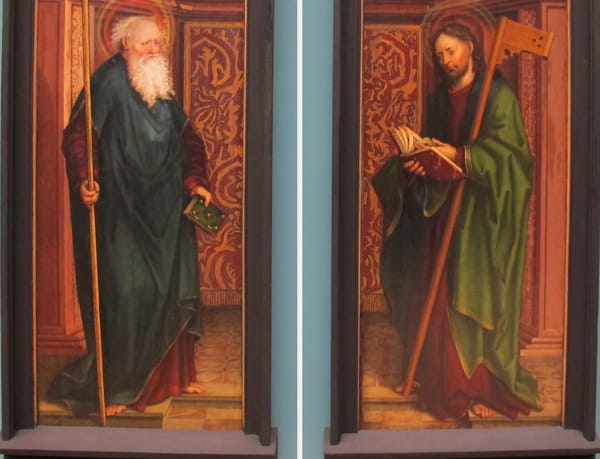
May 11 [May 1]: Sts. Philip and James the Less, Apostles
[This feast day, previously kept on May 1, was moved to May 11 when the feast of St. Joseph the Worker was established on May 1. The Solemnity of St. Joseph, which was replaced by St. Joseph the Work, was originally celebrated on the Third Sunday after Easter, as it was in the time of Dom Guéranger, whose article on that feast can be found here.-Ed.]
From Dom Guéranger's The Liturgical Year.
TWO of the favoured witnesses of our beloved Jesus' Resurrection come before us on this first day of May. Philip and James are here, bearing testimony to us that their Master is truly risen from the dead, that they have seen him, that they have touched him, that they have conversed with him,1 during these forty days. And, that we may have no doubt as to the truth of their testimony, they hold in their hands the instruments of the martyrdom they underwent for asserting that Jesus, after having suffered death, came to life again and rose from the grave. Philip is leaning upon the cross to which he was fastened, as Jesus had been; James is holding the club wherewith he was struck dead.
Philip preached the Gospel in the two Phrygias, and his martyrdom took place at Hierapolis. He was married when he was called by our Saviour; and we learn from writers of the second century that he had three daughters, remarkable for their great piety, one of whom lived at Ephesus, where she was justly revered as one of the glories of that early Church.
James is better known than Philip. He is called, in the sacred Scripture, Brother of the Lord,2 on account of the close relationship that existed between his own mother and the blessed Mother of Jesus. He claims our veneration during Paschal Time, inasmuch as he was favoured with a special visit from our Risen Lord, as we learn from St Paul.3 There can be no doubt but that he had done something to deserve this mark of Jesus’ predilection. St Jerome and St Epiphanius tell us that our Saviour, when ascending into heaven, recommended to St James’s care the Church of Jerusalem, and that he was accordingly appointed the first bishop of that city. The Christians of Jerusalem, in the fourth century, had possession of the chair on which St James used to sit when he assisted at the assemblies of the faithful. St Epiphanius also tells us that the holy Apostle used to wear a lamina of gold upon his forehead as the badge of his dignity. His garment was a tunic made of linen.
He was held in such high repute for virtue that the people of Jerusalem called him ' The Just and when the time of the siege came, instead of attributing the frightful punishment they then endured to the deicide they or their fathers had .committed, they would have it to be a consequence of the murder of James, who, when dying, prayed for his people. The admirable Epistle he has left us bears testimony to the gentleness and uprightness of his character. He there teaches us, with the eloquence of an inspired writer, that works must accompany our faith if we would be just with that justice which makes us like our Risen Lord.
The bodies of SS Philip and James repose in the Basilica of the Holy Apostles at Rome. These relics are counted as one of the richest treasures of the Holy City, and there is reason to believe that this first of May is the real anniversary of their translation. For a long period the Church of Rome kept special feasts in honour of four only of the Apostles: SS Peter and Paul, St John the Evangelist, and St Andrew (Peter’s brother): the rest were united in the solemnity of June 29, and a vestige of this is still to be found in the office of that day, as we shall see later on. The reception of the bodies of SS Philip and James, which were brought from the East somewhere about the sixth century, gave rise to the institution of to-day's feast; and this led gradually to the insertion into the Calendar of special feasts for the other Apostles and Evangelists.
Let us now read the brief account given of St Philip in the Liturgy.
The Breviary then gives the two following Lessons upon St James:
The Greek Church celebrates the memory of these two Apostles on distinct days, which are the anniversaries of their martyrdom. The following stanzas are from the hymn in honour of St Philip:
Hymn (Die XIV Novembris)
Let us now make a selection from the Menæa in honour of St James, whose memory is so affectionately cherished by the Eastern Churches:
Hymn (Die XXIII Octobris)
Holy Apostles! you saw our Risen Jesus in all his glory. He said to you on the evening of that great Sunday: Peace be to you! He appeared to you during the forty days following, that he might make you certain of his Resurrection. Great indeed must have been your joy at seeing once more that dear Master, who had admitted you into the number of his chosen Twelve; and his return made your love of him more than ever fervent. We address ourselves to you as our special patrons during this holy season, and most earnestly do we beseech you to teach us how to know and love the great mystery of our Lord’s Resurrection. May our hearts glow with Paschal joy, and may we never lose the new life that our Jesus has now given unto us.
Thou, O Philip! wast devoted to him, even from the first day of his calling thee. Scarcely hadst thou come to know him as the Messias, than thou didst announce the great tidings to thy friend Nathanael. Jesus treated thee with affectionate familiarity. When about to work the great miracle of the multiplication of the loaves, it was to thee that he addressed himself, and said to thee: Whence shall we buy bread, that these may eat?4 A few days before the Passion of thy divine Master, some of the Gentiles wished to see this great Prophet, of whom they had heard such wonderful things, and it was to thee that they applied. How fervently didst thou not ask him, at the Last Supper, to show thee the Father! Thy soul longed for the divine light; and when the rays of the Holy Ghost had inflamed thy spirit, nothing could daunt thy courage. As a reward of thy labours, Jesus gave thee to share with him the honours of the Cross. O holy Apostle! intercede for us, that we may imitate thy devotedness to Jesus; and that, when he deigns to send us the Cross, we may reverence and love it.
We also honour thy love of Jesus, O thou that art called the brother of the Lord, on whose venerable features was stamped the likeness of our Redeemer. If, like the rest of the Apostles, thou didst abandon him in his Passion, thy repentance was speedy and earnest, for thou wast the first, after Peter, to whom he appeared after his Resurrection. We affectionately congratulate thee, O James, for the honour thus conferred upon thee; do thou, in return, obtain for us that we may taste and see how sweet is our Risen Lord.5 Thy ambition was to give him every possible proof of thy gratitude; and the last testimony thou didst bear, in the faithless city, to the divinity of thy dear Master (when the Jews took thee to the top of the Temple) opened to thee, by martyrdom, the way that was to unite thee to him for eternity. Pray for us, O thou generous Apostle, that we also may confess his holy Name with the firmness which befits his disciples; and that we may ever be brave and loyal in proclaiming his rights as King over all creatures.
O holy Apostles! we beseech you to unite your prayers, and intercede for the Churches of the East, to which you preached the Gospel. Have compassion on Jerusalem, the dupe of schism and heresy; obtain her purification and her liberty; and rid her Holy Places of the sacrileges that have so long polluted them. Lead back the Christians of Asia Minor to union with the fold governed by the one supreme pastor. And lastly, pray for Rome, the city where your bodies repose, awaiting their glorious Resurrection. In return for the long hospitality she has given you, shield her with your protection; and permit not that the city of Peter, your venerable Head, should be deprived of its grandest glory—the presence of the Vicar of Christ.
Rogation Days: Monday
It seems strange that there should be anything like mourning during Paschal Time: and yet these three days are days of penance. A moment’s reflection, however, will show us that the institution of the Rogation days is a most appropriate one. True, our Saviour told us, before His Passion, that ‘the children of the Bridegroom should not fast whilst the Bridegroom is with them’:1 but is not sadness in keeping with these the last hours of Jesus’ presence on earth? Were not His Mother and disciples oppressed with grief at the thought of their having so soon to lose Him, whose company had been to them a foretaste of heaven?
Let us see how the liturgical year came to have inserted in its calendar these three days, during which holy Church, though radiant with the joy of Easter, seems to go back to her lenten observances. The Holy Ghost, who guides hex in all things, willed that this completion of her paschal liturgy should owe its origin to a devotion peculiar to one of the most illustrious and venerable Churches of southern Gaul, the Church of Vienne.
The second half of the fifth century had but just commenced, when the country round Vienne, which had been recently conquered by the Burgundians, was visited with calamities of every kind. The people were struck with fear at these indications of God’s anger. St. Mamertus, who, at the time, was bishop of Vienne, prescribed three days' public expiation, during which the faithful were to devote themselves to penance, and walk in procession chanting appropriate psalms. The three days preceding the Ascension were the ones chosen. Unknown to himself, the holy bishop was thus instituting a practice, which was afterwards to form part of the liturgy of the universal Church.
The Churches of Gaul, as might naturally be expected, were the first to adopt the devotion. St. Alcimus Avitus, who was one of the earliest successors of St. Mamertus in the See of Vienne, informs us that the custom of keeping the Rogation days was, at that time, firmly established in his diocese.2 St. Cæsarius of Arles, who lived in the early part of the sixth century, speaks of them as being observed in countries afar off; by which he meant, at the very least, to designate all that portion of Gaul which was under the Visigoths.3 That the whole of Gaul soon adopted the custom, is evident from the canons drawn up at the first Council of Orleans, held in 511, which represented all the provinces that were in allegiance to Clovis. The regulations, made by the council regarding the Rogations, give us a great idea of the importance attached to their observance. Not only abstinence from flesh-meat, but even fasting, is made of obligation. Masters are also required to dispense their servants from work, in order that they may assist at the long functions which fill up almost the whole of these three days.4 In 567, the Council of Tours, likewise, imposed the precept of fasting during the Rogation days;5 and as to the obligation of resting from servile work, we find it recognized in the Capitularia of Charlemagne and Charles the Bald.
The main part of the Rogation rite originally consisted, (at least in Gaul,) in singing canticles of supplication while passing from place to place; and hence the word Procession. We learn from St. Cæsarius of Arles, that each day’s procession lasted six hours; and that when the clergy became tired, the women took up the chanting.6 The faithful of those days had not made the discovery, which was reserved for modem times, that one requisite for religious processions is that they be as short as possible.
The procession for the Rogation days was preceded by the faithful receiving the ashes upon their heads, as now at the beginning of Lent; they were then sprinkled with holy water, and the procession began. It was made up of the clergy and people of several of the smaller parishes, who were headed by the cross of the principal church, which conducted the whole ceremony. All walked bare-foot, singing the litany, psalms, and antiphons, until they reached the church appointed for the station, where the holy sacrifice was offered. They entered the churches that lay on their route, and sang an antiphon or responsory appropriate to each.
Such was the original ceremony of the Rogation days, and it was thus observed for a very long period. The monk of St. Gall’s who has left us so many interesting details regarding the life of Charlemagne, tells us that this holy emperor used to join the processions of these three days, and walk bare-footed from his palace to the stational church.7 We find St. Elizabeth of Hungary, in the thirteenth century, setting the like example: during the Rogation days, she used to mingle with the poorest women of the place, and walk bare-footed, wearing a dress of coarse stuff.8 St. Charles Borromeo, who restored in his diocese of Milan so many ancient practices of piety, was sure not to be indifferent about the Rogation days. He spared neither word nor example to reanimate this salutary devotion among his people. He ordered fasting to be observed during these three days; he fasted himself on bread and water. The procession, in which all the clergy of the city were obliged to join, and which began after the sprinkling of ashes, started from the cathedral at an early hour in the morning, and was not over till three or four o’clock in the afternoon. Thirteen churches were visited on the Monday; nine, on the Tuesday; and eleven, on the Wednesday. The saintly archbishop celebrated Mass and preached in one of these churches.9
If we compare the indifference shown by the Catholics of the present age for the Rogation days, with the devotion wherewith our ancestors kept them, we cannot but acknowledge that there is a great falling off in faith and piety. Knowing, as we do, the importance attached to these processions by the Church, we cannot help wondering how it is that there are so few among the faithful who assist at them. Our surprise increases when we find persons preferring their own private devotions to these public prayers of the Church, which, to say nothing of the result of good example, merit far greater graces than any exercises of our own fancying.
The whole western Church soon adopted the Rogation days. They were introduced into England at an early period; as likewise into Spain and Germany. Rome herself sanctioned them by herself observing them; this she did in the eighth century, during the pontificate of St. Leo III. She gave them the name of the Lesser Litanies, in contradistinction to the procession of April 25, which she calls the Greater Litanies. With regard to the fast which the Churches of Gaul observed during the Rogation days, Rome did not adopt that part of the institution. Fasting seemed to her to throw a gloom over the joyous forty days, which our risen Jesus grants to His disciples; she therefore enjoined only abstinence from flesh-meat during the Rogation days. The Church of Milan, which, as we have just seen, so strictly observes the Rogations, keeps them on the Monday, Tuesday and Wednesday after the Sunday within the Octave of the Ascension, that is to say, after the forty days devoted to the celebration of the Resurrection.
If, then, we would have a correct idea of the Rogation days, we must consider them as Rome does,—that is, as a holy institution which, without interrupting our paschal joy, tempers it. The purple vestments used during the procession and Mass do not signify that our Jesus has fled from us,10 but that the time for His departure is approaching. By prescribing abstinence for these three days, the Church would express how much she will feel the loss of her Spouse, who is so soon to be taken from her.
In England, as in many other countries, abstinence is no longer of obligation for the Rogation days. This should be an additional motive to induce the faithful to assist at the processions and litanies, and, by fervently uniting in the prayers of the Church, to make some compensation for the abolition of the law of abstinence. We need so much penance, and we do so little! If we are truly in earnest, we shall be most fervent in doing the little that is left us to do.
The object of the Rogation days is to appease the anger of God, and avert the chastisements which the sins of the world so justly deserve; moreover, to draw down the divine blessing on the fruits of the earth. The litany of the saints is sung during the procession, which is followed by a special Mass said in the stational church, or if there be no Station appointed, in the church whence the procession first started.
The litany of the saints is one of the most efficacious of prayers. The Church makes use of it on all solemn occasions, as a means of rendering God propitious through the intercession of the whole court of heaven. They who are prevented from assisting at the procession, should recite the litany in union with holy Church: they will thus share in the graces attached to the Rogation days; they will be joining in the supplications now being made throughout the entire world; they will be proving themselves to be Catholics.
We give the Mass of the Rogations, which is the same for all three days. It speaks to us, throughout, of the power and necessity of prayer. The Church uses the lenten colour, to express the expiatory character of the function she is celebrating: but she is evidently full of confidence; she trusts to the love of her risen Jesus, and that gives her hope of her prayers being granted.
For the convenience of the faithful we also insert the litany.
Litany of the Saints
Ps. Deus, auribus nostris audivimus: patres nostri annuntiaverunt nobis.℣. Gloria Patri. Exsurge.
Christe, eleison.
Kyrie, eleison.
Christe, audi nos.
Christe, exaudi nos.
Pater de cœlis, Deus, miserere nobis.
Fili, Redemptor mundi, Deus, miserere nobis.
Spiritus Sancte, Deus, miserere nobis.
Sancta Trinitas, unus Deus, miserere nobis.
Sancta Maria, Ora pro nobis.
Sancta Dei Genitrix, ora.
Sancta Virgo virginum, ora.
Sancte Michael, ora.
Sancte Gabriel, ora.
Sancte Raphael, ora.
Omnes sancti angeli et archangeli, orate.
Omnes sancti beatorum spirituum ordines, orate.
Sancte Joannes Baptista, ora.
Sancte Joseph, ora.
Omnes sancti patriarchæ et prophetæ, orate.
Sancte Petre, ora.
Sancte Paule, ora.
Sancte Andrea, ora.
Sancte Jacobe, ora.
Sancte Joannes, ora.
Sancte Thoma, ora.
Sancte Jacobe, ora.
Sancte Philippe, ora.
Sancte Bartholomæe, ora.
Sancte Matthæe, ora.
Sancte Simon, ora.
Sancte Thaddæe, ora.
Sancte Mathia, ora.
Sancte Barnaba, ora.
Sancte Luca, ora.
Sancte Maree, ora.
Omnes sancti apostoli et evangelistæ, orate.
Omnes sancti discipuli Domini, orate.
Omnes sancti Innocentes, orate.
Sancte Stephane, ora.
Sancte Laurenti, ora.
Sancte Vincenti, ora.
Sancti Fabiane et Sebastiane. orate.
Sancti Joannes et Paule, orate.
Sancti Cosma et Damiane, orate.
Sancti Gervasi et Protasi, orate.
Omnes sancti martyres, orate.
Sancte Sylvester, ora.
Sancte Gregori, ora.
Sancte Ambrosi, ora.
Sancte Augustine, ora.
Sancte Hieronyme, ora.
Sancte Martine, ora.
Sancte Nicolæ, ora.
Omnes sancti pontifices et confessores, orate.
Omnes sancti doctores, orate.
Sancte Antoni, ora.
Sancte Benedicte, ora.
Sancte Bernardo, ora.
Sancte Dominice, ora.
Sancte Francisce, ora.
Omnes sancti sacerdotes et levitæ, orate.
Omnes sancti monachi et eremitæ, orate,
Sancta Maria Magdalena, ora.
Sancta Agatha, ora.
Sancta Lucia, ora.
Sancta Agnes, ora.
Sancta Cæcilia, ora.
Sancta Catharina, ora.
Sancta Anastasia, ora.
Omnes sanctae virgines et viduae, orate.
Omnes sancti et sanctae Dei, Intercedite pro nobis.
Propitius esto, parce nobis, Domine.
Propitius esto, exaudi nos, Domine.
Ab omni malo, libera nos, Domine.
Ab omni peccato, libera nos, Domine.
Ab ira tua, libera.
A subitanea et improvisa morte, libera.
Ab insidiis diaboli, libera.
Ab ira, et odio, et omni mala voluntate, libera.
A spiritu fornicationis, libera.
A fulgure et tempestate, libera.
A flagello terræmotus, libera.
A peste, fame, et bello, libera.
A morte perpetua, libera.
Per mysterium sanctae Incarnationis tuæ, libera.
Per adventum tuum, libera.
Per nativitatem tuam, libera.
Per baptismum et sanctum jejunium tuum, libera.
Per crucem et passionem tuam, libera.
Per mortem et sepulturam tuam, libera.
Per sanctam Resurrectionem tuam, libera.
Per admirabilem Ascensionem tuam, libera.
Per adventum Spiritus sancti Paracliti, libera.
In die judicii, libera.
Peccatores, te rogamue, audi nos.
Ut nobis parcas, te rogamue, audi nos.
Ut nobis indulgeas, te rogamus.
Ut ad veram pœnitentiam nos perducere digneris, te rogamus.
Ut Ecclesiam tuam sanctam regere et conservare digneris, te rogamus.
Ut Domnum apostolicum, et omnes ecclesiasticos ordines, in sancta religione conservare digneris, te rogamus.
Ut inimicos sanctæ Ecclesiæ humillare digneris, te rogamus.
Ut regibue et principibus Christianis pacem et veram concordiam donare digneris, te rogamus.
Ut cuncto populo Christiano pacem et unitatem largiri digneris, te rogamus.
Ut nosmetipsos in tuo sancto servitio confortare et conservare digneris, te rogamus,
Ut mentes nostras ad cœlestia desideria erigas, te rogamus.
Ut omnibus benefactoribus nostris sempiterna bona retribuas, te rogamus.
Ut animas nostras, fratrum, propinquorum, et benefactorum nostrorum ab æterna damnatione eripias, te rogamus.
Ut fructus terræ dare et conservare digneris, te rogamus.
Ut omnibus fidelibus defunctis requiem æternam donare digneris, te rogamus.
Ut nos exaudire digneris, te rogamus.
Fili Dei, te rogamus.
Agnus Dei, qui tollis peccata mundi, parce nobis, Domine.
Agnus Dei, qui tollis peccata mundi, exaudi nos, Domine.
Agnus Dei, qui tollis peccata mundi, miserere nobis.
Christe, audi nos.
Christe, exaudi nos.
Kyrie, eleison.
Christe, eleison.
Kyrie, eleison.
Pater noster. (Secreto.)℣. Et ne nos inducas in tentationem.℟. Sed libera nos a malo.
Ps. We have heard, O God, with our ears: our fathers have told it unto us.℣. Glory, &c. Arise, &c.
Christ, have mercy on us.
Lord, have mercy on us.
Christ, hear us.
Christ, graciously hear us.
God the Father of heaven, have mercy on us.
God the Son, Redeemer of the world, have mercy on us.
God the Holy Ghost, have mercy on us.
Holy Trinity, one God, have mercy on us.
Holy Mary, pray for us.
Holy Mother of God, pray for us.
Holy Virgin of virgins, pray for us.
Saint Michael, pray for us
Saint Gabriel,
Saint Raphael,
All ye holy angels and archangels,
All ye holy orders of blessed spirits,
Saint John Baptist,
Saint Joseph,
All ye holy patriarchs and prophets,
Saint Peter,
Saint Paul,
Saint Andrew,
Saint James,
Saint John,
Saint Thomas,
Saint James,
Saint Philip,
Saint Bartholomew,
Saint Matthew,
Saint Simon,
Saint Thaddeus,
Saint Mathias,
Saint Barnaby,
Saint Luke,
Saint Mark,
All ye holy apostles and evangelists,
All ye holy disciples of our Lord,
All ye holy Innocents,
Saint Stephen,
Saint Laurence,
Saint Vincent,
Saints Fabian and Sebastian,
Saints John and Paul,
Saints Cosmas and Damian,
Saints Gervasius and Protasius,
All ye holy martyrs,
Saint Sylvester,
Saint Gregory,
Saint Ambrose,
Saint Augustine,
Saint Jerome,
Saint Martin,
Saint Nicholas,
All ye holy bishops and confessors,
All ye holy doctors,
Saint Antony,
Saint Benedict,
Saint Bernard,
Saint Dominic,
Saint Francis,
All ye holy priests and levites,
All ye holy monks and hermits.
Saint Mary Magdalene,
Saint Agatha,
Saint Lucy,
Saint Agnes,
Saint Cecily,
Saint Catharine,
Saint Anastasia,
All ye holy virgins and widows,
All ye men and women, saints of God, make intercession for us.
Be merciful to us, spare us O Lord,
Be merciful to us, graciously hear us, O Lord.
From all evil, deliver us, O Lord.
From all sin, deliver us, O Lord.
From thy wrath,
From sudden and unprovided death,
From the snares of the devil,
From anger, hatred, and all ill-will,
From the spirit of fornication,
From lightning and tempest,
From the scourge of earthquakes,
From plague, famine, and war,
From everlasting death,
Through the mystery of thy holy Incarnation,
Through thy coming,
Through thy nativity,
Through thy baptism and holy fasting,
Through thy cross and Passion,
Through thy death and burial,
Through thy holy Resurrection,
Through thy admirable Ascension,
Through the coming of the Holy Ghost the Comforter,
In the day of Judgment,
We sinners, beseech thee, hear us.
That thou spare us, we beseech thee, hear us.
That thou pardon us,
That thou vouchsafe to bring us to true penance,
That thou vouchsafe to govern and preserve thy holy Church,
That thou vouchsafe to preserve our apostolic Prelate, and all ecclesiastical orders, in holy religion,
That thou vouchsafe to humble the enemies of thy holy Church,
That thou vouchsafe to give peace and true concord to Christian kings and princes,
That thou vouchsafe to grant peace and unity to all Christian people,
That thou vouchsafe to strengthen and preserve us in thy holy service,
That thou render eternal good things to all our benefactors,
That thou deliver our souls, and those of our brethren, kinsfolk, and benefactors, from eternal damnation,
That thou vouchsafe to give and preserve the fruits of the earth,
That thou vouchsafe to give eternal rest to all the faithful departed,
That thou vouchsafe graciously to hear us,
Son of God, we beseech thee, hear us.
Lamb of God, who takest away the sins of the world, spare us, O Lord.
Lamb of God, who takest away the sins of the world, graciously hear us, O Lord.
Lamb of God, who takest away the sins of the world, have mercy on us.
Christ, hear us.
Christ, graciously hear us.
Lord, have mercy on us.
Christ, have mercy on us.
Lord, have mercy on us.
Our Father. (In secret.) ℣. And lead us not into temptation.℟. But deliver us from evil.
Psalm 69
Confundantur et revereantur: qui quærunt animam meam.
Avertantur retrorsum et erubescant: qui volunt mihi mala.
Avertantur statim erubescentes: qui dicunt mihi, Euge, euge.
Exsultent et lætentur in te omnes qui quærunt te: et dicant semper, Magnificetur Dominus, qui diligunt salutare tuum.
Ego vero egenus et pauper sum: Deus adjuva me.
Adjutor meus et liberator meus es tu: Domine, ne moreris.
Gloria Patri, et Filio, et Spiritui sancto.
Sicut erat in principio, et nunc, et semper: et in sæcula sæculorum. Amen. ℣. Salvos fac servos tuos.
Let them be confounded and ashamed that seek my soul.
Let them be turned backward, and blush for shame, that desire evils to me.
Let them be presently turned away blushing for shame, that say to me: ’Tis well, ’tis well.
Let all that seek thee rejoice and be glad in thee: and let such as love thy salvation, say always, The Lord be magnified.
But I am needy and poor: O God help me.
Thou art my helper and my deliverer: O Lord, make no delay.
Glory be to the Father, and to the Son, and to the Holy Ghost.
As it was in the beginning, is now, and ever shall be, world without end. Amen. ℣. Save thy servants.
illam, quam mundus dare non potest, pacem; ut et corda nostra mandatis tuis dedita, et hostium sublata formidine, tempora sint, tua protectione, tranquilla.
MASS OF THE ROGATION DAYS
The Introit, which is taken from the Psalms, tells us of the mercy of God, and how He graciously hears our prayer the moment we make it.
Introit
Ps. Diligam te, Domine, virtus mea: Dominus firmamentum meum et refugium meum, et liberator meus.℣. Gloria Patri. Exaudivit.
Ps. I will love thee, O Lord, my strength! The Lord is my rock, my refuge, and my deliverer.℣. Glory, &c. He hath, &c.
In the Collect, the Church represents the necessities of her children to almighty God. As a motive for His granting them His protection, she speaks of the confidence wherewith they ask it.
Collect
Then are added the other Collects, as in the Mass of the fifth Sunday after Easter, page 119.
Epistle
Cap. v.Charissimi, confitemini alterutrum peccata vestra, et orate pro invicem ut salvemini: multum enim valet deprecatio justi assidua. Elias homo erat similis nobis, passibilis: et oratione oravit ut non plueret super terram, et non pluit annos tres, et menses sex. Et rursum oravit: et cœlum dedit pluviam, et terra dedit fructum suum. Fratres mei, si quis ex vobis erraverit a veritate, et converterit quis eum: scire debet quoniam qui converti fecerit peccatorem ab errore viæ suæ, salvabit animam ejus a morte, et operiet multitudinem peccatorum.
Ch. v.Dearly beloved: Confess your sins one to another; and pray one for another, that you may be saved. For the continual prayer of a just man availeth much. Elias was a man passible like unto us: and with prayer he prayed that it might not rain upon the earth, and it rained not for three years and six months. And he prayed again, and the heaven gave rain, and the earth brought forth her fruit. My brethren, if any of you err from the truth, and one convert him; he must know, that he who caused a sinner to be converted from the error of his way, shall save his soul from death, and shall cover a multitude of sins.
Again it is the apostle St. James the Less, who speaks to us in to-day’s Epistle; and could any words be more appropriate? One of the motives for the institution of the Rogation days, is to obtain from God the blessing of weather favourable to the fruits of the earth; and St. James here adduces the example of Elias, to show us that prayer can stay or bring down the rain of heaven. Let us imitate the faith of this Prophet, and beg of our heavenly Father to give and preserve what we require for our nourishment. Another object of the Rogations, is to obtain the forgiveness of sin. If we pray with fervour for our brethren who are gone astray, we shall obtain for them the graces they stand in need of. We shall perhaps never know, during this life, those whom our prayer, united with the prayer of the Church, shall have converted from the error of their way; but the apostle assures us, that our charity will receive a rich reward,—the mercy of God upon ourselves.
In order the better to express mourning and communction in the Mass of the Rogation days, the Church not only uses purple vestments, she also retrenches somewhat of the joy of her canticles. She allows herself but one Alleluia-versicle; but it is full of hope in the goodness of her Lord.
Gospel
Cap. xi.In illo tempore: Dixit Jesus discipulis suis: Quis vestrum habebit amicum, et ibit ad ilium media nocte, et dicet illi: Amice, commoda mihi tres panes, quoniam amicus meus venit de via ad me, et non habeo quod ponam ante illum; et ille deintus respondensdicat; Noli mihi molestus esse, jam ostium clausum est, et pueri mei mecum sunt in cubili: non possum surgere, et dare tibi. Et si ille perseveraverit pulsans: dico vobis, et si non dabit illi surgens eo quod amicus ejus sit, propter improbitatem tamen ejus surget, et dabit illi quotquot habet necessarios. Et ego dico vobis: Petite, et dabitur vobis: quærite, et invenietis: pulsate, et aperietur vobis. Omnis enim qui petit, accipit: et qui quærit, invenit: et pulsanti aperietur. Quis autem ex vobis patrem petit panem, numquid lapidem dabit illi? Aut piscem: numquid pro pisce serpentem dabit illi? Aut si petierit ovum: numquid porriget illi scorpionem? Si ergo vos, cum sitis mali, nostis bona data dare filiis vestris: quanto magis Pater vester de cœlo dabit spiritum bonum petentibus se?
Ch. xi.At that time: Jesus said to his disciples: Which of you shall have a friend, and shall go to him at midnight, and shall say to him: Friend, lend me three loaves, because a friend of mine has come off his journey to me, and I have not what to set before him: and he from within should answer and say: Trouble me not, the door is now shut, and my children are with me in bed; I cannot rise and give thee. Yet if he shall continue knocking, I say to you, although he will not rise and give him, because he is his friend; yet because of his importunity he will rise, and give him as many as he needeth. And I say to you: Ask, and it shall be given you; seek, and you shall find; knock, and it shall be opened to you. For every one that asketh, receiveth; and he that seeketh, findeth; and to him that knocketh, it shall be opened. And which of you, if he ask his father bread, will he give him a stone? or a fish, will he for a fish give him a serpent? Or if he shall ask an egg, will he reach him a scorpion? If you then being evil, know how to give good gifts to your children, how much more will your Father from heaven give the good Spirit to them that ask him?
Could anything show us the all-powerfulness of prayer more clearly than do these words of our Gospel? By thus putting them before us, holy Church shows us the importance of the Rogation days, since it is during them that she shows us the efficacy of supplication, which triumphs over the refusal of God Himself. The reader, who has followed us thus far in our work, must have observed how the passages of holy Writ, selected by the liturgy, form a continued series of instruction, appropriate to each day. During these three days, we are labouring to appease the anger of heaven; could there be a more fitting occasion for our being told that God cannot resist persevering prayer? The Litanies we have been chanting in procession, are a model of this holy obstinacy, or, as our Gospel terms it, this importunity, of prayer. How often did we repeat the same words! Lord have mercy on ns!—Deliver us, O Lord!—We beseech thee, hear us! The divine Paschal Lamb, who is about to be offered on our altar, will mediate for us; a few moments hence He will unite His ever efficacious intercession with our poor prayers. With such a pledge as this, we shall leave the holy place, feeling sure that these prayers have not been made in vain. Let us, therefore, make a resolution to keep aloof no longer from the holy practices of the Church; let us always prefer praying with her, to praying by ourselves; she is the spouse of Jesus, she is our common mother, and she always wishes us to take part with her in the prayers she offers up. Besides, is it not for us that she makes these prayers?
The Offertory is taken from the Psalms. It gives praise to God, who, notwithstanding our being poor sinners, permits Himself to be overcome by our prayers, rises in our defence, and gives us all we stand in need of.
Offertory
The bonds of sin enchained us, and, of ourselves, we could not have returned to our Creator; but the Paschal Lamb has restored us our liberty; and as often as His Sacrifice is renewed upon the altar, our deliverance is achieved afresh. The Church expresses this in the Secret: her confidence rests on the divine Victim, which the Father has given us, and which she is now about to offer to Him.
Secret
Then are added the other Secrets, as given above in the Mass of the fifth Sunday after Easter, page 124.
The Communion-anthem is the repetition of the consoling words of our Saviour, as given us in the Gospel. It is He Himself who authorizes us to ask for whatsoever we please; we cannot ask too much. None of us would have dared to say: ‘Whosoever makes a petition to God, will have his petition granted’: but now that the Son of God has come from heaven to teach us this astounding truth, we should never tire of repeating it.
Communion
The Sacrifice of peace is consummated, and the Church gives free scope to her confidence by the words of thanksgiving expressed in the Postcommunion. The sacred gifts have brought us consolation; and our holy mother prays that consolation may prompt us to warmer love.
Postcommunion
To this are added the other Postcommunions, as given above, in the Mass of the fifth Sunday after Easter, page 126.
We subjoin a liturgical fragment, taken from the Rogation Mass of the ancient Gallican rite. This prayer was one of the supplications made on the first of these three days, and it bears with it the marks of its venerable antiquity.
Prayer (Post Nomina)
- St. Luke, v. 34. ↩︎
- Homil. de Rogationibus. ↩︎
- Serm. clxxii; amongst the Sermons of St. Augustine. ↩︎
- Canon xxvii. ↩︎
- Canon xvii. ↩︎
- Serm. clxxiv. Herbertus Turritanus. Miracul., lib. i. o. 21. ↩︎
- De rebus bellicis Caroli Magni, cap. xvi. ↩︎
- Surius: ad diem xix. Novembris. ↩︎
- Giussano: Life of St. Charles Borromeo. ↩︎
- Cant. viii. 14. ↩︎
| Previous May 10 (the Same Day): Sts. Gordian and Epimachus, Martyrs | Next Rogation Days: Monday |