Daily reading
Paschal Time
Double · Movable from Easter · Temporal
May 17, 2026
From Dom Guéranger’s The Liturgical Year.

|
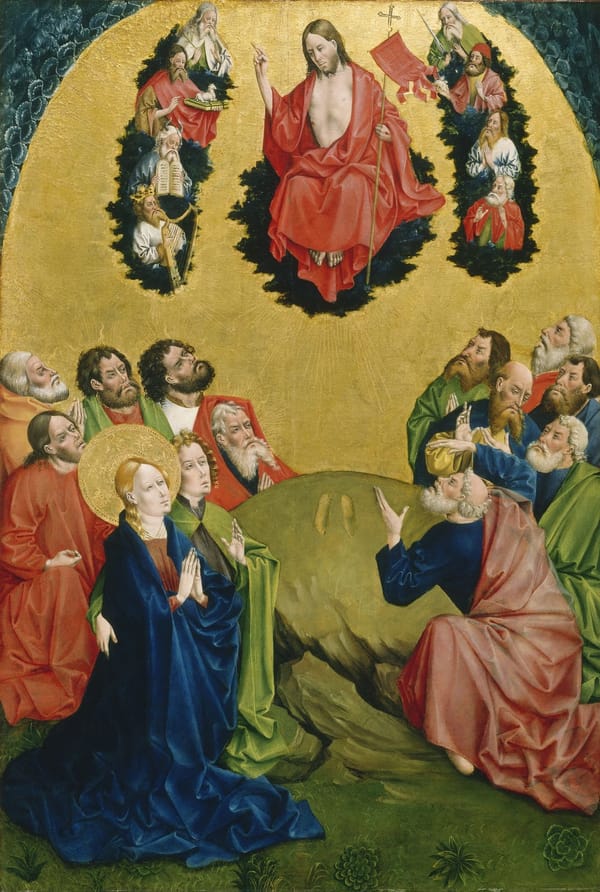
Sunday within the Octave of the Ascension
Jesus has ascended into heaven. His Divinity had never been absent; hut, by the Ascension, His Humanity was also enthroned there, and crowned with the brightest diadem of glory. This is another phase of the mystery we are now solemnizing. Besides a triumph, the Ascension gave to the sacred Humanity a place on the very throne of the eternal Word, to whom it was united in unity of Person. From this throne, it is to receive the adoration of men and of angels. At the name of Jesus, Son of Man, and Son of God,—of Jesus who is seated at the right hand of the Father almighty,—'Every knee shall bend, in heaven, on earth and in hell.’1
Give ear, O ye inhabitants of earth! This is the Man Jesus, who heretofore was a little Babe wrapped in swaddling clothes; who went through Judea and Galilee, not having where to lay His head; who was bound by the sacrilegious hands of his enemies, was scourged, crowned with thorns, nailed to a cross; who, whilst men thus trampled Him, as a worm, beneath their feet, submitted His will to that of His Father, accepted the chalice of suffering, and, that He might make amends to the divine glory, shed His Blood for the redemption of you sinners. This Man Jesus, child of Adam through Mary the immaculate, is the master-piece of God’s omnipotence. He is the most beautiful of the sons of men’;2 the angels love to fix their gaze upon Him;3 the blessed Trinity is well-pleased with Him; the gifts of grace bestowed on Him surpass all that men and angels together have ever received. But He came to suffer, and suffer for you; and though He might have redeemed you at a much lower price, yet would He generously overpay your debts by a superabundance of humiliation and suffering. What reward shall be given to Him? The apostle tells us in these words: 'He humbled Himself, becoming obedient unto death, even to the death of the cross; for which cause God also hath exalted Him, and hath given Him a name, which is above all names.’4
You, then, who compassionate with Him in the suffering whereby He wrought your redemption; you who devoutly follow Him in the stages of His sacred Passion; now raise up your heads, and look up to the highest heaven! Behold this Jesus ‘crowned with glory and honour because He suffered death’!5 See how the Father has magnified Him in return for His having 'emptied Himself, taking the form of a servant,’ though in His other nature, He was equal with God.6 His crown of thorns is replaced by a crown of precious stones.7 The cross that was laid on His shoulders is now the ensign of His power.8 The wounds made by the nails and the spear are now like five bright suns that light up all heaven. Glory, then, he to the justice of the Father, who has dealt thus with His Son! Let us rejoice at seeing the Man of sorrows9 become now the King of glory; and let us, with all the transport of our souls, repeat the hosanna wherewith the angels welcomed Him into heaven.
Nor must we suppose that the Son of Man now that He is seated on the throne of His Divinity, is inactive in His glorious rest. No; the sovereignty bestowed upon Him by the Father, is an active one. First of all, He is appointed Judge of the living and of the dead,10 before whose judgement-seat we must all stand.11 No sooner shall our soul have quitted the body, than she shall be presented before this tribunal, and receive from the lips of the Son of Man the sentence she will have deserved. O Jesus! by the glory Thou didst receive on the day of Thine Ascension, have mercy on us at that moment whereon depends eternity.
But the judgeship of our Lord Jesus Christ is not to be confined to this silent exercise of His sovereign power. The angels, who appeared to the apostles after His Ascension, told us that He is to come again upon the earth; that He is to descend through the clouds, as He ascended; and that then shall be the last judgement, at which the whole human race is to be present! Throned on a cloud, and surrounded by the angelic host, the Son of Man will show Himself to mankind, and this time with all majesty. Men shall see Him whom they pierced;12 the imprints of those wounds, which will give additional beauty to His sacred Body, will be an object of terror to the wicked, while to the good they will be a source of unspeakable consolation. The shepherd, seated on His ethereal throne, will separate the goats from the sheep. His voice, after so many ages of silence, will make itself once more heard upon this earth: He will speak to impenitent sinners, condemning them to eternal torments; He will speak to the just, calling them to approach Him, and ascend, body and soul, into the region of everlasting bliss.
Meanwhile, He exercises over all nations the royal power, which He received, as Man, on the day of His Ascension. He redeemed us all by His Blood; we are therefore His people, and He is our King. He is, and He calls Himself, 'King of kings and Lord of lords.’13 The kings of the earth reign not either by their own prowess, or by the boasted social compact; they lawfully reign by Christ alone. Peoples and nations are not their own masters; they belong to Christ and are His subjects. His law requires no sanction from man; it is above all human laws, and should be their guide and controller. ‘Why have the nations raged, and the people devised vain things? The kings of the earth stood up and the princes met together, against the Lord and against His Christ. They said: Let us break their bonds asunder, and let us cast away their yoke from us,’14 How vain all these efforts! For, as the apostle says, ‘He must reign, until He hath put all His enemies under His feet.’15 that is, until His second coming, when the pride of man and satan’s power shall both be at an end.
Thus, then, the Son of Man, crowned at His Ascension, must reign over the world to the end of time. But it will be objected: 'How can He be said to reign in these our times, when kings and emperors and presidents acknowledge that their authority comes from the people; and when the people themselves, carried away with the ideas of self-government and liberty and independence, have lost all idea of authority?’ And yet, He reigns; He reigns in His justice, since men refused to be guided by His clemency . They expunged His law from their statutes; they gave the rights of citizenship to error and blasphemy: then did He deliver them up, both people and rulers, to their own follies and lies. Authority and power have become ephemeral: and as they scorn to receive the consecration of the Church, the hand that holds them to-day, may be empty to-morrow. Then anarchy, then a new ruler, and then a fresh revolution. This will be the future, as it is the present, history of nations, until they once more acknowledge Jesus as their King, and resume the constitution of the ages of faith: ‘It is Christ that conquers! it is Christ that reigns! it is Christ that commands! May Christ preserve His people from all evil!'
On this Thy coronation-day, receive our devoted homage, O Jesus, our King, our Lord, our Judge! By our sins, we were the cause of Thy humiliations and sufferings; so much the more fervently, then, do we nite with the acclamations made to Thee by the angels when the royal diadem was placed on Thy head by the eternal Father. As yet, we but faintly see Thy grandeur; but the holy Spirit, whom Thou art about to send upon us, will teach us more and more of Thy sovereign power, for we are, and wish to be eternally, Thy humble and faithful subjects!
In the middle-ages, the Sunday within the octave of the Ascension was called the Sunday of roses, because it was the custom to strew the pavement of the churches with roses, as a homage to Christ who ascended to heaven when earth was in the season of flowers. How well the Christians of those times appreciated the harmony that God has set between the world of grace and that of nature! The feast of the Ascension, when considered in its chief characteristic, is one of gladness and jubilation, and spring’s loveliest days are made for its celebration. Our forefathers had the spirit of the Church; they forgot, for a moment, the sadness of poor earth at losing her Emmanuel, and they remembered how He said to His apostles: 'If ye loved Me, ye would be glad, because I go to the Father!’16 Let us do in like manner; let us offer to Jesus the roses wherewith He has beautified our earth: their beauty and fragrance should make us think of Him who made them, of Him who calls Himself the flower of the field and the lily of the valleys.17 He loved to be called Jesus of Nazareth; for Nazareth meaus a flower; and the symbol would tell us what a charm and sweetness there is in Him whom we serve and love as our God.
Mass
The Introit, which is taken from the Book of Psalms, expresses the longings of the Church to behold her Spouse, who has fled far from her. The faithful soul is possessed with the same desire; she unites in the prayer of our holy mother, and says to Jesus: ‘Oh! hearken to the wish of my heart, and show me Thy divine face!’
Introit
Ps. Dominus illuminatio mea, et salus mea: quem timebo? ℣. Gloria Patri. Exaudi.
Ps. The Lord is my light, and my salvation: whom shall I fear? Glory &c. Hear, &c.
The Church, in the Collect, teaches us to ask of God that good will, which will render us worthy of seeing our Jesus, by making us zealous in the service of His divine Majesty.
Collect
A commemoration of the Ascension is added, by the Collect, page 176.
Epistle
I Cap. iv.Charissimi, estote prudentes, et vigilate in orationibus. Ante omnia autem, mutuam in vobismetipsis caritatem continuam habentes: quia caritas operit multitudinem peccatorum. Hospitales invicem sine murmuratione. Unusquisque, sicut accepit gratiam, in alterutrum illam administrantes, sicut boni dispensatores multiformis gratiae Dei. Si quis loquitur, quasi sermones Dei: si quis ministrat, tamquam ex virtute, quam administrat Deus: ut in omnibus honorificetur Deus per Jesum Christum Dominum nostrum.
I Ch. iv.Dearly beloved: Be prudent, and watch in prayers. But before all things have a constant mutual charity among yourselves: for charity covereth a multitude of sins. Using hospitality one towards another, without murmuring. As every man hath received grace, ministering the same one to another: as good stewards of the manifold grace of God. If any man speak, let him speak as the words of God. If any man minister, let him do it as of the power which God administereth; that in all things God may be honoured through Jesus Christ our Lord.
The prince of the apostles, who presided over the holy assembly that awaited in the cenacle the descent of the divine Spirit, here addresses us, who are in expectation of the same great gift, and recommends us to practise fraternal charity. This virtue, says he, covereth a multitude of sins; could we make any better preparation for receiving the Holy Ghost? This Paraclete is coming that He may unite all men into one family; let us, then, put an end to all our dissensions, and prove ourselves to be members of the brotherhood established by the preaching of the Gospel. During these days of our preparing to receive the promised Comforter, the apostle bids us be prudent and watch in prayers. Let us follow his instruction; we must show our prudence by excluding everything that might be an obstacle to the Holy Ghost’s entering our hearts; and as to prayer, it is the means which will open our hearts to Him, that He may make them His own for ever.
The first of the two Alleluia-versicles is taken from the Psalms, and celebrates the majesty of Jesus upon His royal throne; the second is formed of the words of this same Saviour, promising us that He will return at the end of the world, when He comes to gather together His elect.
Gospel
Cap. xv., xvi.In illo tempore: dixit Jesus discipulis suis: cum venerit Paraclitus, quem ego mittam vobis a Patre, Spiritum veritatis, qui a Patre procedit, ille testimonium perhibebit de me: et vos testimonium perhibebitis, quia ab initio mecum estis. Hæc locutus sum vobis, ut non scandalizemini. Absque synagogis facient vos: sed venit hora ut omnis, qui interficit vos, arbitretur obsequium se præstare Deo. Et hæc facient vobis, quia non noverunt Patrem, neque me. Sed hæc locutus sum vobis: ut, cum venerit hora eorum, reminiscamini quia ego dixi vobis.
Ch. xv., xvi.At that time: Jesus said to his disciples: when the Paraclete cometh, whom I will send you from the Father, the Spirit of truth, who proceedeth from the Father, he shall give testimony of me; and you shall give testimony, because you are with me from the beginning. These things have I spoken to you, that you may not be scandalized. They will put you out of the synagogues; yea the hour cometh, that whosoever killeth you will think that he doth a service to God. And these things will they do to you, because they have not known the Father, nor me. But these things I have told you; that when the hour shall come, you may remember that I told you of them.
Here we have our Jesus telling us the effects, which the coming of the Holy Ghost will produce in our souls. These words were first addressed to the apostles, at the last Supper. He told them that the Paraclete would give testimony of Him, that is, would instruct them upon His Divinity, and teach them to be faithful to Him, even so as to lay down their lives for Him. A few moments before His Ascension, Jesus again spoke to them concerning the Paraclete, and called Him’the power from on high.’18 Severe trials were awaiting these apostles; they would have to resist unto blood.19 Who would be their support P For, of themselves, they were but weak men. The Holy Ghost, who was to abide with them. By Him they would conquer, and the Gospel would be preached to all nations. Now, this Spirit of the Father and of the Son is about to descend upon us; and what is the object of His visit, but that of arming us for the combat, and strengthening us against the attacks of our enemies? As soon as this holy season of Easter is over, and we no longer have the celebration of its mysteries to enlighten and cheer us, we shall find ourselves at the old work of battling with the three enemies: the devil, who is angered by the graces we have received; the world, to which we must unfortunately return; and our passions, which, after this calm, will again awaken, and molest us. If we be’endued with the power from on high’, we shall have nothing to fear. Let us, therefore, ardently desire to receive Him; let us prepare Him a worthy reception; let us use every endeavour to make Him abide with us; and we shall gain the victory, as did the apostles.
The Offertory gives us the words of the psalmist, describing the glories of Jesus’ Ascension. Holy Church wishes to impress the thought of this triumph well upon us, that our hearts may be fixed on the dear country, where our Jesus awaits us.
Offertory
While offering to God the bread and wine, which are soon to be changed into the Body and Blood of Christ, the Church, in the Secret, prays that we may not only be made pure by our contact with these divine mysteries, but may also receive the vigour and energy which are so indispensably needed by every Christian.
Secret
A commemoration is then made of the Ascension, by the Secret of the feast, given on page 182.
The Preface is that of the Ascension, page 182.
The Communion-anthem is formed of the words addressed by Jesus to His eternal Father, after having instituted the sacrament of the Eucharist, at the last Supper. They show us what His wishes are in our regard.
Communion
Thanksgiving is the Christian’s first duty after receiving, in holy Communion, the Body and Blood of Christ. The Church, which appreciates so much more perfectly than we can ever do the greatness of the favour thus bestowed on us, prays, in her Postcommunion, that we may ever be giving thanks to our divine benefactor.
Postcommunion
Vespers
Antiphon of the Magnificat
OREMUS
Omnipotens sempiterne Deus, fac nos tibi semper et devotam gerere voluntatem, et majestati tuæ sincero corde servire. Per Dominum.
LET US PRAY
O almighty and eternal God, inspire thy servants with true devotion, and grant that we may serve thy divine Majesty with sincere hearts. Through, &c.
Let us offer to our triumphant Jesus the following beautiful hymn, which is used by the Church at the Matins of the feast of the Ascension, and during the octave. It forcibly expresses the mystery, and shows us how fervently we ought to celebrate it.
Hymn
Redemptor et fidelium,
Cui mors perempta detulit
Summae triumphum gloriae.
Quo te vocabat cœlitus
Collata, non humanitus,
Rerum potestas omnium.
Cœlestium, terrestrium
Et inferorum condita,
Flectat genu jam subdita.
Versam vicem mortalium:
Peccat caro, mandat caro,
Regnat Deus Dei caro.
Manens Olympo præmium,
Mundi regis qui fabricam,
Mundana vincens gaudia.
Ignosce culpis omnibus,
Et corda sursum subleva
Ad te superna gratia.
Clarere nube judicis,
Poenas repellas debitas,
Reddas coronas perditas.
Qui victor in cœlum redis,
Cum Patre et almo Spiritu,
In sempiterna sæcula.
and Redeemer of the faithful!
thy victory over death won for thee
a triumph of highest glory.
there to exercise thy supreme
power over all creatures,
—a power conferred by heaven, not by man.
of heaven, earth, and hell,
is subject to thee; and all things in them
bow the knee in homage to thy power.
it was flesh that sinned,
and now Flesh taketh all sin away,
and the God that reigns is the God made Flesh.
to be our reward in heaven.
Thou art the ruler of this world;
our joy that surpasses all earthly joys.
that thou pardon all our sins,
and, by thy heavenly grace,
lift up our hearts to the things that are above.
suddenly on a bright cloud as our judge,
thou mayst forgive us the punishment we deserve,
and restore to us the crown we had lost.
who ascendest in triumph to heaven!
and to the Father, and to the Spirit of love,
for everlasting ages.
We may close the day with this prayer, taken from the Mozarabic breviary.
Prayer
- Philipp. ii. 10. ↩︎
- Ps. xliv. 3. ↩︎
- 1 St. Pet. i 21. ↩︎
- Philipp ii. 8, 9. ↩︎
- Heb. ii. 9. ↩︎
- Philipp. ii. 6,7. ↩︎
- Ps. xx. 4. ↩︎
- Is. ix. 6. ↩︎
- Is. liii. 3. ↩︎
- Acts, x. 42. ↩︎
- Rom. xiv. 10. ↩︎
- Zach. xii. 10. ↩︎
- Apoc. xix. 16. ↩︎
- Ps. ii. 1-3. ↩︎
- 1 Cor. xv, 25. ↩︎
- St. John, xiv. 28. ↩︎
- Cant. ii, 1. ↩︎
- St. Luke, xxiv. 49. ↩︎
- Heb. xii. 4. ↩︎
May 17: St. Paschal Baylon, Confessor
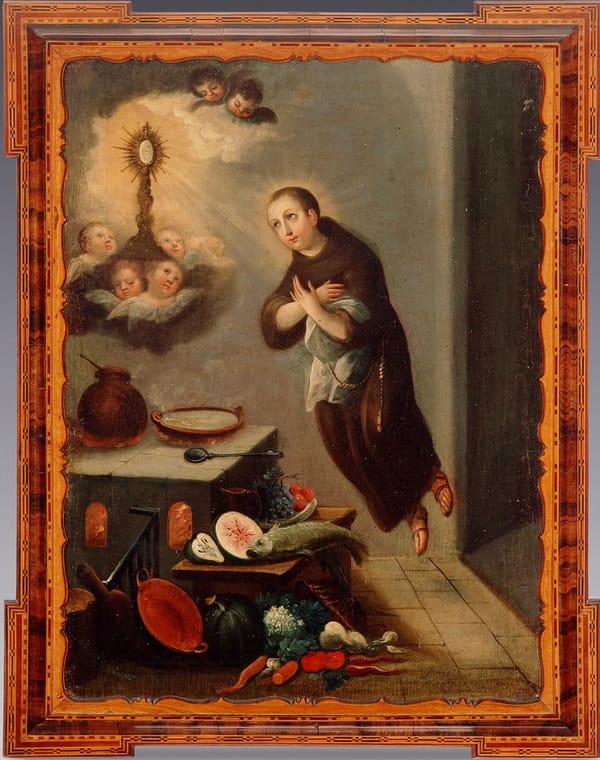 |
THE Seraph of Assisi was sure to depute some of his children to pay their court to his Risen Master. The one he sends to-day is the humblest and most obscure of men; another will follow, three days hence, powerful in word and work, and holding a palm in his hands, as a most devoted preacher of the Gospel. Paschal Baylon was a simple peasant. He was a shepherd-boy; and it was in tending his flock that he found the Lord Jesus. He had a great love for contemplation. Forests and fields spoke to him of their great Creator; and, in order that he might be the more closely united with him, he resolved to seek him in the highest paths of perfection. He was ambitious to imitate the humble, poor and suffering life of the Man-God; the Franciscan Cloister offered him the opportunity of satisfying this desire and he flew to it. On that blessed soil, he grew to be one of heaven's choicest plants, and the whole earth has now heard the name of the humble lay-brother of a little convent in Spain. Holy Church brings him before us to-day enraptured in the contemplation of Jesus' Resurrection. He had trod the path of humiliation and the cross; it was but just that he should share in his Master's triumph. It was of him, and of such as he, that this divine Saviour spoke, when he said: Ye are they that have continued with me in my temptations; and I dispose to you, as my Father hath disposed to me, a kingdom; that ye may eat and drink at my table in my kingdom, and may sit upon thrones, judging the twelve tribes of Israel.1
The account given by the Liturgy of the angelic life of this illustrious son of St Francis is as follows:
Heaven opened to receive thee, O Paschal! Even when here below, the fervour of thy contemplation often gave thee a foretaste of the delights of eternal bliss; but now every veil is drawn aside, and thou art face to face with him whom thou didst so ardently desire to possess. Thou hast no further need to unite thyself with him by humiliation and suffering; thou enjoyest his own glory, his own happiness, his own triumph, and he will have thee enjoy it for all eternity. Deign to cast an eye of pity on us, who have not thy eagerness to walk in our Redeemer’s footsteps, and who, as yet, have but the hope of being united to him for eternity. Gain for us courage. Gain for us that love which leads straight to Jesus, which surmounts every obstacle of flesh and blood, and gives to man an admirable resemblance to his divine Model. The pledge of this happy transformation has been given to us by our being permitted to partake of the Paschal Mystery; may it be perfected by our fidelity in keeping close to our divine conqueror and Lord! Though he leave us some time further in this vale of tears, his eye is ever upon us, he longs to see us persevere in our loyalty to him. Yet a little while, and we shall see him! Behold! says he, I come quickly; hold fast that which thou hast. Behold! I stand at the gate and knock. If any man shall hear my voice, and open to me the door, I will come in to him, and will sup with him, and he with me.2 Thus will the Pasch of time be changed into the Pasch of eternity. Pray for us, O Paschal, that like thee, we may hold fast that which, by the grace of our Risen Jesus, we already possess.
| Previous May 16 (the Same Day): St. John Nepomucen, Martyr | Next May 17: St. Paschal Baylon, Confessor |