Daily reading
Semidouble · Movable from Easter · Temporal
May 20, 2026
From Dom Guéranger’s The Liturgical Year.
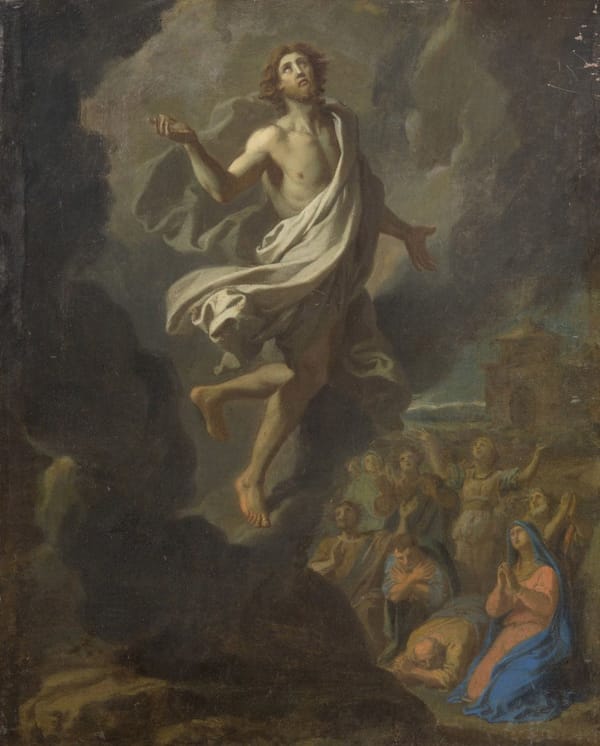
Wednesday within the Octave of the Ascension
Let us now look upon the earth, for our eyes have hitherto been riveted upon the heaven into which our Jesus has entered. Let us see what effects the mystery of the Ascension has produced on this land of our exile. These effects are of the most extraordinary nature. This Jesus, who ascended into heaven unknown to the city of Jerusalem, and whose departure, when it did become known, excited neither regret nor joy among the men of that generation,—now, eighteen hundred years after His departure from us, finds the whole earth celebrating the anniversary of His glorious Ascension. Our age is far from being one of earnest faith; and yet there is not a single country on the face of the globe, where, if there be a church or chapel or even a Catholic home, the feast of Jesus’ Ascension is not being now kept and loved.
He lived for three-and-thirty years on our earth. He, the eternal Son of our God, dwelt among His creatures, and there was only one people that knew it. That one favoured people crucified Him. As to the Gentiles, they would have thought Him beneath their notice. True, this beautiful’light shone in the darkness; but the darkness did not comprehend it; He came unto His own, and His own received Him not.’1 He preached to His chosen people; but His word was that seed which falls on stony ground, and takes no root, or is cast among thorns and is choked; it could with difficulty find a plot of good ground, wherein to bring forth fruit.2 If, thanks to His infinite patience and goodness, He succeeded in keeping a few disciples around Him, their faith was weak and hesitating, and gave way when temptation came.
And yet, ever since the preaching of these same apostles, the name and glory of Jesus are every where; in every language, and in every clime, He is proclaimed the Incarnate Son of God; the most civilized, as well as the most barbarous nations, have submitted to His sweet yoke; in every part of the universe men celebrate His birth in the stable of Bethlehem, His death on the cross whereby He ransomed a guilty world, His resurrection whereby He strengthened the work He came to do, and His Ascension, which gives Him, the Man-God, to sit at the right hand of His Father. The great voice of the Church carries to the uttermost bounds of the earth the mystery of the blessed Trinity, which He came to reveal to mankind. This holy Church, founded by Him, teaches the truths of faith to all nations, and in every nation there are souls who are docile to her teaching.
How was this marvellous change brought about? What has given it stability during these eighteen hundred years? Our Saviour Himself explains it to us, by the words He spoke to His apostles after the last Supper: ‘It is,’ said He,’expedient to you that I go.’3 What means this, but that there is something more advantageous to us than having Him visibly present amongst us? This mortal life is not the time for seeing and contemplating Him, even in His human Nature. To know Him, and relish Him, even in His human Nature, we stand in need of a special gift; it is faith. Now, faith in the mysteries of the Incarnate Word did not begin its reign upon the earth, until He ceased to be visible here below.
Who could tell the triumphant power of faith? St. John gives it a glorious name; he says:’It is the victory which overcometh the world.’4 It subdued the world to our absent King; it subdued the power and pride and superstitions of paganism; it won the homage of the earth for Him who has ascended into heaven, the Son of God and the Son of Mary, Jesus.
St. Leo the Great, the sublime theologian of the mystery of the Incarnation, has treated this point with his characteristic authority and eloquence. Let us listen to his glorious teaching.’Having fulfilled all the mysteries pertaining to the preaching of the Gospel and to the new Covenant, our Lord Jesus Christ ascended into heaven, in the sight of His disciples, on the fortieth day after His Resurrection; hereby withdrawing His corporal presence, for He was to remain at the right hand of His Father until should be filled up the measure of time decreed by God for the multiplication of the children of the Church, and He (Jesus) should again come, and in the same Flesh wherewith He ascended, to judge the living and the dead. Thus, therefore, that which in our Redeemer had hitherto been visible passed into the order of mysteries. And to the end that faith might be grander and surer, teaching took the place of sight; which teaching was to be accepted by the faithful with hearts illumined by heavenly light.
This faith, increased by our Lord’s Ascension, and strengthened by the gift of the Holy Ghost, was proof against every trial; so that neither chains, nor prisons, nor banishment, nor hunger, nor fire, nor wild beasts, nor all the ingenuity of cruelty and persecution, could affright it. For this faith, not only men, but even women, not only beardless boys but even tender maidens, fought unto the shedding of their blood, and this in every country of the world. This faith cast out devils from such as were possessed, cured the sick, and raised the dead to life. The blessed apostles themselves,—who, though they had so often witnessed their Master’s miracles and heard His teachings, turned cowards when they saw Him in His sufferings, and hesitated to believe His Resurrection,—these same, I say, were so changed by His Ascension, that what heretofore had been a subject of fear, then became a subject of joy. And why? Because the whole energy of the soul’s contemplation was raised up to Jesus’ Divinity, now seated at the right hand of His Father; the vigour of the mind’s eye was not dulled by the bodily vision, and they came to the clear view of the mystery, namely, that He neither left the, Father when He descended upon the earth, nor left His disciples when He ascended into heaven.
Never, then, was Jesus so well known, as when He withdrew Himself into the glory of His Father’s majesty, and became more present by His Divinity in proportion as He was distant in His Humanity. Then did faith, made keener, approach to the Son coequal with His Father; she needed not the handling of the bodily substance of her Christ,—that bodily substance, whereby He is less than His Father, The substance of His glorified Body is the same; but our faith was to be of so generous a kind, that we were to go to the coequal Son, not by a corporal feeling, but by a spiritual understanding. Hence, when Mary Magdalene, who represented the Church, threw herself at the feet of the risen Jesus, and would have embraced them, He said to her: Touch Me not, for I am not yet ascended to My Father; as though He would say: I will not that thou come to Me corporally, or that thou know Me by the testimony of thy senses. I have a sublimer recognition in store for thee; I have prepared something far better for thee. When I shall have ascended to My Father, then shalt thou feel Me in a higher and truer way; for thou shalt grasp what thou touchest not, and believe what thou seest not.’5
The departure of our Emmanuel was, therefore, the opening of that reign of faith, which is to prepare us for the eternal vision of the sovereign Good; and this blessed faith, which is our very life, gives us, at the same time, all the light compatible with our mortal existence, for knowing and loving the Word consubstantial with the Father, and for the just appreciation of the mysteries which this Incarnate Word wrought here below in His Humanity. It is now eighteen hundred years since He lived on the earth; and yet we know Him better than His disciples did before His Ascension. Oh! truly it was expedient for us that He should go from us; His visible presence would have checked the generosity of our faith; and it is our faith alone that can bridge over the space which is to be between Himself and us until our ascension comes, and then we shall enter within the veil.
How strangely blind are those who see not the superhuman power of this element of faith, which has not only conquered, but even transformed, the world! Some of them have written long treatises to prove that the Gospels were not written by the evangelists: we pity their ravings. But these great discoverers have another difficulty to get over, and so far they have not attempted to grapple with it; we mean the living Gospel which is the production of the unanimous faith of eighteen centuries, and is the result of the courageous confession of so many millions of martyrs, of the holiness of countless men and women, of the conversion of so many both civilized and uncivilized nations. Assuredly He,—who after having spent a few short years in one little spot of earth, had but to disappear in order to draw men’s hearts to Himself so that the brightest intellects and the purest minds gave Him their faith,—must be what He tells us He is: the eternal Son of God. Glory, then, and thanks to Thee O Jesus! who to console us in Thine absence, hast given us faith, whereby the eye of our soul is purified, the hope of our heart is strengthened, and the divine realities we possess tell upon us in all their power! Preserve within us this precious gift of Thy gratuitous goodness; give it increase; and when our death comes,—that solemn hour which precedes our seeing Thee face to face,—Oh, give us the grand fullness of our dearest faith!
One of the most northern of the Churches, now, alas! a slave to Lutheranism, shall provide us to-day with a hymn in honour of the mystery we are celebrating. It is a sequence taken from the last missal of Abo, in Finland. It was composed in the fourteenth or fifteenth century.
Sequence
Festos choros ducite,
Christo triumphante;
Redit cum victoria,
Capta ducens spolia,
Tuba jubilante.
Hodie dominicum
Germen gloriatur!
Terrae fructus hodie
Super thronos curiæ
Cœli sublimatur.
Moyses, et populum
Trahit ad spectaculum
Stant suspensis vultibus,
Intendentes nubibus
Jesum subducentibus,
Viri Galilaei.
Elisaeo duplex datur
Spiritus et pallium:
Alta Christus dum conscendit,
Servis suis mnas appendit
Gratiarum omnium.
Luctum gerens non inanem,
Crucis usus baculo;
Redit turmis cum duabus,
Angelis et animabus,
Et thesauri sacculo.
Qui de mortis
Victor portis
Introit cum gloria;
Rex virtutum,
Cujus nutum
Et obtutum
Trina tremit regia.
Ad consessus solium,
Donec suppedaneos,
Victos vel spontaneos,
Ponat inimicos.
Fruitur potissimis;
Redit ex novissimis,
Judicans ex intimis
Justos et iniquos.
Veni cum clementia:
Dum sistemur ante thronum
Tua in præsentia:
Fac misericordiam;
In perennem transfer vitam
Ad futuram gloriam.
and sing your festive songs,
for it is the triumph of Christ!
He returns to heaven, leading thither
the trophies he has won; and as he ascends,
the jubilant sound of the trumpet is heard.
that is this day conferred on the Son of God!
The fruit of our earth
is this day exalted
above all the thrones
of the heavenly court.
and people flock to see
the grandeur of the mystery:
stand looking up
to the cloud
that received him
out of their sight.
he gave his twofold
spirit and his mantle to Eliseus:
when Jesus ascended into heaven,
he gave to his servants
the talents of his grace.
enduring sufferings of wondrous avail to us,
and the staff he used was the cross.
He returned to heaven with two troops,
—of angels, and of souls (set free from limbo),
—and laden with treasures.
who, having conquered
the gates of death,
entered heaven with glory.
He is the King of hosts,
at whose bidding
and presence
the triple creation trembles.
to sit with him on his throne,
until he make his enemies
bow down before him,
vanquished by force or love.
he receives supreme honour;
he is to come again upon our earth
to judge the consciences of all,
saints and sinners.
come in thy mercy,
when we are to appear
before thee seated on thy throne.
and give us to ascend
to the endless life
of future glory.
Again the Mozarabic breviary offers us one of its beautiful prayers for this octave.
Prayer
May 20: St. Bernardine of Siena, Confessor
|
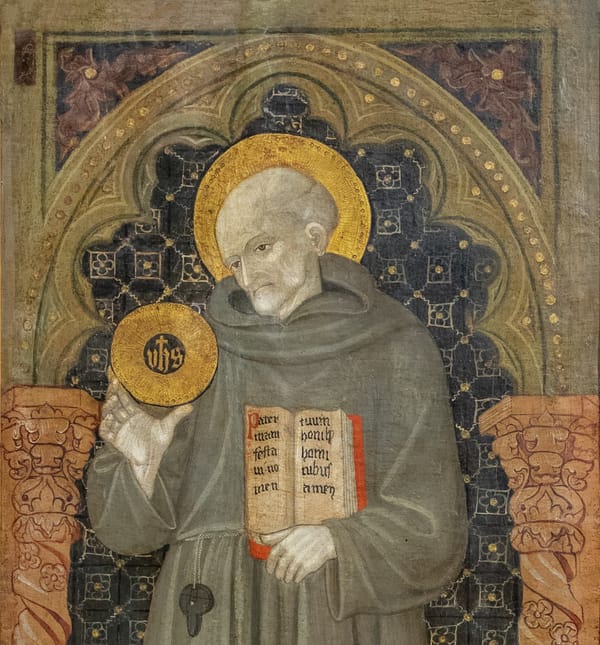
IN that season of the liturgical year when we were kneeling in love and prayer around the crib of the Infant Jesus, one day was devoted to the celebration of the glory and sweetness of his Name. Holy Church was full of joy when she pronounced the dear Name chosen from all eternity by her heavenly Spouse; and mankind found consolation in the thought that the great God who might so justly have bid us call him the Just and the Avenger, willed us henceforth to call him the Saviour. The devout Bemardine of Siena, whose feast we keep to-day, stood then before us, holding in his hands this ever blessed Name, surrounded with rays. He urged the whole earth to venerate with love and confidence the sacred name which expresses the whole economy of our salvation. The Church, ever attentive to what is for the good of her children, adopted the beautiful device. She encouraged them to receive it from the Saint, as a shield that would protect them against the darts of the evil spirit, and as an additional means of reminding ourselves of the exceeding charity wherewith God has loved this world of ours. And finally, when the loveliness of the holy Name of Jesus had won all Christian hearts, she instituted in its honour one of the most beautiful solemnities of Christmastide.
Bemardine, the worthy son of St Francis of Assisi, returns to us on this twentieth day of May, and the sweet flower of the holy Name is, of course, in his hand. But it is not now the prophetic appellation of the newborn Babe; it is not the endearing Name, respectfully and lovingly whispered by the Virgin-Mother over the crib; it is the Name whose sound has gone through the whole creation, it is the trophy of the grandest of victories, it is the fulfilment of all that was prophesied. The Name of Jesus was a promise to mankind of a Saviour; Jesus has saved mankind, by dying and rising again; he is now Jesus in the full sense of the word. Go where you will, and you hear this Name—the Name that has united men into the one great family of the Church.
The chief priests of the Synagogue strove to stifle the Name of Jesus, for it was even then winning men’s hearts. They forbade the Apostles to teach in this Name; and it was on this occasion that Peter uttered the words which embody the whole energy of the Church: We ought to obey God rather than men.1 The Synagogue might as well have tried to stay the course of the sun. So too, when the mighty power of the Roman Empire set itself against the triumphant progress of this Name, and would annul the decree that every knee should bow at its sound,2 its attempt was a complete failure, and at the end of three centuries the Name of Jesus was heard and loved in every city and hamlet of the Empire.
Armed with this sacred motto, Bernardine traversed the towns of Italy, which at that period (the fifteenth century) were at enmity with each other, and not unfrequently torn with domestic strifes. The Name of Jesus, which he carried in his hand, became as a rainbow of reconciliation; and wheresoever he set it up, there every knee bowed down, every vindictive heart was appeased, and sinners hastened to the sacrament of pardon. The three letters (I H S) which represent this Name, became familiar to the faithful; they were everywhere to be seen carved, or engraven, or painted; and the Catholic world thus gained a new form whereby to express its adoration and love of its Saviour.
Bernardine was a preacher of inspired eloquence. He was also a distinguished master in the science of sacred things, as is proved by the writings he has left us. We regret not being able, from want of space, to give our readers his words on the greatness of the Paschal mystery; but we cannot withhold from them what he says regarding the apparition of Jesus to his Blessed Mother after the Resurrection. They will be rejoiced at finding unity of doctrine on this interesting subject existing between the Franciscan school, represented by St Bemardine, and the school of St Dominic, whose testimony we have already given on the Feast of St Vincent Ferrer.
'From the fact of there being no mention made in the Gospel of the visit wherewith Christ consoled his Mother after his Resurrection, we are not to conclude that this most merciful Jesus, the source of all grace and consolation, who was so anxious to gladden his disciples by his presence, forgot his Mother, who he knew had drunk so deeply of the bitterness of his Passion. But it has pleased divine Providence that the Gospel should be silent on this subject; and this for three reasons.
‘In the first place, because of the firmness of Mary's faith. The confidence which the Virgin-Mother had of her Son's rising again had never faltered, not even by the slightest doubt. This we can readily believe, if we reflect on the special grace wherewith she was filled, she the Mother of the Man-God, the Queen of angels, and the Mistress of the world. To a truly enlightened mind, the silence of the Scripture on this subject says more than any affirmation could have done. We have learned to know something of Mary by the visit she received from the angel, when the Holy Ghost overshadowed her. We met her again at the foot of the Cross, where she, the Mother of Sorrows, stood nigh her dying Son. If then the Apostle could say: As ye are partakers of the sufferings, so shall ye he also of the consolation:3 what share must not the Virgin-Mother have had in the joys of the Resurrection? We should hold it as a certain truth that her most sweet Jesus, after his Resurrection, consoled her first of all. The holy Roman Church would seem to express this, by celebrating at Saint Mary Major's the Station of Easter Sunday. Moreover, if from the silence of the Evan-gelists you would conclude that our Risen Lord did not appear to her first, you must go farther, and say that he did not appear to her at all, inasmuch as these same Evangelists, when relating the several apparitions, do not mention a single one as made to her. Now, such a conclusion as this would savour of impiety.
'In the second place, the silence of the Gospel is explained by the incredulity of men. The object of the Holy Spirit, when dictating the Gospels, was to describe such apparitions as would remove all doubt from carnalminded men with regard to the Resurrection of Christ. The fact of Mary's being his Mother would have weakened her testimony, at least in their eyes. For this reason she was not brought forward as a witness, though most assuredly there never was or will be any creature (the humanity of her Son alone excepted) whose assertion better deserved the confidence of every truly pious soul. But the text of the Gospel was not to adduce any testimonies, save such as might be offered to the whole world. As to Jesus' apparition to his Mother, the Holy Ghost has left it to be believed by those that are enlightened by his light.
'In the third place, this silence is explained by the sublime nature of the apparition itself. The Gospel says nothing regarding the Mother of Christ after the Resurrection; and the reason is, that her interviews with her Son were so sublime and ineffable that no words could have described them. There are two sorts of visions: one is merely corporal, and feeble in proportion; the other is mainly in the soul, and is granted only to such as have been transformed. Say, if you will, that Magdalen was the first to have the merely corporal vision, provided that you admit that the Blessed Virgin saw, previously to Magdalen, and in a far sublimer way, her Risen Jesus, that she recognized him, and enjoyed his sweet embraces in her soul, more even than in her body.'4
Let us now read the Life of our Saint, as given, though too briefly, in the Lessons of to-day's Office:
How beautiful, O Bernardine, are the rays that form the aureole round the Name of Jesus! How soft their light on that eighth day after his birth, when he received this Name! But how dazzling, now that this Jesus achieves our salvation, not only by humiliation and suffering, but by the triumph of his Resurrection! Thou comest to us, O Bernardine, in the midst of the Paschal glory of the Name of Jesus. This Name, for which thou didst so lovingly and zealously labour, gives thee to share in its immortal victory. Now therefore, pour forth upon us, even more abundantly than when thou wast here on earth, the treasures of love, admiration and hope, of which this divine Name is the source, and cleanse the eyes of our soul, that we may one day be enabled to join thee in contemplating its beauty and magnificence.
Apostle of peace! Italy, whose factions were so often quelled by thee, may well number thee among her protectors. Behold her now a prey to the enemies of Jesus, rebellious against the Church of God, and abandoned to her fate. Oh! forget not that she is thy native land, that she was obedient to thy preaching, and that thy memory was long most dear to her. Intercede in her favour; deliver her from her oppressors; and show that when earthly armies fail, the host of heaven can always save both cities and countries.
Illustrious son of the great patriarch of Assisi! the seraphic Order venerates thee as one of its main supports. Thou didst reanimate it to its primitive observance; continue now from heaven to protect the work thou didst commence here on earth. The Order of St Francis is one of the grandest consolations of holy Mother Church; make this Order for ever flourish, protect it in its trials, give it increase in proportion to the necessities of the faithful; for thou art the second Father of this venerable family, and thy prayers are powerful with the Redeemer, whose glorious Name thou didst confess upon earth.
| Previous May 19 (the Same Day): St. Pudentiana, Virgin | Next May 20: St. Bernardine of Siena, Confessor |