Daily reading
Paschal Time
Double of the I Class · Movable from Easter · Temporal
May 26, 2026
From Dom Guéranger’s The Liturgical Year.

|
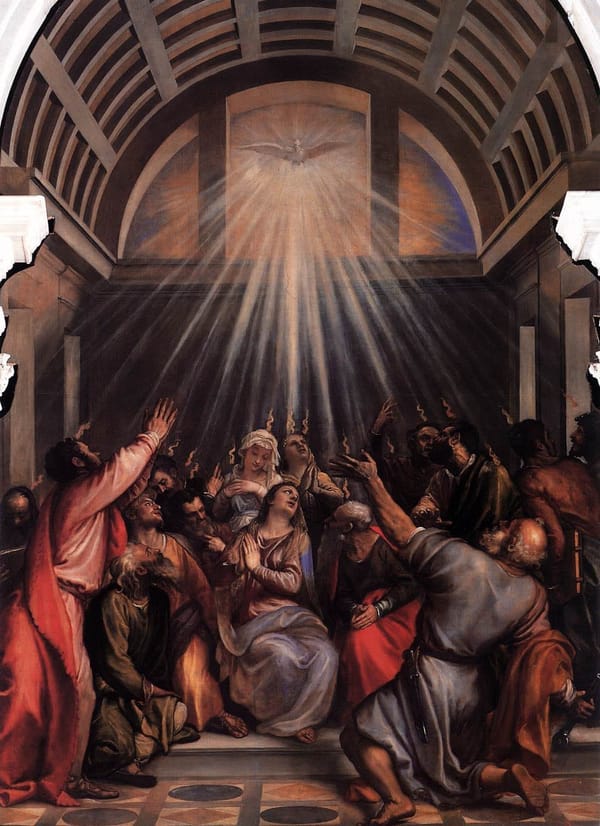
Tuesday in Whitsun Week
Yesterday, we were admiring the work of the Holy Ghost, whereby He drew mankind to the faith and the name of Jesus, to whom ‘all power was given in heaven and in earth.’1 The instruments used for this conquest were the apostles and their immediate successors. The tongue of fire was victorious, and the prince of this world was defeated, Let us continue our reflections, and see the further workings of the holy Spirit for the glory of the Son of God, who had sent Him into this world.
Our Emmanuel came down from heaven, that He might effect the union He had desired from all eternity. He began it by uniting our human nature to His own divine Person; but this personal union did not satisfy His love. He mercifully deigned to invite the whole human race to a spiritual union with Himself, by giving her to become His Church, His own dearest one,2 as He calls her; His ‘glorious Church, not having spot or wrinkle, but holy and without blemish.’3 But how could mankind, deformed as it was by sin, be worthy of such an honour? His love would make it worthy. He tells us that this Church is His bride.4 Having chosen her, He beautified her in the laver of His own precious Blood, and gave her, in dowry, the infinite merits He had acquired.
Thus prepared, her union with Him was to be of the closest. Jesus and His Church are one body; He is the Head, she is the aggregate of the members united together under this one Head. Such is the teaching of the apostle: ‘Christ is the Head of the Church; we are members of His body, of His flesh, and of His bones’.5 This body is to be formed of all who shall, in each successive age, be faithful to the call of divine grace, and enroll themselves as children of the Church. The world we inhabit is to be preserved, till the last elect required to complete the mystic body of Jesus, be added to the Church triumphant: then all will be consummated; the divine mystery of the Incarnation will have achieved its whole work.
But as in the Incarnate Word there was the invisible Soul and the visible Body, so also the Church was to have a soul and a body: a soul, whose hidden beauty no eye but God’s can fully see, at least during her earthly sojourn; and a body, which is to be visible to men: an ever-living proof of God’s power, and of His love for the human race. Up to the day of Pentecost, the just, who had been united under Jesus, their Head, had belonged only to the soul of the Church, for the body was not then in existence. The heavenly Father had adopted them as His children; the Son of God had accepted them as His members; and the Holy Ghost, who is now about to work exteriorly, had interiorly wrought their election and sanctification. The new order of things is to begin in Mary’s person. As we have already explained, the Church in its entirety, that is both soul and body, resided first in her. It was but fitting that she who was as truly the Mother of the Son of God, according to His human Nature, as the heavenly Father was His Father according to the divine Nature, should be superior to all other members of the Church, and this not only in the high degree of grace, but also in the precedence of time.
When our Saviour gave His Church an existence outside the loved sanctuary of His Mother’s heart, He, with His own hands, set the foundation stone, Peter, the rock; He raised up the pillars, and we have seen how He spent the forty days before His Ascension in organizing this Church, which was then so small, but which was afterwards to cover the whole earth. He told His apostles that He would be with them all days even to the consummation of the world;6 it was the same as telling them that, even after His Ascension into heaven, His Church was to continue on earth, even to the end of time.
He left the plan, thus begun by Himself, to be perfected by the Holy Ghost. It was necessary that this holy Spirit should come down from heaven, in order to strengthen those whom Jesus had chosen as His apostles. He was to be their Paraclete; their comforter, in the absence of their Master; He was to be the power from on high, who was to serve them as armour in their future combats; He was to remind them of all the words spoken to them by Christ; He was to give fruitfulness, by His own action, to the Sacraments, which Jesus had instituted, and over which the apostles had power because of the character impressed upon them by this holy Spirit. It is on this account that Jesus said to His apostles: ‘It is expedient to you that I go; for if I go not, the Paraclete will not come to you’.7 We have seen this divine Spirit, on the day of Pentecost, producing His effects on the apostles and disciples; let us now see His action in the creation, maintenance, and perfecting of this Church, which Jesus has promised to assist, by His mysterious presence, even to the consummation of the world.
The first operation of the Holy Ghost in the Church is the election of its members. This right of election is so especially Hisprerogative, that, as we learn from the Scriptures, it was by the Holy Ghost8 that Jesus chose the apostles, who were to be the pillars of His Church. We have seen how this holy Spirit began His mission on the day of Pentecost, by the election of three thousand Jews. A few days after, five thousand were added to the number, being converted by the preaching of Peter and John.9 The Gentiles, also, were called to the Church; and the Holy Ghost, having led Peter to Cornelius the centurion, descended upon this Roman and his household, thus declaring them to be elected as candidates for holy Baptism. The liturgy put this history before us, in the Mass of yesterday.
We seem able to keep pace with these first workings of the holy Spirit; but the sequel is all impetuosity, divine rapidity of action, irresistible conquest. He sends forth His messengers: their sound goeth forth into all the earth, and their words unto the ends of the world.10 He goes before them; He goes with them; He works the victory, while they speak. We come to the commencement of the third century, and we find a Christian writer addressing the magistrates of the Roman empire in these words: ‘We are but of yesterday, and we abound everywhere; in your cities, in your towns, in your camps; in the palace, the senate, the forum.’11 Nothing can withstand the Spirit of God; and in less than three hundred years from the day of His first manifestation, He calls the very emperors of Rome to be members of the Church.
Thus does the bride of Jesus advance in her beauty and strength; He looks upon her from His throne in heaven, and tenderly loves her. In the early part of the fourth century, she exceeds the limits of the Roman empire. Here and there, within this vast empire, there are men who still cling to paganism; but they all know what the Church is, and the very hatred they bear her is a proof that they are aware of her progress.
But let us not suppose that the mission of the Holy Ghost is limited to founding the Church on the ruins of the great pagan empire. No; the bride of Jesus is to be immortal; she is to exist in every place and age; she is to be superior, both by the extent of her dominions and the number of her subjects, to every other human power.
The divine Spirit could not, therefore, suspend His mission. The Roman empire has merited, by her crimes, to be swept away by the inundation of barbarous nations: it is the preparation of a new triumph for the Spirit. He comes and works, invisibly and silently, amidst this huge mass: He has His elect there, and by millions. He has renewed the face of the pagan world; He renews the face of the World, now that the barbarians rule it. He chooses His co-operators, and right faithful are they. He creates new apostles, and He selects them from all classes, for He is Master to do as He wills. Queens such as Clotilda, Bertha, Theodolind, or Hedwiges, are ready to do His biddings; they deck the bride of Jesus with their royal hands, and she comes forth to the world once more, younger and lovelier than ever.
There are, indeed, immense tracts of country in Europe not yet in the Church; it was necessary first to give stability to the work in those that had pre viously been Christian, and had been well-nigh submerged beneath the deluge of invasion. But, at the close of the sixth century, the holy Spirit visits Britain, Germany, Scandinavia and Sclavonia; He sends them apostles, such as Augustine, Boniface, Anscharius, Adalbert, Cyril, Methodius, Otho. By the labours of missioners like these, the bride is compensated for the losses she has sustained in the east, where schism and heresy have encroached upon her primitive inheritance. That holy Spirit, who is God together with the Father and the Son, and has been sent by Them to defend the honour of the bride, is ever faithful to His trust.
Thus, when the so-called Reformation was preparing for Europe the great apostasy of the sixteenth century, the Paraclete was extending the glories of the Church in other continents. The East Indies became the conquest of the most faithful nation; and, in the west, a new world was discovered by and made subject to the Catholic kingdom. The divine Spirit, who is ever jealous to maintain the honour and entirety of the deposit entrusted to Him by the Incarnate Word, then raised up new apostles to go and carry the name of Jesus to these immense tracts of country, which were to be added to the kingdom of His bride. St. Francis Xavier was sent to the East Indies; his brethren, together with the sons of St. Dominio and St. Francis of Assisi, laboured most perseveringly in preaching the Gospel to the people of the West Indies.
If, later on again, our Europe be misled by false theories and break with the Church; if this beloved bride of Jesus be betrayed and pillaged, calumniated and deprived of her rights, by those very nations which she had protected for so many ages, as the most loving of mothers—fear not; the Holy Ghost will add to her glories in some other way. Look at His present workings in the Church. Whence, if not from Him, are those ever increasing vocations to the apostolic ministry? Moreover, whilst conversions from heresy are more numerous than at any previous period, there is not an infidel country where the Gospel is not being preached. Our century has had its martyrs for the faith; it has heard the authorities of China and Cochin China, like the proconsuls of old, putting the Christians through an examination; it has heard the sublime answers, suggested by the Holy Ghost to these brave confessors, as Christ had promised.12 The farthest east produces its elect; the negroes of Africa are evangelized; and the most recently discovered portion of the world already counts its faithful by thousands, flourishing under a hierarchy of lawfully appointed pastors.
Be Thou blessed, then, O holy Spirit! who thus watchest over the dear bride of Jesus! Thanks to Thy ceaseless and untiring action, she has never once failed. In every age, Thou hast raised up apostles to enrich her by their conquests: Thy grace has been uninterruptedly inviting men to give themselves to her; in every nation and period, Thou Thyself hast chosen the members of her happy and countless family. She is our mother and we are her children; she is the bride of our divine Master, to whom we hope to be united through her: so that, by working for the glory of the Son of God who sent Thee, O holy Spirit! Thou hast deigned to work for us poor sinful creatures. We offer Thee our feeble tribute of thanks for all these Thy benefits to us.
Our Emmanuel has revealed to us that Thou art to abide with us to the end of the world; and we now understand how necessary is Thy presence. It is Thou that presidest over the formation of the bride; that maintainest her; that renderest her victorious over her enemies; that carriest her from one country to another, when a people becomes unworthy to possess her; that avengest her when she is insulted; and all this Thou wilt continue to do to the end of time.
But this noble bride of our God is not to remain for ever an exile from her Lord. As Mary was left for several years upon the earth, in order that she might labour for the glory of her Son, and was then taken up to heaven, there to reign eternally with Him; so likewise the Church is to remain militant here below as long as God sees her to be needed for completing the number of His elect. But the time will come of which it is written: ‘The marriage of the Lamb is come, and His wife hath prepared herself. And it is granted to her that she should clothe herself with fine linen glittering and white; for the fine linen are the justifications of the saints.’13 that is, the virtues of the saints she has formed. In those days, the bride ever comely and worthy of her Jesus, will grow no more, nay, she will decrease on earth in proportion as her triumphant glory is perfect in heaven. The revolt, spoken of by St. Paul,14 will show itself; men will abandon her, side with the prince of this world, who is to be let loose for a little while,15 and serve the beast, to whom it shall be given to make war with the saints, yea, and to overcome them.16 The bride herself will not be degenerate, during these her last days on earth, for Thou O holy Spirit! wilt still be with her, supporting her. But as soon as the last of the elect shall have been born, the Spirit and the bride will say ‘Come!’17 Then will Jesus appear upon the clouds of heaven; the mission of the Spirit will be accomplished; and the bride leaning upon her Beloved,18 will ascend from this ungrateful barren earth to heaven, where the eternal nuptials with the Lamb await her.
Mass
The station for to-day is in the church of Saint Anastasia, where we assisted at the Mass of the Aurora on the birthday of our Emmanuel. We revisit it now that we have celebrated all the grand mysteries of our Redemption. Let us bless our God for having so magnificently completed what He began so humbly and so sweetly. The neophytes, clothed in their white garments, are present, bearing testimony both to the love of the Son of God who has cleansed them by His Blood, and to the power of the Holy Ghost who has rescued them from the tyranny of satan, the prince of this world.
The Introit is addressed to the neophytes, inviting them to appreciate the glory they have received, and to give thanks to the God who has called them to a heavenly kingdom. The words of this Introit, which has been used almost from the very commencement of the Church, are taken from the fourth Book of Esdras, which, although not received by the Church as part of the sacred Scriptures, was frequently read by the early Christians on account of the admirable instructions it contains.
Introit
Ps. Attendite, popule meus, legem meam: inclinate aurem vestram in verba oris mei. ℣. Gloria Patri. Accipite.
Ps. Attend, O my people, to my law: incline your ears to the words of my mouth. ℣. Glory, &c. Receive, &c.
In the Collect, the Church teaches us that the action of the Holy Ghost in our souls is one of mercy and power combined. This divine action purifies our souls from all their stains, and defends them from the attacks of the crafty and jealous enemy, who is ever lying in wait for us.
Collect
Epistle
Cap. viii.In diebus illis: Quum au- dissent apostoli, qui erant Jerosolymis, quod recepisset Samaria verbum Dei, miserunt ad eos Petrum et Joannem, qui quum venissent, oraverunt pro ipsis ut acciperent Spiritum sanctum; nondum enim in quemquam illorum venerat, sed baptizati tantum erant in nomine Domini Jesu. Tunc imponebant manus super illos, et accipiebant Spiritum sanctum.
Ch. viii.In those days: When the apostles, who were in Jerusalem, had heard that Samaria had received the word of God, they sent unto them Peter and John. Who when they were come, prayed for them, that they might receive the Holy Ghost. For he was not as yet come upon any of them; but they were only baptized in the name of the Lord Jesus. Then they laid their hands upon them, and they received the Holy Ghost.
The inhabitants of Samaria had received the word of God through the preaching of Philip the deacon. They had received, at his hands, the Sacrament of Baptism, which made them Christians. This reminds us of the dialogue between Jesus and the woman at Jacob’s well, and of the three days that He spent in the city. Their faith is rewarded: Baptism has made them children of God and members of Christ their Redeemer. But they must also receive the Holy Ghost, in the Sacrament that gives perfection to the Christian character. The deacon Philip has not power to confer it upon them: Peter and John, who are invested with episcopal authority, visit them, and complete their happiness. This event makes us think of the grace bestowed on us by the Holy Ghost, when He strengthened our souls by the Sarcrament of Confirmation. Let us thank Him for this favour, which brought us into closer union with Himself, and gave us the courage needed for confessing our faith before heretics or tyrants.
Here all kneel.
Then follows the Sequence, Veni, sancte Spiritus; page 305.
Gospel
Cap. x.In illo tempore: Dixit Jesus Pharisæis: Amen, amen dico vobis, qui non intrat per ostium in ovile ovium, sed ascendit aliunde, ille fur est, et latro. Qui autem intrat per ostium, pastor est ovium. Huic ostiarius aperit, et oves vocem ejus audiunt, et proprias oves vocat nominatim, et educit eas. Et quum proprias oves emiserit, ante eas vadit: et oves illum sequuntur, quia sciunt vocem ejus. Alienum autem non sequuntur, sed fugiunt ab eo: quia non noverunt vocem alienorum. Hoc proverbium dixit eis Jesus. Illi autem non cognoverunt quid loqueretur eis. Dixit ergo eis iterum Jesus: Amen, amen dico vobis, quia ego sum ostium ovium. Omnes quotquot venerunt, fures sunt et latrones, et non audierunt eos oves. Ego sum ostium. Per me si quis introierit, salvabitur: et ingredietur, et egredietur, et pascua inveniet. Fur non venit nisi ut furetur, et mactet et perdat. Ego veni ut vitam habeant, et abundantius habeant.
Ch. x.At that time: Jesus said to the Pharisees: Amen, amen, I say to you: he that entereth not by the door into the sheepfold, but climbeth up another way, the same is a thief and a robber. But he that entereth in by the door, is the shepherd of the sheep. To him the porter openeth; and the sheep hear his voice: and he calleth his own. sheep by name, and leadeth them out. And when he hath let out his own sheep, he goeth before them: and the sheep follow him, because they know his voice. But a stranger they follow not, but fly from him, because they know not the voice of strangers. This proverb Jesus spoke to them. But they understood not what he spoke to them. Jesus therefore said to them again: Amen, amen, I say to you, I am the door of the sheep. All others, as many as have come, are thieves and robbers: and the sheep heard them not. I am the door. By me if any man enter in, he shall be saved; and he shall go in, and go out, and shall find pastures. The thief cometh not, but for to steal, and to kill, and to destroy. I am come that they may have life, and may have it more abundantly.
The Church’s motive for putting this passage of the Gospel before the neophytes of Pentecost was, to put them on their guard against a danger which might probably occur in after years. At present, they are the favoured sheep of the good Shepherd Jesus, represented by men to whom He Himself has given the charge to feed His lambs. These men have received their mission from Peter; and he who is with Peter, is with Jesus. But it has not unfrequently happened that false shepherds have got into the fold; our Saviour calls them thieves and robbers. He tells us that He Himself is the door, through which they must pass who can claim the right to feed His sheep. Every shepherd, if he would avoid the imputation of being a robber, must have received his mission from Jesus; and this mission cannot be given save by him whom Jesus has appointed to be His vicar and representative until He Himself return.
The Holy Ghost has poured forth His divine gifts upon these new Christians; but the virtues that are in them cannot be meritorious of eternal life, unless they continue to be members of the true Church. If, instead of following the lawful pastor, they were to be so unhappy as to go after false pastors, all these virtues would become barren. They should, therefore, flee, as they would from a stranger, from any guide who has not received his mission from the Master, who alone can lead them to the pastures of life. During the past centuries, schismatical pastors have risen up from time to time: the faithful were bound to shun them. We, who are living now, should take seriously to heart the admonition here given us by our Redeemer. The Church He has founded, and which He guides by His holy Spirit, is apostolic. The mission of those pastors alone is lawful who are sent by apostolic authority; and whereas Peter lives in his successors, the successor of Peter is the source whence alone can come pastoral power. He who is with Peter, is with Christ.
In the Offertory, the Church excites our devotion to the holy Sacrifice at which we are assisting, by speaking to us, in the words of the psalmist, the praises of the sacred nourishment which is to be given to us; it is a manna from heaven, it is the very Bread of the angels.
Offertory
The Victim that is about to be offered, has the power to purify, by His immolation, those who are to feed upon His sacred Flesh. The Church prays in the Secret, that it may be thus with them that are assisting at this holy sacrifice.
Secret
The Preface is given page 310.
In the Communion-anthem, the Church puts before us the words wherein Jesus told His disciples that the Holy Ghost would glorify Him. We, who have seen the workings of this holy Spirit throughout the whole earth, can testify to the most perfect fulfilment of the prophecy.
Communion
The faithful people have partaken of the sacred mysteries; and the Church comes immediately after, telling them that the Holy Ghost has actively co-operated in what has taken place. It is He that achieved the change of the bread and wine into the Body and Blood of our Redeemer; it is He also that prepared our souls for their union with the Son of God, by purifying them from their sins.
Postcommunion
Vespers
They are the same as on Sunday page 311, with the exception of the Magnificat antiphon and the Prayer.
Antiphon of the Magnificat
The Prayer is the Collect of the Mass, given above, page 368.
Again let us give ear to the Armenian Church celebrating the coming of the Holy Ghost, and that with all the dignity of sentiment and diction which characterizes its hymnarium.
Hymn (Canon tertiæ diei)
Sequence
Veri splendor auxilii,
Totius spes solatii.
Et præmium justorum:
Sublevator perditorum.
Ac omnis sanctitudinis
Ac beatitudinis Donator,
Omnis rectitudinis amator.
Omnitenens, innoxius.
Justius, carius
Quo nihil est potentius,
Quo nihil est vel melius.
Per quem ad Patrem omnium
Venitur, et ad Filium.
Dator gaudii:
Medicina vitii,
Spiritus consilii.
Et invariabilis;
Habilis, nobilis,
Et insuperabilis,
Promptus et amabilis.
Dans intellectum,
Dans et affectum,
Diligens rectum.
Vivificans Paraclitus:
Divinæ dextræ digitus.
Pietas et bonitas,
Benignitas et largitas:
Quando vult,
Et ubi vult,
Quousque vult,
Et quantum vult,
Spirat et erudit,
Replet et erigit,
Ditat et instruit.
Ad consolandum hodie
Apostolis donatur:
Et eis plenarie
Fons verae sapientiae
Per hunc administratur.
thou art our true and brightest aid,
in whom alone we hope for solace.
the reward of the just,
the resuscitator of sinners!
and holiness,
and blessing!
Lover of all righteousness.
All-governing,
and so merciful!
and strong, and spiritual!
No, nothing is so mighty, nothing so good!
by whom we come to the Father of all,
and to the Son.
giver of joy;
remedy for sin;
Spirit of counsel!
and unchangeable;
prudent, noble,
and invincible;
prompt and endearing!
‘tis thou that givest us understanding
and love,
and that lovest what is right.
the lifegiving Paraclete;
the Finger of God’s right hand!
mercy and goodness,
benignity and munificence;
and when he wills,
and where he wills,
and as long as he wills,
and as much as he wills,
inspires and teaches,
fills and exalts,
enriches and guides.
is given to the apostles,
on this day,
that he may console them.
By him is opened to them, in all its fullness,
the fount of true wisdom.
- St. Matth. xxviii. 18. ↩︎
- Cant. vi. 8. ↩︎
- Eph. v. 27. ↩︎
- St. Matth, ix. 15; xxv. 6. St. Mark, ii. 19. St. Luke, v. 34. St. John, iii. 29. ↩︎
- Eph. v. 23, 30. ↩︎
- St. Matth, xxviii. 20. ↩︎
- St. John, xvi. 7. ↩︎
- Acts, i. 2. ↩︎
- Ibid. iii. & iv. 4 ↩︎
- Ps. xviii. 5. ↩︎
- Tertullian, Apologet. xxxvii. ↩︎
- St. Matth. x. 20. ↩︎
- Apoc. xix.7, 8. ↩︎
- II Thess. ii. 3. ↩︎
- Apoc. xx. 3. ↩︎
- Ibid. xiii. 7. ↩︎
- Ibid. xxii. 17. ↩︎
- Cant. viii. 5. ↩︎
Tuesday in Whitsun Week: The Gift of Knowledge
Detached from evil by the fear of the Lord, and ennobled with holy love by the gift of godliness, the soul feels the want of knowing how she is to avoid what she must fear, and how to find what she must love. The Holy Ghost comes to her assistance, and brings her what she needs, by infusing into her the gift of knowledge. By means of this precious gift, truth is made evident to her; she knows what God asks of her and what He condemns, she knows what to seek and what to shun. Without this holy knowledge, we are in danger of going astray, because of the frequent darkness which, more or less, clouds our understanding. This darkness arises, in the first place, from our own nature, which bears upon itself the hut too visible proofs of the fall. It is added to by the false maxims and judgments of the world, which so often warp even those whose upright minds seemed to make them safe. And lastly, the action of satan, who is the prince of darkness, has this for one of its chief aims: to obscure our mind, or to mislead it by false lights.
The light of our soul is faith, which was infused into us at our Baptism. By the gift of knowledge, the Holy Ghost empowers our faith to elicit rays of light strong enough to dispel all darkness. Doubts are then cleared up, error is exposed and put to flight, truth beams upon us in all its beauty. Everything is viewed in its true light, the light of faith. We see how false are the principles which sway the world, which ruin so many souls, and of which we ourselves were once, perhaps, victims.
The gift of knowledge reveals to us the end which God had in creation, and out of which creatures can never find either happiness or rest. It teaches us what use we are to make of creatures, for they were not given us to be a hindrance, but a help whereby to reach our God. The secret of life thus possessed, we walk on in safety, we halt not, and we are resolved to shun every path which would not lead us to our end.
The apostle had this gift in view, when, speaking to the converts of Ephesus, he said: ‘Ye were heretofore darkness, but now light in the Lord: walk then as children of the light.’1 Hence comes that unhesitatingness, that confidence of the Christian life. There may be a want of experience now and then; so much so, indeed, that the little world around talks feelingly about the indiscretions and scandals which are almost sure to arise; but they forget that there is the gift of knowledge, of which the sacred Scripture thus speaks: ‘She conducted the just through the right ways, and gave him the knowledge of holy things,’ or, as some render it, ‘the science of the saints.’2 We have daily proofs of this truth: a Christian, by means of supernatural light, is found to escape every danger; he has no experience of his own, but he has the experience of God.
We give thee thanks, O holy Paraclete! for this Thy gift of light, which Thou so lovingly maintainest within us! Oh! never permit us to seek any other. It alone is sufficient; without it, there is nought but darkness. Preserve us from those sad inconsistencies, of which so many are guilty, who follow Thy guidance to-day, and the maxims of the world to-morrow; wretched double-dealing, which displeases Thee, and does not please the world! Make us love that knowledge, which Thou gavest us in order to our salvation. The enemy of our souls is jealous of our having such a gift, and is ever studying to make us exchange it for his lying principles. O divine Spirit! suffer not his treachery to triumph. Be Thou ever within us, aiding us to distinguish truth from falsity, and right from wrong. May our eye be single and simple, as our Jesus bids it be; that so our body, that is, our actions, desires, and thoughts, may be lightsome; and preserve us from that evil eye, which makes the whole body to be darkness.3
May 26: St. Philip Neri, Confessor
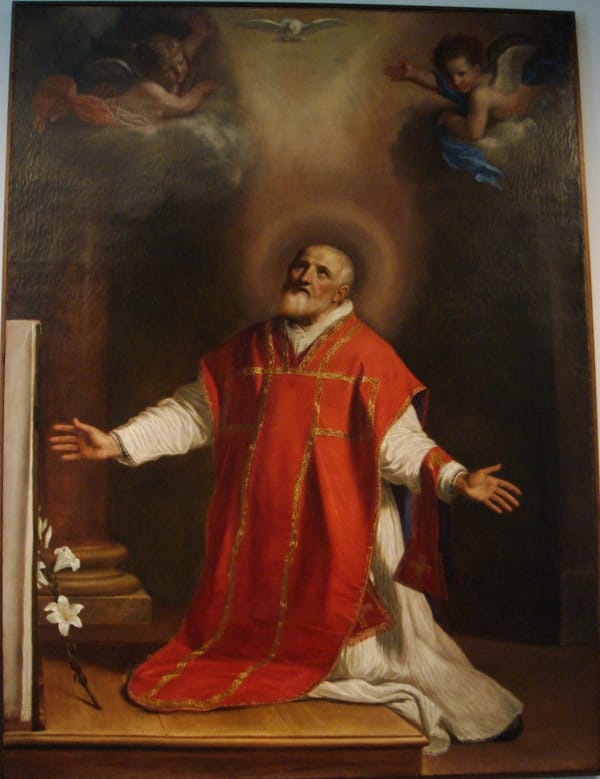 |
AS we have already said, joy is the leading feature A of the Paschal season—a supernatural joy which springs from our delight at seeing the glorious triumph of our Emmanuel, and from the happiness we feel at our own being delivered from the bonds of death. This interior joy was the characteristic of the Saint whom we honour to-day. His heart was ever full of a jubilant enthusiasm for what regards God; so that we could truly apply to him those words of Scripture: A secure mind is like a continual feast.1 One of his latest disciples, the illustrious Father Faber, tells us in his beautiful treatise, Growth in Holiness, that cheerfulness is one of the chief means for advancing in Christian perfection. We will therefore welcome with gladness and veneration the benevolent and light-hearted Philip Neri, the Apostle of Rome, and one of the greatest Saints produced by the Church in the sixteenth century.
Love of God—but a love of the most ardent kind, and one that communicated itself to all that came near him—was our Saint’s characteristic virtue. All the Saints loved God; for the love of God is the first and greatest of the commandments: but Philip’s whole life was, in an especial manner, the fulfilment of this divine precept. His entire existence seemed to be but one long transport of love for his Creator; and had it not been for a miracle of God’s power and goodness, this burning love would have soon put an end to his mortal career. He was in his twenty-ninth year, when one day—it was within the octave of Pentecost—he was seized with such a vehemence of divine charity that two of his ribs broke, thus making room for the action of the heart to respond freely to the intensity of the love of the soul. The fracture was never healed; it caused a protrusion which was distinctly observable; and, owing to this miraculous enlargement of the region of the heart, Philip was enabled to live fifty years more, during which time he loved his God with a fervour and strength which would do honour to one already in heaven.
This seraph in human flesh was a living answer to the insults heaped upon the Catholic Church by the so-called Reformation. Luther and Calvin had called this Holy Church the harlot of Babylon; and yet she had, at that very time, such children as Teresa of Spain, and Philip Neri of Rome, to offer to the admiration of mankind. But Protestantism cared little or nothing for piety or charity; its great object was the throwing off the yoke of restraint. Under pretence of religious liberty, it persecuted them that adhered to the true faith; it forced itself by violence where it could not enter by seduction; but it never aimed at or thought of leading men to love their God. The result was that wheresoever it imposed its errors, devotedness was at an end—we mean that devotedness which leads man to make sacrifices for God or for his neighbour. A very long period of time elapsed after the Reformation before Protestantism ever gave a thought to the infidels who abounded in various parts of the globe: and if, later on, it organized what it calls its missions, it chose a strange set of men to be the apostles of its Bible Societies. It has made a recent discovery; it has found out that the Catholic Church is prolific in Orders and Congregations devoted to works of charity. The discovery has excited it to emulation; and among its other imitations, it can now boast of having Protestant Sisters of Charity. To a certain point, success may encourage it to persevere in these tardy efforts; but anything like the devotedness of Catholic institutions is an impossibility for Protestantism, were it only for this reason, that its principles are opposed to the Evangelical Counsels, which are the great sources of the spirit of sacrifice, and are prompted by a motive of the love of God.
Glory, then, to Philip Neri, one of the worthiest representatives of charity in the sixteenth century! It was owing to his zeal that Rome and Christendom at large were replenished with a new life by the frequentation of the sacraments and by the exercises of Catholic piety. His word, his very look, used to excite people to devotion. His memory is still held in deep veneration, especially in Rome, where his feast is kept with the greatest solemnity on this twenty-sixth day of May. He shares with Saints Peter and Paul the honour of being patron of the Holy City. Formerly, on his feast, the Pope went, with great solemnity, to the Church of St Mary in Vallicella, and paid the debt of gratitude which the Holy See owes to the Saint who accomplished such great things for the glory of our holy Mother the Church.
Philip had the gift of miracles; and though seeking to be forgotten and despised, he was continually surrounded by people who besought him to pray for them, either in their temporal or spiritual concerns. Death itself was obedient to his command, as in the case of the young prince Paul Massimo. The young prince, when breathing his last, desired that Philip should be sent for, in order that he might assist him to die happily. The Saint was saying Mass at the time. As soon as the holy Sacrifice was over, he repaired to the palace; but he was too late; he found the father, sister and the whole family in tears. The young prince had died after an illness of sixty-five days, which he had borne with most edifying patience. Philip fell upon his knees; and, after a fervent prayer, he put his hand on the head of the corpse, and called the prince by his name. Thus awakened from the sleep of death, Paul opened his eyes, and looking at Philip, said to him: ‘My Father!’ He then added these words: ‘I only wished to go to confession.’ The assistants left the room, and Philip remained alone with the prince. After a few moments the family were called back; and in their presence, Paul began to speak to Philip regarding his mother and sister who had been taken from him by death, and whom he loved with the tenderest affection. During the conversation, the prince's face regained all it had lost by sickness. His animation was that of one in perfect health. The saint then asked him if he would wish to die again. ‘Oh! yes,’ answered the prince, ‘most willingly; for I should then see my mother and sister in heaven.’ ‘Take then’ said Philip, ‘take thy departure for heaven, and pray to the Lord for me.’ At these words, the young prince expired once more, and entered into the joys of eternal life, leaving his family to mourn his departure, and venerate a Saint such as Philip.
He was almost continually visited by our Lord with raptures and ecstasies; he was gifted with the spirit of prophecy, and could read the secrets of the conscience. His virtues were such as to draw souls to him by an irresistible charm. The youth of Rome, rich and poor, used to flock to him. Some he warned against danger; others he saved, after they had fallen. The poor and sick were the object of his unceasing care. He seemed to be everywhere in the city by his works of zeal, which gave an impulse to piety that has never been forgotten.
Philip was convinced that one of the principal means for maintaining the Christian spirit is preaching the word of God: hence he was most anxious to provide the faithful with apostolic men, who would draw them to God by good and solid preaching. He established, under the name of The Oratory, an institute which still exists, the object of which is to encourage Christian piety among the people. By founding it, Philip aimed at securing the services, zeal, and talent of priests who are not called to the Religious life, but who, by uniting their labours together, would produce great good to the souls of men.2
Thus did he afford to priests, whose vocation does not lead them to the Religious state, the great advantages of a common rule and mutual good example, which are such powerful aids both in the service of God and in the exercise of pastoral duties. But the holy Apostle was a man of too much faith not to have an esteem of the Religious life as a state of perfection. He never lost an opportunity of encouraging a vocation to that holy state. The Religious Orders were indebted to him for so many members, that his intimate friend and admirer, St Ignatius of Loyola, used playfully to compare him to a bell, which calls others to Church, yet never goes in itself!
The awful crisis of the sixteenth century, through which the Christian world had to pass, and which robbed the Catholic Church of so many provinces, was a source of keenest grief to Philip during the whole of his life. His heart bled at seeing so many thousand souls fall into the abyss of error and heresy. He took the deepest interest in the efforts that were made to reclaim those that had been led astray by the pretended Reformation. He kept a watchful eye on the tactics wherewith Protestantism sought to maintain its ground. The ‘Centuries of Magdeburg,’ for example, suggested to his zeal a counterbalance of truth. The ‘Centuries’ was a series of historical essays, whereby the Reformers sought to prove that the Roman Church had changed the ancient faith, and introduced superstitious practices in the place of those that were used in the early ages of Christianity. A work like this, with its falsified quotations, its misrepresentation and its frequent invention of facts, was destined to do great injury; and Philip resolved to meet it by a work of profound erudition—a true history, compiled from authentic sources. One of the fathers of his Oratory, Cæsar Baronius, was just the man for such an undertaking; and Philip ordered him to take the field against the enemy. The Ecclesiastical Annals were the fruit of this happy thought; and Baronius himself, at the beginning of Book VIII, acknowledges that Philip was the originator of the work. Three centuries have passed away since then. It is easy for us, with the means which science now puts into our hands, to detect certain imperfections in the Annals; at the same time, it is acknowledged on all sides that they form by far the truest and finest History of the Church of the first twelve hundred years—which is as far as the learned Cardinal went. Heresy felt the injury it must needs sustain by such a History. The sickly and untrustworthy erudition of the Centuriators could not stand before an honest statement of facts; and we may safely assert that the progress of Protestantism was checked by the Annals of Baronius, which showed that the Church was then as she had ever been—the pillar and ground of the truth.3 Philip's sanctity and Baronius’ learning secured the victory. Numerous conversions soon followed, consoling the Church for the losses she had sustained. And if in these our own days there are so many returning to the ancient faith, it is but fair to attribute the movement, in part at least, to the success of the historical method begun by the Annals.
Let us now read the liturgical account of the virtues and holy deeds of the Apostle of Rome in the sixteenth century:
Philippus Nerius piis honestisque parentibus Florentiae natus, ab ipsa ineunte ætate non obscura dedit futuræ sanctitatis indicia. Adolescens ampla patrui hereditate dimissa, Romam se contulit; ubi philosophia ac sacris litteris eruditus, totum se Christo dicavit. Ea fuit abstinentia, ut sæpe jejunus triduum permanserit. Vigiliis et orationibus intentus, septem Urbis ecclesias frequenter visitans, apud Cœmeterium Callisti in cœlestium rerum contemplatione pernoctare consuevit. Sacerdos ex obedientia factus, in animarum salute procuranda totus fuit, et in confessionibus audiendis ad extremum usque diem perseverans, innumeros pene filios Christo peperit; quos verbi Dei quotidiano pabulo, sacramentorum frequentia, orationisassiduitate, aliisque piis exercitationibus enutriri cupiens, Oratorii congregationem instituit.
Thy whole life, O Philip, was one long act of love of Jesus; but it was also one untiring effort to make others know and love him, and thus secure the end for which they were created. Thou wast the indefatigable Apostle of Rome for forty years, and no one could approach thee without receiving something of the divine ardour that filled thy heart. We too would fain receive of thy fulness of devotion; and therefore we pray thee to teach us how to love our Risen Jesus. It is not enough that we adore him and rejoice in his triumph—we must love him; for he has permitted us to celebrate the various mysteries of his life on earth, with a view to our seeing more and more clearly how deserving he is of our warmest love. It is love that will lead us to the full appreciation of his Resurrection, that bright mystery which shows us all the riches of the Sacred Heart. The new life which he put on by rising from the tomb, teaches us more eloquently than ever how tenderly he loves us, and how earnestly he importunes us to love him in rerum. Pray for us, O Philip, that our heart and our flesh may rejoice in the Living God!4 Now that we have relished the mystery of the Pasch, lead us to that of the Ascension; prepare our souls to receive the Holy Spirit at Pentecost; and when the august mystery of the Eucharist beams upon us, with all its loveliness, in the approaching festival, the very day that ushered thee into the unveiled vision of thy Jesus, intercede for us, that we may receive and relish that Living Bread, which giveth life to the world!5
The sanctity that shone on thee, O Philip, was marked by the impetuosity of thy soul's longing after her God; and all they that held intercourse with thee, quickly imbibed thy spirit—which, in truth, is the only one that contents our Redeemer’s Heart. Thou hadst the talent of winning souls, and leading them to perfection by the path of confidence and generosity. In this great work, thy method consisted in having none; thus imitating the Apostles and ancient Fathers, and trusting to the power of God’s own word. It was by thee that the frequentation of the sacraments was restored—that surest indication of the Christian spirit. Pray for the faithful of our times, and come to the assistance of so many souls that are anxiously pursuing systems of spirituality which have been coined by the hands of men, and which but too frequently retard or even impede the intimate union of the creature with his Creator.
Thy love of the Church, O Philip, was most fervent: there can be no true sanctity without it. Though thy contemplation was of the sublimest kind, yet did it not make thee lose sight of the cruel trials which this holy Spouse of Christ had to endure in those sad times. The successful efforts of heresy stimulated thy zeal: oh! obtain for us that keen sympathy for our holy faith which will make us take an interest in all that concerns its progress. It is not enough for us that we save our own souls; we must, moreover, ardently desire and do our utmost to obtain the advancement of God’s kingdom on earth, the extirpation of heresy, and the exaltation of our holy Mother the Church: if these are not our dispositions, how can we call ourselves children of God? May thy example urge us to take to heart the sacred cause of our common Mother. Pray too for the Church militant, of which thou wast one of the bravest soldiers. Shield with thy protection that Rome which loves thee so devoutly because of the services which she received at thy hands. Thou didst lead her children to holiness during thy mortal career; bless her and defend her now that thou art in heaven.
May 26 (the Same Day): St. Eleutherius, Pope and Martyr
THIS twenty-sixth of May is also honoured by the memory of one of those early Pontiffs who, like Urban, were the foundations of the Church in the age of persecution. Eleutherius ascended the papal throne in the very midst of the storm that was raised by Marcus Aurelius and Commodus. It was he that received the embassy sent to Rome by the martyrs of Lyons; and at the head of them that were thus sent was the great St Irenæus. This illustrious Church, which was then so rich in martyrdom, would offer its palms to Christian Rome, in which, to use St Irenæus’ own expression, it recognized ‘the highest sovereignty.’1
Peace, however, was soon restored to the Church, and the remainder of Eleutherius’ pontificate was undisturbed. In the enjoyment of this peace, and with his name, which signifies a freeman, this Pontiff is an image of our Risen Jesus, who, as the Psalmist says of him, is free among the dead.2
The Church honours St Eleutherius as a martyr, as she does the other Popes who hved before Constantine, and of whom almost all shed their blood in the persecutions of the first three centuries. Sharing, as they did, in all the sufferings of the Church, governing it amidst perils of every description, and seldom or never knowing what peace was, these three and thirty Pontiffs have every right to be considered as martyrs.
It is a special glory for Eleutherius that he was the Apostle of our own dear country. The Romans had made Britain one of their colonies, and thus brought the island into intercourse with the rest of the world. Divine Providence chose the peaceful years of Eleutherius as the time for uniting it to the Church, at least in some measure. This was in the second century. But later on, our England was to become the Island of Saints; and this same day gives us our second Apostle, St Augustine.
Thy name, O Eleutherius, is the name of every Christian that has risen with Christ. The Pasch has delivered us all, emancipated all, made us all freemen. Pray for us that we may ever preserve that glorious liberty of the children of God, of which the Apostle speaks.3 By it were we freed from the chains of sin, which consigned us to death; from the slavery of Satan, who would fain have robbed us of our last end; and from the tyranny of the world, which was deceiving us by its false maxims. The new life given to us by our Pasch is one that is all of heaven, where our Jesus is awaiting us in glory; to lose it would be to return to slavery. Holy Pontiff! pray for us, that when the Pasch of next year comes, it may find us in that happy liberty which is the fruit of our having been redeemed by Christ.4
There is another kind of liberty of which the world boasts, and for the acquiring whereof it sets men at variance with men. It consists in avoiding as a crime all subjection and dependence, and in recognizing no authority except the one appointed by our own elections, which we can remove as soon as we please. Deliver us, O holy Pontiff, from this false liberty, which is so opposed to the Christian spirit of obedience, and is simply the triumph of human pride. In its frenzy, it sheds torrents of blood; and with its pompous cant of what it calls the rights of man, it substitutes egoism for duty. It acknowledges no such thing as truth, for it maintains that error has its sacred rights; it acknowledges no such thing as good, for it has given up all pretension to prevent evil. It puts God aside, for it refuses to recognize him in those who govern. It puts upon man the yoke of brute force: it tyrannizes over him by what it calls a Majority; and it answers every complaint that he may make against injustice by the jargon of Accomplished Facts. No, this is not the liberty into which we are called by Christ, our Deliverer. We are free, as St Peter says, and yet make not liberty a cloak for malice.5
O holy Pontiff! show thyself still a Father to the world. During thy peaceful reign thy throne was near to that of the Cæsars, who governed the city of the Seven Hills. They were the rulers of the world, and yet thy name was revered in every part of their Empire. Whilst the material power held the sword suspended over thy head, the faithful of various distant lands were flocking to Rome, there to venerate the Tomb of Peter, and pay homage to thee his successor. When Lucius sent ambassadors from his island, they turned not their steps to the Emperor's palace, but to thy humble dwelling. They came to tell thee that a people was called by divine grace to receive the Good Tidings, and become a portion of the Christian family. The destinies of this people, which thou wast the first to evangelize, were to be great in the Church. The Island of Britain is a daughter of the Roman
Church; and the attempts she is now making to disown her origin are useless. Have pity on her, O thou who wast her first Apostle! Bless the efforts which are being everywhere made to bring her back to unity with the Church. Remember the faith of Lucius and his people; and show thy paternal solicitude for a country which thou didst lead to the faith.
| Previous Monday in Whitsun Week | Next Tuesday in Whitsun Week: The Gift of Knowledge |