Daily reading
Semidouble · Movable from Easter · Temporal
May 29, 2026
From Dom Guéranger’s The Liturgical Year.
Friday in Whitsun Week
So far, we have considered the action of the Holy Ghost in the Church; we must now study His workings in the soul of the Christian. Here, also, we shall find fresh motives for admiration and gratitude towards this divine Paraclete, who so graciously condescends to minister to us in all our necessities, and lead us to the glorious end for which we were created.
As the Holy Ghost, who was sent that He might abide with us for ever,1 exercises His power in upholding and guiding the Church, that thus she may be the faithful bride of Jesus; so, likewise, does He work in each one of us, that He may make us worthy members of our divine Head. This is His mission: to unite us so closely with Jesus, that we may be made one body with Him. His office is, to create us in the supernatural order, to give and maintain within us the life of grace, by applying to us the merits acquired for us by Jesus, our Mediator and our Saviour.
Let us begin by considering how sublime is this mission given by the Father and the Son to the Holy Ghost. In the Godhead, the Holy Ghost is produced, and does not produce. The Father begets the Son; the Father and the Son produce the Holy Ghost. This difference is founded on the divine Nature itself, which is not and cannot be but in three Persons. Hence, as the holy fathers teach, the Holy Ghost has received a fecundity outside, having none within, the Godhead. Thus, when the Humanity of the Son of God was to be produced in Mary’s womb, it was the Holy Ghost that achieved the mystery. Again, when the Christian is to be formed in the creature corrupted by original sin, it is the same holy Spirit who produces the new being. St. Augustine thus forcibly expresses himself: ‘The same grace that produced Christ when He first became Man, produces the Christian when He first becomes a believer; the same Spirit of whom Christ was conceived, is the principle of the new birth of the Christian.’2
We have dwelt at some length on the action of the Holy Ghost in the formation and government of the Church, because the chief work of this divine Spirit is to produce, here upon the earth, the bride of the Son of God, and because it is through her that all blessings come to us. She is the depository of a portion of the Paraclete’s graces, inasmuch as He is ever ready to serve her for our salvation and sanctification’s sake. It is for us, also, that He made her Catholic and visible to the world; and this, to the end that we might the more easily find her. It is for us that He maintains her in truth and holiness, that so we may drink our fill at these two sources of life-giving water. Coming now to consider what He does in the souls of men, the first marvel that demands our attention is His creative power. Is it not a veritable creation, when He raises a soul from the abyss of original sin, or from the still deeper fall of actual guilt, and instantly makes her an adopted child of God, and a member of the Son of God? The Father and the Son look with complacency upon this work of the Spirit, who is their own mutual love. They sent Him into the world that He might work, yea, work with sovereign authority; and wheresoever He reigns, there do They also reign.
This elect soul has been eternally present to the mind of the blessed Trinity. The time fixed by the divine decree having come, the Holy Ghost descends, and takes possession of this object of His love. Swifter than ever eagle to his prey, the Dove of infinite mercy flies to His destined habitation. If no hindrance be offered to His action by the creature’s free-will, there happens in her what St. Paul describes as happening in the Church herself: the things that were not become superior to the things that were,3 and where sin abounded, grace is made to dwell in rich superabundance.4
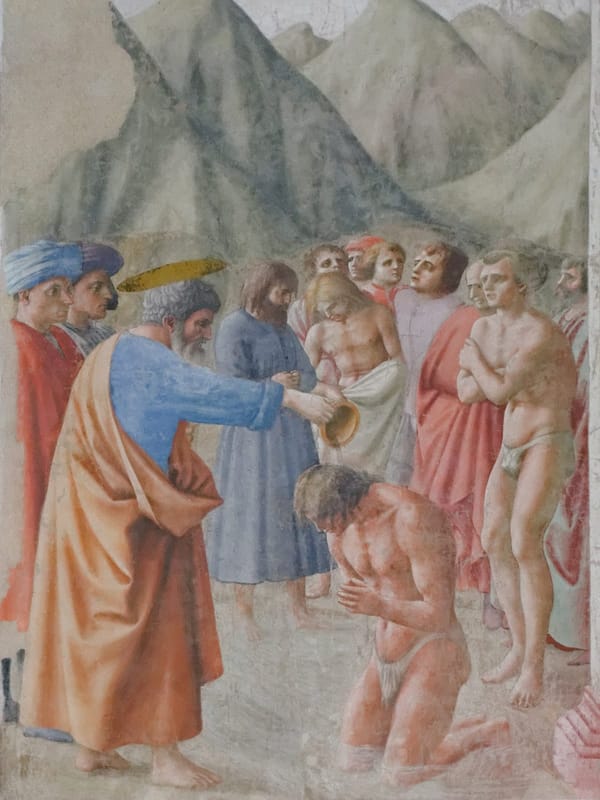
We have already seen how our Emmanuel gave to water the power of purifying the soul; but we also remember how, when He went down into the Jordan stream, the Dove rested upon Him; hereby showing that He, the Spirit of God, took possession of the element of regeneration. The font of Baptism is His domain.’The water of Baptism,’ says the great St. Leo,’is like the virginal womb (that conceived Jesus) it gives to man a spiritual regeneration; for the same holy Spirit that gave fecundity to the Virgin, gives fecundity to the font, to the end that sin, of which there could be no question in the sacred conception (of the Son of God in Mary’s womb), may be washed away by the mystic font.’5
What tongue could describe the fond delight wherewith the holy Spirit looks upon the new creature that rises from the font, or the impetuosity of love wherewith He comes into such a soul? He is’the Gift of the Most High,’ sent that He may dwell within us. He takes up His abode in the new-born soul, be it that of an infant but one day old, or that of an adult advanced in years. He is well-pleased with the dwelling He has, from all eternity, longed to possess; He fills it with His glowing and His light; and being, by nature, one with the other divine Persons, He brings thither with Him the presence of the Father and the Son, and all Three abide in that happy soul!6
But the Holy Ghost has here His own special action, His mission of sanctification: and in order that we may understand the full effect of His presence in the Christian, we must know that it is not confined to the soul. The body, too, is part of man, and had its share in the regeneration. The apostle tells us that the soul is the dwelling of the Holy Ghost;7 but he also assures us that our bodies are the temple of the same divine Spirit,8 who bids us make them serve justice unto sanctification.9 He graces them with a germ of immortality, which will rest upon them even in the tomb, and give them to rise again, at the last day, spiritualized,10 and bearing on them the seal of the divine Paraclete, who deigned to be their Guest during the term of their mortality.
After having thus made the Christian to be His dwelling-place, the Holy Ghost bestows upon him what may fit him for this high destiny. Think, for a moment, of the beauty of the theological virtues! Faith puts us into the certified and real possession of the divine truths which our mind cannot, in this present life, understand; hope gives us both the divine assistance we stand in need of, and the eternal happiness we look forward to; charity unites us to God by the strongest and sweetest of ties. Now it is to the indwelling of the Holy Ghost within him, that the Christian is indebted for these three virtues, these three means whereby regenerated man is made capable of attaining the end of his creation. The holy Spirit marked His first entrance into the soul by this triple gift, which surpasses all the creature’s merits, past, present, or future.
Over and above the three theological virtues, He bestows on the soul four other virtues, which are the hinges whereon the rest of the moral virtues turn, and hence their name of cardinal; they are, justice, fortitude, prudence, and temperance. Though, in themselves, natural qualities, the Holy Ghost transforms them by making them serve the supernatural end of the Christian. Finally, as a finish to the beauty of His abode, He infuses His seven gifts, which are to impart movement and life to the seven virtues.
But though the virtues and gifts relate to God, yet do they need that element, which is the essential means of union with Him: an element which is indispensable, for which nothing can serve as substitute, the soul of the soul, the life-giving principle, without which man can neither see nor possess God, viz. sanctifying grace. The Holy Ghost exultingly plants it in the soul; it becomes part of herself, and makes her an object of delight to the blessed Trinity. So close is the union between this grace and the presence of the holy Spirit, that when it is lost by mortal sin, He, that same instant, ceases to dwell in the soul.
He watches most carefully over His inheritance. He is ceaselessly working for the interests of His much-loved dwelling. The virtues He has infused into her are not to remain inert; they must elicit virtuous acts, and by the merits they thus produce, must increase, strengthen, and develop the fundamental element of sanctifying grace, which unites the Christian to his God. The Holy Ghost is, therefore, ever exciting the soul to action, either interior or exterior, by means of those divine influences, which theologians call actual graces. He thus enables the soul to raise herself higher and higher in virtue, add to her riches, strengthen her strength, and, in a word, become the instrument of glory to her Maker, who created her that she might serve Him, labour for Him, and yield Him fruit.
To this end, the Spirit, after giving Himself to her, and dwelling within her with devoted love, urges her to prayer, whereby she may procure every blessing: light, strength, and success in what she undertakes. But how are we to know what to pray for? The apostle solves the difficulty, by telling us the truth, of which he himself had such experience. He says: ‘The Spirit Himself asketh for us with unspeakable groanings’.11 Yes, the Holy Ghost makes our wants His own. God as He is, He unites His own speakings with the voice of our prayer, and, with His dove-like moaning, cries in our hearts to the Father.12 He thus, by His presence and His workings, makes us feel that we are children of God.13 Could there be intimacy greater than this? And who, after this, can be surprised at our Jesus’ saying that we have but to ask, and we shall receive?14 Is it not His own Spirit that asks within us?
So that He is the author of our prayer, when we pray: He is, also, the great co-operator with us in the good actions we do. So intimate is His union with the soul, that He leaves her no liberty of her own save what is necessary for her to have merit; but it is He that does the rest: that is, He inspires her, He supports her, He directs her. All she has to do, is to co-operate in what He does in and by her. It is by this mark, that is, by the united action of the Holy Ghost and the soul, that our heavenly Father knows who are His. Hence that saying of the apostle: Whosoever are led by the Spirit of God, they are the sons of God.15 O glorious union! which brings the Christian to life everlasting, and makes Jesus triumph in him, Jesus, whose likeness is imprinted by the Holy Ghost in the creature, that the creature may become worthy to be united with his divine Head!
Alas! this union may be severed, as long as we are on earth. Our free-will is not confirmed in good, until we reach heaven; and meanwhile, it may, and frequently does, lead to a rupture between the Spirit that sanctifies, and the creature that is sanctified. The unhappy love of independence, and the passions, which we cannot master, save when we are docile to the divine Spirit, excite the unguarded heart to the desire of what is unworthy of her. Satan is jealous of the reign of the Holy Ghost, and seeks to make us disloyal, by holding out to us the lying promise of happiness and good, other than those we can find in God. The world, too, which is a spirit of evil, sets itself up as a rival of the holy Spirit of God. Wily, audacious, and active, it excels in the art of seduction, and its victims are countless, although our Saviour has put us on our guard against it, by telling us that He excluded it from any share in His prayers;16 and the apostle tells us, that we have received, not the spirit of the world, but the Spirit that is of God.17
And yet, how many there are who bring about in themselves a cruel separation of their soul from the Holy Ghost! The separation is generally preceded by a certain coolness of the creature for his divine Benefactor. A want of respect, a slight disobedience, are the preliminaries of the rupture. This occasions in the holy Spirit a displeasure, which proves the tender love He bears to a faithful soul. The apostle describes the nature of this displeasure, where he says: ‘Grieve not the holy Spirit, who put His seal upon you on the day of your redemption.’18 There is a deep meaning in these few words, and, among other truths, they reveal to us the effects of venial sins: the Holy Ghost is grieved, He finds but little pleasure in that soul; there is danger of a separation; and though, as St. Augustine tells us, ‘He does not leave us, unless we leave Him,’ and though, consequently, such a soul still possesses sanctifying grace, yet actual grace becomes less frequent and less powerful.
But, when mortal sin—that act of the creature’s boldest malice and worst ingratitude—enters the soul, it breaks the sacred compact which closely united the Christian and the Holy Ghost. He, the Spirit of love, is driven from the dwelling He had chosen for Himself and had enriched with so many graces. A greater outrage cannot be offered to God by man; for, as the apostle so strongly expresses it, he hath trodden under foot the Son of God, and hath esteemed the Blood of the testament unclean, by which he was sanctified, and hath offered an affront to the Spirit of grace.19
And yet, this miserable state of the sinner may excite the compassion of the Holy Ghost, who has been sent that He might ever be our Guest. Could anything be imagined more sad, than the wretchedness of a Christian, who, by having cast out the divine Spirit, has lost the soul of his soul, forfeited the treasure of sanctifying grace, and robbed himself of all past merits? But—O mystery of mercy, worthy of eternal praise!—the Holy Ghost longs to return to the dwelling whence sin has driven Him. Yes, such is the fulness of the mission given by the Father and the Son to the Holy Ghost: He is love, and in His love He abandons not the poor ungrateful worm, but would restore him to his former dignity, and make him, once more, a partaker of the divine nature.20
This divine Spirit of love labours to regain possession of His dwelling. He begins by exciting within the soul a fear of divine justice; He makes her feel the shame and anguish of spiritual death. He thus detaches her from evil, by what the holy Council of Trent calls ‘impulses of the Holy Ghost, not indeed as yet dwelling within the soul, but moving her.’21 Dissatisfied and unhappy, the soul sighs after a reconciliation; she breaks the chains of her slavery; the sacrament of Penance then comes, bringing life-giving love, and her justification is completed. Who could describe the triumphant joy wherewith the divine Spirit re-enters His dear abode? The Father and the Son return to the dwelling that for days, or perhaps for years, had been defiled with sin. The soul is restored to life. Sanctifying grace returns to her, just as it was on the day of her Baptism. As we have already said, she had lost, by mortal sin, that fund of merit which had developed the power of grace; it is now restored to her fully and entirely, for the power of the holy Spirit is equal to the vehemence of His love.
This admirable raising from death to life is going on every day, yea every hour. It is part of the mission given to the Holy Ghost. He does the work He came for—the sanctification of man. The Son of God came down from heaven, and gave Himself to us. He found us slaves to satan; He ransomed us at the price of His Blood; gave us everything that could lead us to Himself and His heavenly Father; and, when He returned to heaven, there to prepare a place for us, He sent us His own Spirit to be our second Comforter, until He Himself should return to us. We have seen how strenuously this divine Helper undertakes His work. Let us fervently celebrate the love wherewith He treats us, and the wisdom and power wherewith He accomplishes His glorious mission. May He be blessed and glorified! May He be known throughout the whole world, for it is through Him that all blessings are imparted unto men! He is the soul of the Church; may she render Him the homage of her praise! And may He be tenderly loved by those countless millions of hearts, wherein He desires to dwell that He may give them eternal salvation and happiness.
This is the second of the three days’ fast prescribed for this week. To-morrow is the day for the ordination of the priests and other sacred ministers. It behoves us to redouble our efforts to obtain from God that the abundance of His grace may be in keeping with the sacred and ever-abiding character, which the divine Spirit is to imprint on these aspirants to Holy Orders.
At Rome, to-day’s Station is in the church of the twelve apostles, where repose the bodies of St. Philip and St. James the Less. This allusion to the favoured ones of the cenacle is most appropriate, for they were the first guests of the Holy Ghost.
The Armenian Church again lends us its beautiful hymn, in praise of the coming of the Paraclete.
Hymn (Canon sextæ diei)
implevisti apostolos; precibus horum miserere.
The following is taken from the Mozarabic missal. It is an address made to the faithful by the bishop, during the Mass of Whit Sunday. He exhorts them to receive with devotion the divine Spirit, who is about to visit them.
Missa
- St. John, xiv. 16. ↩︎
- De Prædestinatione Sanctorum, cap. xv. ↩︎
- 1 Cor. i. 28. ↩︎
- Rom. v. 20. ↩︎
- Serm. xxiv. In Nativitate Domini, iv. ↩︎
- St. John, xiv. 23. ↩︎
- Rom. viii. 11. ↩︎
- 1 Cor. vi. 19. ↩︎
- Rom. vi. 19. ↩︎
- 1 Cor. xv. 44. ↩︎
- Rom. viii. 26. ↩︎
- Gal. iv. 6. ↩︎
- Rom. viii. 16. ↩︎
- St. Luke, xi. 9. ↩︎
- Rom. viii. 14. ↩︎
- St. John, xvii. 9. ↩︎
- 1 Cor. ii. 12. ↩︎
- Eph. iv. 30. ↩︎
- Heb. x. 29. ↩︎
- 2 St. Peter, i. 4. ↩︎
- Sess. xiv. cap. iv. De Pœitentia. ↩︎
Friday in Whitsun Week: The Gift of Understanding
This sixth gift of the Holy Ghost raises the soul to a still higher state. The first five gifts all tend to action. The fear of God keeps man in his right place, for it humbles him; godliness opens his heart to holy affections; knowledge enables him to discern the path of salvation from that of perdition; fortitude arms him for the battle; counsel directs him in his thoughts and works:—thus gifted, he can act, and pursue his journey with the sure hope of coming at length to his heavenly home. But the Holy Ghost has other favours in store for him. He would give him a foretaste, here below, of the happiness that awaits him in the next life: it will give him confidence, it will encourage him, it will reward his efforts. Contemplation—this is the blissful region thrown open to him, and the Holy Ghost leads him thither by the gift of understanding.
There will be a feeling of surprise and hesitation arising in the minds of many at hearing this word, contemplation. They have been taught to look on contemplation as an element of the spiritual life which is rarely to be hoped for, and almost impossible for persons who are in the ordinary walks of life. We must begin, then, by telling them that such an idea is a great and dangerous error, and one that checks the progress of the soul. No: contemplation is a state to which, more or less, the soul of every Christian is called. It does not consist in those extraordinary effects which the Holy Ghost occasionally produces in some privileged souls, and by which He would convince the world of the reality of the supernatural life. It is simply a relation of close intimacy existing between God and a soul that is faithful to Him in action. For such a soul, unless she herself put an obstacle, God reserves two favours: the first is the gift of understanding, which consists in a supernatural light granted to the mind of man.
This light does not remove the sacred obscurity of faith: but it enlightens the eye of the soul, strengthens her perception, and widens her view of divine things. It dispels clouds, which were occasioned by the previous weakness and ignorance of the soul. The exquisite beauty of the mysteries is now revealed to her, and the truths which hitherto seemed unconnected, now delight her by the sweetness of their harmony, It is not the face-to-face vision which heaven gives, but it is something incomparably brighter than the feeble glimmer of former days, when all was mist and doubt. The eye of her spirit discovers analogies and reasons, which do something more than please—they bring conviction. The heart opens under the influence of these bright beams, for they feed faith, cherish hope, and give ardour to love. Everything seems new to her. Looking at the past, and comparing it with the present, she wonders within herself, how it is that truth, which is ever the same, has a charm and a power over her now which once it had not.
The reading or hearing of the Gospel produces an impression far deeper than formerly: she finds a relish in the words of Jesus, which, in times past, she never experienced. She can understand so much better the object of the institution of the Sacraments. The holy liturgy, with its magnificent ceremonies and sublime formulas, is to her an anticipation of heaven. She loves to read the lives of the saints; she can do so, and never feel a temptation to carp at their sentiments or conduct: she prefers their writings to all others, and she finds in these communications with the friends of God a special increase of her spiritual good. No matter what may be the duties of her station in life, she has, in this glorious gift, a light which guides her in each of them. The virtues required from her, however varied they may be, are so regulated, that one is never done to the detriment of another; she knows the harmony that exists between them all, and she never breaks it. She is as far from scrupulosity as from tepidity; and when she commits a fault, she loses no time in repairing it. Sometimes the Holy Ghost favours her with an interior speaking, which gives her additional light for some special emergency.
The world and its maxims are mere vanities in her estimation; and when necessity obliges her to con- form to what is not sinful in either, she does so without setting her heart upon it. Mere natural grandeur or beauty seems unworthy of notice to her whose eye has been opened, by the holy Spirit, to the divine and the eternal. To her, this outward world which the carnal-minded man loves to his own destruction, has but one fair side, viz: that the visible creation, with the impress of God’s beauty upon it, can be turned to its Maker’s glory. She gives Him thanks when she uses it; she elevates it to the supernatural order, by praising, as did the royal prophet, Him who shadowed the likeness of His own beauty on this world of created things, which men so often abuse to their perdition, but which were intended as so many steps to lead us to our God.
The gift of understanding teaches the Christian a just appreciation of the state of life in which God has placed Him. It shows him the wisdom and mercy of those designs of Providence which have, at times, disconcerted his own plans, and led him in a direction the very opposite to his wishes. He sees that had he been left to arrange things according to his own views, he would have gone astray; whereas now, God has put him in the right place, though the workings of His fatherly wisdom were, at first, hidden from him. Yes, he is so happy now! he enjoys such peace of soul! he knows not how sufficiently to thank his God for having brought him where he is, without consulting his poor fancies! If such a Christian as this be called upon to give counsel, if either duty or charity require him to guide others, he may safely be trusted; the gift of understanding teaches him to see the right thing for others as well as for himself. Not that he ever intrudes his counsel upon others, or makes himself adviser-general to all around him; but if his advice be asked, he gives it, and the advice is a reflex of the inward light that burns within him.
Such is the gift of understanding. It is the true life of the soul, and it is weaker or stronger according to the measure of her correspondence with the other gifts. Its safeguards are humility, restraint over the desires of the heart, and interior recollection. Dissipation of mind would dim its brightness, or even wholly put out the light. But where duty imposes occupations, not only busy and frequent, but even distracting, let the Christian discharge them with a pure intention, and his soul will not lose her recollection. Let him be single-hearted, let him be little in his own eyes, and that which God hides from the proud and reveals to the humble,1 will be manifested to him and abide with him.
It is evident from all this, that the gift of understanding is of immense importance to the salvation and sanctification of the soul. It behoves us, therefore, to beg it of the Holy Ghost with all the earnestness of supplication; for we must not forget that it is obtained rather by the longings of our love, than by any efforts of the intellect. True, it is the intellect that receives the light; but it is the heart, the will, inflamed with love, that wins the radiant gift. Hence that saying of Isaias: ‘Unless ye believe, ye shall not understand!’2 Let us, then, address ourselves to the holy Spirit in these words of the psalmist: ‘Open Thou our eyes, and we will consider the wondrous things of Thy law! Give us understanding and we shall live!’3 Let us beseech Him in these words of the apostle, wherein he is praying for his Ephesians: ‘Give us the Spirit of wisdom and revelation, whereby we may have the knowledge of our God! Enlighten the eyes of our heart, that we may know what is the hope of our calling, and what the riches of the glorious inheritance prepared for the saints!’4
May 29: St. Mary Magdalen de Pazzi, Virgin
|
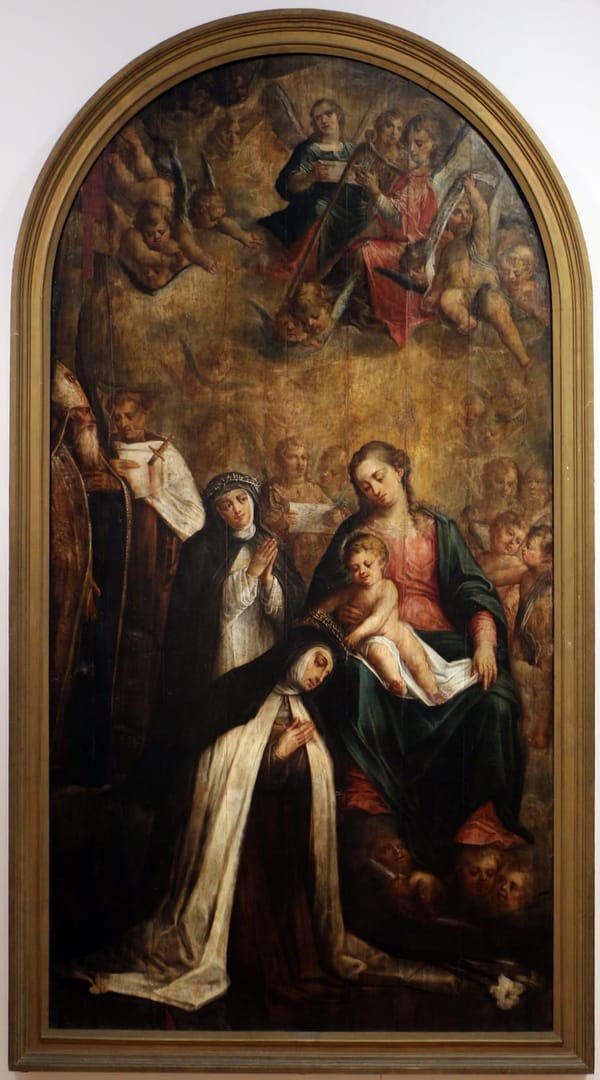
OUR Paschal Calendar gives us three illustrious virgins of beautiful Italy. We have already kept the feast of the valiant Catharine of Siena; in a few days we shall be honouring the memory of Angela dei Merici, surrounded by her school-children; to-day it is the fair lily of Florence, Magdalen de Pazzi, who embalms the whole Church with the fragrance of her name and intercession. She devoted herself to the loving imitation of our crucified Jesus; was it not just that she should have some share in the joy of his Resurrection?
Magdalen de Pazzi was one of the brightest ornaments of the Order of Carmel, by her angelic purity, and by the ardour of her love for God. Like St Philip Neri, she was one of the grandest manifestations of the divine charity that is found in the true Church. Magdalen in her peaceful cloister, and Philip in his active labours for the salvation of souls—both made it their ambition to satisfy that desire expressed by our Jesus when he said: I am come to cast fire on the earth; and what will I, hut that it he kindled?1 The life of this Spouse of Christ was one continued miracle. Her ecstasies and raptures were almost of daily occurrence. The lights given to her regarding the mysteries were extraordinary; and in order to prepare her for those sublime communications, God would have her go through the severest trials of the spiritual life. She triumphed over them all; and her love having found its nourishment in them, she could not be happy without suffering; for nothing else seemed to satisfy the longings of the love that burned within her. At the same time, her heart was filled to overflowing with charity for her neighbour: she would have saved all mankind, and her charity to all, even for their temporal well-being, was something heroic. God blessed Florence on her account; and she so endeared herself to its people by her admirable virtues, that devotion to her, even to this day, which is more than three hundred years since her death, is as fervent as ever it was.
One of the most striking proofs of the divine origin and holiness of the Church is to be found in such privileged souls as Magdalen de Pazzi, on whom we see the mysteries of our salvation acting with such direct influence. God so loved the world as to give it his Only Begotten Son;2 and this Son of God deigns to love some of his creatures with such special affection, and to lavish upon them such extraordinary favours, that all men may have some idea of the love wherewith his Sacred Heart is inflamed for this world, which he redeemed at the price of his Blood. Happy those Christians that appreciate and relish these instances of Jesus' special love! Happy they that can give him thanks for bestowing such grits on some of our fellowcreatures! They have the true light; whereas they that have an unpleasant feeling at hearing of such things, and are angry at the thought that there can be between God and any soul an intimacy of which they are not worthy, prove that there is a great deal of darkness in their faith.
We regret extremely that we have not space for a fuller development of the character and life of our Saint. We therefore proceed at once to the Lessons given in her Office. Even they are too short, and give us but an imperfect idea of this admirable spouse of Christ.
Charitate erga proximum singulariter enituit; nam sæpe noctes ducebat insomnes, vel obeundis sororum ministeriis, vel inserviendo infirmis occupata, quarum aliquando ulcera lambens sanavit. Infidelium et peccatorum perditionem amare deflens, se ad quælibet pro illorum salute tormenta paratam offerebat. Multis ante obitum annis, universis cœli deliciis, quibus copiose affluebat, heroica virtute renuntians, illud frequenter in ore habebat: Pati, non mori. Tandem longa et gravissima infirmitate exhausta, transivit ad Sponsum die vigesima quinta Maji anno millesimo sexcentesimo septimo, expleto anno quadragesimo primo ætatis suæ. Eam multis in vita et post mortem miraculis claram Clemens Nonus sanctarum Virginum numero adscripsit: cujus corpus in præsentem diem incorruptum conservatur.
She was remarkable for her charity towards others. She would frequently sit up the whole night, either doing the work of the sisters, or waiting upon the sick, whose sores she sometimes healed by sucking the wounds. She wept bitterly over the perdition of infidels and sinners, and offered to suffer every sort of torment so that they might be saved. Several years before her death she heroically besought our Lord to take from her the heavenly delights wherewith he favoured her; and was frequently heard saying these words: ‘To suffer; not to die.' At length, worn out by a long and most painful illness, she passed hence to her Spouse, on the twenty-fifth of May, in the year 1607, having completed the forty-first year of her age. Many miracles having been wrought by her merits, both before and after death, she was canonized by Pope Clement the Ninth. Her body is, even to this day, preserved from corruption.
Thy life here below, O Magdalen, resembled that of an angel sent by God to assume our weak and fallen nature and be subject to its laws. Thy soul ceaselessly aspired to a life which was all heavenly, and thy Jesus was ever giving thee that thirst of love which can only be quenched by the waters of life everlasting.3 A heavenly light revealed to thee such admirable mysteries, such treasures of truth and beauty, that thy heart, unequal to the sweetness thus given to it by the Holy Ghost, sought relief in sacrifice and suffering. It seemed to thee as though there was but one way of making God a return for his favours—the annihilation of self.
Seraphic lover of our God! how are we to imitate thee? what is our love, when we compare it to thine? And yet we can imitate thee. The year of the Church's Liturgy was thy very life. Each of its seasons did its work in thee, and brought thee new light and love. The divine Babe of Bethlehem, the bleeding Victim of the Cross, the glorious Conqueror of Death, the Holy Ghost radiant with his seven gifts—each of these great realities enraptured thee; and thy soul, renewed by the annual succession of the mysteries, was transformed into him who, that he might win our hearts, gives these sublime celebrations to his Church. Thy love of souls was great during thy sojourn here; it is more ardent now that thou art in possession of the Sovereign Good; obtain for us, O Magdalen, light to see the riches which enraptured thee, and love to love the treasures which enamoured thee. O riches! O treasures! is it possible that they are ours too?
| Previous Thursday in Whitsun Week: The Gift of Counsel | Next Friday in Whitsun Week: The Gift of Understanding |