Daily reading
After Pentecost
Double · May 30 · Sanctoral
June 1, 2026
From Dom Guéranger’s The Liturgical Year.
A Double leads the weekday.Rubric
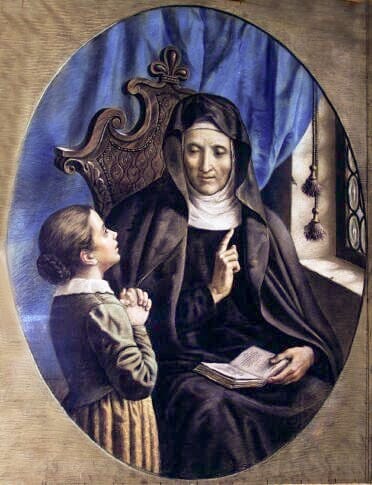 |
June 1 [May 31]: St. Angela de Merici, Virgin
[This feast day, previously kept on May 31, was moved to June 1 when the feast of the Queenship of Mary was established on May 31.-Ed.]
From Dom Guéranger's The Liturgical Year.
THIS last day of May, which is honoured by the virginal triumph of Aurelia Petronilla, in the first age of the Church, is also fragrant with the lilies that wreathe the brow of Angela de Merici. The sixteenth century, which, a few days back, offered to our Risen Lord the seraphic Magdalen de Pazzi, now presents him with this second fruit of heroic sanctity. Angela realized the whole meaning of her beautiful name. She possessed the purity of the blessed spirits in a mortal body, and she imitated their celestial energy by the vigorous practice of every virtue. This heroine of grace trampled beneath her feet everything that could impede her heavenward march. Gifted at an early age with the highest contemplation, she bravely travelled to Palestine, there to venerate the footsteps of her divine Spouse Jesus. After this, she visited the New Jerusalem, Rome, and offered up her fervent prayers at the Confession of St Peter. She then returned to her life of seclusion, and founded a Religious Order which is, and will be to the end of time, one of the glories and aids of Holy Church.
The thought of the great St Ursula and her virginal legion made a deep impression on Angela’s soul, and she too would form to our Lord an army of valiant women. Ursula confronted the barbarian host; Angela would give battle to the world and to its seductions, which are so dangerous to young girls. God blessed her with victory. As a trophy of her combats, she can point to the countless generations of young people whom her Order has saved during the last three centuries, by giving them a solid Christian education.
The Liturgy thus speaks of the virtues and actions of St Angela:
Thou didst fight the battles of our Lord, O Angela, and thy holy labours merited for thee a glorious rest in the mansions of eternal bliss. An insatiable zeal for the honour of Jesus whom thou hadst chosen as thy Spouse, and an ardent charity for the creatures redeemed by his precious Blood were the characteristics of thy whole life. This love of thy neighbour made thee the mother of a countless progeny; for who can number the young children that have been educated, in sound doctrine and piety, by thy daughters? Thou didst powerfully contribute to the welfare of Christian society, by thus preparing so many for the duties of domestic life; and how many other Congregations, in imitation of thy Ursulines, have taken up the same admirable work, and have brought consolation to the Church, and happiness to the world? The sovereign Pontiff has ordered that thy feast should be kept throughout the whole Church. He declared, in issuing this decree, that he wished to put under thy maternal protection the young girls who are nowadays exposed to such fearful dangers by the enemies of Christ and his Church. They have formed the project of undermining the faith of women, that so their good influence may be destroyed in their families. Disconcert these impious plans, O Angela! Protect thy sex; nourish within it the sentiment of the dignity of Christian woman, and society may still be saved.
We turn to thee, O Spouse of Christ, and ask for fervour in the liturgical year, wherein we are made to follow in the path that was so dear to thee. Thy devotion in following the divine Mysteries which are successively brought before us, led thee to visit the Holy Land. Thou didst long to see Nazareth and Bethlehem, to traverse Galilee and Judea, to give thanks in the Cenacle, to weep on Calvary, and to adore the glorious Sepulchre. Deign to bless our feeble desires and efforts to tread in these same holy paths. We have still to follow thee to Mount Olivet, whence our Redeemer ascended into heaven; we have to return to the Cenacle, which the Holy Ghost is preparing to light up with his divine Fire. Obtain for us, O Angela, that we may follow thee to these hallowed spots, which made thee quit thy country and undertake a long and perilous pilgrimage. Oh! prepare our hearts for the sublime Mysteries which are to crown our Paschal season.
Monday after Trinity Sunday
Having, by His divine light, increased the Church’s appreciation of the sovereign mystery of the august Trinity, the Holy Ghost next leads her to contemplate that other marvel, which concentrates in itself all the works of the Incarnate Word, and leads us, even in this present life, to union with God. The mystery of the holy Eucharist is going to be brought before us in all its magnificence; it behoves us therefore, to prepare the eyes of our soul for the worthy reception of the light which is so soon to dawn upon us. As, during the whole year, we have never lost sight of the mystery of the holy Trinity, and all our worship has unceasingly been offered to the Three divine Persons; so, in like manner, the blessed Eucharist has uninterruptedly accompanied us throughout the whole period of the liturgical year, either as the means for paying our homage to the infinite Majesty of God, or as the nourishment which sustains the supernatural life. Though we knew and loved these two ineffable mysteries before, yet the graces of Pentecost have added much to both our knowledge and our love; yesterday, the mystery of the Trinity beamed upon us with greater clearness than ever; and now we are close upon the solemnity which is to show us the holy Eucharist with an increase of light and joy to our faith.
The blessed Trinity is, as we have already shown, the essential object of all religion; It is the centre to which all our homage converges; and this, even when we do not seem to make It our direct intention. Now, the holy Eucharist is the best of all the means whereby we can give to the Three divine Persons the worship we owe Them; it is, moreover, the bond whereby earth is united with heaven. It is easy, therefore, to understand how it was that holy Church so long deferred the institution of the two festivals immediately following Whitsuntide. All the mysteries we have celebrated up to this time were contained in the august Sacrament, which is the memorial, and, so to say, the compendium, of the wonderful things wrought in our favour by our Redeemer.1 It is the reality of Christ’s presence under the sacramental species that enabled us to recognize in the sacred Host, at Christmas, the Child that was born unto us, in Passiontide, the Victim who redeemed us, and at Easter, the glorious conqueror of death. We could not celebrate all those admirable mysteries without the aid of the perpetual Sacrifice; neither could that Sacrifice be offered up, without renewing and repeating them.
It is the same with the feasts of our blessed Lady and the saints: they kept us in the continual contemplation of the holy Sacrament. When we honoured Mary on the solemnities of the Immaculate Conception, the Purification, or the Annunciation, we were honouring her who had, from her own substance, given that Body and Blood which was then offered upon our altars. As to the apostles and the martyrs, whose memories we solemnized, whence had they the strength to suffer so much and so bravely for the faith, but from the sacred banquet which we then celebrated, and which gives courage and constancy to them that partake of·it? The confessors and virgins, as their feasts came round, seemed to us as so many lovely flowers in the garden of the Church, and that garden itself all fruitful with wheat and clusters of grapes, because of the fertility given by Him who is called, in the Scriptures, both Wheat and Wine.2
Putting together all the means within our reach for honouring these blessed citizens of the heavenly court, we have chanted the grand Psalms of David, and hymns, and canticles, with all the varied formulas of the liturgy; but nothing that we could do towards celebrating their praise could be compared to the holy Sacrifice offered to the divine Majesty. It is in that Sacrifice that we entered into direct communication with them, according to the energetic term used by the Church in the Canon of the Mass (communicantes). The blessed in heaven are ever adoring the most holy Trinity by and in Christ Jesus our Lord; and it is by the Sacrifice of the Mass that we were united with them in the one same centre, and that we mingled our homage with theirs; hence, they received an increase of glory and happiness. So, then, the holy Euoharist, both as Sacrifice and Sacrament, has always been prominently before us. If we are now going to devote several days to a more attentive consideration of its magnificence and power; if we are now going to make more earnest efforts to taste more fully its heavenly sweetness; it is not something fresh, which attracts our special notice and devotion for a season, and will then give way for something else: the Eucharist is that element prepared for us by the love of our Redeemer, of which we must always avail ourselves in order that we may enter into direct communication with our God, and pay Him the debt not only of our worship, but also of our love.
And yet, the time was to come when the Holy Ghost, who governs the Church, would inspire her with the thought of instituting a special solemnity in honour of that august mystery, in which all others are included. There is a sacred element, which gives a meaning to every feast that occurs during the year, and graces it with the beauty of its own divine splendour; that sacred element, which is the most holy Eucharist, had itself a right to a solemn festival, in keeping with the dignity of its divine object.
But that festive exaltation of the divine Host, and those triumphant processions so deservedly dear to the present generation of Christians, were not practicable in the ages of the early persecutions. And when those rough times had passed away, and the courageous martyrs had won victory for the Church, those same modes of honouring the Eucharist would not have suited the spirit and form of the primitive liturgical observances, which were kept up for ages following. Neither were they needed for the maintenance of the lively faith of those times; they would have been superfluous for a period such as that was, when the solemnity of the Sacrifice itself, and the share the people at large took in the sacred mysteries, and the uninterrupted homage of liturgical chants sustained by the crowds of faithful adorers around the altar, gave praise and glory to God, secured correctness of faith, and fostered in the people a superabundance of supernatural life, which is not to be found now-a-days. The divine Memorial produced its fruits; the intentions our Lord had in instituting the Eucharist were realized; and the remembrance of that institution, which used then to be solemnized as we now celebrate Mass on Maundy Thursday, was deeply impressed on the minds of the faithful.
This state of things lasted till the beginning of the thirteenth century, when, as the Church expresses it, a certain coldness took possession of the world;3 faith grew weak, and the vigorous piety which characterized the Christians of the previous ages became exceedingly rare. There were grand exceptions, here and there, of individual saintliness; but there was an unmistakable falling off among people at large, and the falling off was progressive; so much so, indeed, that there was danger that the mystery, which by its very nature is the mystery of faith, would suffer, in a special manner, from that coldness, that indifference, of the new generation. Even at that period, hell had been at work, stirring up sacrilegious teachers here and there, who dared to throw doubts upon the dogma of the real Presence; fortunately, the people easily took alarm, and, as a general rule, were too strong in the old faith to be led astray. The pastors, too, of the Church were alive to the danger, for there were souls who allowed themselves to be deceived.
Scotus Erigena had formulated the sacramentarian heresy: he had taught that the Eucharist ‘was but a sign, a figure of spiritual union with Jesus, of which the intellect alone could be cognizant.’ His teaching made little impression; it was regarded as mere pedantry, and was too novel to make head against Catholic tradition, such as was to be found exposed in the learned writings of Paschasius Radbert, Abbot of Corbie. The sophistry of Scotus was revived, in the eleventh century, by Berengarius; but although its new promoter was more crafty and conceited than its originator, and did greater and more lasting mischief, yet it died with him. The time for hell to play havoc by such direct attacks as these had not yet come; they were laid aside for others of a more covert kind. That hotbed of heresies, the empire of Byzantium, fostered the almost extinct germ of Manicheism; the teaching of that sect regarding the flesh—that it is the work of the evil principle—was subversive of the dogma of the Eucharist. While Berengarius was trying to bring himself into notice by the noisy, but ineffectual, broaching of his errors, Thrace and Bulgaria were quietly sending their teachers into the west. Lombardy, the Marches, and Tuscany, became infected; so did Austria, in several places, and almost all at one and the same time; so, too, did three cities of France: Orleans, Toulouse, and Arras. Forcible measures were used for repressing the evil; but it knew how to grow strong by retreat. Taking the south of France for the basis of its operations, the foul heresy silently organized its strength during the whole of the twelfth century. So great was the progress it made thus unperceived, that when it came publicly before the world, at the beginning of the thirteenth century, it had an army ready for the maintenance of its impious doctrines. Torrents of blood had to be shed in order to subdue it, and deprive it of its strongholds; and for years after the defeat of the armed insurrection, the Inquisition had to exercise active watchfulness in the provinces that had been tainted by the Albigensian contagion.
Simon of Montfort was the avenger of the Catholic faith. But, while the victorious arm of the Christian hero was dealing a death-blow to heresy, God was preparing for His Son, who had been so unworthily outraged by the sectarians in the Sacrament of His love, a triumph of a more peaceful kind, and a more perfect reparation. It was in the year 1208, that a humble religious of the Congregation of the Hospitallers, by name the Blessed Juliana of Mont-Cornillon near Liege, had a mysterious vision, in which she beheld the moon at its full, but having a hollow on its disc. In spite of all her efforts to divert herself from what she feared was an illusion, the same vision appeared before her as often as she set herself to pray. After two years of such efforts and earnest supplications, it was revealed to her that the moon signified the Church as it then was; and that the hollow she observed on its disc expressed the want of one more solemnity in the liturgical year; a want which God willed should be supplied by the introduction of a feast, to be kept annually in honour of the institution of the blessed Eucharist. The solemn commemoration made of the last Supper, on Maundy Thursday, was no longer sufficient for the children of the Church, shaken as they had been by the influences of heresy; it was not sufficient even for the Church herself, who, on that Thursday, has her attention divided by the important functions of the day, and is wholly taken up, a few hours later, by the sad mysteries of the great Friday. At the same time that Juliana received this communication, she was also commanded to make known to the world what she had been told was the divine will. Twenty years, however, passed, before the humble and timid virgin could bring herself to put her person thus forward. She at length mentioned the subject to a Canon of St. Martin’s of Liége, named John of Lausanne, whom she much respected for his great holiness of life; and she besought him to confer with men of theological learning on the subject of the mission confided to her. All agreed that not only there was no reason why such a feast should not be instituted, but, moreover, that it would be a means for procuring much glory to God and great good to souls. Encouraged by this decision, the saintly Juliana had a proper Office composed and approved for the future festival; it begins with the words: Animarum cibus, and a few portions are still extant.
The Church of Liege, to which the universal Church owes yesterday’s solemnity of the blessed Trinity, was predestined to have the honour of originating the feast of Corpus Christi. It was a happy day, when, in the year 1246, after so many delays and difficulties, the bishop of Liege, Robert de Torôte, published a synodical decree that each year, on the Thursday after Trinity Sunday, there should be observed in all the churches of his diocese, with rest from servile work, and with the preparation of fasting on the eve, a solemn feast in honour of the blessed Sacrament.
But the mission of the Blessed Juliana was far from being at an end; she had to be punished for having so long deferred it. The bishop died; and the decree he had issued would have long been a dead letter, had there not been one, and only one, church of the diocese, whose clergy were determined to carry the decree into execution: these were the Canons of Saint Martin-au-Mont. Though there was no authority, during the vacancy, that cared to enforoe the observance, yet, in the year 1247, the feast of Corpus Christi was kept in that privileged church. Robert’s successor, Henry de Gueldre, a warrior and grandee, took no interest in what his predecessor had had so much at heart. Hugh de Saint Cher, Cardinal of St. Sabina, and legate in Germany, having gone to Liege with a view to remedy the disorders to which the new episcopal government had given rise, heard mention of the decree of the late bishop Robert, and of the new feast. The Cardinal had, formerly, been prior and provincial in the Order of St. Dominio, and was one of the theologians who, having been consulted by John de Lausanne, had favoured the project. He was of the same mind when legate; and claimed the honour of keeping the feast himself, and singing Mass with much solemnity. Not satisfied with that, he issued a circular, dated December 29,1253, which he addressed to the archbishops, bishops, abbots, and faithful of the territory of his legation; and, in that document, he confirmed the decree of the bishop of Liege, and extended it to all the country over which he was legate, granting one hundred days’ indulgence to all who, being contrite, and having confessed their sins, should, on the feast itself or during its Octave, devoutly visit a church in which the Office of Corpus Christi was being celebrated. In the year following, the Cardinal of St. George in Velabro, who had succeeded as legate, confirmed and renewed the ordinances made by the Cardinal of St. Sabina. These reiterated decrees, however, failed to remove the wide-spread indifference. A terrible blow had been given, by the proposed feast, to the powers of hell, and satan excited every possible opposition to it. As soon as the legates had taken their departure, several local superiors, men of note and authority! published their own ordinances in opposition to what had been already given. In 1258, the year of the Blessed Juliana’s death, there was still but the single church of St. Martin that would celebrate the feast, which it was her mission to spread throughout the entire world. But she left the continuation of her work to a holy recluse, of the name of Eve, to whom she had confided her secrets.
On the twenty-ninth day of August, 1261, James Pantaléon ascended the papal throne, under the name of Urban IV. He owed his election to this dignity to his great personal merits, for by birth4 he had nothing to recommend him. He had been archdeacon of Liege, and there had met with the Blessed Juliana, and had approved her work. In this his exaltation to the papacy, Eve thought she had an indication of God’s providence. She induced the bishop, Henry de Gueldre, to send his written congratulations to the new Pontiff, and, at the same time, to entreat him to confirm, by his own approbation, the feast which had been instituted by Robert de Torôte. About the same time, several supernatural events had attracted public attention; and in particular, the prodigy at Bolsena, near Orvieto, (where the papal court happened to be then residing) of a corporal having been stained with blood by a miraculous Host. These events seemed as though providentially permitted in order to rouse Urban’s attention, and to confirm him in the holy zeal he had formerly evinced for the glory of the blessed Sacrament. St. Thomas of Aquin was appointed to compose, according to the Roman rite, the Office for the feast; which Office was to be substituted for the one prepared by the Blessed Juliana, which she had adapted to the ancient liturgy of France. The Bull Transiturus was published soon after; it made known to the Church the Pope’s intentions. Urban there mentions the revelations which had come to his knowledge before his election; and declares that, in virtue of his apostolic authority, both for the confounding of heresy, and for the increase of the true faith, he institutes a special solemnity in honour of the divine Memorial left, by Christ, to His Church. The day there fixed for the feast is the fifth feria (that is, the Thursday) after the Octave of Pentecost; for the Papal document does not mention, as the decree of the bishop of Liege had done, the feast of the blessed Trinity, which had not yet been received into the calendar of the Church of Rome. In imitation of what had been done by Hugh de Saint Cher, the Pontiff granted a hundred days’ indulgence to all the faithful, who, being contrite, and having confessed their sins, should assist at Mass, or Matins, at first or second Vespers, of the feast; and for assisting at Prime, Tierce, Sext, None, and Compline, forty days for each of those Hours. He also granted a hundred days to those who should assist, on any day within the Octave, at the Mass and the entire Office. Among all these details, there is no allusion to the procession, for this was not introduced till the following century.
All now seemed settled; and yet, owing to the troubles which were then so rife in Italy and the Empire, the Bull of Urban IV was forgotten, and remained a dead letter. Forty years and more elapsed before it was again promulgated and confirmed by Pope Clement V, at the Council of Vienne. John XXII gave it the force of a settled law, by inserting it in the Clementines, about the year 1318; and he had thus the honour of putting the finishing stroke to the great work, which had taken upwards of a century for its completion,
The feast of the blessed Sacrament, or, as it is commonly called, Corpus Christi, began a new phase in the Catholic worship of the holy Eucharist. But, in order to understand this, we must go more thoroughly into the question of Eucharistic worship, as practised in the previous ages of the Church: the inquiry is one of importance for the full appreciation of the great feast, for which we must now be preparing our souls. No preparation, it seems to us, could be more to the point, than to devote the next two days to a faithful and compendious study of the chief features in the history of the blessed Eucharist.
It belongs to Thee, O holy Spirit, to teach us the history of so great a mystery. Scarcely has Thy reign begun upon the earth, when, faithful to Thy divine mission of glorifying our Emmanuel,5 who has ascended into heaven, Thou at once raisest our eyes and hearts up to that best gift of His love, whereby we still possess Him under the eucharistic veil. During those long ages of the expectation of nations, it is Thou who didst bring the Word before mankind; Thou spakest of Him in the Scriptures, Thou proclaimedst Him by the prophets.6 O Thou who art the Gift of the Most High,7 Thou art, also, infinite Love; and it is through Thee, as such, that are wrought all the manifestations which God vouchsafes to make to us His creatures. It is Thou that broughtest this divine Person, the Word, into the womb of the immaculate Virgin Mary, there to clothe Him with sinless flesh, and so make Him our Brother and our Saviour. And now that He has ascended to His Father and our Father,8 depriving us of the sight of His human Nature all beauteous with its perfections and charms; now that we have to go through this vale of tears deprived of His visible company: He has sent Thee unto us;9 and Thou hast come, O divine Spirit, as our Consoler. But the consolation Thou bringest us, dear Paraclete, is ever the same: it is the faithful remembrance of Jesus;10 yea, more, it is His divine Presence, perpetuated by Thee in the Sacrament of love. We had already been told that this would be so; that Thou wouldst not speak of Thyself,11 or for Thyself; but that Thou wouldst come to give testimony of the Emmanuel,12 continue His work, and produce His divine likeness in each one of us.
How admirable is this Thy fulfilment of Thy sublime mission, which is all for the glory of Jesus! O divine Spirit, Guardian of the Word in the Church! it is far beyond our power to describe how great is Thy vigilance over the word of teaching, brought by the Saviour to this earth of ours, a teaching which is the true expression of Himself, and which, coming, as He Himself does, from the mouth of the Father, is the nourishment of His bride here below.13 But with what infinite respect and vigilance, O holy Spirit, dost Thou preside over the august Sacrament, wherein is present, with all the reality of His adorable Flesh, that same Incarnate Word, who, from the very beginning of creation, was the centre and object of all Thy dealings with creatures! It is by the mystery produced by Thine omnipotence, that the exiled bride recovers her Spouse; it is by Thee that she traverses the long ages of time, holding and prizing her infinite treasure; it is by Thee that she, with such superhuman wisdom, puts it to profit, by so arranging, so modifying her discipline, yea, her very life, as to secure in each age of time the greatest possible faith, respect and love towards the divine Eucharist. If she anxiously hide It from the profane men that would only turn their knowledge into blasphemy; or if she lavish upon It all that liturgy can give of pomp and magnificence; or if, again, she bring It forth from her sacred temples, and triumphantly carry It in procession through the crowded streets of cities, or the green lanes of the quiet country, it is Thou, O divine Spirit, that inspirest her with what is best; it is Thy divine foresight that suggests to her what is the surest means for gaining, in each respective period and age, the most of honour and love for Jesus who is ever present in the sacred Host, and who deigns to let His love be delighted with being thus among the children of men.14
Vouchsafe, O Holy Ghost, to aid us in our contemplations of this sacred mystery. Enlighten our understanding, inflame our hearts, during these hours of preparation for its feast. Give to our souls the knowledge of that Jesus, who is coming to us beneath the sacramental veil.
May this holy mystery be to us, during this last portion of the year and its liturgy, our Bread to support us on the journey we have still to make through the desert, before we can reach the mount of God;15 we have yet a great way to go, and a way so different from the one we have already passed through, when we had the company of Jesus in the mysteries He was working for our salvation. Be Thou, O holy Spirit, our guide in those paths, which the Church, under Thy direction, is courageously traversing, while she is every day approaching nearer to the end of her pilgrimage here below. Yet scarcely have we entered on this second portion of our year, than Thou, divine Spirit, bringest us to the banquet prepared by divine Wisdom,16 where the pilgrim receives the strength he needs for his journey. We will walk on, then, in the strength of this heavenly food;17 and when our course is run, we will, with the same Bread to support us, cry out, with the Spirit and the bride, that our Lord Jesus may come18 to us, at that last hour, and admit us into His eternal kingdom.
In honour of the adorable Sacrament, and in memory of the Blessed Juliana, to whom the Church owes the feast she is about to celebrate, we will offer our readers, to-day and during the Octave, the main portions, which are still extant, of the Office which bears her name. It will be interesting to them to hear how this Office was drawn up; we give the details as supplied to us by the Bollandists, in the life written of her by one of her contemporaries.
Juliana, then, began to ask herself whom she should get to compose the Office of the great feast. She knew of no clever man, or holy priest, who seemed to her fitted for the work; so, trusting solely to divine Wisdom, she made up her mind to select a young brother of the Hospital, named John,19 whose innocent life had been revealed to her by God. John refused the work, declaring that it far exceeded his powers or learning; he begged her to excuse him, as he was but an ignorant man. Juliana knew all that; but she also knew that divine Wisdom, whose work she was furthering, could speak admirable things through an unlearned man; she kept to her purpose; and John, unable to resist the entreaties and influence of Juliana, began his labours. She prayed, and he wrote; and with the efforts of the two united, the work progressed in a way that surprised the young brother. He attributed all, and he was not far wrong, to Juliana’s prayers. When he had any considerable portion of the composition ready, he gave it to her, saying: ‘This, Sister, is what heaven sends thee: read it, and examine whether I have put down anything, either in the chant, or the words, which needs correction.’ She would then take it; and, by the wonderful infused wisdom which she possessed, would examine, and, where needed, correct; and with so much prudence and judgment, that not even the most expert critics could find anything to change. And thus, by the wondrous help of God, was completed the whole Office of the new feast.20
The antiphons we here subjoin were taken by the Bollandists,21 from a very ancient Directorium of the church of Saint-Martin-au-Mont. They are the antiphons assigned for the Benedictus and Magnificat of each day during the Octave.
Antiphons
- Ps. cx. 4. ↩︎
- Zach. ix. 17· ↩︎
- Collect for the feast of the Stigmata of St. Francis. ↩︎
- Troyes, France, was his native town. ↩︎
- St. John xvi. 14. ↩︎
- 2 St. Pet. i. 19-21. ↩︎
- Hymn for Pentecost. ↩︎
- St. John xx. 17. ↩︎
- St. Luke xxiv. 49. ↩︎
- St. John xiv. 26. ↩︎
- St. John xvi. 13. ↩︎
- St. John xv. 26. ↩︎
- St. Matt. iv. ↩︎
- Prov. viii. 31. ↩︎
- 3 Kings xix. 8. ↩︎
- Prov. ix. ↩︎
- 3 Kings xix. 8. ↩︎
- Apoc. xxii. 17. ↩︎
- We must not confound him with John de Lausanne, of whom we have previously spoken. ↩︎
- Vita B. Julianæ, ab auctore coævo descripta lib. ii. cap. 2. Act. Ss. ad diem quintam Aprilis. ↩︎
- Ibid. in Append. ↩︎
| Previous May 31: St. Petronilla | Next Monday after Trinity Sunday |