Daily reading
After Pentecost
Double · Movable from Easter · Temporal
July 12, 2026
From Dom Guéranger’s The Liturgical Year.

|
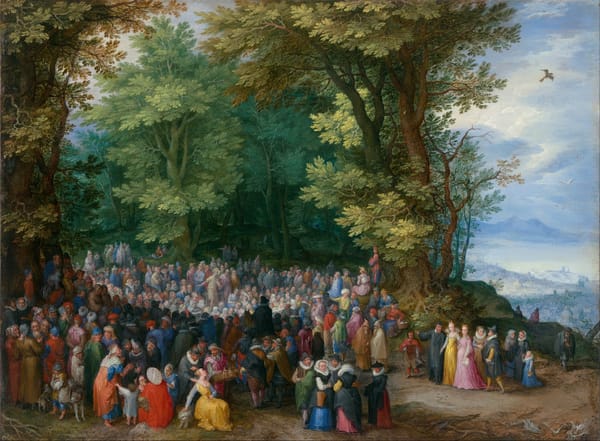
The Seventh Sunday after Pentecost
The dominical cycle of the Time after Pentecost completes to-day its first seven. Previous to the general adoption of the changes introduced into the Sunday Gospels for this portion of the year, the Gospel of the multiplication of the seven loaves gave its name to the seventh Sunday; and the mystery it contains is still evident in more than one section of to-day's liturgy.
As we have already seen, this mystery was that of the consummation of the perfect in the repose or rest of God Himself; it was the fruitful peace of the divine union. Nothing, then, could be more fitting than that Solomon, who is pre-eminently thepeaceful, the sacred and authorized chanter of the nuptial Canticle, should have been selected to come forward, on this day, to speak the praises of infinite Wisdom, and reveal her ways to the children of men. When Easter is kept as late in April as it is possible, the seventh Sunday after Pentecost is the first of the month of August; and the Church then begins, in her night Office, the lessons from the Sapiential Books. Otherwise, she continues the historic Scriptures, and that, in some years, for five weeks more; but even in that case eternal Wisdom maintains her rights to this Sunday, which the number of seven had already made hers in so special a way. For, when we cannot have the inspired instructions of Proverbs, we have Solomon's own example preaching to us in the third Book of Kings; we find him preferring Wisdom to all other treasures, and, on the throne of his father David, making her sit there with him as his inspirer and most noble Bride.
St. Jerome, who has been appointed by the Church herself as the interpreter of to-day's Scripture lessons,1 tells us that David, at the close of his life of wars and troubles, knew, as well as Solomon, the loveliness of this incomparable Bride of the Peaceful; the chill of his age was remedied by her caresses, whose very contact is purity.
‘Oh that this wisdom may be mine!’ exclaims the fervent solitary of Bethlehem; 'may she embrace me, and abide with me. She never grows old. She is ever the purest of virgins, fruitful, yet ever immaculate. I think the apostle means her when he speaks of a something that can make us fervent in spirit.2 So again, when our Lord tells us in the Gospel that, at the end of the world, the charity of many will grow cold,3 I believe it will be because wisdom will then grow rare.’4
The history of the two blind men, as related in the ninth chapter of St. Matthew, is the subject of to-day's Gospel in the Greek Church.
Mass
The Church, leaving the Synagogue in its cities which are to perish, has followed Jesus into the wilderness. Whilst the children of the kingdom5 are assisting at, without seeing it, this transmigration which is to be so fatal to them, the root of Jesse, now become the standard of nations,6 is rallying the people, and marshals them by thousands on towards the Church. From east and west, from north and south, they are pouring in, sitting down to the banquet of the kingdom,7 in company with Abraham and Isaac and Jacob. Here is our Introit; let us mingle our voices with these their glad chants.
Introit
All the opposition that men are capable of can never prevent divine Wisdom from compassing her ends. The Jewish people deny their King; but the Gentiles come forward and proclaim the Son of David. As we were just now singing in the Introit, His kingdom is extended the whole world over. In the Collect the Church asks that all evils may be removed, and that an abundance of blessings may consolidate in peace the power of the true Solomon.
Collect
The other Collects as on page 120.
Epistle
Cap. vi.Fratres, Humanum dico propter infirmitatem carnis vestræ : sicut enim exhibuistis membra vestra servire immunditiæ et iniquitati ad iuiquitatem; ita nunc exhibete membra vestra servire justifciæ in sanctificationem. Cum enim servi essetis peccati, liberi fuistis justitiæ. Quem ergo fructum habuistis tunc in illis, in quibus nunc erubescitis? Nam finis illorum mors est. Nunc vero liberati a peccato, servi autem facti Deo, habetis fructum vesferum in sanctificationem, finem vero vitam æternam. Stipendia enim peccati, mors. Gratia autem Dei, vita æterna : in Christo Jesu Domino nostro.
Ch. vi.Brethren : I speak a human thing, because of the infirmity of your flesh : for as you have yielded your members to serve uncleanness and iniquity unto iniquity; so now yield your members to serve justice, unto sanctification. For when you were the servants of sin, you were free from justice. What fruit therefore had you then in those things of which you are now ashamed? For the end of them is death. But now being made free from sin, and become servants to God, you have your fruit unto sanctification, and the end life everlasting. For the wages of sin is death; but the grace of God, life everlasting in Christ Jesus our Lord.
‘Reckon that ye are dead unto sin, but alive unto God, in Christ Jesus our Lord.’8 The apostle of the Gentiles enters to-day into the development of this leading formula of the Christian life. The Epistle of last Sunday aimed exclusively at putting it in language that could not be misunderstood; it showed us that it expresses what is meant by that Baptism which, when we are immersed in the water, unites us to Christ.
There, as in a sepulchre, the death of Jesus becomes ours, and delivers us from sin. Sold under sin9 by our first parents even before we had seen the day, and branded with its infamous stigma, our whole life belonged to the cruel tyrant. He is a master who is never satisfied with our service; he is a merciless exactor; there is scarce an hour that he does not make us feel his power over the members of our body; he does not allow us to forget that our body is his slave. But, if the life of a slave is under his master’s control, death comes at last and sets the soul free; and as to the body, the oppressor can claim nothing, once it is buried.10 Now, it was on the cross of the Man-God, who, as the apostle so strongly expresses it, was made sin11 because of our sins, that guilty human nature was considered by God's merciful justice to have become what its divine and innocent Head was. The old man that was the issue of Adam the sinner has been crucified; he has died in Christ; the slave by birth, affranchised by this happy death, has had buried under the waters of Baptism the body of sin, which carried in its flesh the mark of its slavery.
The body of sin was indeed our flesh; not that innocent flesh which originally came all pure from its Creator's hands, but the flesh which, generation after generation, was defiled by the transmission of a disgraceful inheritance. In Baptism, which the apostle calls the mysterious sepulchre, the sacred stream has not only washed away the defilement of this degraded body, but it has also set it free from those members of sin, which are the evil passions. These passions were powers of iniquity—that is, powers which deformed, and turned into uncleanness, those faculties and organs wherewith God had endowed us, that we might fulfil all justice, unto sanctification.12 At that moment of our Baptism the strong-armed tyrant forfeited his possession of us;13 that Baptism was a death which set his slave free. Sin being thus destroyed, the head of triple concupiscence has been severed, and the monster may writhe as he can; aided by grace, man thus liberated may always prevent, if he wishes, the coils of the serpent from again being joined with their head.
Yes, this is the manifold, yet single, work of holy Baptism: in the twinkling of an eye, and by its own power, it extirpates sin, and annihilates all its rights over us; but, once this is achieved, man must co-operate with the grace of the sacrament, that is, he must keep watch over his treacherous inclinations to sin, which come to life again by the slightest encouragement; he must be ever keeping up the work which his baptism-day began—that is, he must be ever cutting down the vile and noxious weeds which are ever cropping up. First, then, there is the death of sin, which, in its complete and sudden defeat of the old enemy, is the result of God's divine operation; but all this is to be followed up by a work which it belongs to the affranchised slave to do : the life-long work of mortification of the spirit and of the senses. It is the virtue of the first sacrament which is still telling on the Christian in this work of two-fold mortification; in his mortification, the sacrament is still pushing on its ceaseless work of vengeance against sin. Holy Baptism, having operated in the wretched slave of sin what God alone could empower it to achieve, summons man, now that his chains have fallen, to join it in the glorious work of maintaining his liberty; it invites him to share with it the honour of the divine victory over satan and his works.
The keeping down of the flesh will be again brought before us next Sunday, as the true indicator of liberty on this earth, and as the authentication of our being truly children of God. As the apostle says : 'Let not sin reign in your mortal body, so as to obey the lusts thereof. Neither yield ye your members as instruments of iniquity unto sin; but present yourselves to God as those that are alive from the dead, and your members as instruments of justice unto God. For sin shall not have dominion over you : for ye are not under the law, but under grace. Know ye not, that to whom ye yield yourselves servants to obey, his servants are ye whom ye obey, whether it be of sin unto death, or of obedience unto justice? But thanks be to God, that ye were the servants of sin; . . . but being freed from sin, we have been made servants of justice.'14
And shall we do less for justice than is being done everywhere in favour of our enemy, sin? Surely justice deserves that we should make greater efforts in her service than for that odious tyrant who requites his slaves with nothing but shame and death. And yet—oh admirable condescension of God to our weakness!—we have St. Paul telling us in to-day's Epistle, in the name of the Holy Ghost, that we shall be saints, we shall attain eternal life,15 if we will but serve justice with as much earnestness as we once served uncleanness and iniquity.
Let us humble ourselves at hearing such words; let us be honest, and we shall feel that they contain a reproach. Many of usmight ask : What has become of that intense ardour wherewith we once used to follow after sin? To say that we have converted our ways would be no answer, for a conversion does not paralyse our faculties; it enlists our natural energy in God's service, it even intensifies it by the very fact of its now being employed as originally intended. At all events, conversion does not lessen the activity which was in us before our conversion; it would be an insult to grace to accuse it of diminishing in us the gifts of God.
What lessons, then, may we learn by seeing how eager in the pursuit of honour, interest, or pleasure, are the votaries of the world! What earnestness, what toil, what perseverance, what frequent sufferings, what abnegation at every turn, what misplaced heroism—and all for the purpose of satisfying the seven heads of the beast, and tasting a lew drops of the poisoned cup of Babylon!16 There are many souls in hell who have gone through more fatigue and pain to procure their damnation than even the martyrs endured for Christ; and even with all that, never attaining the object they sought to obtain in this world! so true is it that the fools who are the most subservient to satan's wishes do not always succeed in enjoying, even for a single day, the vile rewards he promises his slaves.
Justice treats her followers in a very different way; she does not degrade, she does not deceive them that keep her. She blesses them with peace of mind at every step they take in duty-doing; she is ever enriching their treasure of merit; she leads them safely to the perfection of love. The life of divine union then grows, almost spontaneously, on that high ground of justice; it rests on justice, as a flower does on its stem. 'He that possesseth justice,' says the Scripture, 'shall lay hold on wisdom': he shall find delights in that divine wisdom, which surpasses all that earth could procure.17
Would it, then, be fair to hesitate to go through those toils which procure heaven for us, and are a preparation here on earth for the glories which are to be revealed in us in our eternal home? The present life, how long soever it may be, seems but momentary to a faithful soul; she is glad to give this proof of the love she bears to Him she longs for. 'Jacob,' says St. Augustine, 'gave his twice seven years of service18 for the sake of Rachel, whose name, they tell us, signifies vision of the Beginning, that is, of the Word, that is, of the Wisdom which shows us God. Every virtuous man on earth loves this Wisdom; it is for her he works and suffers, by serving justice. What he, like Jacob, aims at by his labours, is, not the fatigue for its own sake, but the possession of that which the fatigue is to bring him, namely, the fair Rachel, that is to say, rest in the Word, in whom we have the vision of the Beginning. Is there any true servant of God who can have any other thought, when he is under the influence of grace? Once converted, what is it that man wishes? What is in bis thoughts? What has he in his heart? What is it that he thus passionately loves and desires? It is the knowledge of Wisdom. Of course, man would, if he could, avoid all fatigue and suffering, and come straight to the delights which he knows are in the exquisitely beautiful and perfect Wisdom; but that cannot be in the land of the dying. "If thou desire Wisdom, keep justice; and God will give her unto thee."19 Justice here means the commandments; and the commandments prescribe works of justice, of that justice which comes of faith; and faith lives amidst the uncertainty of temptations; that by piously believing what it does not as yet understand, it may merit the happiness of understanding.
‘We are not, therefore, to find fault with the ardour of those who are desirous of possessing truth in its unveiled loveliness; what we must do, is to put order in their love, by telling them to begin with faith, and strive, by the exercise of good deeds, to arrive at the bliss they long for. Do thou love and desire, at the very outset, and above all things, this object which is so worthy of thy possession; but, let the ardour which burns within thee show itself, first of all, by its leading thee cheerfully to endure the fatigues of the road which leads to the prize, towards which thy love is all directed. Yea, and when thou has reached it, remember, thou wilt never enjoy beautiful truth in this life, without having, at the same time, still to cultivate labourious justice. How comprehensive and pure soever may be the sight granted to mortal men of the unchangeable Good, the corruptible body is a load upon the soul, and the earthly habitation presseth down the mind that museth upon many things.”20 One, then, is that to which we must tend; but many are the things we are to bear for that one’s sake.’21
In the Gradual, the Church keeps up the thought which pervades this seventh Sunday; she invites her sons to come and receive from her the knowledge of the fear of the Lord; for the fear of the Lord is the beginning of wisdom.22 The Alleluiaverse again calls upon the Gentiles, the heirs of Jacob, to celebrate in gladness the gift of God.
Gradual
Gospel
Cap. vii.In illo tempore : dixit Jesus discipulis suis : Attendite a falsis prophetis, qui veniunt ad vos in vestimentis ovium, intrinsecus autem sunt lupi rapaces : a fructibus eorum cognoscetis eos. Numquid colligunt de spinis uvas, aut de tribulis ficus? Sic omnis arbor bona fructus bonos facit : mala autem arbor malos fructus facit. Non potest arbor bona malos fructus facere : neque arbor mala bonos fructus facere. Omnis arbor, quæ non facit fructum bonum, excidetur, et in ignem mittetur. Igitur ex fructibus eorum cognoscetis eos. Non omnis, qui dicit mihi : Domine, Domine, intrabit in regnum cœlorum : sed qui facit voluntatem Patris mei, qui in cœlis est, ipse intrabit in regnum cœlorum.
Ch. vii.At that time : Jesus said to his disciples: Beware of false prophets, who come to you in the clothing of sheep, but inwardly they are ravening wolves. By their fruits you shall know them. Do men gather grapes of thorns, or figs of thistles? Even so every good tree bringeth forth good fruit, and the evil tree bringeth forth evil fruit. A good tree cannot bring forth evil fruit, neither can an evil tree bring forth good fruit. Every tree that bringeth not forth good fruit shall be cut down, and shall be cast into the fire. Wherefore by their fruits you shall know them. Not every one that saith to me, Lord, Lord, shall enter into the kingdom of heaven; but he that doth the will of my Father who is in heaven, he shall enter into the kingdom of heaven.
By rejecting the Gospel, the Jewish people have refused the light. Whilst the Sun of justice, hailed with delight by the Gentiles, is lighting up, in all splendour, the land that was once in the shadow of death,23 a black night is covering the heretofore blessed country of the patriarchs, and darkness is every hour thickening in Jerusalem. By the blindness which is leading her to destruction, the Synagogue is verifying our Lord’s words : ‘He that walketh in darkness, knoweth not whither he goeth.’24
False prophets and false Christs are numerous in Israel,25 ever since the true Messiah, whom the prophets foretold, has been ignored, and treated by His own people26 as the prophets themselves had been.27 His witnesses, the apostles, have vainly tried to induce Juda to retract the fatal denial made in the pretorium. And yet, Jada knows better than all the world beside, that the times are accomplished; for, has not the sceptre fallen from his hands?28 And Juda, who disdainfully disowns the spiritual royalty of the Saviour of men, is going on with his ceaseless expectation and search of the Christ of his own imagining,—a Messiah who will restore to him the power he has lost. The Jewish doctors have not as yet invented the sentence of Talmud, whereby they will endeavour to stifle the unpleasant prophecies which give them the lie: ‘Cursed be he, that calculates the times of the coming of Messiah!’29 What, then, must be the feelings of a people, which has for ages been living in the expectation of an event the most important that could be, now that it sees the time specified by prophecy to be fast expiring, when it will be compelled either to disavow the past, or to acknowledge, at the foot of the cross which it has set up, its most sinful error.
A strange anxiety has seized on the nation of deicides. The spirit of madness governs her determinations. In the scare of her feverish excitement, which is the very opposite of the calm and resigned expectation of her ancient patriarchs, she takes every rebel for a Christ. She, that would not have the Son of David, hails every upstart as her Messiah, and follows every adventurer that sets up the cry of war against Rome, or that cheats her with the promise of making her country independent. With such materials, Judea is soon turned into a kingdom of anarchy and confusion. The very sanctuary of the temple is made the scene of party quarrels and bloodshed. The daughter of Sion follows her false Christs into the desert;30 there organizes riot; and returns to the holy city, filling it with highwaymen, or with assassins imported from the wilderness. Long before these events, Ezechiel had thus spoken: 'Woe to the foolish prophets that see nothing! Thy prophets, O Israel, were like foxes in the deserts!’31 And Isaias had thus prophesied :
‘Therefore, the Lord shall have no joy in their young men; neither shall He have mercy on their fatherless and widows; for every one is a hypocrite and wicked, and every mouth hath spoken folly.'32
The time is close at hand : the hour is come, when they that are in Judea must flee to the mountains,'33 as our Lord had said. The Christians of Jerusalem will, as history records, soon be leaving the doomed city, under the guidance of Simeon, their bishop.34 With them departs Sion’s last hope; God is about to avenge His Christ. Already has the signal of destruction been heard, the whistle, as the prophet Isaias had foretold,35 has been heard from beyond the seas; and, as Balaam had seen it in vision, 'they are coming in galleys from Italy, to lay waste the Hebrews.'36 The leader, announced by Daniel, is approaching towards that which was once the land of promise; the appointed desolation and ruin shall remain there even after the end of the war.37
Let us leave the Jews to hurry on their own ruin; let us return to the Church, which, at the same time, is rising up, so grand and so beautiful, on the corner-stone that had been rejected by the Synagogue.38 Because of the absence of this stone, which the builders of Sion had not the wisdom to recognize as the basis indispensably necessary to their city, Jerusalem falls in Judea, but reappears, more than ever beauteous, on the hills,39 whither Cephas,40 prince of the apostles, has carried her everlasting foundation. Set firmly on the divine rock, she shall no longer fear the violence of the billows and winds, when they storm against her walls.41 False prophets, and all the workers of lies, who had so successfully sapped the walls of the ancient, will not leave the new Jerusalem in peace; for our Lord had plainly said : 'It is necessary that scandals should come';42 and the apostle, speaking of heresy (that greatest of all scandals), said : 'There must be heresies in order that they who are approved may be made manifest.’43
Indeed, for each individual Christian, as for the Church at large, the security of the spiritual building depends primarily on the firmness of the foundation, which is faith. The Holy Ghost will not build on a foundation that is unsound or unsafe. When, especially, He is to lead a soul to the higher degrees of divine union, He exacts from her, as the first condition, that her faith, too, be above the average, —a faith, that is, with heroism enough to fight successfully those battles which brace the soul, and so render her worthy of light and love. In every stage of the Christian life, however, it is faith that provides love with its enduring and substantial44 nourishment; it is faith that gives to the virtues their supernatural motives, and makes them fit to form a worthy court for their queen, charity. A soul's development never goes beyond the measure of her faith. The capaciousness of faith, and its ever-growing plenitude, and its certified conformity with truth, these are the guarantees of the progress which will be made by a just man; whereas all such holiness as affects to be guided by a faith which is cramped or false is holiness of a very dubious kind, and one that is exposed to most fearful illusions.
It was, therefore, a good and a wholesome thing that faith should be put to the test, for it grows brighter and stronger under trial. St. Paul, in his Epistle to the Hebrews, is enthusiastic in his praise of the triumphs won by the faith of our forefathers.45 Could there be denied to the new Covenant those glorious combats which constituted the eternal merit and honour of the saints who lived in the period of expectation and figures? It is by their victorious faith in the word of the promise, that all those worthy ancestors of the Christian people merited to have God Himself as their praise-giver.46 For us, who joyously have possession of that Messias who to them was but the object of heroic hope, our trial cannot be like theirs—the trial of expectation. This is quite true; and yet, heresy, which is the offspring of man's pride and hell's malice—heresy and its manifold outcomings, which are ever producing the diminution of truth in this world47—will give us occasions of merit even in our possession of what they beheld and saluted only afar off.48 Man is ever trying to intrude his foolish ideas into the truths of divine revelation; and, as to the prince of this world,49 he will do all in his power to encourage these audacious attempts at corrupting the purity of the word. But Wisdom, who is never overcome,50 will turn all these impious efforts into an occasion of glorious victories for her children. Here we have the reason why God permitted, from the very commencement of the Church’s existence, and still permits, that sects should be continually springing up. It is in the battlefield against error that the Church brings forth the armour of God,51 and shows herself all brilliant with that absolute truth which is the brightness of the Word, her Spouse;52 it is by his personal triumph over the spirit of lying, and by spontaneous adhesion to the teachings of Christ and His Church, that the Christian shows himself to be a true child of light,53 and becomes himself a light to the world.54
The combat is not without its dangers for the Christian who would hold, in all its integrity, the faith of his mother the Church. The tricks of the enemy, his studied and obstinate hypocrisy, the crafty skill wherewith he tries to stir up in the soul, almost without her knowing it, a score of little weaknesses of hers which more or less favour error—all this frequently ends in injuring the light, not perhaps in extinguishing it altogether, but in robbing it of some of us brilliancy. And yet, they who live on the teachings given us in our to-day's Gospel are sure to come off with the victory. Let us meditate upon them with gratitude and love; for it is by such teachings that eternal Wisdom grants us what we so ardently ask of Him, when in Advent we thus beseech Him : 'Come and teach us the way of prudence!'55 Prudence, the friend of a wise man,56 guardian of his treasures, and his surest defence, has no greater peril from which to keep him than shipwreck concerning the faith;57 if faith be lost, all is lost. No price is too great to give58 for that prudence of the serpent which, in a disciple of Christ, goes so admirably with the simplicity of the dove.59 If we are happy enough to possess prudence, we shall readily distinguish between those false teachers whom we must shun and those to whom we must hearken—between the falsifiers of the word and its faithful interpreters.
By their fruits shall ye know them, says our Gospel, and history confirms the words of our Redeemer. Under the sheep's clothing, which they wear that they may deceive simple souls, the apostles of falsehood ever betray their real nature. The artful language they use,60 and the flatteries they utter for gain's sake,61 cannot hide the hollowness of their works.62 They separate themselves from the flock of Christ,63 and flee from the light; for, as the apostle says : 'All things that are reproved, or deserve to be so, are made manifest by the light; and as to the things that are done by them in secret, it is a shame even to speak of them. Therefore, be ye not partakers with them.’64 The useless or rotten fruits of darkness, and 'the trees of autumn, twice dead,'65 which bear such fruits on their withered branches, both of them shall be cast into the fire. If you yourselves were heretofore darkness, now that you have become light in the Lord by Baptism, or by a sincere conversion, show yourselves to be so, and produce ‘the fruits of light, in all goodness, and justice, and truth.'66 On this condition alone can you hope to enter into the kingdom of heaven, and call yourselves disciples of that Wisdom of the Father, who, on this seventh Sunday, asks us to give Him our love.
St. James the apostle almost seems to be giving a commentary on the Gospel of this seventh Sunday, where he says : ‘Can the fig-tree, my brethren, bear grapes, or the vine figs? So neither can the salt water yield sweet. Who is a wise man and endued with wisdom among you, let him, by a good conversation (that is, by his good conduct) show his work in the meekness of wisdom.' . . . For there is a wisdom which is bitter, and misleads others; it 'descendeth not from above, but is earthly, sensual, devilish. . . . But the wisdom which is from above, first indeed is chaste, then peaceable, modest, easy to be persuaded, consenting to the good (and always sides with them), full of mercy and good fruits, without judging (the conduct of others), without dissimulation. And the fruit of justice is sown in peace to them that make peace.'67
The Offertory-anthem has been selected, according to Honorius of Autun,68 in allusion to the sacrifice of the thousand victims which were offered at Gabaon by Solomon, in the early days of his reign; when the sacrifice was ended, he was bidden to ask, what he would have God give to him : he desired and obtained wisdom, with the addition of riches and glory, for which he had not asked.69 It depends upon us, that the sacrifice which is here ready to be offered up, should be equally, and even more, accepted of God, for it is Incarnate Wisdom that is being offered to the most high God; He desires to obtain for us all the gifts of His eternal Father, and to give Himself also to us.
Offertory
Another circumstance which confirms what we have said regarding the mysterious character of this seventh Sunday, as to its being especially sacred to eternal Wisdom, is the fact that the verse of Scripture which formerly used to be joined to the present Offertory-anthem70 is the same as that which, in the Roman pontifical, opens the magnificent ceremony of the consecration of virgins : ‘And now we follow thee with all our heart, and we fear thee, and seek thy face; put us not to confusion, but deal with us according to thy meekness, and according to the multitude of thy mercies!’71 After being thrice called by the bishop, the affianced of the divine Spouse, singing these words, advance to the altar, where they are to be espoused to Him.
The Secret speaks to God of how the multiplied variety of the ancient sacrifices, such as those mentioned in the Offertory, were all made one in the oblation of our Christian sacrifice.
Secret
The other Secrets, as on page 130.
The Communion, says Honorius of Autun, gives us the prayer of Solomon, who asks wisdom of God, and obtains it.72 'If any of you,’ says St. James, 'want wisdom, let him ask of God, who giveth to all men abundantly, and upbraideth not : and it shall be given him.’73
Communion
Original sin has vitiated man to such a degree— he is so far from divine union, at his first coming into this life—that, of himself, he can neither cleanse the defilement that is on him, nor enter on the path which leads to God. It is requisite that our God, as a generous and patient physician, take our cure into His own hand; and, even when the cure is effected, should support and guide us. Let us then, in the Postcommunion, say with the Church:
Postcommunion
The other Postcommunions, as on page 131.
Vespers
The psalms, capitulum, hymn and versicle, as above, pages 71-81.
Antiphon of the Magnificat
- In II. Noct., ex Epist ad Nepotianum. ↩︎
- Rom. xii. 11. ↩︎
- St. Matt. xxiv. 12. ↩︎
- Ep. ad Nepot. 4. ↩︎
- St. Matt. viii. 12. ↩︎
- Isa. xi. 10. ↩︎
- St. Matt. viii. 11. ↩︎
- Rom. vi. 11. ↩︎
- Ibid. vii. 14. ↩︎
- Job iii. 18. ↩︎
- 2 Cor. v. 21. ↩︎
- Col. iii 5-9. ↩︎
- St. Luke xi. 21 ↩︎
- Rom. vi. 12-18. ↩︎
- Ibid. 19-23. ↩︎
- Apoc. xvii. 7. ↩︎
- Ecclus. xv. 1-8. ↩︎
- Gen. xxix. 18-30. ↩︎
- Ecclus. i. 33. ↩︎
- Wisd. ix. 15. ↩︎
- St. Augustine, Contra Faust, xxii. 50-58 (freely epitomized). ↩︎
- Ps. cx.10. ↩︎
- Isa. ix. 2. ↩︎
- St. John xii. 35. ↩︎
- St. Matt. xxiv. 24. ↩︎
- St. John i. 11. ↩︎
- St. Matt. xxiii 29-82. ↩︎
- Gen. xlix. 10. ↩︎
- Tract. Sanhedr., c. x. ↩︎
- St. Matt. xxiv. 26. ↩︎
- Ezech. xiii. 1-8. ↩︎
- Isa. ix. 17. ↩︎
- St. Matt. xxiv. 16. ↩︎
- Euseb., Hist. Eccl., iii. 5. ↩︎
- Isa. v. 26. ↩︎
- Num. xxiv. 24. ↩︎
- Dan. ix. 26, 27. ↩︎
- Ps. cxvii. 22. ↩︎
- Isa. ii. 2. ↩︎
- St. John i. 42. ↩︎
- St. Matt. vii. 24-27. ↩︎
- Ibid. xviii. 7. ↩︎
- 1 Cor. xi. 19. ↩︎
- Heb. xi. 1. ↩︎
- Ibid. 4-40. ↩︎
- Ibid. 2, 39. ↩︎
- Ps. xi. 2. ↩︎
- Heb. xi. 13. ↩︎
- St. John xvi. 11. ↩︎
- Wisd. vii. 30. ↩︎
- Eph. vi. 11-17. ↩︎
- Heb. i. 3. ↩︎
- St. John xii. 36. ↩︎
- St. Matt. v. 14. ↩︎
- First of the Great Antiphons. ↩︎
- Prov. vii. 4. ↩︎
- 1 Tim. i. 19. ↩︎
- Prov. iii. 13-19. ↩︎
- St. Matt. x. 16. ↩︎
- Eph. v. 6. ↩︎
- St. Jude. 16. ↩︎
- Eph. v. 11. ↩︎
- St. Jude 19 ↩︎
- Eph. v. 13, 12, 7. ↩︎
- St. Jude 12. ↩︎
- Eph. v. 8, 9. ↩︎
- St. James iii. 11-18. ↩︎
- Gemma Anim., iv. 57. ↩︎
- 3 Kings iii.; 2 Paralip. i. ↩︎
- Antiph. Gregor. ap. Thomasi, v. ↩︎
- Dan. iii. 40-42. ↩︎
- Honorius, ubi supra. ↩︎
- St. Jas. i. 5. ↩︎
July 12: St. John Gualbert, Abbot
 |
NEVER, from the day when Simon Magus was baptized at Samaria, had hell seemed so near to conquering the Church as at the period brought before us by to-day's feast. Rejected and anathematized by Peter, the new Simon had said to the princes, as the former had said to the apostles:' Sell me this power, that upon whomsoever I shall lay hands, he may receive the Holy Ghost.' And the princes, ready enough to supplant Peter and fill their coffers at the same time, had taken upon themselves to invest men of their own choice with the government of the churches; the bishops in their turn had sold to the highest bidders the various orders of the hierarchy; and sensuality, ever in the wake of covetousness, had filled the sanctuary with defilement.
The tenth century had witnessed the humiliation of the supreme pontificate itself; early in the eleventh, simony was rife among the clergy. The work of salvation was going on in the silence of the cloister; but Peter Damian had not yet come forth from the desert; nor had Hugh of Cluny, Leo IX, and Hildebrand brought their united efforts to bear upon the evil. A single voice was heard to utter the cry of alarm and rouse the people from their lethargy; it was the voice of a monk, who had once been a valiant soldier, and to whom the crucifix had bowed its head in recognition of his generous forgiveness of an enemy. John Gualbert, seeing simony introduced into his own monastery of San Miniato, left it and entered Florence, only to find the pastoral staff in the hands of a hireling. The zeal of God's House was devouring his heart; and going into the public squares, he denounced the bishop and his own abbot, that thus he might, at least, deliver his own soul.
At the sight of this monk confronting single-handed the universal corruption, the multitude was for a moment seized with stupefaction; but soon surprise was turned into rage, and John with difficulty escaped death. From this day his special vocation was determined: the just, who had never despaired, hailed him as the avenger of Israel, and their hope was not to be confounded. But like all who are chosen for a divine work, he was to spend a long time under the training of the Holy Spirit. The athlete had challenged the powers of this world; the holy war was declared: one would naturally have expected it to wage without ceasing until the enemy was entirely defeated. And yet, the chosen soldier of Christ hastened into solitude to 'amend his life,' according to the truly Christian expression used in the foundationcharter of Vallombrosa.1 The promoters of the disorder, startled at the suddenness of the attack, and then seeing the aggressor as suddenly disappear, would laugh at the false alarm; but, cost what it might to the once brilliant soldier, he knew how to abide, in humility and submission, the hour of God’s good pleasure.
Little by little other souls, disgusted with the state of society, came to join him; and soon the army of prayer and penance spread throughout Tuscany. It was destined to extend over all Italy, and even to cross the mountains. Settimo, seven miles from Florence, and San Salvi, at the gates of the city, were the strongholds whence the holy war was to recommence in 1063. Another simoniac, Peter of Pavia, had purchased the succession to the episcopal see. John, with all his monks, was resolved rather to die than to witness in silence this new insult offered to the Church of God. His reception this time was to be very different from the former, for the fame of his sanctity and miracles had caused him to be looked upon by the people as an oracle. No sooner was his voice heard once more in Florence than the whole flock was so stirred that the unworthy pastor, seeing he could no longer dissemble, cast off his disguise and showed what he really was: a thief who had come only to rob and kill and destroy. By his orders a body of armed men descended upon San Salvi, set fire to the monastery, fell upon the brethren in the midst of the Night Office, and put them all to the sword; each monk continuing to chant till he received the fatal stroke. John Gualbert, hearing at Vallombrosa of the martyrdom of his sons, intoned a canticle of triumph. Florence was seized with horror, and refused to communicate with the assassin bishop. Nevertheless, four years had yet to elapse before deliverance could come; and the trials of St. John had scarcely begun.
St. Peter Damian, invested with full authority by the Sovereign Pontiff, had just arrived from the Eternal City. All expected that no quarter would be given to simony by its sworn enemy, and that peace would be restored to the afflicted Church. The very contrary took place. The greatest saints may be mistaken, and so become to one another the cause of sufferings by so much the more bitter as their will, being less subject to caprice than that of other men, remains more firmly set upon the course they have adopted for the interests of God and His Church. Perhaps the great bishop of Ostia did not sufficiently take into consideration the exceptional position in which the Florentines were placed by the notorious simony of Peter of Pavia, and the violent manner in which he put to death, without form of trial, all who dared to withstand him. Starting from the indisputable principle that inferiors have no right to depose their superiors, the legate reprehended the conduct of the monks, and of all who had separated themselves from the bishop. There was but one refuge for them, the Apostolic See, to which they fearlessly appealed, a proceeding which no one could call uncanonical. But there, says the historian, many who feared for themselves, rose up against them, declaring that these monks were worthy of death for having dared to attack the prelates of the Church; while Peter Damian severely reproached them before the whole Roman Council. The holy and glorious Pope Alexander II took the monks under his own protection, and praised the uprightness of their intention. Yet he dared not comply with their request and proceed further, because the greater number of the bishops sided with Peter of Pavia; the archdeacon Hildebrand alone was entirely in favour of the Abbot of Vallombrosa.2
Nevertheless, the hour was at hand when God Himself would pronounce the judgment refused them by men. While overwhelmed with threats and treated as lambs amongst wolves, John Gualbert and his sons cried to heaven with the Psalmist: 'Arise, O Lord, and help us; arise, why dost Thou sleep, O Lord? Arise, O God, and judge our cause.' At Florence the storm continued to rage. St. Saviour’s at Settimo had become the refuge of such of the clergy as were banished from the town by the persecution; the holy founder, who was then residing in that monastery, multiplied in their behalf the resources of his charity. At length the situation became so critical that one day in Lent of the year 1067 the rest of the clergy and the whole population left the simoniac alone in his deserted palace and fled to Settimo. Neither the length of the road, deep in mud from the rain, noi the rigorous fast observed by all, says the narrative written at that very time to the Sovereign Pontiff by the clergy and people of Florence, could stay the most delicate matrons, women about to become mothers, or even children. Evidently the Holy Ghost was actuating the crowd; they called for the judgment of God. John Gualbert, under the inspiration of the same Holy Spirit, gave his consent to the trial; and in testimony of the truth of the accusation brought by him against the Bishop of Florence, Peter, one of his monks, since known as Peter Igneus, walked slowly before the eyes of the multitude through an immense fire, without receivingthe smallest injury. Heaven had spoken: the bishop was deposed by Rome, and ended his days, a happy penitent, in that very monastery of Settimo.
In 1073, the year in which his friend Hildebrand was raised to the Apostolic See, John was called to God. His influence against simony had reached far beyond Tuscany. The Republic of Florence ordered his feast to be kept as a holiday, and the following words were engraved upon his tombstone:
TO JOHN GUALBERT,
CITIZEN OF FLORENCE,
DELIVERER OF ITALY.
Let us read the notice which the Church consecrates to his blessed memory, though with a few differences of detail.
O true disciple of the New Law, who didst know how to spare an enemy for the love of the Holy Cross! teach us to practise, as thou didst, the lessons conveyed by the instrument of our salvation, which will then become to us, as to thee, a weapon ever victorious over the powers of hell. Could we look upon the Cross, and then refuse to forgive our brother an injury, when God Himself not only forgets our heinous offences against His sovereign Majesty, but even died upon the Tree to expiate them? The most generous pardon a creature can grant is but a feeble shadow of the pardon we daily obtain from our Father in heaven. Still, the Gospel which the Church sings in thy honour may well teach us that the love of our enemies is the nearest resemblance we can have to our heavenly Father, and the sign that we are truly His children.
Thou hadst, O John, this grand trait of resemblance. He, who in virtue of His eternal generation is the true Son of God by nature, recognized in thee the mark of nobility which made thee His brother. When He bowed His sacred Head to thee, He saluted in thee the character of a child of God, which thou hadst just so beautifully maintained: a title a thousand times more glorious than those of thy noble ancestry. What a powerful germ was the Holy Ghost planting at that moment in thy heart! And how richly does God recompense a single generous act! Thy sanctification, the glorious share thou didst take in the Church's victory, the fecundity whereby thou livest still in the Order sprung from thee: all these choice graces for thy own soul and for so many others hung upon that critical moment. Fate, or the justice of God, as thy contemporaries would have said, had brought thy enemy within thy power: how wouldst thou treat him? He was deserving of death; and in those days every man was his own avenger. Hadst thou then inflicted due punishment upon him, thy reputation would have rather increased than diminished. Thou wouldst have obtained the esteem of thy comrades; but the only glory which is of any worth before God, indeed the only glory which lasts long even in the sight of men, would never have been thine. Who would have known thee at the present day? Who would have felt the admiration and gratitude with which thy very name now inspires the children of the Church?
The Son of God, seeing that thy dispositions were conformable to those of His Sacred Heart, filled thee with His own jealous love of the holy City for whose redemption He shed His blood. O thou that wert zealous for the beauty of the Bride, watch over her still; deliver her from hirelings who would fain receive from men the right of holding the place of the Bridegroom. In our days venality is less to be feared than compromise. Simony would take another form; there is not so much danger of bribery as of fawning, paying homage, making advances, entering into implicit contracts; all which proceedings are as contrary to the holy canons as are pecuniary transactions. And after all, is the evil any the less for taking a milder form, if it enables princes to bind the Church again in fetters such as thou didst labour to break? Suffer not, O John Gualbert, such a misfortune, which would be the forerunner of terrible disasters. Continue to support with thy powerful arm the common Mother of men. Save thy fatherland a second time, even in spite of itself. Protect, in these sad times, the Order of which thou art the glory and the father; give it strength to outlive the confiscations and the cruelties it has suffered from that same Italy which once hailed thee as its deliverer. Obtain for Christians of every condition the courage required for the warfare in which all are bound to engage.
July 12 (the Same Day): Sts. Nabor and Felix, Martyrs
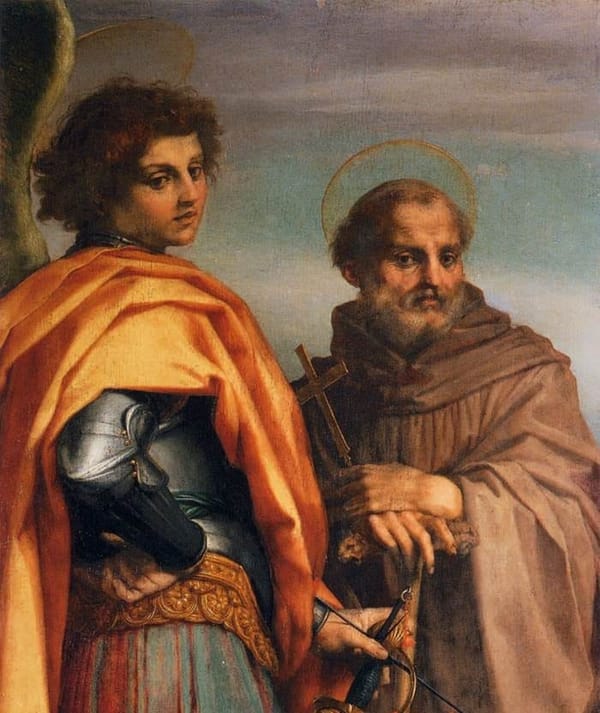
On this same day the whole Church unites in the solemn homage which Milan continues to pay, after a lapse of sixteen centuries, to two valiant witnesses of Christ. ‘Our martyrs, Felix and Nabor,’ says St. Ambrose, ‘are the grain of mustard-seed mentioned in the Gospel. They possessed the good odour of faith, though it did not appear to men; persecution arose, they laid down their arms, and bowed their heads to the sword, and immediately the grace that was hidden within them was shed abroad even to the ends of the world; so that we can now in all truth say of them: Their sound has gone forth into all the earth.'
Let us honour them and ask their intercession by the prayer which the Church addresses to God in commemoration of their glorious combat.
Collect
| Previous July 11: St. Pius I, Pope and Martyr | Next July 12: St. John Gualbert, Abbot |