Daily reading
After Pentecost
Double of the I Class · November 1 · Sanctoral
November 1, 2026
From Dom Guéranger’s The Liturgical Year.
A Double of the I Class leads the Sunday.Rubric

|
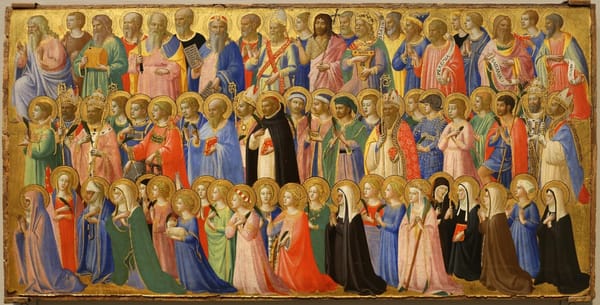
November 1: Feast of All Saints
I saw a great multitude which no man could number of all nations and tribes and peoples and tongues, standing before the throne, and in sight of the Lamb, clothed with white robes, and palms in their hands: and they cried with a loud voice, saying: Salvation to our God!1
TIME is no more; it is the human race eternally saved that is thus presented in vision to the prophet of Patmos. Our life of struggle and suffering on earth is then, to have an end. Our long-lost race is to fill up the angelic ranks thinned by Satan’s revolt; and, uniting in the gratitude of the redeemed of the Lamb, the faithful spirits will sing with us: “Thanksgiving, honour, and power, and strength to our God forever and ever!2
And this shall be the end, as the apostle says;3 the end of death and suffering; the end of history and of its revolutions, which will then be explained. The old enemy, hurled down with his followers into the abyss, will live on only to witness his own eternal defeat. The Son of man, the Saviour of the world, will have delivered the kingdom to God His Father; and God, the last end of creation and of redemption, will be all in all.4
Long before the seer of the Apocalypse, Isaias sang: I saw the Lord sitting upon a throne, high and elevated, and his train filled the temple. And the Seraphim cried one to another, and said: Holy, holy, holy, the Lord God of hosts, all the earth is full of his glory.5 The train and fringes of God’s vesture are the elect, who are the adornment of the Word, the splendour of the Father. For since the Word has espoused our human nature, that nature is his glory, as he is the glory of God. The Bride herself is clothed with the justifications of the Saints; and when this glittering robe is perfected, the signal will be given for the end of time. This feast announces the ever-growing nearness of the eternal nuptials; for on it we annually celebrate the progress of the Bride’s preparation.
Blessed are they that are called to the marriage-supper of the Lamb!6 Blessed are we all, who have received in Baptism the nuptial robe of holy charity, which entitles us to a seat at the heavenly banquet! Let us prepare ourselves for the unspeakable destiny reserved for us by love. To this end are directed all the labours of this life: toils, struggles, sufferings for God’s sake, all adorn with priceless jewels the garment of grace, the clothing of the elect. Blessed are they that mourn!7
They that have gone before us, wept as they turned the furrows and cast in the seed; but now their triumphant joy overflows upon us as an anticipated glory in this valley of tears. Without waiting for the dawn of eternity, the present solemnity gives us to enter by hope into the land of light, whither our fathers have followed Jesus the divine forerunner. Do not the thorns of suffering lose their sharpness, at the sight of the eternal joys into which they are to blossom? Does not the happiness of the dear departed cause a heavenly sweetness to mingle with our sorrow? Let us hearken to the chants of deliverance sung by those for whom we weep; little and great, this is the feast of them all, as it will one day be ours. At this season, when cold and darkness prevail, nature herself, stripping off her last adornments, seems to be preparing the world for the passage of the human race into the heavenly country. Let us, then, sing with the Psalmist: “I rejoiced at the things that were said to me: We shall go into the house of the Lord. Our feet as yet stand only in thy outer courts; but we see thy building ever going on, O Jerusalem, city of peace, compacted together in concord and love. To thee do the tribes go up, the tribes of the Lord, praising the name of the Lord, thy vacant seats are being filled up. May all good things be for them that love thee, O Jerusalem; may peace be in thy strength, and abundance in thy towers. For the sake of my brethren and of my neighbours, who are already thy inhabitants, I take pleasure in thee; because of the Lord our God, whose dwelling thou art, I have placed in thee all my desire.”8
First Vespers
The bells ring out as joyously as on the brightest days. They announce the great solemnity of the closing Cycle; the feast which shows us time stamped with the impress of eternity, and God taking possession of the declining year and gathering in its harvest. At the sound of their triumphant and harmonious peals, the Church, prostrate and fasting since morning, raises her brow to the light. Guided by St. John, she penetrates the secrets of heaven; and the words of the beloved disciple, uttered by her lips, assume a tone of incomparable enthusiasm. This feast is truly the triumph of her motherhood; for the great crowd of the blessed before the throne of the Lamb, are the sons and daughters she alone has given to the Lord.
Ps. Dixit Dominus, page 36.
Beside her own glorified sons the Church beholds the Angels, with their magnificent ritual and their prostrate adoration. Her heart is enraptured at the scene, and she describes it to those who are still militant on earth with her.
Ps. Confitebor tibi Domine, page 37.
But the uninterrupted homage and chants of the heavenly Princes, are not the only glory rendered to the Most High in his eternal temple. As, even in the midst of a numerous choir, a mother can distinguish the voice of her child, so the Church exults to hear the family she has brought up for her Spouse, joining in the heavenly concert and celebrating the Lamb, whose Blood has purchased them the kingdom of God.
Ps. Beatus vir, page 38.
This is the true joy, the ineffable consolation of this day; and the exiled Church cannot refrain from sending up a burning appeal to the Saints, to praise the Lord if possible with still greater zeal. “Be happy, all of you, and sing to him,” she cries out from this valley of tears, borrowing the words of Tobias in the land of his captivity.
Ps. Laudate pueri, page 39.
To praise God unceasingly is the lot of the Saints, Israel’s goodly inheritance in the true Sion. The Church, in her transport, wearies not of extolling this glorious lot, this better part, privilege of a few on earth, but enjoyed by all in heaven.
Psalm 116
Quoniam confirmata est super nos misericordia ejus: * et veritas Domini manet in aeternum.
For his mercy is confirmed upon us: and the truth of the Lord remaineth forever.
No power can lessen the glory of the holy city, or diminish the number of its happy inhabitants, which was fixed before all ages in the counsels of the Most High. Although the world is only too deserving of wrath, it cannot be consumed until it has furnished heaven with the last of the elect. This is expressed in a lively manner by the Capitulum, taken from the Apocalypse.
Capitulum.
(Apoc. vii.)
Rabanus Maurus, Abbot of Fulda and Archbishop of Mayence, is supposed to be the author of the following hymn. The perfidious nation, whose expulsion from Christian lands is prayed for, was in the ninth century the race of infidel Normans, who filled the empire with slaughter and ruin under Charlemagne’s weak successors. The striking conversion of these savage destroyers was the answer of the Saints. May they ever hear the Church’s prayers in a like manner, enlighten those who persecute her without knowing her, and make of them her firmest supporters.
Hymn
Quibus Patris clementiam
Tuae ad tribunal gratiae
Patrona Virgo postulat.
Distincta gyros agmina,
Antiqua cum praesentibus,
Futura damna pellite.
Apud severum Judicem,
Veris reorum fletibus
Exposcite indulgentiam.
Vos candidati praemio
Confessionis, exsules
Vocate nos in patriam.
Et quos eremus incolas
Transmisit astris, coelitum
Locate nos in sedibus.
Credentium de finibus,
Ut unus omnes unicum
Ovile nos pastor regat.
Natoque Patris unico,
Sancto simul Paraclito,
In sempiterna saecula.
for whom thy Virgin Mother
stands as advocate before the throne of grace,
imploring the Father’s mercy.
of blessed choirs,
drive far from us all evils,
past, present, and to come.
plead before the terrible Judge,
and, for the unfeigned tears of us poor sinners,
obtain our pardon.
ye confessors with snow-white wreaths,
call us from exile
into our fatherland.
and ye who from the desert
have sped beyond the stars,
give us a place among your heavenly thrones.
far from Christian lands,
that we may all be gathered
by one Pastor into the one fold.
and to his only Son,
together with the holy Paraclete,
through everlasting ages.
All the choirs of Angels, all the ranks of the Saints receive, in the Magnificat Antiphon, the homage of the Church’s prayer; and all will join in praising the Queen of heaven and earth, by singing her own glorious Canticle.
Antiphon of the Magnificat
The Canticle Magnificat page 44.
Prayer
When Rome had completed the conquest of the world, she dedicated to all the gods in token of her gratitude the Pantheon, the most durable monument of her power. But when she herself had been conquered by Christ, and invested by him with the empire over souls, she withdrew her homage from vain idols and offered it to the Martyrs; for they, praying for her as she slew them, had rendered her truly eternal. To the martyrs then, and to Mary their Queen, she consecrated forever, on the morrow of her merciful chastisement, the now purified Pantheon.
“Come forth from your dwellings, ye Saints of God, hasten to the place prepared for you.”9 For three centuries the catacombs were the resting‑place of our Lord’s athletes, when they were borne from the arena. These valiant warriors deserved the honours of a triumph far better than did the great victors of old. In 312, however, Rome disarmed but not yet changed in heart, was not at all disposed to applaud the men who had conquered the gods of Olympus and of the Capitol. While the Cross surmounted her ramparts, the white-robed army still lay entrenched in the subterranean crypts that surrounded the city like so many outworks. Three centuries more were granted to Rome, that she might make satisfaction to God’s justice, and take full cognizance of the salvation reserved for her by his mercy. In 609 the patient work of grace was completed; the Sovereign Pontiff Boniface IV uttered the word for the sacred crypts to yield up their treasures. It was a solemn moment, a forerunner of that wherein the Angel’s trumpet-call shall sound over the sepulchers of the world.10 The successor of St. Peter, in all his apostolic majesty, and surrounded by an immense crowd, presented himself at the entrance of the catacombs. He was attended by eighteen chariots magnificently adorned for the conveyance of the martyrs. The ancient triumphal way opened before the Saints; the sons of the Quirites sang in their honour: “You shall come with joy and proceed with gladness; for behold, the mountains and the hills exult, awaiting you with joy. Arise, ye Saints of God, come forth from your hiding-places; enter into Rome, which is now the holy city; bless the Roman people following you to the temple of the false gods, which is now dedicated as your own church, there to adore together with you the majesty of the Lord.”11
Thus, after six centuries of persecution and destruction, the martyrs had the last word; and it was a word of blessing, a signal of grace for the great city hitherto drunk with the blood of Christians. More than rehabilitated by the reception she was giving to the witnesses of Christ, she was now not merely Rome, but the new Sion, the privileged city of the Lord. She now burned before the Saints the incense they had refused to offer to her idols; their blood had flowed before the very altar, on which she now invited them to rest, since the usurpers had been hurled back into the abyss. It was a happy inspiration that induced her, when she dedicated to the holy martyrs the temple built by Marcus Agrippa and restored by Severus Augustus, to leave upon its pediment the names of its primitive constructers and the title they had given it; for then only did the famous monument truly merit its name, when Christian Rome could apply to the new inhabitants of the Pantheon those words of the Psalm: I have said, you are gods.12 The thirteenth of May was the day of their triumphant installation.
Every dedication on earth reminds the Church, as she herself tells us, of the assembly of the Saints, the living stones of the eternal dwelling which God is building for himself in heaven.13 It is not astonishing, then, that the dedication of Agrippa’s Pantheon, under the above-mentioned circumstances, should have originated the feast of today.14 Its anniversary, recalling the memory of the martyrs collectively, satisfied the Church’s desire of honouring year by year all her blessed sons who had died for the Lord; for, at an early date it became impossible to celebrate each of them on the day of his glorious death. In the age of peace there was added to the cultus of the martyrs that of the other just, who daily sanctified themselves in all the paths of heroism opened out to Christian courage. The thought of uniting these with the former in one common solemnity, which would supply for the unavoidable omission of many of them, followed naturally upon the initiative given by Boniface IV.
In 732, in the first half of that eighth century which was such a grand age for the Church, Gregory III dedicated, at St. Peter’s on the Vatican, an oratory in honour of the Saviour, of his blessed Mother, of the holy Apostles, of all the holy Martyrs, Confessors, and perfect Just, who repose throughout the world.15 A dedication under so extensive a title did not, it is true, imply the establishment of our feast of All Saints by the illustrious Pontiff; yet from this period it began to be celebrated by divers churches, and that too on the first of November; as is attested, with regard to England, by Venerable Bede’s Martyrology and the Pontifical of Egbert of York. It was far, however, from being universal, when in the year 835 Louis Le Débonnaire, at the request of Gregory IV and with the consent of all the bishops of his realm, made its celebration obligatory by law. This decree was welcomed by the whole Church and adopted as her own, says Ado, with reverence and love.16
The councils of Spain and Gaul, as early as the sixth century,17 mention a custom then existing, of sanctifying the commencement of November by three days of penance and litanies, like the Rogation days which precede the feast of our Lord’s Ascension. The fast on the Vigil of All Saints is the only remaining vestige of this custom of our forefathers, who, after the institution of the feast, advanced the triduum of penance, so as to make it a preparation for the solemnity itself. “Let our devotion be ‘complete,’ is the recommendation of a contemporaneous author; ‘let us prepare ourselves for this ‘most holy solemnity by three days of fasting, prayer and almsdeeds.’”18
When extended to the entire world, the feast became complete; it was made equal to the greatest solemnities, and widened its horizon till it reached the infinite, embracing uncreated as well as created sanctity. Its object was now, not only Mary and the martyrs; not only all the just children of Adam, but moreover the nine choirs of Angels, and above all the Holy Trinity Itself, God who is all in all, the King of kings, that is, of the Saints, the God of gods in Sion. Hear how the Church awakes her children on this day: Come let us adore the Lord, the King of kings, for he is the crown of all the Saints.19 Such was the invitation addressed by our Lord himself to St. Mechtilde, the chantress of Helfta, the privileged one of his divine Heart: “Praise me, for that I am ‘the crown of all the Saints.’” The virgin then beheld all the beauty of the elect and their glory drawing increase from the Blood of Christ, and resplendent with the virtues practised by him; and responding to our Lord’s appeal, she praised with all her might the blissful and ever adorable Trinity, for deigning to be to the Saints their diadem and their admirable dignity.20
Dante too describes Beatrice in the highest heaven, forming her crown of the reflection of the eternal rays. “Glory be to the Father, and to the Son, and to the Holy Ghost,” sang the inhabitants of Paradise with one voice. “I seemed,” says the sublime poet, “to behold a smile of the universe. The kingdom of bliss, with all its people both ancient and new, turned look and love all towards one point. O triple light, which shining in a single star dost so delight them, look down upon our tempests!”21
In many churches, the ancient Office of the Feast, up to the sixteenth century, had this peculiarity, that at the Nocturns the first Antiphon, the first Blessing, the first Lesson, and the first Responsory treated of the Blessed Trinity; the second of these respective pieces spoke of our Lady, the third of the Angels, the fourth of the Patriarchs and Prophets, the fifth of the Apostles, the sixth of the Martyrs; the seventh of the Confessors, the eighth of the Virgins, the ninth of all the Saints. On this account the first Lesson, contrary to the custom of the rest of the year, was given to the highest dignitary of the choir, and the first Responsory to the first cantors. The rest followed in order down to the children; one of whom sang the Lesson of the Virgins, and five others clothed in white and holding lighted tapers in their hands in memory of the five wise virgins, sang the eighth Responsory before the Lady-Altar. The ninth Lesson and Responsory were again chanted by Priests. All, or nearly all, these customs have been successively modified; but the arrangement of the Responsories remains the same.
Our readers will be glad to find here the primitive Antiphons and Responsories referred to in the visions of Saints, who show us each order of the blessed in heaven taking part, during this sacred night, in the prayers and thanksgivings of earth. The following texts are found alike in the Breviaries of Aberdeen and Salisbury.
Antiphons.
Responsories.
3. ℟. Te sanctum Dominum in excelsis laudant omnes Angeli, dicentes:* Te decet † Laus et honor, Domine.℣. Cherubim quoque ac Seraphim Sanctus proclamant, et omnis coelicus ordo dicens.* Te decet. Gloria Patri. † Laus et honor.
4. ℟. Inter natos mulierum non surrexit major Johanne Baptista:* Qui viam Domino praeparavit in eremo.℣. Fuit homo missus a Deo cui nomen Johannes erat.* Qui viam.
5. ℟. Cives Apostolorum et domestici Dei advenerunt hodie: * Portantes facem et illuminantes patriam, dare pacem gentibus et liberare populum Domini.℣. Audite preces supplicum vitae aeternae poscentes praemia, qui fertis in dextris manipulos justitiae, quique gaudentes advenistis hodie.* Portantes.
6. ℟. O constantia Martyrum laudabilis: o charitas inexstinguibilis:* patientia invincibilis quae, licet inter pressuras persequentium visa sit despicabilis:* Invenietur in laudem et gloriam et honorem. * In tempore retributionis.℣. Nobis ergo petimus piis subveniant meritis, honorificati a Patre qui est in coelis.* Invenietur. Gloria. † In tempore.
7. ℟. Sint lumbi vestri praecincti et lucernae ardentes in manibus vestris:* Et vos similes hominibus exspectantibus dominum suum quando revertatur a nuptiis.℣. Vigilate ergo, quia nescitis qua hora Dominus vester venturus sit.* Et vos.
8. ℟. Audivi vocem de coelo venientem: Venite, omnes Virgines sapientissimae:* Oleum recondite in vasis vestris, dum Sponsus advenerit.℣. Media nocte clamor factus est: Ecce Sponsus venit.* Oleum.
9. ℟. Concede nobis, Domine quaesumus, veniam delictorum: et intercedentibus Sanctis quorum hodie solemnia celebramus:* Talem nobis tribue devotionem.* Ut ad eorum pervenire mereamur societatem.℣. Adjuvent nos eorum merita, quos, propria impediunt scelera; excuset intercessio accusat quos actio: et qui eis tribuisti coelestis palmam triumphi, nobis veniam non deneges peccati.* Talem. Gloria. † Ut ad.
3. ℟. Thee, holy Lord, all the Angels praise on high, saying:* To thee beseemeth † Praise and honour, O Lord.℣. The Cherubim also and the Seraphim cry out, Holy; and every heavenly rank, saying:* To thee beseemeth. Glory be to the Father. † Praise and honour.
4. ℟. Among those born of women there hath not arisen a greater than John the Baptist: * Who prepared the way for the Lord in the desert.℣. There was a man sent from God, whose name was John.* Who prepared.
5. ℟. The fellow-citizens of the Apostles and the servants of God have come before us today: * Bearing a torch and enlightening our fatherland, to give peace to the nations, and to deliver the people of the Lord.℣. Hear the prayers of suppliants imploring the rewards of eternal life, O ye who bear in your hands the sheaves of justice, and who come today rejoicing.* Bearing.
6. ℟. O praiseworthy constancy of the Martyrs; O inextinguishable charity; O invincible patience! Although under the tortures of the persecutors it appeared despicable, * It shall be found worthy of praise and glory and honour, † In the time of retribution.℣. Therefore we pray that they may assist us with their blessed merits, now that they are honoured by the Father who is in heaven.* It shall be found. Glory be to the Father. † In the time.
7. ℟. Let your loins be girt and lamps burning in your hands. * And you yourselves like to men who wait for their lord, when he shall return from the wedding.℣. Watch ye therefore, because you know not what hour your Lord will come.* And you yourselves.
8. ℟. I heard a voice coming from heaven: Come all ye most wise Virgins: * Keep oil ready in your vessels, for when the Spouse shall come.℣. At midnight there was a cry made: Behold the Bride-groom cometh.* Keep oil.
The Greeks honour with us, on one common solemnity, “all the Saints of all the countries on earth, of Asia, Lybia, and Europe, of North and South.”22 But, whereas the West celebrates at the close of the year a feast which represents the gathering of the harvest into our heavenly Father’s granary, the East keeps it on the first Sunday after Pentecost, in the spring time of the Church, when under the action of the Holy Ghost, sanctity was everywhere beginning to blossom.23 We find it thus as early as the fourth century; for it was on this first Sunday after Pentecost, which with us Latins is now the feast of the most holy Trinity, that St. John Chrysostom pronounced his discourse in honour of “all the Martyrs, who have suffered throughout ‘the world.’”24
In the West also as we have seen, the origin of All Saints’ feast was this general commemoration of the Martyrs. This latter was placed by some Eastern churches on the Friday within the Octave of Easter.25 It was a happy thought thus to associate the confession of Christ’s witnesses with the victory over death won by him, whose divine confession before Pontius Pilate had been an example and a support to them in presence of their executioners. Indeed Rome herself had had the same inspiration, when she made her solemn commemoration of the Martyrs in the beginning of May; and she still reserves to the Martyrs and Apostles the honour of having a special Office for the whole of Paschal Time.
We borrow the following passages from the Greek Office for the Sunday of All Saints.
In Magno Vespertino.
Mass
Ancient documents referring to this day inform us, that on the Calends of November the same eagerness was shown as at Christmas to assist at the holy Sacrifice.26 However general the Feast was, or rather because of its universality, was it not the special joy of everyone, and the honour of Christian families? Taking a holy pride in the persons whose virtues they handed down to posterity, they considered the heavenly glory of their ancestors, who had perhaps been unknown in the world, to be a higher nobility than any earthly dignity.
Faith was lively in those days; and Christians seized the opportunity of this feast to make amends for the neglect, voluntary or involuntary, suffered during the year by the blessed inscribed on the general Calendar. In the famous Bull Transiturus de hoc mundo, by which he established the feast of Corpus Christi, Urban IV mentions this as one of the motives that had led to the prior institution of All Saints;27 and expresses a hope that the new solemnity may in like manner compensate for the distractions and coldness of the rest of the year, towards this divine Sacrament, wherein he resides who is the crown and the glory of all Saints.28
The Introit Antiphon resembles that of our Lady’s Assumption day. This feast is indeed a sequel to Mary’s triumph. As our Lord’s Ascension called for his Mother’s Assumption, both required for their completion the universal glorification of the human race which provides heaven with its King and Queen. Joy, then, on earth, which continues thus magnificently to give its fruit! Joy among the Angels, who see their vacant thrones filled up! Joy, says the Verse, to all the blessed, who are receiving the congratulations of heaven and earth!
Introit
But we sinners, who are still in exile, have always and everywhere need of mercy. Today we may well hope for it, since so many are interceding for us. If the prayer of one Saint is powerful, what must be the united suffrages of all heaven!
Collect
Epistle
Cap. Vii.In diebus illis: Ecce ego Joannes vidi alterum Angelum ascendentem ab ortu solis, habentem signum Dei vivi: et clamavit voce magna quatuor Angelis, quibus datum est nocere terrae et mari, dicens: Nolite nocere terrae et mari, neque arboribus, quoadusque signemus servos Dei nostri in frontibus eorum. Et audivi numerum signatorum, centum quadraginta quatuor milia signati, ex omni tribu filiorum Israel. Ex tribu Juda duodecim millia signati. Ex tribu Ruben duodecim millia signati. Ex tribu Gad duodecim millia signati. Ex tribu Aser duodecim millia signati. Ex tribu Nephthali duodecim millia signati. Ex tribu Manasse duodecim millia signati. Ex tribu Simeon duodecim millia signati. Ex tribu Levi duodecim millia signati. Ex tribu Issachar duodecim millia signati. Ex tribu Zabulon duodecim millia signati. Ex tribu Joseph duodecim millia signati. Ex tribu Benjamin duodecim millia signati. Post haec vidi turbam magnam, quam dinumerare nemo poterat ex omnibus gentibus, et tribubus, et populis, et linguis: stantes ante thronum, et in conspectu Agni, amicti stolis albis, et palmae in manibus eorum; et clamabant voce magna, dicentes: Salus Deo nostro, qui sedet super thronum, et Agno. Et omnes Angeli stabant in circuitu throni, et seniorum, et quatuor animalium: et ceciderunt in conspectu throni in facies suas, et adoraverunt Deum, dicentes, Amen. Benedictio, et claritas, et sapientia, et gratiarum actio, honor, et virtus, et fortitudo Deo nostro, in saecula saeculorum. Amen.
Chap. vii.
In those days, behold I, John, saw another angel ascending from the rising of the sun, having the sign of the living God. And he cried with a loud voice to the four angels, to whom it was given to hurt the earth and the sea, saying, Hurt not the earth, nor the sea, nor the trees, till we sign the servants of our God in their foreheads. And I heard the number of them that were signed: an hundred forty‑four thousand were signed, of every tribe of the children of Israel. Of the tribe of Juda were twelve thousand signed: of the tribe of Ruben twelve thousand signed: of the tribe of Gad twelve thousand signed: of the tribe of Aser twelve thousand signed: of the tribe of Nephthali twelve thousand signed: of the tribe of Manasses twelve thousand signed: of the tribe of Simeon twelve thousand signed: of the tribe of Levi twelve thousand signed: of the tribe of Issachar twelve thousand signed: of the tribe of Zabulon twelve thousand signed: of the tribe of Joseph twelve thousand signed: of the tribe of Benjamin twelve thousand signed. After this I saw a great multitude, which no man could number, of all nations, and tribes, and peoples, and tongues, standing before the throne and in sight of the Lamb, clothed with white robes, and palms in their hands; and they cried with a loud voice saying: Salvation to our God who sitteth upon the throne, and to the Lamb. And all the angels stood round about the throne, and the ancients, and the four living creatures; and they fell down before the throne upon their faces, and adored God, saying: Amen. Benediction, and glory, and wisdom, and thanksgiving, honour, and power, and strength to our God forever and ever. Amen.
At the time of his birth, the Man-God, through the instrumentality of Caesar Augustus, took a census of the world; it was fitting that on the eve of the Redemption, the statistics of the human race should be officially registered. And now it is time to make a fresh enrollment, and to enter in the Book of Life the results of the work of Redemption.
“Wherefore this number of the world at the time of our Lord’s birth,” says St. Gregory in one of the Christmas homilies, “save for this manifest reason, that he was appearing in the Flesh, who is to enregister the elect in eternity?”29 But, many having withdrawn themselves by their own fault from the benefit of the first enrollment, which included all men in the ranks of those to be redeemed, there was need of a second and definitive registration, which should cancel the names of the guilty. Let them be blotted out of the book of the living, and with the just let them not be written;30 such are the words of the Psalmist, quoted by St. Gregory in the above-mentioned homily.
Today, however, the Church is too full of joy to think of any but the elect; they alone take part in the glorious close of human history described in the Epistle. Indeed, they alone are reckoned before God; the reprobate are but the waste of a world where sanctity alone responds to the Creator’s advances, to the ventures of his infinite love. Let our souls be supple to receive the divine stamp, which is to render us comformable to the image of the Only-begotten Son, and mark us out as God’s coin. Whoever is unwilling to receive the divine impress will inevitably be marked with the character of the beast;31 and when the Angels come to make the final settlement, every coin unfit to bear the divine stamp will fall into the furnace, where the dross will burn eternally.
Let us then, as the Gradual recommends, live in fear; not that of the slave, who dreads punishment; but that filial fear, which is anxious never to displease him from whom are all good things, and whose kindness deserves all our love in return. Without losing aught of their beatitude, or diminishing their love, the angelic Powers and all the Saints in heaven prostrate with a holy trembling beneath the gaze of God’s awful majesty.32
Gradual
Gospel
Cap. v.
In illo tempore: Videns Jesus turbas, ascendit in montem, et cum sedisset, accesserunt ad eum discipuli ejus, et aperiens os suum, docebat eos, dicens: Beati pauperes spiritu: quoniam ipsorum est regnum coelorum. Beati mites: quoniam ipsi possidebunt terram. Beati, qui lugent: quoniam ipsi consolabuntur. Beati, qui esuriunt et sitiunt justitiam: quoniam ipsi saturabuntur. Beati misericordes: quoniam ipsi misericordiam consequentur. Beati mundo corde: quoniam ipsi Deum videbunt. Beati pacifici: quoniam filii Dei vocabuntur. Beati qui persecutionem patiuntur propter justitiam: quoniam ipsorum est regnum coelorum. Beati estis cum maledixerint vobis, et persecuti vos fuerint, et dixerint omne malum adversum vos mentientes, propter me: gaudete, et exsultate, quoniam merces vestra copiosa est in coelis.
Chap. v.
At that time, Jesus, seeing the multitudes, went up into a mountain; and when he was set down his disciples came unto him. And opening his mouth, he taught them saying: Blessed are the poor in spirit; for theirs is the kingdom of heaven. Blessed are the meek; for they shall possess the land. Blessed are they that mourn; for they shall be comforted. Blessed are they that hunger and thirst after justice; for they shall have their fill. Blessed are the merciful; for they shall obtain mercy. Blessed are the clean of heart; for they shall see God. Blessed are the peacemakers; for they shall be called the children of God. Blessed are they that suffer persecution for justice sake; for theirs is the kingdom of heaven. Blessed are ye when they shall revile you, and persecute you, and speak all that is evil against you, untruly, for my sake: be glad and rejoice, for your reward is very great in heaven.
Earth is so near to heaven today, that the one thought which fills all hearts is happiness. The Friend, the Bridegroom, the divine Brother of Adam’s children, comes and sits down among them, and talks of blessedness: “Come to me all you that labour and suffer,” sang the Alleluia-Verse, that sweet echo from our fatherland reminding us withal of our exile. And immediately in the Gospel appears the goodness and kindness of God our Saviour. Let us listen to him, teaching us the ways of blessed hope, the holy delights which are at once an assurance and a foretaste of the perfect bliss of heaven.
On Sinai Jehovah held the Jew at a distance, giving him precepts under pain of death. On the summit of this other mountain where the Son of God is seated how differently the Law of love is promulgated! In the New Testament, the eight beatitudes have taken the place occupied in the Old by the Decalogue graven on stone. Not that the beatitudes repeal the Commandments; but their superabundant justice goes far beyond all prescriptions. It is from his Heart that Jesus brought them forth in order to imprint them, more lastingly than on stone, in the hearts of his people. They are the portrait of the Son of Man, the summary of our Redeemer’s life. Look then, and do according to the pattern that was shown thee in the mount.33
Poverty was the first mark of our God in Bethlehem; and who ever appeared so meek as Mary’s Child? Who wept for more noble causes than he in his crib, where he was already expiating our sins and appeasing his Father? They that hunger after justice, the merciful, the clean of heart, the peacemakers where, save in him, will they find the incomparable ideal, never attained yet ever imitable? And by his death he became the leader of all those who are persecuted for justice’ sake. In this the highest beatitude on earth, the Incarnate Word takes delight, returning upon it, detailing it, and closing with it in today’s Gospel as with a song of ecstasy. The Church has never had any other ideal; she has ever walked in the footsteps of her Spouse, and her history, throughout the ages, has been but the prolonged echo of the Beatitudes. Let us also understand; that we may be blessed both in this world and in the next, let us follow our Lord and the Church.
The evangelical beatitudes raise man above torments, above death itself, which disturbs not the peace of the just, but consummates it. Such is the burthen of the Offertory chant, taken from the Book of Wisdom.
Offertory
As the Secret explains, the Sacrifice in which we are allowed to take part, glorifies God, honours the Saints, and renders the divine goodness propitious to us.
Secret
The Communion Antiphon, like an echo of the Gospel, repeats the last three beatitudes, referring them, and rightly, to the divine Sacrament whereby they are nourished.
Communion
In the Postcommunion, the Church asks as the fruit of this feast, that her children may always honour the Saints, and ever benefit by their favour with God.
Postcommunion
Second Vespers
The Second Vespers are the same as the First, except the last Psalm, the Versicle, and the Magnificat Antiphon. The Psalm, which is as follows, puts upon the lips of the Saints a beautiful summary of their life of faith and suffering here on earth, and of their eternal gratitude and praise in heaven.
Psalm 115
Ego dixi in excessu meo: * Omnis homo mendax.
Quid retribuam Domino: * pro omnibus quae retribuit mihi?
Calicem salutaris accipiam: * et nomen Domini invocabo.
Vota mea Domino reddam coram omni populo ejus: * pretiosa in conspectu Domini mors Sanctorum ejus.
O Domine, quia ego servus tuus: * ego servus tuus, et filius ancillae tuae.
Dirupisti vincula mea: * tibi sacrificabo hostiam laudis, et nomen Domini invocabo.
Vota mea Domino reddam in conspectu omnis populi ejus: * in atriis domus Domini, in medio tui, Jerusalem.
I said in my excess: Every man is a liar.
What shall I render to the Lord, for all the things that he hath rendered to me?
I will take the chalice of salvation; and I will call upon the name of the Lord.
I will pay my vows to the Lord, before all his people: precious in the sight of the Lord is the death of his saints.
O Lord, for I am thy servant: I am thy servant and the son of thy handmaid.
Thou hast broken my bonds: I will sacrifice to thee the sacrifice of praise, and I will call upon the name of the Lord.
I will pay my vows to the Lord in the sight of all his people; in the courts of the house of the Lord, in the midst of thee, O Jerusalem!
Antiphon of the Magnificat
This Antiphon which expresses at once an unspeakable delight and a patient longing, closes the solemnity of the Saints. But the Church’s day is not yet ended. Scarcely has she given the last salute to her glorious sons disappearing in their white robes in the train of the Lamb, when an innumerable crowd of suffering souls surrounds her at the gate of heaven; and to these she at once lends her voice and her heart. The glittering vestments, which reminded her of the snowy garments of the blessed, are changed for the colour of mourning; the ornaments and flowers disappear from the Altar; the organ is hushed; the bells ring a plaintive knell. Without any transition, the Vespers of All Saints’ are followed by the Vespers of the Dead.34
Vespers Of The Dead
No human science or eloquence could ever reach the depth of teaching, the power of soul-stirring supplication contained in the office of the Dead. This intimate knowledge of the secrets of the other world, and of the way to win the Heart of her Spouse, belongs to the Bride alone; and she alone, the true Mother of men, is able with exquisite tact to console the orphans and the bereaved, by shortening the painful purification of those who have passed away.
Dilexi: this first song of the holy souls is all love; as the Credidi, the last Psalm sung by the heavenly citizens on this feast, recalled their faith, and the trials they have endured on earth. We have just remarked that there is no transition between the two solemnities. What need of any? The suffering souls and the blessed, both are the captives of love; love gives them their dignity, and is their imperishable treasure. In the case of the blessed, faith having given place to the vision of God, their love is highest bliss; but to the suffering souls, imprisoned in darkness by sins not yet expiated, love is the source of inexpressible pain. However, they are now free from the anxieties of this world, the perils of hell; they are confirmed in grace, and can never sin again; they are full of gratitude towards God who has saved them in his mercy, and in his justice is purifying them to make them worthy of himself. They are in a state of absolute and perfect resignation, and of calm expectancy, called by holy Church a “sleep of peace.”35
Psalm 114
Quia inclinavit aurem suam mihi: * et in diebus meis invocabo.
Circumdederunt me dolores mortis: * et pericula inferni invenerunt me.
Tribulationem et dolorem inveni: * et nomen Domini invocavi.
O Domine, libera animam meam: * misericors Dominus, et justus, et Deus noster miseretur.
Custodiens parvulos Dominus: * humiliatus sum; et liberavit me.
Convertere anima mea in requiem tuam: * quia Dominus benefecit tibi.
Quia eripuit animam meam de morte: * oculos meos a lacrimis, pedes meos a lapsu.
Placebo Domino: * in regione vivorum.
Because he has inclined his ear to me, and in my days I will call to him.
The sorrows of death have surrounded me; and the dangers of hell are come upon me.
I have found tribulation and sorrow; and I have invoked the name of the Lord.
O Lord, deliver my soul: the Lord is merciful and just: and our God shows mercy.
The Lord keeps the little ones; I was humbled, and he delivered me.
Return, my soul, into thy rest; because the Lord has done good to thee.
Because he has delivered my soul from death, my eyes from tears, and my feet from slipping.
I will please the Lord in the land of the living.
Instead of the usual doxology the Church makes, at the end of every Psalm, a fervent prayer for the departed.
Requiem aeternam * dona eis Domine.
Et lux perpetua * luceat eis.
Grant them eternal rest, O Lord:
And let perpetual light shine on them.
The soul in Purgatory, separated from the body which weighed her down and distracted her by a thousand vain preoccupations, is now entirely absorbed by the one desire of becoming at length perfectly pleasing to God. Towards this end her whole energy is directed; and so too is the force of the torments for whose violence she is so grateful. Purgatory is a crucible where the dross of sin is burnt away, until every debt is cancelled. When its flames have effaced every stain and every wrinkle that marred the soul’s beauty, then she flees away to her Spouse, truly a blessed one and sure of offering no obstacle to the complacent love of her Lord.
Yet to what a sad length her exile is prolonged! True she is united by charity to the inhabitants of heaven: but the fire which torments her is of the same nature as that of hell; her abode is nigh to that of the damned: she must endure the proximity of the infernal Cedar, and of those adversaries of all peace, the detestable demons, who attacked her unceasingly during her mortal life with their assaults and their snares, and who still with deceitful tongue accuse her before the throne of God. Presently we shall hear the Church imploring: “ From the gate of hell deliver her!”
Psalm 119
Ad Dominum cum tribularer clamavi: * et exaudivit me.
Domine libera animam meam a labiis iniquis: * et a lingua dolosa.
Quid detur tibi aut quid apponatur tibi: * ad linguam dolosam?
Sagittae potentis acutae: * cum carbonibus desolatoriis.
Heu mihi, quia incolatus meus prolongatus est: habitavi cum habitantibus cedar: * multum incola fuit anima mea.
Cum his, qui oderunt pacem, eram pacificus: * cum loquebar illis, impugnabant me gratis.
Requiem aeternam * dona eis Domine.
Et lux perpetua * luceat eis.
When I was in tribulation, I cried to the Lord; and he heard me.
O Lord deliver my soul from unjust lips, and from a deceitful tongue.
What is to be given to thee, or what is to be added to thee: to a deceitful tongue?
The sharp arrows of the mighty: with coals of desolation.
Woe is me that my abode is prolonged. I have dwelt with the inhabitants of Cedar; my soul has been long a sojourner.
I was peaceable with those that hated peace; when I spoke to them, they insulted me for no reason.
Grant them eternal rest, O Lord;
And let perpetual light shine on them.
Yet the soul faints not; lifting up her eyes to the mountains, she feels that she can rely upon her Lord, and that she is abandoned neither by heaven which is expecting her arrival, nor by her mother the Church on earth. Although Purgatory, where justice and peace meet and embrace, is so near to the region of endless weeping, it is still accessible to the Angels. These august messengers comfort the soul with divine communications; while the blessed in heaven and the just on earth assist her with their prayers and suffrages. She is well assured that sin, the only real evil, can never touch her.
Psalm 120
Levavi oculos meos in montes: * unde veniet auxilium mihi.
Auxilium meum a Domino: * qui fecit coelum et terram.
Non det in commotionem pedem tuum: * neque dormitet qui custodit te.
Ecce non dormitabit neque dormiet: * qui custodit Israel.
Dominus custodit te, Dominus protectio tua: * super manum dexteram tuam.
Per diem sol non uret te: * neque luna per noctem.
Dominus custodit te ab omni malo: * custodiat animam tuam Dominus.
Dominus custodiat introitum tuum, et exitum tuum: * ex hoc nunc, et usque in saeculum.
Et lux perpetua * luceat eis.
I lifted up my eyes to the mountains: from whence my help will come.
My help is from the Lord: who made heaven and earth.
May he not suffer thy foot to stagger; and may he not slumber that keeps thee.
Lo, he will not slumber nor sleep: that keeps Israel.
Our Lord keeps thee, our Lord is thy protection: on thy right hand.
The sun shall not burn thee by day: nor the moon by night.
The Lord preserveth thee from all evil; may the Lord keep thy soul.
May the Lord keep thy coming in, and thy going out: from henceforth, now and forever.
And let perpetual light shine on them.
Christian usage has appropriated the 129th Psalm as the peculiar prayer for the dead; it is a cry of anguish, mingled with hope. The destitute condition of the holy souls is well calculated to touch our hearts. Though not yet in heaven, they no longer belong to earth, and have consequently lost those privileges whereby God compensates us for the dangers which surround us in our passage through this world of trial. Their perfect acts of love, of hope, of faith, and of resignation have no merit. Such unspeakable sufferings, accepted with their dispositions, would earn for us a reward equal to that of a thousand martyrs; yet to these souls they profit nothing, for all eternity, beyond the mere payment of the penalty exacted by the just judge. Besides their inability to merit, they can no longer satisfy God’s justice by offering him an equivalent such as he can accept. Their powerlessness to help themselves is more absolute than that of the paralytic of the Pool of Bethsaida:36 the saving waters are left behind on earth, together with the holy Sacrifice, the Sacraments, and the use of the all-powerful keys entrusted to the Church.
The Church, however, albeit she has no longer any jurisdiction over these poor souls, still feels towards them all a mother’s tenderness; nor has she lost her credit with the Spouse. She makes their prayer her own. Opening the treasure she has inherited from the plenteous redemption of the Lord, she makes an offering from her dowry to him who gave it her, begging in return the deliverance of the captives, or at least an alleviation of their sufferings. Thus, all rights being duly respected, abundant mercy penetrates into the kingdom of inexorable justice.
Psalm 129
Fiant aures tuae intendentes: * in vocem deprecationis meae.
Si iniquitates observaveris Domine: * Domine quis sustinebit?
Quia apud te propitiatio est: * et propter legem tuam sustinui te Domine.
Sustinuit anima mea in verbo ejus: * speravit anima mea in Domino.
A custodia matutina usque ad noctem: * speret Israel in Domino.
Quia apud Dominum misericordia: * et copiosa apud eum redemptio.
Et ipse redimet Israel: * ex omnibus iniquitatibus ejus.
From the depths I have cried unto thee, O Lord: Lord hear my voice.
Let thy ears be attentive: to the voice of my petition.
If thou wilt observe iniquities, O Lord: Lord, who shall sustain it?
Because with thee is propitiation: and for thy law I have expected thee, O Lord.
My soul has relied on his word: my soul has hoped in the Lord.
From the morning watch even until night: let Israel hope in the Lord.
Because with the Lord there is mercy: and with him plentiful redemption.
And he will redeem Israel from all his iniquities.
And let perpetual light shine on them.
I will praise thee for thou hast heard me. The Church’s prayer is never in vain. The last Psalm utters her gratitude, and that of the souls freed, by the Office we are now saying, from the abyss, or drawn nearer to heaven. The Church has prayed, and in answer to her prayer many who were captives this morning make their entrance into everlasting light on the evening of this beautiful feast; and they enhance its joy and glory at its close. Let our hearts and our thoughts follow these new Saints; they smile upon us, they thank us their brethren and children, as they ascend all radiant from the land of shadows singing; In the sight of Angels I will sing to thee, O Lord ; I will adore in thy holy temple. –No; the Lord does not despise the works of his hands.
Psalm 137
In conspectu angelorum psallam tibi: * adorabo ad templum sanctum tuum, et confitebor nomini tuo.
Super misericordia tua et veritate tua: * quoniam magnificasti super omne, nomen sanctum tuum.
In quacumque die invocavero te, exaudi me: * multiplicabis in anima mea virtutem.
Confiteantur tibi Domine omnes reges terrae: * quia audierunt omnia verba oris tui:
Et cantent in viis Domini: * quoniam magna est gloria Domini.
Quoniam excelsus Dominus, et humilia respicit: * et alta a longe cognoscit.
Si ambulavero in medio tribulationis, vivificabis me: * et super iram inimicorum meorum extendisti manum tuam, et salvum me fecit dextera tua.
Dominus retribuet pro me: Domine, misericordia tua in saeculum: * opera manuum tuarum ne despicias.
I will praise thee, O Lord, with all my heart: because thou hast heard the words of my mouth.
In the sight of angels I will sing to thee: I will adore in thy holy temple, and praise thy name.
For thy mercy and thy truth; because thou hast magnified thy holy name above everything.
In what day soever I shall call to thee, hear me: thou wilt increase strength in my soul.
Let all kings of the earth confess thee, O Lord; for they have heard all the words of thy mouth.
And let them sing in the ways of our Lord: because the glory of the Lord is great:
Because the Lord is high, and he beholds the low things; and the high things he knows afar off.
If I shall walk in the midst of trouble, thou wilt enliven me; and upon the wrath of my enemies thou hast stretched thy hand, and thy right hand has saved me.
The Lord will repay for me: thy mercy, O Lord, is forever: despise not the works of thy hand.
And let perpetual light shine on them.
And now from heaven itself, as if sent to us by the dear newly-delivered souls, comes this intimation of their happiness:37
The whole of this wonderful liturgical drama, which has been represented before us, points to the fulfilment of our Lord’s promise,38 which the Church repeats in the following Antiphon.
Antiphon of the Magnificat
But as in this world every grace from Jesus comes to us through Mary, so in the next world it is through her that deliverance and all good things are obtained. The Mother of God is queen over all whom her Son has redeemed. Thus the revelations of the saints tell us that she is truly the queen of Purgatory; whether she graciously sends the Angels of her guard to represent her there; or deigns herself, the beautiful dawn of eternal day, to enter its gloomy precincts, and shed upon its flames the abundant dew of morning. Shall the snow of Libanus fail from the rock of the field? Or can the cold waters that gush out and run down, be taken away?39 We must understand, then, why we sing the Magnificat in the Office of the Dead: it is the loyal homage to Mary of the souls that are entering heaven, and the sweet hope of those still detained in the region of expiation.
Our Lady’s Canticle.
(St. Luke, i.)
Magnificat: * anima mea Dominum;
Et exsultavit spiritus meus: * in Deo Salutari meo.
Quia respexit humilitatem ancillae suae: * ecce enim ex hoc beatam me dicent omnes generationes.
Quia fecit mihi magna qui potens est: * et sanctum Nomen ejus.
Et misericordia ejus a progenie in progenies: * timentibus eum.
Fecit potentiam in brachio suo: * dispersit superbos mente cordis sui.
Deposuit potentes de sede: * et exaltavit humiles.
Esurientes implevit bonis: * et divites dimisit inanes.
Suscepit Israel puerum suum: * recordatus misericordiae suae.
Sicut locutus est ad patres nostros: * Abraham et semini ejus in saecula.
Et lux perpetua * luceat eis.
My soul magnifies the Lord.
And my spirit hath rejoiced in God my Saviour.
Because he has regarded the humility of his handmaid: for behold from henceforth all generations shall call me blessed.
Because he that is mighty had done great things for me: and holy is his Name.
And his mercy is from generation to generation: on them that fear him.
He has showed power in his arm: he has dispersed the proud in the conceit of their heart.
He has deposed the mighty from their seat: and has exalted the humble.
He has filled the hungry with good things: and has sent the rich away empty.
He has received Israel his servant: being mindful of his mercy.
As he spoke to our fathers; to Abraham, and his seed forever.
And let perpetual light shine on them.
Here all kneel, and the Priest begins the Lord’s Prayer:
The rest is said in silence as far as this conclusion, which is followed by the Versicles and Prayer that close the Vespers of the Dead.
℟. Sed libera nos a malo.
℟. Erue Domine animas eorum.
℟. Et clamor meus ad te veniat.
℟. Deliver their souls, O Lord.
Prayer
Let us offer our Lady this touching supplication, which for a long time many churches addressed to her for the dead. It was composed in the fourteenth century, by John IV. de Langoueznou, Abbot of Landevenec, inspired by his tender love for Mary.
Prose.
Qui purgantur ardore nimio,
Et torquentur gravi supplicio,
Subveniat tua compassio:
O Maria!
Omnes juvas et nullum respuis:
Manum tuam extende mortuis,
Qui sub poenis languent continuis:
O Maria!
Cupientes de poenis erui,
Et adesse tuo conspectui,
Aeternisque gaudiis perfrui:
O Maria!
Pietatis ostende viscera:
Illos Jesus per sua vulnera
Ut sanare dignetur impetra:
O Maria!
Ad te clamat turba sodalium.
Pro fratribus ut places Filium,
Et coeleste det eis praemium:
O Maria!
Quas fundimus ad pedes Judicis,
Mox exstinguant vim flammae vindicis,
Ut jungantur choris angelicis:
O Maria!
In tremendo Dei judicio,
Judicanti supplica Filio,
Ut cum Sanctis sit nobis portio:
O Maria!
whom the burning flame is cleansing
and sharp pains are tormenting,
may thy compassion bring assistance,
O Mary!
thou aidest all, despisest none:
to the dead who languish in unceasing tortures
stretch forth thy hand,
O Mary!
yearning to be delivered from their sufferings
and to be admitted to the sight
of thee in the enjoyment of eternal bliss,
O Mary!
to show the love of thy heart;
obtain of Jesus that he would deign
to heal them thro’ his own wounds,
O Mary!
lo! United multitudes cry to thee for their brethren,
that thou wouldst appease thy Son,
and obtain for them the heavenly reward,
O Mary!
thou seest us shed before the feet of the Judge,
to speedily extinguish the flames of the avenging fire,
that the dear souls may join the angelic choirs,
O Mary!
shall take place at God’s terrible judgment,
oh! Then implore thy Son the Judge
that we may share the inheritance of the Saints,
O Mary!
Truly this day is grand and beautiful. Earth, midway between heaven and purgatory, has united them together. The wonderful mystery of the communion of saints is revealed in all its fulness. The immense family of the sons of God is shown to be one in love, while distinct in its three states of beatitude, trial, and purifying expiation: the trial and expiation being but temporary, the beatitude eternal. It is the fitting completion of the teaching given us through the entire year; and every day within the octave we shall see the light increase.
Meanwhile, every soul is recollected, pondering over the dearest and noblest memories. On leaving the home of God, let our thoughts linger lovingly upon those who have the best claim to them. It is the feast of our beloved dead. Let us hear their suppliant voices in the plaintive tones that, from belfry to belfry throughout the Christian world, are ushering in this dark November night. This evening or to-morrow they will expect us to visit them at the tombs where their mortal remains rest in peace. Let us pray for them; and let us also pray to them: we need never be afraid to speak to them of the interests that were dear to them before God. For God loves them; and, as his justice keeps them in an utter inability to help themselves, he makes amends to his goodness by hearing them all the more willingly on behalf of others.
- Apoc vi. 9, 10. ↩︎
- Ibid. 12. ↩︎
- I Cor. xv. 24. ↩︎
- I Cor. xv. 24-28. ↩︎
- Is. vi. 1-3. ↩︎
- Apoc. xix. 9. ↩︎
- St. Matth. v. 5. ↩︎
- Ps. cxxi. ↩︎
- Pontificale rom. Ant. In Eccl. dedicatione. ↩︎
- Sequence Dies irae. ↩︎
- Cf. Pontifical. Rom. Ant. In Eccl. dedicat. ↩︎
- Ps. lxxxi. 6. ↩︎
- Collects in die Dedicationis Altaris; Postcom. Anniv. Ded. Eccl ↩︎
- Martyrolog. ad hanc diem. ↩︎
- Lib pontific. in Gregorio III. ↩︎
- Ado. Martyrol. ↩︎
- Concil. Gerund. an. 517, can. 3; Lugdun. II. an. 567, can. 1. ↩︎
- Inter Opera Alcuini, Epist. xci. Ad calcem. ↩︎
- Invitatory of the Feast. ↩︎
- Liber specialis gratiae, P. I. cap. Xxxi. ↩︎
- Dante, Paradiso, xxvii, xxxi. ↩︎
- Pentecostarion, in Dominica Sanctorum omnium. ↩︎
- Leon. Philosoph. Oratio xv. In universae terrae Sanctos universos. ↩︎
- Chrys. Opera ii, 711. ↩︎
- Calendaria Syrorum et Chaldaeorum. ↩︎
- Lectiones antiquae Breviarii Romani ad hanc diem. ↩︎
- Hil/Trop. Ordo rom. ↩︎
- Cap. Si Dominum, De Reliquiis et Veneratione Sanctorum. Clementin. iii. 16. ↩︎
- Lectio vii. In Nocte Natal. Domini; ex Homil. viii. In Ev. ↩︎
- Ps. lxviii. 29 ↩︎
- Apoc. xiii. 16. ↩︎
- Cf. Praefat. Missae. ↩︎
- Exod. xxv. 40 ↩︎
- If the morrow of All Saints’ be a Sunday, the Commemoration of the Dead is transferred to the Monday. ↩︎
- Canon Missae. ↩︎
- St John v. ↩︎
- Apoc. xiv. 13. ↩︎
- St. John vi. 37. ↩︎
- Jerem. xviii.14. ↩︎
The Twenty-Third Sunday after Pentecost
|
When the number of the Sundays after Pentecost is only twenty-three, the Mass for to-day is taken from the twenty-fourth and last Sunday; and the Mass appointed for the twenty-third is said on the previous Saturday, or on the nearest day of the preceding week which is not impeded by a double or semi-double feast.
But, under all circumstances, the antiphonary ends to-day. The Introits, Graduals, Communions, and Postcommunions, which are given below, are to be repeated on each of the Sundays till Advent, which vary in number each year. Our readers will remember that, in the time of St. Gregory, Advent was longer than we now have it;1 and that, in those days, its weeks commenced in that part of the cycle which is now occupied by the last Sundays after Pentecost. This is one of the reasons for the lack of liturgical riches in the composition of the dominical Masses which follow the twenty-third.
Even on this one, the Church, without losing sight of the last day, used to lend a thought to the new season which was fast approaching, the season, that is, of preparation for the great feast of Christmas. There was read, as Epistle, the following passage from Jeremias, which was afterwards, in several Churches, inserted in the Mass of the first Sunday of Advent: 'Behold! the days come, saith the Lord, and I will raise up to David a just branch: and a King shall reign, and shall be wise: and shall execute judgment and justice in the earth. In those days, shall Juda be saved, and Israel shall dwell confidently: and this is the name that they shall call Him: The Lord our Just One. Therefore, behold the days come, saith the Lord, and they shall say no more: The Lord liveth, who brought up the children of Israel out of the land of Egypt! But: The Lord liveth, who hath brought out, and brought hither, the seed of the house of Israel, from the land of the north, and out of all the lands, to which I had cast them forth! And they shall dwell in their own land.’2
As is evident, this passage is equally applicable to the conversion of the Jews and the restoration of Israel, which are to take place at the end of the world. This was the view taken by the chief liturgists of the middle ages, in order to explain thoroughly the Mass of the twenty-third Sunday after Pentecost. Bearing in mind that, originally, the Gospel of this Sunday was that of the multiplication of the five loaves, let us listen to the profound and learned Abbot Rupert, who, better than anyone, will teach us the mysteries of this day, which brings to a close the grand and varied Gregorian melodies.
'Holy Church,’ he says,’is so intent on paying her debt of supplication, and prayer, and thanksgiving, for all men, as the apostle demands,3 that we find her giving thanks also for the salvation of the children of Israel, who, she knows, are one day to be united with her. And, as their remnants are to be saved at the end of the world,4 so, on this last Sunday of the year, she delights in them, as though they were already her members. In the Introit, calling to mind the prophecies concerning them, she thus sings every year: My thoughts are thoughts of peace, and not of affliction. Verily, His thoughts are those of peace, for He promises to admit to the banquet of His grace the Jews, who are His brethren according to the flesh; thus realizing what had been prefigured in the history of the patriarch Joseph. The brethren of Joseph, having sold him, came to him when they were tormented by hunger; for then he ruled over the whole land of Egypt. He recognized them; he received them; and made, together with them, a great feast. So, too, our Lord, who is now reigning over the whole earth, and is giving the bread of life, in abundance, to the Egyptians (that is, to the Gentiles), will see coming to Him the remnants of the children of Israel. He, whom they had denied and put to death, will admit them to His favour, will give them a place at His table, and the true Joseph will feast delightedly with His brethren.
‘The benefit of this divine Table is signified, in the Office of this Sunday, by the Gospel, which tells us of our Lord’s feeding the multitude with five loaves. For it will be then that Jesus will open to the Jews the five Books of Moses, which are now being carried whole, and not yet broken; yea, carried by a child, that is to say, this people itself, who, up to that time, will have been cramped up in the narrowness of a childish spirit.
‘Then will be fulfilled the prophecy of Jeremias, which is so aptly placed before this Gospel: “They shall say no more: The Lord liveth, who brought up the children of Israel out of the land of Egypt! But, the Lord liveth, who hath brought out the seed of Israel from the land of the north, and from all the lands into which they had been cast."
‘Thus delivered from the spiritual bondage which still holds them, they will sing with all their heart the words of thanksgiving as we have them in the Gradual: “Thou hast saved us, O Lord, from them that afflict us!"
‘The words we use in the Offertory: “From the depths I have cried to thee, O Lord," clearly allude to the same events; for, on that day, His brethren will say to the great and true Joseph: “We beseech thee to forget the wickedness of thy brethren!”5 The Communion: “Amen, I say to you, all things whatsoever ye ask, when ye pray," etc., is the answer made by that same Joseph, as it was by the first:6 “Fear not! Ye thought evil against me : but God turned it into good, that He might exalt me, as at present ye see, and might save many people. Fear not, therefore, I will feed you, and your children.”’7
Mass
The Introit, which we have just had explained to us by Rupert, is taken from the Prophet Jeremias,8 as was the ancient Epistle.
Introit
Prayer for pardon is continually on the lips of the Christian people, because the weakness of human nature is ever making itself felt, here below, even by the just man.9 God knows our frailty, and He is always ready to pardon us; but it is on the condition that we humbly acknowledge our faults, and have confidence in His mercy. These are the sentiments which suggest to the Church the words of the Collect.
Collect
The other Collects, as on page 120.
Epistle
Cap. iii. et iv.Fratres, Imitatores mei estote, et observate eos, qui ita ambulant, sicut habetis formam nostram. Multi enim ambulant, quos sæpe dicebam vobis (nunc autem et flens dico) inimicos crucis Christi : quorum finis interitus : quorum deus venter est : et gloria in confusione ipsorum, qui terrena sapiunt. Nostra autem conversatio in cœlis est: unde etiam Salvatorem exspectamus Dominum nostrum Jesum Christum, qui reformabit corpus humilitatis nostræ, configuratum corpori claritatis suæ, secundum operationem, qua etiam possit subjicere sibi omnia. Itaque, fratres mei charissimi et desideratissimi, gaudium meum et corona mea : sic state in Domino, charissimi. Evodiam rogo, et Syntichen deprecor idipsum sapere in Domino. Etiam rogo et te, germane compar, adjuva illas, quæ mecum laboraverunt in Evangelio, cum Clemente, et ceteris adjutoribus meis, quorum nomina sunt in libro vitæ.
Chapters iii. and iv.
Brethren: Be followers of me, and observe them who walk so as you have our model. For many walk, of whom I have told you often (and now tell you weeping) that they are enemies of the cross of Christ; whose end is destruction, whose god is their belly, and whose glory is in their shame: who mind earthly things. But our conversation is in heaven; from whence also we look for the Saviour, our Lord Jesus Christ, who will reform the body of our lowness, made like to the body of his glory, according to the operation whereby also he is able to subdue all things unto himself. Therefore, my dearly beloved brethren, and most desired, my joy, and my crown: so stand fast in the Lord, my dearly beloved. I beg of Evodia, and I beseech Syntyche, to be of one mind in the Lord. And I entreat thee also, my sincere companion, help those women that have laboured with me in the Gospel, with Clement and the rest of my fellow labourers, whose names are in the book of life.
The Clement here mentioned by the apostle was St. Peter’s second successor. Very frequently, the twenty-third Sunday after Pentecost comes close upon the feast of this great Pope and Martyr of the first century. Disciple of Paul, and, later on, in close intimacy with Peter, and named by the Vicar of Christ as the fittest to succeed him in the apostolic chair, Clement, as we shall see on November 23, was one of the saints most venerated by the faithful in those early times. The mention made of him in the Office of the time, just before his appearance on the cycle of holy Church, excited the Christian people to joy, and roused their fervour; it reminded them, that one of their best and dearest protectors would soon be visiting them.
At the time when St. Paul was writing to the Philippians, Clement, who was long to survive the apostles, was prominently one of those men spoken of in our Epistle, those illustrious models, who were called to perpetuate in the flock confided to their care10 the pattern of holy living; and that, not so much by their zealous teaching, as by the force of example. The Church, the one true bride of the divine Word, was known by the incommunicable privilege of possessing within her the truth; not only its dead letter, but its ever-living self. The Holy Ghost has not kept the Books of sacred Scripture from passing into the hands of the sects separated from the centre of unity; but He has reserved to the Church the treasure of tradition, which transmits, surely and fully, from one generation to another, the word which is life and light.11 This tradition is kept up by the truth and the holiness of the Man-God, ever existing in His members, ever tangible and visible in the Church.12 Holiness, which is inherent in the Church, is tradition in its purest and strongest form; because it is the truth, not only preached, but reduced to action and work,13 as it was in Christ Jesus, and as it is in God.14 It is the deposit,15 which the disciples of the apostles had the mission to hand faithfully down to their successors, just as the apostles themselves had received it from the Word, who had come upon the earth.
Hence, St. Paul did not content himself with entrusting dogmatic teaching to his disciple Timothy;16 he said to him : 'Be thou an example to the faithful, in word, and in living.,17 He said much the same to Titus: ‘Show thyself an example of good works, in doctrine and in integrity of life.’18 He repeated to all: 'Be ye followers of me, as I also am of Christ.'19 He sent Timothy to the Corinthians, that he might remind them, or, where it was necessary, might teach them, not only the dogmas of his Gospel, but likewise his ways in Christ Jesus, that is, his manner of life. For this manner of life of the apostle was, in a certain measure, his teaching everywhere in all the Churches;20 and he lauded the faithful of Corinth for being mindful to imitate him in all things, which was a keeping to the tradition of Christ.21 As for the Thessalonians, they had so thoroughly entered into this teaching, taken from their apostle’s life, that, as St. Paul says of them, they had become a pattern to all believers; this silent teaching of Christian revelation, which they showed forth in their conduct, made it superfluous for the messengers of the Gospel to say much.22
The Church is a magnificent temple, which is built up, to the glory of God, of the living stones, which let themselves be set into its walls.23 The constructing of those sacred walls on the plan laid down by Christ is a work in which all are permitted to share. What one does by word,24 another does by good example;25 but both of them build, both of them edify the holy city; and, as it was in the apostolic age, so always; example is more powerful than word, unless that word be supported by the authority of holiness in him who speaks it, unless, that is, he lead a life according to the perfection taught by the Gospel.
But, as the giving of edification to those around him is an obligation incumbent on the Christian—an obligation imposed both by the charity he owes to his neighbour, and by the zeal he should have for the house of God—so likewise, under pain of presumption, he should seek his own edification in the conduct of others. The reading of good books, the study of the lives of the saints, the observing, as our Epistle says, those holy people with whom he lives, all this will be an incalculable aid to him, in the work of his own personal sanctification and in the fulfilment of God’s purposes in this regard. This devout intercourse with the elect of earth and of heaven will keep us away from men who are enemies of the cross of Christ and mind earthly things, and put their happiness in carnal pleasures. It will make our conversation be in heaven. Preparing for the day which cannot now be far off, the day of the coming of our Lord, we shall stand fast in Him, in spite of the falling off of so many amongst us, who, by the current of the world’s fashion, are hurried into perdition. The troubles and sufferings of the last times will but intensify our hope in God; for they will make us long all the more ardently for the happy day when our Redeemer will appear and complete the work of the salvation of His servants by imparting to their very flesh the brightness of His own divine Body. Let us, as our apostle says, be of one mind in the Lord; and then, as he bids his dear Philippians, let us rejoice in the Lord always, for the Lord is nigh.26
Gradual
Gospel
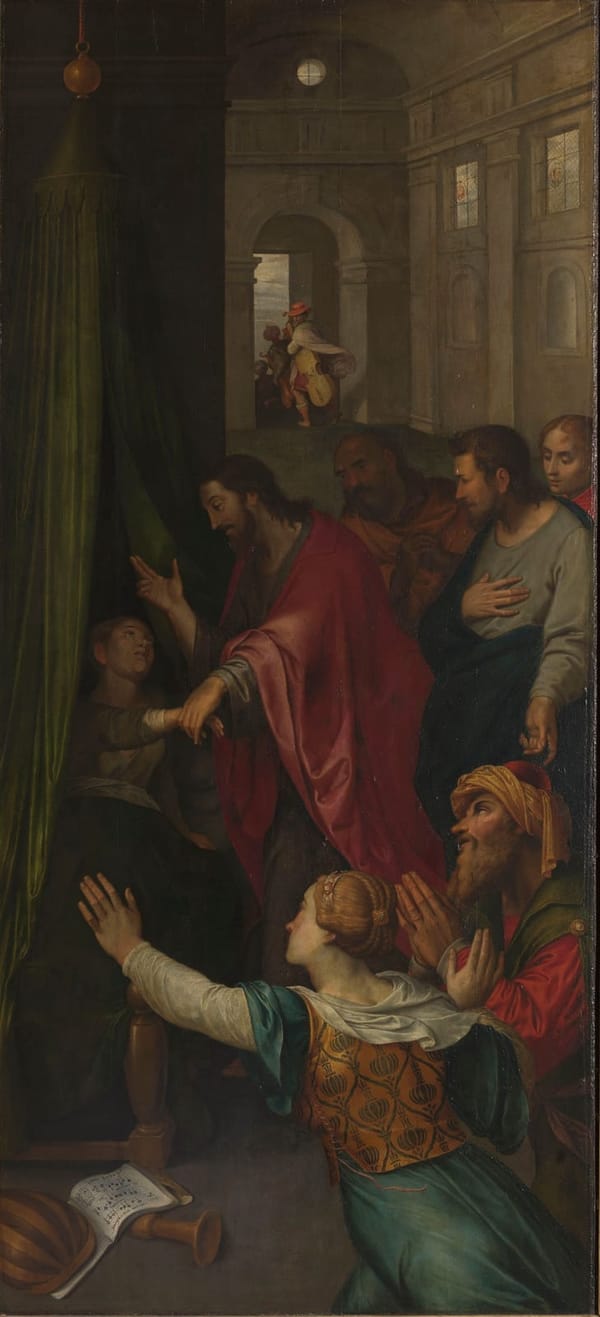
Cap. ix.In illo tempore : Loquente Jesu ad turbas, ecce princeps unus accessit, et adorabat eum, dicens: Domine, filia mea modo defuncta est: sed veni, impone manum tuam super eam, et vivet. Et surgens Jesus sequebatur eum, et discipuli ejus. Et ecce mulier, quæ sanguinis fluxum patiebatur duodecim annis, accessit retro, et tetigit fimbriam vestimenti ejus. Dicebat enim intra se : Si tetigero tantum vestimentum ejus, salva ero. At Jesus conversus, et videns eam, dixit : Confide, filia, fides tua te salvam fecit. Et salva facta est mulier ex illa hora. Et cum venisset Jesus in domum principis, et vidisset tibicines, et turbam tumultuantem, dicebat : Recedite, non est enim mortua puella, sed dormii. Et deridebant eum. Et cum ejecta esset turba, intravit, et tenuit manum ejus. Et surrexit puella. Et exiit fama hæc in universam terram illam.
Ch. ix.At that time : As Jesus was speaking to the multitude: Behold a certain ruler came up and adored him, saying : Lord, my daughter is even now dead; but come lay thy hand upon her, and she shall live. And Jesus rising up followed him, with his disciples. And behold a woman who was troubled with an issue of blood twelve years, came behind him, and touched the hem of his garment. For she said within herself: If I shall touch only his garment I shall be healed. But Jesus turning and seeing her, said : Be of good heart, daughter, thy faith hath made thee whole. And the woman was made whole from that hour. And when Jesus was come into the house of the ruler, and saw the minstrels and the multitude making a rout, he said : Give place: for the girl is not dead, but sleepeth. And they laughed him to scorn. And when the multitude was put forth, he went in and took her by the hand. And the maid arose. And the fame hereof went abroad into all that country.
Although the choice of this Gospel for the twenty-third Sunday is not of great antiquity, yet is it in most perfect keeping with the post-pentecostal liturgy, and confirms what we have stated relative to the character of this portion of the Church’s year. St. Jerome tells us, in the homily selected for the day, that the hemorrhoissa, healed by our Lord, is a type of the Gentile world; whilst the Jewish people is represented by the daughter of the ruler of the Synagogue.27 This latter is not to be restored to life until the former has been cured; and this is precisely the mystery we are so continually commemorating during these closing weeks of the liturgical year, viz., the fullness of the Gentiles recognizing and welcoming the divine Physician, and the blindness of Israel at last giving way to the light.28
The liturgy at this close of the year continually alludes to the end of the world. The earth seems to be sinking away, down into some deep abyss; but it is only that it may shake off the wicked from its surface, and then it will come up again blooming in light and love. After the divine realities of this year of grace, we ought to be capable of feeling a thrill of admiration at the mysterious, yet, at the same time, the strong and sweet ways of eternal Wisdom.29 At the beginning, when man was first created, sin soon followed, breaking up the harmony of God’s beautiful world, and throwing man off the divine path where his Creator had placed him. Wickedness went on increasing, until God’s mercy fell upon one family. The light which beamed on that privileged favourite only showed more plainly the thick darkness in which the rest of mankind were enveloped. The Gentiles, abandoned to their misery, all the more terrible because they had caused it and loved it, saw God’s favours all bestowed on Israel, whilst they themselves were disregarded, and wished to be so. Even when the time came for original sin to be remedied, it seemed to be the very time for the final reprobation of the Gentiles; for the salvation that came down from heaven in the person of the Man-God was seen to be exclusively directed towards the Jews and the lost sheep of the house of Israel.30
But the people that had been treated with so much predilection, and whose fathers and first rulers had so ardently prayed for the coming of the Messias, was no longer in the position to which it had been raised by the holy patriarchs and prophets. Its beautiful religion, founded on desire and hope, was then nothing but a sterile expectancy, which kept it motionless and unable to advance a single step towards its Redeemer. As to its Law, Israel then minded nothing but the letter, and, at last, turned it into a mummy of sectarian formalism. Now, whilst in spite of all this sinful apathy it was mad with jealousy, pretending that no one else had any right to heaven’s favours, the Gentile, whose ever-increasing misery urged him to go in search of some deliverer, found one, and recognized him in Jesus the Saviour of the world. He was confident that this Jesus could cure him; so he took the bold initiative, went up to Him, and had the merit of being the first to be healed. True, our Lord had treated him with an apparent disdain; but that had only had the effect of intensifying his humility, and humility has a power of making way anywhere, even into heaven itself.31
Israel, therefore, was now made to wait. One of the Psalms he sang ran thus: ‘Ethiopia shall be the first to stretch out her hands to God.’32 It is now the turn for Israel to recover, by the pangs of a long abandonment, the humility which had won the divine promises for his fathers, the humility which alone could merit his seeing those promises fulfilled.
By this time, however, the word of salvation has made itself heard throughout all the nations, healing and saving all who desired the blessing. Jesus, who has been delayed on the road, comes at last to the house towards which He first purposed to direct His sacred steps; He reaches, at last, the house of Juda, where the daughter of Sion is in a deep sleep. His almighty compassion drives away from the poor abandoned one the crowd of false teachers and lying prophets, who had sent her into that mortal sleep, by all the noise of their vain babbling: He casts forth for ever from her house those insulters of Himself, who are quite resolved to keep the dead one dead. Taking the poor daughter by the hand, He restores her to life, and to all the charm of her first youth; proving thus, that her apparent death had been but a sleep, and that the long delay of dreary ages could never belie the word of God, which He had given to Abraham, His servant.33
Now therefore, let this world hold itself in readiness for its final transformation; for the tidings of the restoration of the daughter of Sion puts the last seal to the accomplishment of the prophecies. It remains now but for the graves to give back their dead.34 The valley of Josaphat is preparing for the great meeting of the nations;35 Mount Olivet is once more to have Jesus standing upon it,36 but this time as Lord and Judge!37
Offertory
The service we pay to God is, of itself, far beneath what His sovereign Majesty deserves; but the Sacrifice, which every day constitutes part of our service, ennobles it even to an infinite worth, and supplies all our own deficiencies of merit. This is what we are told in this Sunday’s Secret.
Secret
The other Secrets, as on page 130.
Communion
Having, by these sacred mysteries, entered into a participation of divine life, let us beseech our Lord, that we may no longer be subject to the dangers of this world. Let us say with the Church:
Postcommunion
The other Postcommunions, as on page 131.
Vespers
The psalms, capitulum, hymn, and versicle, as above, pages 71-81.
Antiphon of the Magnificat
- See our ‘Advent,’ chap. i., page 23 et seq. ↩︎
- Jer. xxiii. 5-8. ↩︎
- 1 Tim. ii. 1. ↩︎
- Rom. ix. 27. ↩︎
- Gen. l. 17. ↩︎
- Ibid. 19-21. ↩︎
- Rup., De Div. Off., xii. 28. ↩︎
- Jer. xxix. ↩︎
- Prov. xxiv. 16. ↩︎
- 1 St. Pet. v. 3. ↩︎
- St. John i. 4. ↩︎
- 1 St. John i. 1. ↩︎
- 1 Thess. ii. 13. ↩︎
- St. John v. 17. ↩︎
- 1 Tim. vi. 20. ↩︎
- 2 Tim. ii. 2. ↩︎
- 1 Tim. iv. 12. ↩︎
- Tit. ii. 7. ↩︎
- 1 Cor. iv. 16. ↩︎
- Ibid, 17. ↩︎
- Ibid. xi. 1-2. ↩︎
- 1 Thess. i. 5-8. ↩︎
- Eph. ii. 20-22. ↩︎
- 1 Cor. xiv. 3. ↩︎
- Rom. xiv. 19. ↩︎
- Phil. iv. 4, 5. ↩︎
- S. Hieron., in Matt., cap. ix. ↩︎
- Rom. xi. 25. ↩︎
- Wisd. viii. 1. ↩︎
- St. Matt. xv. 24. ↩︎
- Ecclus. xxxv. 21. ↩︎
- Ps. lxvii. 32. ↩︎
- St. Luke i. 54, 55. ↩︎
- Dan. xii. 1, 2. ↩︎
- Joel iii. 2. ↩︎
- Acts i. 11. ↩︎
- Zach. xiv. 4. ↩︎
| Previous October 31: Vigil of All Saints | Next The Twenty-Third Sunday after Pentecost |