Daily reading
After Pentecost
Double · November 22 · Sanctoral
November 22, 2026
From Dom Guéranger’s The Liturgical Year.
St. Cecilia (Double) takes the Sunday; 26th & last Sunday after Pentecost commemorated, homily as 9th lesson.Rubrics

|
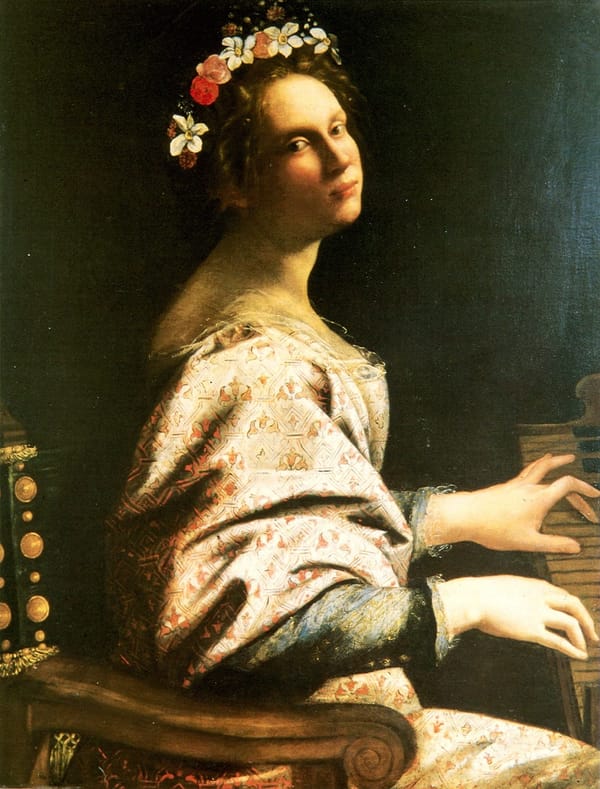
November 22: St. Cecilia, Virgin and Martyr
Cecilia united in her veins the blood of kings with that of Rome's greatest heroes. At the time of the first preaching of the Gospel, more than one ancient patrician family had seen its direct line become extinct. But the adoptions and alliances, which under the Republic had knit more closely the great families by linking them all to the most illustrious among them, formed as it were a common fund of glory, which, even in the days of decline, was passed on intact to the survivors of the aristocracy.
It has now been demonstrated by the undeniable witness of monuments, that Christianity from the very beginning took possession of that glory, by adopting its heirs; and that by a wonderful disposition of divine Providence, the founders of the Rome of the Pontiffs were these last representatives of the Republic, thus preserved in order to give to the two phases of Roman history that powerful unity which is the distinguishing note of divine works. Heretofore bound together by the same patriotism, the Cornelii and the Aemilii, alike heirs of the Fabii, the Caecilii, Valerii, Sergii, Furii, Claudii, Pomponii, Plautii, and Acilii, eldest sons of the Gentile Church, strengthened the connections formed during the Republic, and firmly established, even in the first and second centuries of Christianity, the new Roman society. In the same centuries, and under the influence of the religion preached by Saints Peter and Paul, there came to be grafted on the ever vigorous trunk of the old aristocracy the best members of the new imperial and consular families, worthy by their truly Roman virtues, practised amid the general depravity, to re-inforce the thinned ranks of Rome's founders, and to fill up, without too sudden a transition, the voids made by time in the true patrician houses. Thus was Rome working out her destiny; thus was the building up of the eternal City being accomplished by the very men, who had formerly, by their blood or by their genius, established her strong and mighty on the seven hills.
Caecilia, the lawful representative of this unparalleled aristocracy, the fairest flower of the old stem, was also the last. The second century was passing away; the third, which was to see the empire fall from the hands of Septimus Severus first to the Orientals and then to the barbarians from the banks of the Danube, offered small chance of preservation for the remnants of the ancient nobility. The true Roman society was henceforth at an end; for, save a few individual exceptions, there remained nothing more of Roman but the name: the vain adornment of freedmen and upstarts, who, under princes worthy of them, indulged their passions at the expense of those around them.
Caecilia therefore appeared at the right moment, personifying with the utmost dignity the society that was about to disappear because its work was accomplished. In her strength and her beauty, adorned with the royal purple of martyrdom, she represents ancient Rome rising proud and glorious to the skies, before the upstart Caesars who, by immolating her in their jealousy, unconsciously executed the divine plan. The blood of kings and heroes flowing from her triple wound, is the libation of the old nobility to Christ the conqueror, to the Blessed Trinity the Ruler of nations; it is the final consecration, which reveals in its full extent the sublime vocation of the valiant races called to found the eternal Rome.
But we must not think that to-day's feast is meant to excite in us a mere theoretical and fruitless admiration.1 The Church recognizes and honours in Saint Caecilia three characteristics, which, united together, distinguish her among all the Blessed in heaven, and are a source of grace and an example to men. These three characteristics are, virginity, apostolic zeal, and the superhuman courage which enabled her to bear torture and death. Such is the threefold teaching conveyed by this one Christian life.
In an age so blindly abandoned as ours to the worship of the senses, is it not time to protest, by the strong lessons of our faith, against a fascination which even the children of the promise can hardly resist? Never, since the fall of the Roman empire, have morals, and with them the family and society, been so seriously threatened. For long years, literature, the arts, the comforts of life, have had but one aim : to propose physical enjoyment as the only end of man's destiny. Society already counts an immense number of members who live entirely a life of the senses. Alas for the day when it will expect to save itself by relying on their energy! The Roman empire thus attempted several times to shake off the yoke of invasion: it fell never to rise again.
Yes, the family itself, the family especially, is menaced. It is time to think of defending itself against the legal recognition, or rather encouragement, of divorce. It can do so by one means alone: by reforming and regenerating itself according to the law of God, and becoming once more serious and Christian. Let marriage, with its chaste consequences, be held in honour; let it cease to be an amusement or a speculation; let fatherhood and motherhood be no longer a calculation, but an austere duty: and soon, through the family, the city and the nation will resume their dignity and their vigour.
But marriage cannot be restored to this high level, unless men appreciate the superior element, without which human nature is an ignoble ruin: this heavenly element is continence. True, all are not called to embrace it in the absolute sense; but all must do honour to it, under pain of being delivered up, as the Apostle expresses it, to a reprobate sense.2 It is continence that reveals to man the secret of his dignity, that braces his soul to every kind of devotedness, that purifies his heart and elevates his whole being. It is the culminating point of moral beauty in the individual, and at the same time the great lever of human society. It is because the love of it became extinct, that the ancient world fell to decay; but when the Son of the Virgin came on earth, he renewed and sanctioned this saving principle, and a new phase began in the destinies of the human race.
The children of the Church, if they deserve the name, relish this doctrine, and are not astonished at it. The words of our Saviour and of his Apostles have revealed all to them; and at every page, the annals of the faith they profess set forth in action this fruitful virtue, of which all degrees of the Christian life, each in its measure, must partake. St. Caecilia is one example among others offered to their admiration. But the lesson she gives is a remarkable one, and has been celebrated in every age of Christianity. On how many occasions has Caecilia inspired virtue or sustained courage; how many weaknesses has the thought of her prevented or repaired! Such power for good has God placed in his Saints, that they influence not only by the direct imitation of their heroin virtues, but also by the inductions which each of the faithful is able to draw from them for his own particular situation.
The second characteristic offered for our consideration in the life of St. Caecilia is that ardent zeal, of which she is one of the most admirable models; and we doubt not that here too is a lesson calculated to produce useful impressions. Insensibility to evil for which we are not personally responsible, or from which we are not likely to suffer, is one of the features of the period. We acknowledge that all is going to ruin, and we look on at the universal destruction without ever thinking of holding out a helping hand to save a brother from the wreck. Where should we now be, if the first Christians had had hearts as cold as ours? If they had not been filled with that immense pity, that inexhaustible love, which forbade them to despair of a world, in the midst of which God had placed them to be the salt of the earth? Each one felt himself accountable beyond measure for the gift he had received. Freeman or slave, known or unknown, every man was the object of a boundless devotedness for these hearts filled with the charity of Christ. One has but to read the Acts of the Apostles, and their Epistles, to learn on what an immense scale the apostolate was carried on in those early days; and the ardour of that zeal remained long uncooled. Hence the pagans used to say: “See how they love one another!” And how could they help loving one another? For in the order of faith they were fathers and children.
What maternal tenderness Camilla felt for the souls of her brethren, from the mere fact that she was a Christian! After her we might name a thousand others, in proof of the fact that the conquest of the world by Christianity and its deliverance from the yoke of pagan depravity, are due to such acts of devotedness performed in a thousand places at once, and at length producing universal renovation. Let us imitate in something at least, these examples to which we owe so much. Let us waste less of our time and eloquence in bewailing evils which are only too real. Let each one of us set to work, and gain one of his brethren: and soon the number of the faithful will surpass that of unbelievers. Without doubt, this zeal is not extinct; it still works in some, and its fruits rejoice and console the Church; but why does it slumber so profoundly in so many hearts which God had prepared to be its active centres?
The cause is unhappily to be traced to that general coldness, produced by effeminacy, which might be taken by itself alone as the type of the age; but we must add thereto another sentiment, proceeding from the same source, which would suffice, if of long duration, to render the debasement of a nation incurable. This sentiment is fear; and it may be said to extend at present to its utmost limit. Men fear the loss of goods or position, fear the loss of comforts and ease, fear the loss of life. Needless to say, nothing can be more enervating, and consequently more dangerous to the world, than this humiliating pre-occupation but above all, we must confess that it is anything but Christian. Have we forgotten that we are merely pilgrims on this earth? And has the hope of future good died out of our hearts? Caecilia will teach us how to rid ourselves of this sentiment of fear. In her days, life was less secure than now. There certainly was then some reason to fear; and yet Christians were so courageous, that the powerful pagans often trembled at the words of their victims.
God knows what he has in store for us; but if fear does not soon make way for a sentiment more worthy of men and of Christians, all particular existences will be swallowed up in the political crisis. Come what may, it is time to learn our history over again. The lesson will not be lost, if we come to understand this much: had the first Christians feared, they would have betrayed us, for the word of life would never have come down to us; if we fear, we shall betray future generations, for we are expected to transmit to them the deposit we have received from our fathers.3
The Passio Sanctae Caeciliae is marked in the most ancient Calendars on the 16th September,4 and took place, according to the primitive Acts, under the emperors Marcus Aurelius and Corn modus. The great feast of November 22nd, preceded by a Vigil, was one of the most solemn on the Roman Cycle; it recalled the dedication of the church raised on the site of that palace which had been sanctified by the blood of the descendant of the Metelli, and had been bequeathed by her when dying to Bishop Urban, representative of Pope Eleutherius. This Urban having been later on confounded with the Pope of the same name, who governed the Church in the time of Alexander Severus, the martyrdom of our Saint was thought to have occurred half a century later, as we still read in the Legend of the Office.
It was most probably in the year 178 that Caecilia joined Valerian in heaven, whence, a few months before, the Angel of the Lord had descended, bringing wreaths of lilies and roses to the two spouses.
She was buried by Urban, just as she lay at the moment of death. In the beginning of the following century, the family crypt was given by her relatives to the Roman church, and was set apart for the burial of the Popes. In the ninth century, Paschal I. found her surrounded by these venerable tombs, and brought her back in triumph on May 8th, 822, to her house in the Trastevere, where she remains to this day.
On the 20th October, 1599, in the course of the excavations required for the restoration of the basilica, Caecilia was once more brought forth to the admiring gaze of the city and of the world. She was clad in her robe of cloth of gold, on which traces of her virginal blood were still discernable; at her feet were some pieces of linen steeped in the purple of her martyrdom. Lying on her right side with her arms stretched before her, she seemed in a deep sleep. Her neck still bore the marks of the wounds inflicted by the executioner's sword; her head, in a mysterious and touching position, was turned towards the bottom of the coffin. The body was in a state of perfect preservation; and the whole attitude, retained by an unique prodigy during so many centuries in all its grace and modesty, brought before the eyes with a striking truthfulness Caecilia breathing her last sigh stretched on the floor of the bath chamber.
The spectators were carried back in thought to the day when the holy bishop Urban had enclosed the sacred body in the cypress chest, without altering the position chosen by the bride of Christ to breathe forth her soul into the arms of her divine Spouse. They admired also the discretion of Pope Paschal, who had not disturbed the virgin's repose, but had preserved for posterity so magnificent a spectacle.5
Cardinal Sfondrate, titular of St. Caecilia, who directed the works, found also in the chapel called of the Bath the heating-stove and vents of the sudatorium, where the Saint passed a day and a night in the midst of scalding vapours. Recent excavations have brought to light other objects belonging to the patrician home, which by their style, belong to the early days of the Republic.
Let us now read the liturgical history of the illustrious Virgin and Martyr.
The Antiphons and Responsories for the 22nd November are all taken from the Acts of the Saint, and are the same as were used in the time of St. Gregory. We choose such of them as will complete the foregoing history. The first Responsory represents the virgin as singing in her heart to God amid the profane music of the nuptial feast. It was this silent melody, superior to all earthly concerts, that inspired the happy idea of picturing St. Caecilia as the queen of harmony, and proclaiming her patroness of the most attractive of arts.
Antiphons and Responsories
The two following hymns were approved by the Apostolic See in 1852.
Hymn
Cor aestuans Caeciliae
Coeleste fundit canticum,
Deoquo totum jubilat.
Domus resultat gaudio,
Haec sola tristis candido
Gemit columba pectore.
Cui me sacravit charitas,
Serva pudoris integram,
Averte labem corpore.
Agnum facit mitissimum:
Hic fonte lotus mystico,
Coelo repente militat.
Erroris a caligine;
Factoque fratris asseclae
Ad astra pandit semitam.
Superna replet horrea:
Verbo potens, fit particpes
Apostolorum gloriae.
Illam tuetur Angelus;
Rosaeque mixtae liliis
Ambie orines gostiunt.
Affertur una conjugi,
Quem castitatis aemulum
Coelestis ardor efficit.
Beata laudent agmina;
Patrique cum Paraclito
Par sit per aevum gloria.
Cecilia's burning heart
pours out the heavenly song
she sings to her God alone.
resounds with the nuptial joy,
this dove alone is sad,
and her pure heart sighs out:
to whom I am bound by love,
preserve my purity
of soul and body.
the lion into a meek lamb;
and he, washed in the mystic font,
begins at once to fight for the King of heaven.
she frees him from darksome error,
and bidding him follow his brother,
points out the path to heaven.
fills the heavenly granaries;
powerful in word,
she shares the glory of the Apostles.
from the highest heavens to protect her;
a rose and lily wreath
entwines her flowing locks.
is the crown brought to her spouse,
whom heavenly love has led
to emulate her purity.
praise thee, O Jesus, their Spouse;
to the Father and the Paraclete
be equal and eternal glory.
Hymn
Clamat suis Caecilia:
Mox ipsa virgo sistitur
Ad judicis praetorium.
Et falso ridet numina:
Jam morte digna ducitur
Puella culpae nescia.
Ardent calore fornices
Ast urit intus virginem
Divinus ignis fortior.
Ter ense lictor percutit:
Scelus tamen non perficit;
Christu smoras dat martyri.
Deo sacrandas devovet
Aedes avitas, libera
Volatque ad Agni nuptias.
Diu sub antris abditum:
Nova refulgens gloria
Romae parenti redderis.
Te Virgo servat virginum;
Rubens cruoris purpura
Stola micante cingeris.
Dum sede laetus coelica
Indulget hymnis spiritus,
Votisque dexter annuit.
Beata laudent agmina;
Patrique cum Paraclito
Par sit per aevum gloria.
cries Caecilia to her brethren;
and soon the virgin herself
is led before the judge.
and laughs at his false gods;
wherefore the innocent maiden
is declared deserving of death.
while the furnace rages beneath;
but stronger is the divine fire
that burns in the virgin's heart.
strike the innocent victim:
he cannot accomplish his crime,
for Christ has granted a delay to the martyr.
she devotes her ancestral mansion to God,
then free she wings her flight
to the nuptials of the Lamb.
long hidden in the sombre crypt;
shining with a new glory,
thou art restored to thy mother Rome.
lest thou fade as a flower in the darkness,
while thou liest empurpled with the blood of thy martyrdom,
and clad in thy golden robe.
while thy spirit enthroned in heaven
hymns its glad joy,
and graciously receives our prayers.
praise thee, O Jesus, their Spouse;
to the Father and the Paraclete
be equal and eternal glory.
It would need the language of Angels worthily to celebrate thy greatness, O bride of Christ! And we have but the faltering, timid accents of mortals and sinners. O queen, who standest at the King's right hand, clad in the vesture of gold of which the Psalmist sings, look down upon us with a favourable eye, and deign to accept this offering of our praise, which we lay on the lowest step of thy lofty throne. We make bold to join thereto a prayer for the holy Church, whose humble daughter thou wast heretofore, as now thou art her hope and her support. In the dark night of this present life the Bridegroom is long a-coming. In the midst of this solemn and mysterious silence he suffers the virgin to slumber till the cry shall announce his arrival. We honour the repose earned by thy victories, O Caecilia, but we know that thou dost not forget us, for the Bride says in the Canticle: I sleep, and my heart watcheth.
The hour draws nigh when the Spouse is to appear, calling all who are his to gather under the standard of his Cross. Soon will the cry be heard: Behold the Bridegroom cometh, go ye forth to meet him. Then, O Caecilia, thou wilt say to all Christians what thou saidst to the faithful band grouped around thee at the hour of thy combat: “Soldiers of Christ! Cast off the works of darkness, and put on the armour of light.”8
The Church daily pronounces thy name with love, and confidence, in the Canon of the Mass; and she looks for thy assistance, O Caecilia, knowing it will not fail her. Prepare a victory for her, by raising up the hearts of Christians to the realities, which they too often forget while they run after the vain shadows from which thou didst win Tiburtius. When the minds of men become once more fixed up on the thought of their eternal destiny, the salvation and peace of nations will be secured.
Be thou for ever, O Caecilia, the delight of thy divine Spouse. Breathe eternally the heavenly fragrance of his roses and lilies; and be unceasingly enraptured with the ineffable harmony of which he is the source. From the midst of thy glory thou wilt watch over us; and when our last hour draws nigh, we beseech thee by the merits of thy heroic martyrdom, assist us on our death-bed. Receive our soul into thy arms, and bear it up to the everlasting abode, where the sight of the bliss thou enjoyest will give us to understand the value of Virginity, of the Apostolate, and of Martyrdom.9
- So far we have summed up the thoughts of our illustrious Father and Master in his Sainte Cécile et la Société romaine aux deux premiers siècles; what follows is quoted directly from the Preface to his first Histoire de Sainte Cécile, Vierge romaine et Martyre. ↩︎
- Rom. i. 28. ↩︎
- Dom Gueranger, ubi supra. ↩︎
- Martyrology of St. Jerome. ↩︎
- Dom Gueranger, Sainte Cécile et la Société romaine. ↩︎
- Magnum virum, Urbanum nomine, in quo est aspectus angelicus. Acts, words of Valerian to Tiburtius. ↩︎
- The ancient legend had the word ovis, which recalls the text of Isaias: Leo et ovis simul morabuntur. The lion and the sheep shall abide together. Isaias xi. 6. ↩︎
- Acta S. Caeciliae. ↩︎
- Dom Gueranger, Histoire de sainte Cécile, conclusion. ↩︎
The Twenty-Fourth Sunday after Pentecost
|
The number of the Sundays after Pentecost may exceed twenty-four, and go as far as twenty-eight, according as Easter is each year more or less near to the vernal equinox. But the Mass here given is always reserved for the last; and the intervening ones, be their number what it may, are taken from the Sundays after the Epiphany, which, in that case, were not used at the beginning of the year.1 This, however, does not apply to the Introit, Gradual, Offertory, and Communion, which, as we have already said, are repeated from the twenty-third Sunday.
We have seen how that Mass of the twenty-third Sunday was regarded, by our forefathers, as really the last of the cycle. Abbot Rupert has given us the profound meaning of its several parts. According to the teaching we have already pondered over,2 the reconciliation of Juda was shown us as being, in time, the term intended by God: the last notes of the sacred liturgy blended with the last scene of the world’s history, as seen and known by God. The end proposed by eternal Wisdom in the world’s creation, and mercifully continued, after the fall, by the mystery of Redemption, has now (we speak of the Church’s year and God’s workings) been fully carried out. This end was no other than that of divine union with human nature, making it one in the unity of one only body.3 Now that the two antagonistic people, Gentile and Jew, are brought together in the one same new Man in Christ Jesus their Head,4 the two Testaments, which so strongly marked the distinction between the ages of time, the one called the old, the other the new, fade away, and give place to the glory of the eternal Alliance.
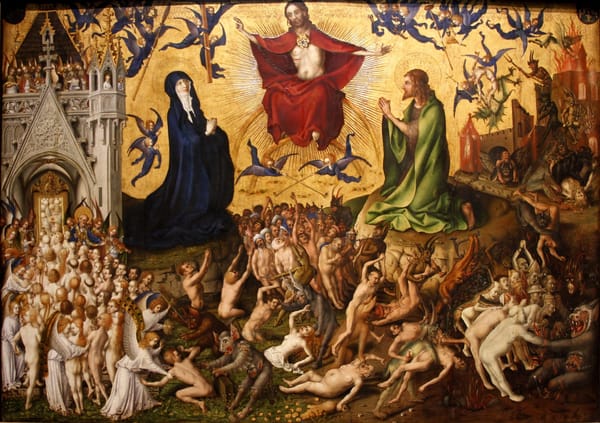
It was here, therefore, that mother Church formerly finished her liturgical year. She was delighted at what she had done during all the past months; that is, at having led her children, not only to have a thorough appreciation of the divine plan, which she had developed before them in her celebrations, but moreover, and more especially, to unite them themselves, by a veritable union, to their Jesus, by a real communion of views, and interests, and loves. On this account, she used not to revert again to the second coming of the God-Man and the last judgment, two great subjects which she had proposed for her children’s reflexions, at the commencement of the purgative life, that is, in her season of Advent. It is only a few centuries ago that, with a view of giving to her year a conclusion more defined and intelligible to the faithful of these comparatively recent times, she chose to conclude the cycle with the prophetic description of the dread coming of her Lord, which is to put an end to time, and to open eternity. From time immemorial, St. Luke had had the office of announcing, in Advent, the approach of the last judgment;5 the evangelist St Matthew was selected for this its second, and more detailed, description, on the last Sunday after Pentecost.
Mass
Introit
Ps. Benedixisti, Domine, terram tuam: avertisti captivitatem Jacob. Gloria Patri. Dicit Dominus.
Ps. Thou, O Lord, hast blessed thy land: thou hast brought back the captive children of Jacob. Glory, etc. The Lord.
The doing of good works, by the help of divine grace, prepares us to receive a still greater grace, for greater works in the future. In the Collect, let us unite with our mother, the Church, in praying for an efficacious influence of the divine Mover upon our wills.
Collect
The other Collects, as on page 120.
Epistle
Cap. i.Fratres, Non cessamus pro vobis orantes et postulantes, ut impleamini agnitione voluntatis Dei in omni sapientia, et intellectu spiritali : ut ambuletis digne Deo per omnia placentes: in omni opere bono fructificantes, et crescentes in scientia Dei : in omni virtute confortati secundum potentiam claritatis ejus, in omni patientia, et longanimitate cum gaudio, gratias agentes Deo Patri, qui dignos nos fecit in partem sortis sanctorum in lumine : qui eripuit nos de potestate tenebrarum, et transtulit in regnum Filii dilectionis suæ; in quo habemus redemptionem per sanguinem ejus, remissionem peccatorum.
Ch. i.Brethren: We cease not to pray for you, and to beg that you may be filled with the knowledge of his will, in all wisdom, and spiritual understanding: that you may walk worthy of God, in all things pleasing: being fruitful in every good work, and increasing in the knowledge of God: strengthened with all might, according to the power of his glory, in all patience and longsuffering with joy. Giving thanks to God the Father, who hath made us worthy to be partakers of the lot of the saints in light: who hath delivered us from the power of darkness, and hath translated us into the kingdom of the Son of his love, in whom we have redemption through his blood, the remission of sins.
Thanksgiving and prayer! There we have the epitome of our Epistle, and an eloquent conclusion of the apostle’s course of instructions: it is also both the summary and the conclusion of the year of the sacred liturgy. The Doctor of the Gentiles has been zealous, beyond measure, in his fulfilment of the task assigned to him by mother Church. Of a certainty, the fault is not his, if the souls he undertook to guide, on the morrow of the descent of the Spirit of love, have not all reached that summit of perfection, which he longed for us all to attain. Those who have gone bravely forward in the path which, a year since, was opened out to them by holy Church, now, by a happy experience, know that that path most surely leads them to the life of union, where divine charity reigns supreme. Who is there that, with anything like earnestness, has allowed his mind and heart to take an interest in the several liturgical seasons which have been brought before us, and been celebrated by the Church during the past twelve months, has not also felt an immense increase of light imparted to him? Now, light is that indispensable element, which delivers us from the power of darkness, and translates us, by the help of God, into the kingdom of the Son of His love. The work of redemption, which this His beloved Son came down upon earth to accomplish for His Father’s glory, could not do otherwise than make progress in those who have, with more or less fervour, entered into the spirit of His Church, during the whole year, that is, from the opening of Advent right up to these the closing days of the sacred cycle. All of us, then, whosoever we may be, should give thanks to this Father of lights,6who hath thus made us worthy to be partakers, somewhat at least, of the lot of the saints.
So, then, all of us, be the share of our participation what it may, must pray that the excellent gift,7 which has been put into our hearts, may fervently yield itself to the still richer development, which the coming new cycle is intended to produce within us.
The just man cannot possibly remain stationary in this world; he must either descend or ascend; and whatever may be the degree of perfection to which grace has led him, he must be ever going still higher as long as he is left in this life.8 The Colossians, to whom the apostle was writing, had fully received the Gospel; the word of truth which had been sown in them had produced abundant fruit in faith, hope, and love;9 and yet, instead of relenting on that account his solicitude in their regard, it is precisely for that reason10 that St. Paul, who had prayed for them up till then, ceases not to pray for them. So let us do: let us go on praying. Let us beg of God, that He will again, and always, fill us with His divine Wisdom, and with the Spirit of understanding. We need all that, in order to correspond with His merciful designs. If the new year of the Church, which is so soon to begin, finds us faithful and making fresh progress, we shall be repaid with new aspects of truth in the garden of the Spouse, and the fruits we shall produce there will be more plentiful, and far sweeter, than in any bygone year. Therefore, let us make up our minds to walk worthy of God, ‘with dilated hearts,’11 and bravely; for the eye of His approving love will be ever upon us, as we toil along. Oh, yes! let us run on in that uphill path, which will lead us to eternal repose in the beatific vision!
Gradual
Gospel
Cap. xxiv.In illo tempore : Dixit Jesus discipulis suis: Cum videritis abominationem desolationis, quæ dicta est a Daniele propheta, stantem in loco sancto, qui legit intelligat: tunc qui in Judæa sunt, fugiant ad montes: et qui in tecto, non descendat tollere aliquid de domo sua: et qui in agro, non revertatur tollere tunicam suam. Væautemprægnantibus, et nutrientibus in illis diebus. Orate autem ut non fìat fuga vestra in hieme, vel Sabbato. Erit enim tunc tribulatio magna, qualis non fuit ab initio mundi usque modo, neque fiet. Et nisi breviati fuissent dies illi, non fìeret salva omnis caro: sed propter electos breviabuntur dies illi. Tunc si quis vobis dixerit : Ecce hic est Christus, aut illic : nolite credere. Surgent enim pseudochristi, et pseudoprophetæ : et dabunt signa magna et prodigia, ita ut in errorem inducantur (si fieri potest) etiam electi. Ecce prædixi vobis. Si ergo dixerint vobis : Ecce in deserto est, nolite exire: Ecce in penetralibus, nolite credere. Sicut enim fulgur exit ab Oriente, et paret usque in Occidentem : ita erit et adventus Filii hominis. Ubicumque fuerit corpus, illic congregabuntur et aquilæ. Statim autem post tribulationem dierum illorum sol obscurabitur, et luna non dabit lumen suum, et stellæ cadent de cœlo, et virtutes cœlorum commovebuntur : et tunc parebit signum Filii hominis in cœlo: et tunc plangent omnes tribus terræ : et videbunt Filium hominis venientem in nubibus cœli cum virtute multa et majestate. Et mittet angelos suos cum tuba, et voce magna: et congregabunt electos ejus a quatuor ventis, a summis cœlorum usque ad terminos eorum. Ab arbore autem fici discite parabolam : cum jam ramus ejus tener fuerit, et folia nata, scitis quia prope est æstas; ita et vos, cum videritis hæc omnia, scitote quia prope est in januis. Amen dico vobis, quia non præteribit generatio hæc, donec omnia hæc fiant. Cœlum et terra transibunt, verba autem mea non præteribunt.
Ch. xxiv.At that time: Jesus said to his disciples: When you shall see the abomination of desolation, which was spoken of by Daniel the prophet, standing in the holy place: he that readeth, let him understand. Then they that are in Judea, let them flee to the mountains; and he that is on the house-top, let him not come down to take anything out of his house; and he that is in the field, let him not go back to take his coat. And wo to them that are with child, and that give suck in those days. But pray that your flight be not in the winter, or on the Sabbath. For there shall be then great tribulation, such as hath not been from the beginning of the world until now, neither shall be. And unless those days had been shortened, no flesh should be saved: but for the sake of the elect, those days shall be shortened. Then if any man shall say to you: Lo! here is Christ, or there: do not believe him. For there shall arise false Christs, and false prophets, and shall shew great signs and wonders, insomuch as to deceive, if possible, even the elect. Behold I have told it to you beforehand; if therefore they shall say to you : Behold he is in the desert, go ye not out: Behold he is in the closets, believe it not. For as lightning cometh out of the east, and appeareth even into the west; so shall also the coming of the Son of Man be. Wheresoever the body shall be there shall the eagles also be gathered together. And immediately after the tribulation of those days, the sun shall be darkened, and the moon shall not give her light, and the stars shall fall from heaven, and the powers of heaven shall be moved: and there shall appear the sign of the Son of Man in heaven: and then shall all tribes of the earth mourn: and they shall see the Son of Man coming in the clouds of heaven with much power and majesty. And he shall send his angels with a trumpet, and a great voice: and they shall gather together his elect from the four winds, from the farthest parts of the heavens to the utmost bounds of them. And from the fig-tree learn a parable: when the branch thereof is now tender and the leaves come forth, you know that summer is nigh. So you also, when you shall see all these things, know ye that it is nigh even at the doors. Amen, I say to you, that this generation shall not pass, till all these things be done. Heaven and earth shall pass, but my words shall not pass.
Several times during Advent we meditated on the circumstances which are to accompany the last coming of Christ our Lord; and in a few days the same great teachings will be again brought before us, filling our souls with a salutary fear. May we, then, be permitted, on this last Sunday of our liturgical year, to address ourselves in a prayer of desire and praise to our adorable Lord and King, the solemn hour of whose judgment is to be the consummation of His work, and the signal of His triumph.
O Jesus! who then art to come to deliver Thy Church, and avenge that God who has so long borne every sort of insult from His creature man, that day of Thy coming will indeed be terrible to the sinner! He will then understand how the Lord hath made all things for Himself—all, even the ungodly, who, on the evil day, are to show forth the divine justice.12 The whole world, fighting on His side against the wicked,13 shall then at last be avenged for that slavery of sin which had been forced upon it.14 Vainly will the wicked cry out to the rocks to fall upon them, and hide them from the face of Him that will then be seated on His throne;15 the abyss will refuse to engulf them; in obedience to Him who holds the keys of death and of hell,16 it will give forth, to a man, its wretched victims, and set them at the foot of the dread tribunal. O Jesus, how magnificent will Thy power then appear! The heavenly hosts will also be standing around Thee, forming Thy brilliant17 court, and assembling Thy elect from the four quarters of the earth.
For we also, Thy redeemed who have become Thy members by becoming the members of Thy beloved Church, we are to be there on that day, and our place (O ineffable mystery!) is to be the one Thou hast reserved for Thy bride; it is to be Thy own throne,18 where seated we shall judge the very angels.19 Even now, all those blessed of the Father,20 all those elect whose youth, like that of the eagle, has been so often renewed by receiving Thy precious Blood,21 have they not had their eyes fitted to gaze without being dazzled on the Sun of justice, when He shall appear in the heavens? The tediousness of their long exile has given such keenness to their hunger that nothing will have power to stay their flight, once the sacred prey of Thy divine Body shall be shown them! What hindrance could be strong enough to check the impetuosity of the love22 which will bring them all together to the banquet of the eternal Pasch? The trumpet of the Archangel, which will ring through the graves of the just, is to be a summons calling them, not to death, but to life; to the sight of the old enemy’s destruction;23 to a redemption which is to include their very bodies;24 to the unimpeded passover to the true Land of promise; in a word, to the Pasch, and this time real, and for all, and for ever. What will be the joy of that true day of the Lord!25 What joy for them that have, by faith, lived in Christ, and loved Him without seeing Him!26 Identifying themselves with Thee, O Jesus, notwithstanding the weakness of the flesh, they have continued here below Thy life of suffering and humiliation. What a triumph when, delivered for ever from sin, and vested in their immortal bodies, they shall be borne aloft before Thy face, that they may for ever be with Thee!27
But their chiefest joy on that great day will be to assist at the glorification of their most dear Lord, by the manifestation of the power which was given to Him over all flesh.28 Then, O Emmanuel! crushing the heads of kings, and making Thine enemies Thy footstool,29 Thou wilt be shown as the one Ruler of all nations.30 Then will heaven, and earth, and hell bow their knee31 before that Son of Man, who heretofore appeared on earth as a slave, and was judged, and condemned, and put to death between two thieves. Then, dear Jesus, Thou wilt judge the unjust judges, to whom, even in the midst of all the humiliations they put on Thee, Thou didst foretell this Thy coming on the clouds of heaven.32 And when, after the irrevocable sentence has been passed, the wicked shall go to everlasting torments, and the just to life eternal,33 Thy apostle tells us that, having conquered Thine enemies and been proclaimed undisputed King, Thou wilt consign to Thy eternal Father this Thy kingdom won over death; it will be the perfect homage of Thee, the Head, and of all Thy faithful members.34 God will thus be all in all. It will be the perfect accomplishment of that sublime prayer Thou taughtest mankind to make,35 which they daily offer up to the Father who is in heaven, saying to Him : 'Hallowed be Thy name! Thy kingdom come! Thy will be done on earth, as it is in heaven!' O blissfully peaceful day, when blasphemy is to cease, and when this poor earth of ours, cleansed by fire from the filth of sin, shall be turned into a new paradise! Where, then, is the Christian, who would not thrill with emotion at the thought of that last of all the days of time, which is to usher in beautiful eternity? Who would not despise the agonies of his own last hour, when he reflects that those sufferings have really only one meaning in them, that the Son of Man, as the Gospel words it, is nigh even at the very doors!
O sweet Jesus, detach us every year more and more from this world, whose fashion passeth away,36 with its vain toils, its false glories, and its lying pleasures. It was Thine own foretelling, that, as in the days of Noe and Sodom, men will go on with their feasting, and business, and amusements, without giving any more thought to Thy approaching coming than their forefathers heeded the threat of the Deluge, or of the fire, which came upon them and destroyed them.37 Let these men go on with their merry-making, and their sending gifts one to the other, as Thine Apocalypse expresses it, because, so they will have it, Christ and His Church are then to be worn-out ideas!38 Whilst they are tyrannizing over Thy holy city in a thousand varied ways, and persecuting her as no past period had ever done, they little think that all this is an announcement of the eternal nuptials, which are nigh at hand. All these trials are the fresh jewels, which the bride is to have given her before her beauty is complete; and the blood of her last martyrs is to incarnadine her already splendid robes with all the richness of royal crimson. As for us, we lend an ear to the echoes of our home above; and, from the throne of our God, we hear going forth the voice heard by Thy beloved prophet of Patmos: 'Give praise unto our God, all ye His servants, and ye that fear Him, little and great! Alleluia! For the Lord our God the almighty hath reigned! Let us be glad and rejoice, and give glory unto Him; for the marriage of the Lamb is come, and His wife hath prepared herself!'39 Yet a little while, till the number of our brethren be made up;40 and then, with the Spirit and the bride, we will say to Thee, in all the ardour of our souls that have long thirsted after Thee: ‘Come, Lord Jesus!41 Come, and perfect us in love, by eternal union, unto the glory of the Father, and of Thyself the Son, and of the Holy Ghost, for ever and ever!'
Offertory
In the Secret, let us ask of God that, at the approach of the last judgment, He would turn all hearts towards Himself, and vouchsafe to make our earthly desires give place to the desire for, and relish of, heavenly things.
Secret
The other Secrets, as on page 130.
Communion
May the divine Sacrament, as the Church prays in the Postcommunion, fully cure, by its virtue, whatsoever may remain faulty in our souls at this close of the year!
Postcommunion
The other Postcommunions, as on page 131.
Vespers
The psalms, capitulum, hymn and versicle, above, pages 71-81.
Antiphon of the Magnificat
- Farther on (vid. inf., pages 496-511) we have given these Sundays, which are the third, fourth, fifth, and sixth, after the Epiphany. When there are twenty-five Sundays after Pentecost, it is the sixth after the Epiphany, which is put after the twenty-third; if the number of Sundays be twenty-six, the fifth after the Epiphany becomes the twenty-fourth after Pentecost; if the number be twenty-seven, we go back to the fourth after the Epiphany, and the rest follow; if it be as high as twenty-eight, we begin with the third. ↩︎
- The thirteenth Sunday after Pentecost. ↩︎
- Eph. ii. 16. ↩︎
- Ibid. 15. ↩︎
- First Sunday of Advent. ↩︎
- St. Jas. i. 17. ↩︎
- Ibid. ↩︎
- Ps. lxxxiii. 6. ↩︎
- Col. i. 4-6. ↩︎
- Ibid. 9. ↩︎
- St. Benedict, The Holy Rule. ↩︎
- Prov. xvi 4. ↩︎
- Wisd. v. 21. ↩︎
- Rom. viii 21. ↩︎
- Apoc. vi. 16. ↩︎
- Ibid. i. 18. ↩︎
- Apoc. xix. 14. ↩︎
- Ibid. iii. 21. ↩︎
- 1 Cor. vi. 3. ↩︎
- St. Matt. xxv. 3. ↩︎
- Ps. cii. 5. ↩︎
- Cant. viii. 6. ↩︎
- 1 Cor. xv. 28. ↩︎
- Rom. viii. 23. ↩︎
- Ps. cxvii. 24. ↩︎
- 1 St. Pet. i. 8. ↩︎
- 1 Thess. iv. 6. ↩︎
- St. John xvii. 2. ↩︎
- Ps. cix. ↩︎
- Ps. ii. ↩︎
- Phil. ii. 10. ↩︎
- St. Matt. xxvi. 64. ↩︎
- Ibid. xxv. 46. ↩︎
- 1 Cor. xv. 24-28. ↩︎
- St. Matt. vi. 9. ↩︎
- 1 Cor. vii. 31. ↩︎
- St. Luke xvii. 26-30. ↩︎
- Apoc. ix. 10. ↩︎
- Apoc. xix. 5-7. ↩︎
- Ibid. vi. 11. ↩︎
- Ibid. xxii. 17. ↩︎
| Previous November 21: The Presentation of the Blessed Virgin Mary | Next The Twenty-Fourth Sunday after Pentecost |