Daily reading
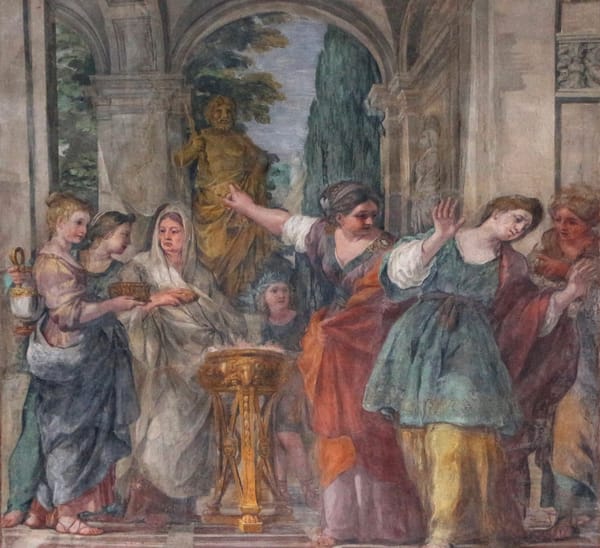

December 2: Saint Bibiana, Virgin and Martyr
Of the saints whose feasts are kept during Advent, five are virgins. The first, St. Bibiana, whom we honour to-day, is a daughter of Rome; the second, St. Barbara, is the glory of the eastern Churches; the third, St. Eulalia of Merida, is one of Spain’s richest treasures; the fourth, St. Lucy, belongs to beautiful Sicily; the fifth, St. Odilia, is claimed by France. These five wise virgins lighted their lamps and watched, waiting for the coming of the Spouse. Such was their constancy and fidelity, that four of them shed their blood for the love of Him, after whom they longed. Let us take courage by this noble example; and since we have not, as the apostle expresses it, as yet resisted unto blood, let us not think it hard if we suffer fatigue and trouble in the holy exercises of this penitential season of Advent: He, for whom we do them all, will soon be with us and repay us. To-day, it is the chaste and courageous Bibiana, who instructs us by her glorious example.
Holy Bibiana, most wise virgin! thou hast gone through the long unbroken watch of this life; and when, suddenly, the Spouse came, thy lamp was bright and richly fed with oil. Now thou art dwelling in the abode of the eternal marriage-feast, where the Beloved feeds among the lilies. Remember us who are still living in the expectation of that same divine Spouse, whose eternal embrace is secured to thee for ever. We are awaiting the birth of the Saviour of the world, which is to be the end of sin and the beginning of justice; we are awaiting the coming of this Saviour into our souls, that He may give them life and union with Himself by love; we are awaiting our Judge, the Judge of the living and the dead. Most wise virgin! intercede for us, by thy fervent prayers, with this our Saviour, our Spouse, and our Judge; pray that each of these three visits may work and perfect in us that divine union, for which we have all been created. Pray also, O faithful virgin, for the Church on earth, which gave thee to the Church in heaven, and which so devoutly watches over thy precious remains. Obtain for her that strict fidelity, which will ever render her worthy of Him, who is her Spouse as He is thine. Though He has enriched her with the most magnificent gifts, and given her confidence by His promises which cannot fail, yet does He wish her to ask, and us to ask for her, the graces which will lead her to the glorious destiny which awaits her.
We will to-day consider the state of nature at this season of the year. The earth is stripped of her wonted verdure, the flowers are gone, the fruits are fallen, the leaves are torn from the trees and scattered by the wind, and every living thing stiffens with the cold. It seems as though the hand of death had touched creation. We see the sun rise after the long night of his absence; and scarcely have we felt his warmth at noon, than he sets again, and leaves us in the chilly darkness. Each day he shortens his visit. Is the world to become sunless, and are men to live out the rest of life in gloom? The old pagans, who witnessed this struggle between light and darkness, and feared the sun was going to leave them, dedicated the twenty-fifth day of December, the winter solstice, to the worship of the sun. After this day their hopes revived on seeing the glorious luminary again mounting up in the sky, and gradually regaining his triumphant position.
We Christians can have no such feelings as these; our light is the true faith, which tells us that there is a Sun to be sought for which never sets, and is never eclipsed. Having Him, we care little for the absence of any other brightness; nay, all other light, without Him, can only lead us astray. O Jesus! Thou true light, that enlightenest every man coming into this world! Thou didst choose, for Thy birth among us, a time of the year which forces us to reflect upon the miserable state of the world when Thou didst come to save it. ‘The evening was coming on, and the day was far spent,’ says St. Bernard: ‘the Sun of justice had all but set, so that exceeding scanty was His light or warmth on earth: for the light of divine knowledge was very faint, and, sin abounding, the heat of charity had grown cold. There was neither angel to visit men, nor prophet to speak to them; both seemed in despair, for the hardness and obstinacy of man had made every effort useless: then I said —they are the words of our Redeemer—then I said, lo! I come!’* O Jesus! O Sun of justice! give us a clear knowledge of what the world is without Thee; what our understanding is without Thy light; and what our heart, without Thy divine heat. Open Thou the eyes of our faith; that whilst seeing with the eyes of the body the gradual decrease of the material light, we may think of that other darkness, which is in the soul that has not Thee. Then, indeed, will the cry which comes from the depths of our misery make its way to Thee, and Thou wilt come on the day Thou hast fixed, dispelling every shadow of darkness by Thy irresistible brightness.
Prayer for the Time of Advent
(The Mozarabic breviary, Wednesday of the second week of Advent, Capitula)
* First Sermon of Advent. ↩︎
Wednesday of the First Week of Advent
Cap. iii.Ecce enim dominator Dominus exercituum auferet a Jerusalem et a Juda validum et fortem, omne robur panis, et omne robur aquæ; fortem, et virum bellatorem, judicem, et prophetam, et ariolum, et senem: principem super quinquaginta, et honorabilem vultu, et consiliarium, et sapientem de architectis, et prudentem eloquii mystici. Et dabo pueros principes eorum; et effœminati dominabuntur eis. Ruit enim Jerusalem, et Judas concidit, quia lingua eorum et adinventiones eorum contra Dominum, ut provocarent oculos majestatis ejus. Agnitio vultus eorum respondit eis, et peccatum suum quasi Sodoma prædicaverunt, nec absconderunt. Væ animæ eorum, quoniam reddita sunt eis mala! Dicite justo quoniam bene, quoniam fructum adinventionum suarum comedet. Væ impio in malum! retributio enim manuum ejus fiet ei.
Ch. iii.For behold the sovereign the Lord of hosts shall take away from Jerusalem and from Juda the valiant and the strong, the whole strength of bread, and the whole strength of water; the strong man, and the man of war, the judge and the prophet, and the cunning man, and the ancient, the captain over fifty, and the honourable in countenance, and the counsellor, and the architect, and the skilful in eloquent speech. And I will give children to be their princes; and the effeminate shall rule over them. For Jerusalem is ruined, and Juda is fallen, because their tongue and their devices are against the Lord, to provoke the eyes of his majesty. The show of their countenance hath answered them, and they have proclaimed abroad their sin as Sodom, and they have not hid it. Woe to their souls, for evils are rendered to them! Say to the just man that it is well, for he shall eat the fruit of his doings. Woe to the wicked unto evil! for the reward of his hands shall be given him.
Jerusalem is tending to her destruction; therefore she is losing all power, and, with the rest, the power of understanding. She no longer knows whither she is going, and she sees not the abyss into which she is plunging. Such are all those men, who never give a thought to the coming of the sovereign Judge; they are men of whom Moses said in his canticle: ‘They are a nation without counsel and without wisdom. O that they would be wise and would understand, and would provide for their last end!’ The Son of God comes now in the swaddling-clothes of a weak Babe, in the humility of a servant, and, to speak with the prophets, as the dew which falls softly drop by drop; but it will not always be so. This earth also, which now is the scene of our sins and our hardheartedness, will perish before the face of the angry Judge; and if we have made it the one object of our love, to what shall we then cling? ‘A sudden death which has happened in your presence,’ says St. John Chrysostom, ‘or an earthquake, or the bare threat of some dire calamity, terrifies and prostrates you: what then shall it be when the whole earth shall sink beneath your feet; when you shall see all nature in disorder; when you shall hear the sound of the last trumpet; when the sovereign Master of the universe shall appear before you in the fulness of His majesty? Perchance you have seen criminals dragged to punishment: did they not seem to die twenty times before they reached the place of execution, and before the executioner could lay his hands on them, fear had crushed out life?’ Oh! the terror of that last day! How is it that men can expose themselves to such misery, when, to avoid it, they have but to open their hearts to Him, who is now coming to them in gentlest love, asking them to give Him a place in their souls, and promising to shelter them from the wrath to come, if they will but receive Him! O Jesus, who can withstand Thy anger at the last day? Now Thou art our Brother, our Friend, a little Child who is to be born for us: we will therefore make covenant with Thee; so that, loving Thee now in Thy first coming, we may not fear Thee in the second. When Thou comest in that second one, bid Thy angels approach us, and say to us those thrilling words: ‘It is well!’
Hymn of Advent
(Roman breviary, the Office of Matins)
E Patris æterni sinu,
Qui natus orbi subvenis,
Labente cursu temporis
Tuoque amore concrema,
Ut cor caduca deserens
Cœli voluptas impleat.
Damnabit igni noxios,
Et vox amica debitum
Vocabit ad cœlum pios,
Volvamur inter turbines;
Vultu Dei sed compotes
Cœli fruamur gaudiis.
Tibique, sancte Spiritus,
Sicut fuit sit jugiter
Sæclum per omne gloria.
of the bosom of the eternal Father,
yet born in the fleeting course of time,
thou bringest succour to the world.
and inflame them with thy love,
that, being detached from earthly things,
they may be filled with the joys of heaven.
shall condemn the wicked to the flames,
and lovingly call the good
to the heaven they have won,
into the dark pool of fire,
but, admitted to the vision of God,
may enjoy the bliss of heaven.
and to thee, O Holy Ghost,
may there ever be, as there ever hath been,
glory for ever and ever.
Prayer from the Mozarabic Missal
(In the Mass of the fourth Sunday of Advent, Illation)
| Previous Tuesday of the First Week of Advent | Next Wednesday of the First Week of Advent |