Daily reading
Advent
Double · December 3 · Sanctoral
December 3, 2026
From Dom Guéranger’s The Liturgical Year.
A Double leads the weekday.Rubric
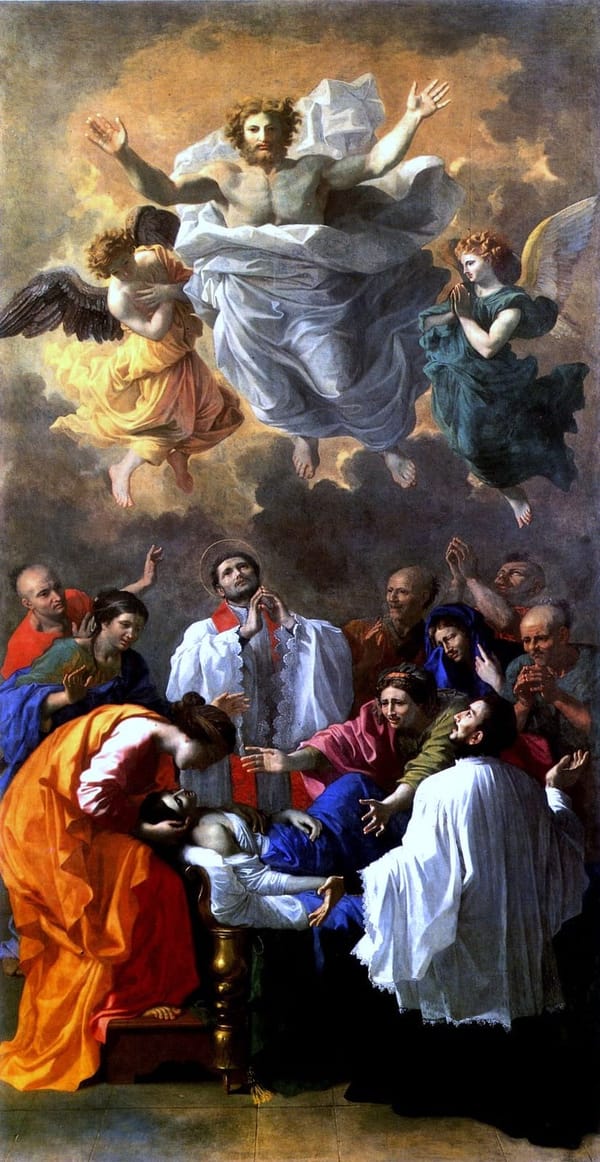 |
December 3: Saint Francis Xavier, Confessor; Apostle of the Indies
The apostles being the heralds of the coming of the Messias, it was fitting that Advent should have in its calendar the name of some one among them. Divine Providence has provided for this; for, to say nothing of St. Andrew, whose feast is oftentimes past before the season of Advent has commenced, St. Thomas’s day is unfailingly kept immediately before Christmas. We will explain, later on, why St. Thomas holds that position rather than any other apostle; at present, we simply assert the fitness of there being at least one of the apostolic college, who should announce to us, in this period of the Catholic cycle, the coming of the Redeemer. But God has not wished that the first apostolate should be the only one to appear on the first page of the liturgical calendar; great also, though in a lower degree, is the glory of that second apostolate, whereby the bride of Jesus Christ multiplies her children, even in her fruitful old age, as the psalmist expresses it.1 There are Gentiles who have still to be evangelized; the coming of the Messias is far from having been announced to all nations. Now of all the valiant messengers of the divine Word who have, during the last few hundred years, proclaimed the good tidings among infidel nations, there is not one whose glory is greater, who has worked greater wonders, or who has shown himself a closer imitator of the first apostles, than the modern apostle of the Indies, St. Francis Xavier.
The life and apostolate of this wonderful man were a great triumph for our mother the holy Catholic Church; for St. Francis came just at a period when heresy, encouraged by false learning, by political intrigues, by covetousness, and by all the wicked passions of the human heart, seemed on the eve of victory. Emboldened by all these, this enemy of God spoke, with the deepest contempt, of that ancient Church which rested on the promises of Jesus Christ; it declared that she was unworthy of the confidence of men, and dared even to call her the harlot of Babylon, as though the vices of her children could taint the purity of the mother. God’s time came at last, and He showed Himself in His power: the garden of the Church suddenly appeared rich in the most admirable fruits of sanctity. Heroes and heroines issued from that apparent barrenness; and whilst the pretended reformers showed themselves to be the most wicked of men, two countries, Italy and Spain, gave to the world the most magnificent saints.
One of these is brought before us to-day, claiming our love and our praise. The calendar of the liturgical year will present to us, from time to time, his contemporaries and his companions in divine grace and heroic sanctity. The sixteenth century is, therefore, worthy of comparison with any other age of the Church. The so-called reformers of those times gave little proof of their desire to convert infidel countries, when their only zeal was to bury Christianity beneath the ruin of her churches. But at that very time, a society of apostles was offering itself to the Roman Pontiff, that he might send them to plant the true faith among people who were sitting in the thickest shades of death. But, we repeat, not one of these holy men so closely imitated the first apostles as did Francis, the disciple of Ignatius. He had all the marks and labours of an apostle: an immense world of people evangelized by his zeal, hundreds of thousands of infidels baptized by his indefatigable ministration, and miracles of every kind, which proved him, to the infidel, to be marked with the sign which they received who, living in the flesh, planted the Church, as the Church speaks in her liturgy. So that, in the sixteenth century, the east received from the ever holy city of Rome an apostle, who, by his character and his works, resembled those earlier ones sent her by Jesus Himself. May our Lord Jesus be for ever praised for having vindicated the honour of the Church, His bride, by raising up Francis Xavier, and giving to men, in this His servant, a representation of what the first apostles were, whom He sent to preach the Gospel when the whole world was pagan.
Let us now read the short account given us, in the words of the Church, of this new apostle.
Glorious apostle of Jesus Christ, who didst impart His divine light to the nations that were sitting in the shadows of death! we, though unworthy of the name of Christians, address our prayers to thee, that by the charity which led thee to sacrifice everything for the conversion of souls, thou wouldst deign to prepare us for the visit of the Saviour, whom our faith and our love desire. Thou wast the father of infidel nations; be the protector, during this holy season, of them that believe in Christ. Before thy eyes had contemplated the Lord Jesus, thou didst make Him known to countless people; now that thou seest Him face to face, obtain for us that, when He is come, we may see Him with that simple and ardent faith of the Magi, those glorious first-fruits of the nations to which thou didst bear the admirable light.2
Remember also, O great apostle, those nations which thou didst evangelize, and where now, by a terrible judgement of God, the word of life has ceased to bring forth fruit. Pray for the vast empire of China, on which thou didst look when dying, but which was not blessed with thy preaching. Pray for Japan, thy dear garden which has been laid waste by the savage wild beast, of which the psalmist speaks. May the blood of the martyrs, which was poured out on that land like water, bring it the long-expected fertility. Bless, too, all the missions which our holy mother the Church has undertaken in those lands where the cross has not yet triumphed. May the heart of the infidel be opened to the grand simplicity and light of faith; may the seed bring forth fruit a hundred-fold; may the number of thy successors in the new apostolate ever increase; may their zeal and charity fail not; may their toil receive its reward of abundant fruit; and may the crown of martyrdom, which they receive, be not only the recompense but the perfection and the triumph of their apostolic ministry. Recommend to our Lord the innumerable members of that Association, which is the means of the faith being propagated through the world, and which has thee for its patron. Pray, with a filial affection and earnestness, for that holy Society, of which thou art so bright an ornament, and which reposes on thee its firmest confidence. May it more and more flourish under the storm of trial which never leaves it at rest; may it be multiplied, that so the children of God may be multiplied by its labours; may it ever have ready, for the service of the Christian world, zealous apostles and doctors; may it not be in vain that it bears the name of Jesus.
Let us consider the wretched condition of the human race, at the time of Christ’s coming into the world. The diminution of truths3 is emphatically expressed by the little light which the earth enjoys at this season of the year. The ancient traditions are gradually becoming extinct; the Creator is not acknowledged, even in the very work of His hands; everything has been made God, except the God who made all things. This frightful pantheism produces the vilest immorality, both in society at large, and in individuals. There are no rights acknowledged, save that of might. Lust, avarice, and theft, are honoured by men in the gods of their altars. There is no such thing as family, for divorce and infanticide are legalized; mankind is degraded by a general system of slavery; nations are being exterminated by endless wars. The human race is in the last extreme of misery; and unless the hand that created it reform it, it must needs sink a prey to crime and bloodshed. There are indeed some few just men still left upon the earth, and they struggle against the torrent of universal degradation; but they cannot save the world; the world despises them, and God will not accept their merits as a palliation of the hideous leprosy which covers the earth. All flesh has corrupted its way, and is more guilty than even in the days of the deluge: and yet, a second destruction of the universe would but manifest anew the justice of God; it is time that a deluge of His divine mercy should flood the universe, and that He who made man, should come down and heal him. Come then, O eternal Son of God! give life again to this dead body; heal all its wounds; purify it; let grace superabound, where sin before abounded; and having converted the world to Thy holy law, Thou wilt have proved to all ages that Thou, who camest, wast in very truth the Word of the Father; for as none but a God could create the world, so none but the same omnipotent God could save it from satan and sin, and restore it to justice and holiness.
A Responsory in Advent
(The Roman breviary, fourth Sunday of Advent)
Thursday of the First Week of Advent
Cap. v.Cantabo dilecto meo canticum patruelis mei vineæ suæ. Vinea facta est dilecto meo in cornu filio olei. Et sepivit eam, et lapides elegit ex illa, et plantavit eam electam, et aedificavit turrim in medio ejus et torcular exstruxit in ea: et exspectavit ut faceret uvas, et fecit labruscas. Nunc ergo habitatores Jerusalem, et viri Juda, judicate inter me et vineam meam. Quid est quod debui ultra facere vineæ meæ, et non feci ei? an quod exspectavi ut faceret uvas, et fecit labruscas? Et nunc ostendam vobis quid ego faciam vineæ meæ: auferam sepem ejus, et erit in direptionem; diruam maceriam ejus, et erit in conculcationem. Et ponam eam desertam: non putabitur, et non fodietur, et ascendent vepres et spinse, et nubibus mandabo ne pluant super eam imbrem. Vinea enim Domini exercituum domus Israel est, et vir Juda germen ejus delectabile: et exspectavi ut faceret judicium, et ecce iniquitas; et justitiam, et ecce clamor.
Ch. v.I will sing to my beloved the canticle of my cousin concerning his vineyard. My beloved had a vineyard on a hill, in a fruitful place. And he fenced it in, and picked the stones out of it, and planted it with the choicest vines, and built a tower in the midst thereof, and set up a wine-press therein: and he looked that it should bring forth grapes, and it brought forth wild grapes. And now, O ye inhabitants of Jerusalem, and ye men of Juda, judge between me and my vineyard. What is there that I ought to do more to my vineyard, that I have not done to it? Was it that I looked that it should bring forth grapes, and it hath brought forth wild grapes? And now I will show you what I will do to my vineyard: I will take away the hedge thereof, and it shall be wasted; I will break down the wall thereof, and it shall be trodden down. And I will make it desolate: and it shall not be pruned, and it shall not be digged, but briars and thorns shall come up, and I will command the clouds to rain no rain upon it. For the vineyard of the Lord of hosts is the house of Israel, and the man of Juda his pleasant plant; and I looked that he should do judgement, and behold iniquity; and do justice, and behold a cry.
We are awaiting the birth of a Child who is to appear seven hundred years after the time of Isaias; and this Child will be the world’s Saviour. Men will persecute Him, load Him with calumnies and injuries, and, but a few hours before they crucify Him, they shall hear this parable from His lips: ‘There was a man, a householder, who planted a vineyard, and made a hedge round about it, and dug in it a press, and built a tower, and let it out to husbandmen: and went into a strange country. And when the time of the fruits drew nigh, he sent his servants to the husbandmen, that they might receive the fruits thereof. And the husbandmen laying hands on his servants, beat one, and killed another, and stoned another. Again he sent other servants more than the former; and they aid to them in like manner. And last of all, he sent to them his son, saying: They will reverence my son.’* See, Christians, this Son is coming to you. Will you reverence Him? Will you treat Him as the Son of God, with that honour and love which are due to Him? Take notice of the wickedness of men; it has a progress in malice. In the days of Isaias, the Jews despised the prophets; but the prophets, though sent by God, were only men. The Son of God came, and they would not acknowledge Him; a far greater crime, assuredly, than to stone the prophets. What, then, would be the crime of Christians, who not only acknowledge Him who is now coming to them, but are His members by Baptism, if they will not open their hearts to this Messias, whom the Father is sending into the vineyard? What punishment would not the ungrateful vine deserve, planted, as it has been, with so much love, should it persist in yielding nothing but bitter fruit? Ah, dear Jesus! let not this be: make us generous: make us produce abundant flower and fruit for the day of Thy coming, which is so near at hand.
Prayer for the Churches of France during Advent
(Taken from the Prophet Isaias)
Prayer from the Ambrosian Missal
(Fourth Sunday of Advent)
* St. Matt xxi. 33-37 ↩︎
| Previous Wednesday of the First Week of Advent | Next Thursday of the First Week of Advent |