Daily reading
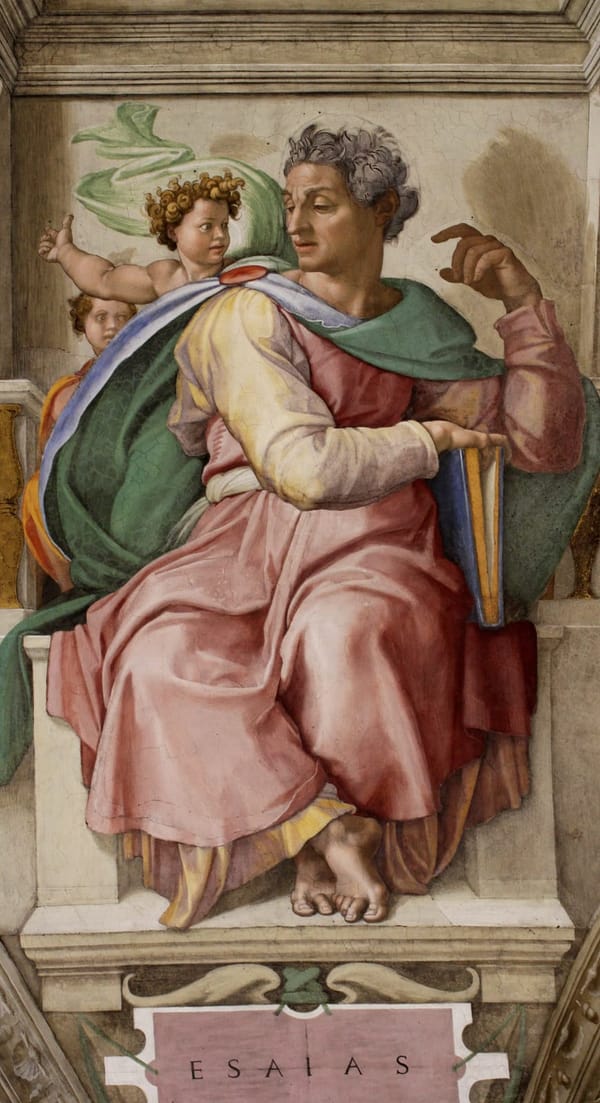
Saturday of the First Week of Advent
Cap. vii.Et adjecit Dominus loqui ad Achaz, dicens: Pete tibi signum a Domino Deo tuo in profundum inferni, sive in excelsum supra. Et dixit Achaz: Non petam, et non tentabo Dominum. Et dixit: Audite ergo domus David: Numquid parum vobis est molestos esse hominibus, quia molesti estis et Deo meo? Propter hoc dabit Dominus ipse vobis signum: Ecce Virgo concipiet, et pariet Filium: et vocabitur nomen ejus Emmanuel.
Ch. vii.And the Lord spoke again to Achaz, saying: Ask thee a sign of the Lord thy God, either unto the depth of hell or unto the height above. And Achaz said: I will not ask, and I will not tempt the Lord. And he said: Hear ye, therefore, O house of David: Is it a small thing for you to be grievous to men, that you are grievous to my God also? Therefore, the Lord himself shall give you a sign. Behold, a Virgin shall conceive and bear a Son, and his name shall be called Emmanuel.
Let your hearts be filled with hope and joy at hearing this fair and sweet prophecy: A Virgin shall conceive and bear a Son. These words contain the salvation of the world, as these others express its perdition: ‘The woman took of the fruit of the tree, and did eat, and gave unto her husband.' This Virgin promised to us has at length come: the divine Fruit is in her womb. By her, Eve’s disobedience is repaired, the world is raised from its fall, the head of the serpent is crushed, God Himself is more glorified by the fidelity of this second Virgin, than He had been outraged by the disobedience of the first. The consent of Mary exercises an immense influence in the saving of the world. It is true that the Word Himself is coming; ‘but,’ says St. Bernard, 'Mary is the way whereby He comes; it is from her virginal womb He issues, as the Bridegroom from the nuptial chamber. Let us endeavour, therefore, to go up to Jesus by Mary, for Jesus came down to us by ner. By thee, O blessed one that didst find grace, O parent of life, O mother of salvation, may we have access to thy Son! May He, who was given to us by thee, receive us by thee. May He admit thy purity, and, for its sake, forgive our impurities: may He give us the pardon of our pride, because of the pleasure He took in thy humility. May thy abundant charity cover the multitude of our sins. May thy glorious fruitfulness get us fruitfulness of merit. Our Lady! our mediatrix! our advocate I reconcile us to thy Son, commend us to thy Son, present us to thy Son. By the grace thou didst find, by the prerogative thou didst merit, by the Mercy thou didst bring forth, grant, O blessed Virgin! that Jesus, who deigned to become, through thy maternity, partaker of our weakness and misery, may, through thy intercession, make us partakers of His glory and bliss.’*
Prose in Honor of the Blessed Virgin
(Composed by Abelard; it is found in all the Roman-French missals)
Non quemvis angelum:
Sed fortitudinem
Suum Archangelum,
Amator hominis.
Pro nobis nuncium,
Naturae faciat
Ut praejudicium
In partu Virginis.
Natus Rex gloriæ:
Regnet et imperet,
Et zyma scoriæ
Tollat de medio.
Terat fastigia:
Colla sublimium
Calcet vi propria,
Potens in prælio.
Mundanum principem;
Secumque faciat
Matrem participem
Patris imperii.
Haec dona dissere:
Revela veteris
Velamen litterae,
Virtute nuncii.
Dic: Ave, cominus.
Dic: Plena gratia:
Dic: Tecum Dominus:
Et dic: Ne timeas.
Dei depositum,
In quo perficias
Casta propositum
Et votum teneas.
Puella nuncium:
Credit et concipit
Et parit Filium,
Sed admirabilem,
Humani generis:
Deum et hominem
Et Patrem posteris,
In pace stabilem.
Nos reddat stabiles,
Ne nos labilitas
Humana labiles
Secum præcipitet,
Concessa venia,
Per Matrem gratiæ
Obtenta gratia,
In nobis habitet.
Peccati veniam:
Reatus deleat,
Donet et patriam
In arce siderum.
sends to the Virgin
no less an angel than him
who is called God’s strength,
the Archangel Gabriel.
be speedily at his work;
may he stay the rights
and laws of nature
in the Virgin’s delivery.
when born, triumph over nature;
may he reign and command;
may he take away from the midst of men
all leaven and rust.
may this God,
mighty in war,
trample in his power
on the necks of the haughty.
the prince of this world;
and make his Mother
share with him
the empire which his Father has given him.
announce these gifts;
lift up,
by the virtue of thy annunciation,
the veil of the ancient Scripture.
Say, when thou art in her presence: ‘Hail!’
Say: ‘O full of grace !"
Say: ‘The Lord is with thee!’
And then: ‘Fear not!’
the divine deposit;
by him fulfil
thy chaste purpose,
and keep thy vow.
and accepts the announcement;
she believes and conceives,
and brings forth a Son,
but he is the admirable,
of mankind,
God and Man,
Father of the world to come,
the Prince of peace.
render us firm,
lest human frailty
should make us stumble
into the abyss.
granting us pardon
and grace, obtained
by the Mother of grace,
dwell within us.
pardon of our sins,
wipe away all our guilt,
and give us the country
in the starry heaven.
Prayer from the Gallican Sacramentary
(Christmas Eve)
* Second Sermon of Advent. ↩︎
December 5: St. Sabas, Abbot
|
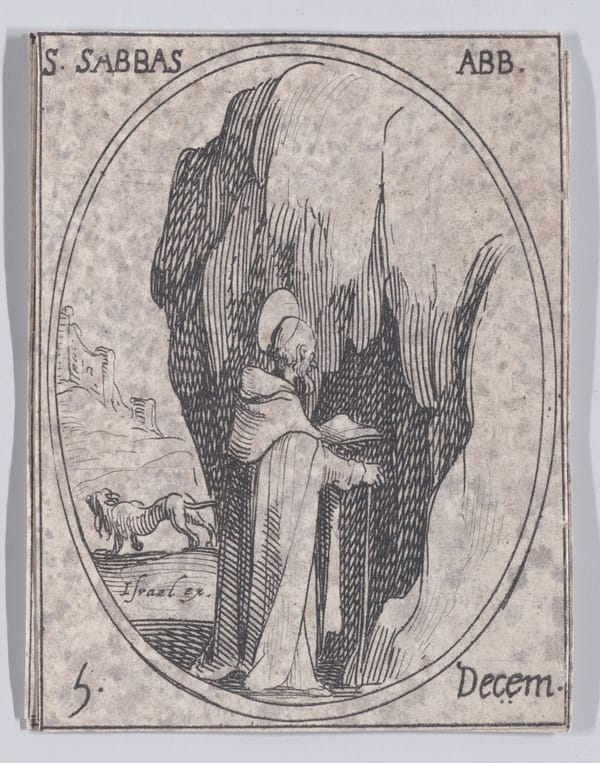
The Roman Church confines herself to-day to the Office of the feria: but to that she joins a commemoration of St. Sabas, abbot of the celebrated laura of Palestine which still exists under his name. This saint, who died in 533, is the only one of the monastic Order of whom the Church makes any mention in her liturgy during the whole period of Advent; we might even say that he is the only simple confessor whose name occurs in the calendar of this part of the year: for, as regards St. Francis Xavier, the glorious title of apostle of the Indies puts him in a distinct class of saints. Here, again, we should recognize divine Providence, which has selected for these days of preparation for Christmas, those saints whose characteristic virtues would make them our fittest models in this work of preparation. We have the feasts of apostles, pontiffs, doctors, virgins: Jesus, the Man-God, the King and Spouse of men, is preceded by this magnificent procession of the noblest of His servants: simple confession has but a single representative, the anchoret and cenobite Sabas, who, by his profession of the monastic life, is of that family of holy solitaries, which began with the prophet Elias under the old Testament, and continued up to the time of St. John the Precursor, who was one of its members, and will continue on, during the new Covenant, until the last coming of Jesus. Let us, then, honour this holy abbot, towards whom the Greek Church professes a filial veneration, and under whose invocation Rome has consecrated one of her churches. Let us beg his prayers by this Collect of the holy liturgy.
Collect
O Sabas, thou man of desires! in thy expectation of that Lord, who has bidden His servants watch until He come, thou didst withdraw into the desert, fearing lest the turmoil of this world might distract thy mind from its God. Have pity on us who are living in the world, and are so occupied in the affairs of that world, and yet who have received the commandment, which thou didst so take to heart, of keeping ourselves in readiness for the coming of our Saviour and our Judge. Pray for us, that when He comes we may be worthy to go out to meet Him. Kemember also the monastic state, of which thou art one of the brightest ornaments; raise it up again from its ruins; let its children be men of prayer and faith, as of old; let thy spirit be among them, and the Church thus regain, by thy intercession, all the glory which is reflected on her from the sublime perfection of this holy state.
Let us look again at the prophecy of Jacob. The holy patriarch not only foretells that the Messias will be the Expectation of nations; he adds that, when this promised Deliverer comes, the sceptre will have been taken away from Juda.1 This oracle is now fulfilled. The flag of Cæsar Augustus floats on the ramparts of Jerusalem. The temple is still untouched; the abomination of desolation stands not yet in the holy place; sacrifices are there still offered up to God; but then, the true temple of God, the Incarnate Word, has not yet been built; the Synagogue has not denied Him, who was her expectation; the Victim, that was to supersede all others, has not been immolated. Yet, Juda has no chief of her own race; Cæsar’s coin is current throughout all Palestine; and the day is not far off when the leaders of the Jewish people will own, in the presence of the Roman governor, that they have not the power to put any man to death.2 So that there is now no king upon the throne of David and Solomon, that throne which was to abide for ever. O Jesus! Son of David, and King of peace, now is the time when Thou must show Thyself and take possession of the sceptre which has been taken in battle from the hand of Juda, and put, for a time, into that of an emperor. Come! for Thou art King, and the psalmist, Thy ancestor, thus sang of Thee: 'Gird Thy sword upon Thy thigh, O Thou Most Mighty! With Thy comeliness and Thy beauty set out, proceed prosperously, and reign, because of truth and meekness and justice, and Thy right hand shall conduct Thee wonderfully. Thy arrows are sharp: under Thee shall people fall: Thy arrows shall go into the hearts of the King’s enemies. Thy throne is for ever and ever; the sceptre of Thy kingdom is a sceptre of uprightness. . . . God, Thy God, hath anointed Thee, O Christ! who takest thence Thy name, with the oil of gladness above Thy fellows, who have been honoured with the name of king.’3 When Thou hast come, O Messias! men will be no more as sheep going astray without a shepherd; there will be but one fold, in which Thou wilt reign by love and justice, for all power will be given unto Thee in heaven and on earth. When, in the hour of Thy Passion, Thy enemies shall ask Thee: ‘Art Thou King?’ Thou wilt answer them in all truth: ‘Verily, I am.’4 Come, dearest King, and reign over our hearts; come, and reign over this world, which is Thine because Thou didst create it, and will soon be Thine because Thou wilt have redeemed it. Reign, then, over this world, and delay not the manifestation of Thy royal power until the day of which it is written: 'He will break kings in the day of His wrath’;5 reign from this very hour, and let all people fall at Thy feet and adore Thee in one grand homage of love and obedience.
Sequence for the Time of Advent
(Composed in the eleventh century, and taken from the ancient Roman-French missals)
| Previous December 4 (the Same Day): Saint Barbara, Virgin and Martyr | Next December 5: St. Sabas, Abbot |