Daily reading
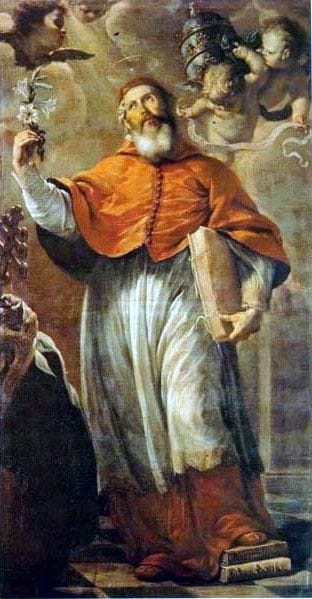
December 11: Saint Damasus, Pope and Confessor
This great Pontiff comes before us in the liturgical year, not to bring us tidings of peace as St. Melchiades did, but as one of the most illustrious defenders of the great mystery of the Incarnation. He defends the faith of the universal Church in the divinity of the Word, by condemning, as his predecessor Liberius had done, the acts and the authors of the celebrated Council of Rimini. With his sovereign authority, he bore witness to the teaching of the Church regarding the Humanity of Jesus Christ, and condemned the heretic Apollinaris, who taught that Jesus Christ had assumed only the flesh and not the soul of man. He commissioned St. Jerome to make a new translation of the new Testament from the Greek, for the use of the Church of Rome; here, again, giving a further proof of the faith and love which he bore to the Incarnate Word. Let us honour this great Pontiff, whom the Council of Chalcedon calls ‘the ornament and support of Rome by his piety.’ St. Jerome, too, who looked upon St. Damasus as his friend and patron, calls him ‘a man of the greatest worth; a man whose equal could not be found, well versed in the holy Scriptures, and a virgin doctor of the virgin Church.’ The legend of the breviary gives us a brief account of his life.
Prose
(Taken from the Cluny missal of 1523)
Holy Pontiff Damasus! during thy life on earth, thou wast the light, which guided the children of the Church; for thou didst teach them the mystery of the Incarnation, and didst guard them against those perfidious doctrines, wherewith hell ever strives to corrupt that glorious symbol of our faith, which tells us of God’s infinite mercy towards us, and of the sublime dignity of man thus mercifully redeemed. Seated on the Chair of Peter, thou didst confirm thy brethren, and thy faith failed not; for Jesus had prayed to His Father for thee. We rejoice at the infinite recompense with which this divine Prince of pastors has rewarded the unsullied purity of thy faith, O thou ‘virgin doctor of the virgin Church!’ Oh that we could have a ray of that light which now enables thee to see Jesus in His glory! Pray for us, that we may have light to see Him, and know Him, and love Him, under the humble guise in which He is so soon to appear to us. Obtain for us the science of the sacred Scriptures, in which thou wast so great a master; and docility to the teachings of the Bishop of Rome, to whom, in the person of St. Peter, Christ has said: ‘Launch out into the deep!’*
Obtain also for all Christians, O thou the successor of this prince of the apostles, that they be animated with those sentiments, which St. Jerome thus describes in one of his letters addressed to thee: ‘It is the Chair of Peter that I will consult, for from it do I derive that faith which is the food of my soul. I will search for this precious pearl, heeding not the vast expanse of sea and land which I must pass over. Where the body is, there shall the eagles be gathered together. It is now in the west that the Sun of justice rises. I ask the Victim of salvation from the priest, and from the shepherd the protection of the sheep. On that rock I know the Church is built. He that eats the Lamb in any house but this, is profane. He that is not in Noah’s ark, shall perish in the waters of the deluge. I know not Vitalis, I reject Meletius, I pass by Paulinus. He that gathers not with thee, Damasus, scatters; for he that is not of Christ, is of Antichrist.’
Let us contemplate our divine Saviour in the womb of His most holy Mother Mary. Let us, together with the holy angels, adore Him in this state of profound humiliation, to which His love for us has brought Him. See Him there offering Himself to His Father for the redemption of mankind, and commencing at once to fulfil the office of our Mediator, which He has taken upon Himself. What an excess of love is this of our Jesus, that He is not satisfied with having humbled Himself in assuming our nature,though that alone would have sufficed to redeem a million worlds! The eternal Son of God wills to remain, as other children, nine months in His Mother’s womb: after that, to be born in poverty, to live a life of labour and suffering, and to be obedient to death, even to the death of the cross. O Jesus! mayst Thou be praised and loved by all creatures for this Thy immense love of us! Thou hast come down from heaven the Victim that art to take the place of all those which were hitherto offered, but which could not efface man’s sin. At length, the earth possesses its Saviour, though as yet unseen. God will not curse the earth, which, though covered with crime, is rich in such a treasure as this. Still repose, O Jesus, in the chaste womb of Mary, that living ark which contains the true manna sent for the food of man. But the time is approaching for Thee to leave this loved sanctuary. The tender love which Thou hast received from Mary, must be changed for the malice wherewith men will treat Thee; yet it must needs be that Thou be born on the day which Thou Thyself hast decreed: it is the will of Thy eternal Father, it is the expectation of the world, it is the salvation of all who shall love Thee.
Prose in Honor of the Blessed Virgin
(Taken from the Cluny missal of 1523)
Prayer for the Time of Advent
(The Mozarabic breviary, Monday of the first week of Advent)
* St. Luke v. 4. ↩︎
Friday of the Second Week of Advent
Cap. xxiv.Ecce Dominus dissipabit terram, et nudabit eam; et affliget faciem ejus et disperget habitatores ejus. Et erit sicut populus, sic sacerdos; et sicut servus, sic dominus ejus; sicut ancilla, sic domina ejus; sicut emens, sic ille qui vendit; sicut fœnerator, sic is qui mutuum accipit; sicut qui repetit, sic qui debet. Dissipatione dissipabitur terra, et direptione prædabitur: Dominus enim locutus est verbum hoc. Luxit et defluxit terra, et infirmata est: defluxit orbis, infirmata est altitudo populi terræ. Et terra infecta est ab habitatoribus suis: quia transgressi sunt leges, mutaverunt jus, dissipaverunt fœdus sempiternum. Propter hoc maledictio vorabit terram, et peccabunt habitatores ejus, ideoque insanient cultores ejus; et relinquentur homines pauci. Luxit vindemia, infirmata est vitis, ingemuerunt omnes qui laetabantur corde. Cessavit gaudium tympanorum, quievit sonitas lætantium, conticuit dulcedo citharæ. Cum cantico non bibent vinum: amara erit potio bibentibus illam. Attrita est civitas vanitatis: clausa est omnis domus, nullo introeunte. Clamor erit super vino in plateis: deserta est omnis laetitia, translatum est gaudium terræ. Relicta est in urbe solitudo, et calamitas opprimet portas. Quia hæc erunt in medio terræ, in medio populorum; quomodo si paucae olivae quae remanserunt, excutiantur ex olea: et racemi, cum fuerit finita vindemia. Hi levabunt vocem suam, atque laudabunt; cum glorificatus fuerit Dominus, hinnient de mari. Propter hoc in doctrinis glorificate Dominum, in insulis maris nomen Domini Dei Israel. A finibus terræ laudes audivimus, gloriam justi.
Ch. xxiv.Behold the Lord shall lay waste the earth, and shall strip it: and shall afflict the face thereof, and scatter abroad the inhabitants thereof. And it shall be as with the people, so with the priest; and as with the servant, so with his master; as with the handmaid, so with her mistress; as with the buyer, so with the seller; as with the lender, so with the borrower; as with him that calleth for his money, so with him that oweth. With desolation shall the earth be laid waste, and it shall be utterly spoiled: for the Lord hath spoken this word. The earth mourned and faded away, and is weakened: the world faded away, the height of the people of the earth is weakened. And the earth is infected by the inhabitants thereof: because they have transgressed the laws, they have changed the ordinance, they have broken the everlasting covenant. Therefore shall a curse devour the earth, and the inhabitants thereof shall sin; and therefore they that dwell therein shall be mad, and few men shall be left. The vintage hath mourned, the vine hath languished away, all the merry-hearted have sighed. The mirth of timbrels hath ceased, the noise of them that rejoice is ended, the melody of the harp is silent. They shall not drink wine with a song; the drink shall be bitter to them that drink it. The city of vanity is broken down, every house is shut up, no man cometh in. There shall be a crying for wine in the streets: all mirth is forsaken, the joy of the earth is gone away. Desolation is left in the city, and calamity shall oppress the gates. For it shall be thus in the midst of the earth, in the midst of the people, as if a few olives that remain should be shaken out of the olive tree: or grapes, when the vintage is ended. These shall lift up their voice, and shall give praise, when the Lord shall be glorified, they shall make a joyful noise from the sea. Therefore glorify ye the Lord in instruction: the name of the Lord God of Israel in the islands of the sea. From the ends of the earth we have heard praises, the glory of the just one.
Thus was the earth in desolation when the Messias came to deliver and save it. So diminished, so decayed, were truths among the children of men, that the human race was bordering on its ruin. The knowledge of the true God was becoming rarer as the world grew older; idolatry had made everything in creation an object of its adulterous worship; the practical result of a religion which was but gross materialism, was frightful immorality; man was for ever at war with man; and the only safeguards of what social order still existed in the world, were the execrable laws of slavery and extermination. Among the countless inhabitants of the globe, a mere handful could be found who were seeking God! they were as rare as the olives that remain on the tree after a careful plucking, or as grape-bunches after the vintage is ended. Of this happy few were, among the Jewish people, those true Israelites whom our Saviour chose for His disciples; and, among the Gentiles, the Magi that came from the east, asking for the new-born King; and later on, Cornelius the centurion, whom the angel of the Lord directed to St. Peter. But with what faith and joy did they acknowledge the incarnate God! and what their hymns of glad gratitude, when they found that they had been privileged, above others, to see with their own eyes the promised Saviour!
Now, all this will again happen when the time draws near of the second coming of the Messias. The earth will once more be filled with desolation, and mankind will be again a slave of its self-degradation. The ways of men will again grow corrupt; and, this time, the malice of their evil will be the greater, because they will have received Him who is the Light of the world, the Word of life. A profound sadness will sit heavy on all nations, and every effort for their well-being will seem paralyzed; they, and the earth they live on, will be conscious of decrepitude; and yet it will never once strike them that the world is drawing to an end. There will be great scandals; there shall fall stars from heaven, that is, many of those who had been masters in Israel shall apostatize, and their light shall be changed into darkness. There shall be days of temptation, and faith shall grow slack; so that when the Son of Man shall appear, faith shall scarce be found on the earth. Let it not be, O Lord, that we live to see those days of temptation; or, if it be Thy will that they overtake us, make our hearts firm in their allegiance to Thy holy Church, which will be the only beacon left to Thy faithful children in that fiorce storm. Grant, O Lord, that we may be of the number of those chosen olives, of those elect bunches of grapes, wherewith Thou wilt complete the rich harvest which Thou wilt garner for ever into Thy house. Preserve intact within us the deposit of faith which Thou hast entrusted to us; let our eye be fixed on that Orient of which the Church speaks to us, and where Thou art suddenly to appear in Thy majesty. When that day of Thine comes, and we behold Thy triumph, we will shout our glad delight, and then, like eagles which cluster round the body, we shall be taken up to meet Thee in the air, as Thy apostle speaks, and thus shall we for ever be with Thee.* Then we shall hear the praises and glory of the Just One, from the ends of this earth, which it is Thy good will to preserve until the decrees of Thy mercy and justice shall have been fully executed. O Jesus! we are the work of Thy hands; save us, and be merciful to us on that great day.
Hymn of Advent
(Mozarabic breviary, in the second week of Advent)
Ad nos venis per Virginem,
Baptismi rore consecrans,
Cunctos fide regenerans.
Excepit formam hominis,
Victor a morte rediens,
Gaudia vitae largiens.
Illabere propitius,
Clarum que nostris cordibus
Lumen præbe deificum.
Ejusque soli Filio
Cum Spiritu Paraclito,
In sempiterna sæcula.
thou comest to us by the Virgin,
consecrating us all by the dew of Baptism,
and by faith regenerating us.
has taken on himself the form of man,
returning after conquering death,
and giving us the joys of a now life.
descend upon us in thy mercy,
and give to our hearts
the brightness of the divine light.
and to his only Son,
and to the holy Paraclete,
be glory for ever and ever.
Prayer from the Gallican Missal
(In Adventu Domini, Collecta)
* 1 Thess. iv. 16. ↩︎
| Previous Thursday of the Second Week of Advent | Next Friday of the Second Week of Advent |