Daily reading
Advent
Movable from Advent · Temporal
December 13, 2026
From Dom Guéranger’s The Liturgical Year.
St. Lucy impeded by the Sunday, transferred to Dec 14.Rubrics

|
The Third Sunday of Advent
To-day, again, the Church is full of joy, and the joy is greater than it was. It is true that her Lord has not come; but she feels that He is nearer than before, and therefore she thinks it just to lessen somewhat the austerity of this penitential season by the innocent cheerfulness of her sacred rites. And first, this Sunday has had the name of Gaudete given to it, from the first word of the Introit; it also is honoured with those impressive exceptions which belong to the fourth Sunday of Lent, called Lœtare. The organ is played at the Mass; the vestments are rose-colour; the deacon resumes the dalmatic, and the subdeacon the tunic; and in cathedral churches the bishop assists with the precious mitre. How touching are all these usages, and how admirable this condescension of the Church, wherewith she so beautifully blends together the unalterable strictness of the dogmas of faith and the graceful poetry of the formulæ of her liturgy! Let us enter into her spirit, and be glad on this third Sunday of her Advent, because our Lord is now so near unto us. To-morrow we will resume our attitude of servants mourning for the absence of their Lord and waiting for Him; for every delay, however short, is painful and makes love sad.
The Station is kept in the basilica of St. Peter, at the Vatican. This august temple, which contains the tomb of the prince of the apostles, is the home and refuge of all the faithful of the world; it is but natural that it should be chosen to witness both the joy and the sadness of the Church.
The night Office commences with a new Invitatory. The voice of the Church no longer invites the faithful to come and adore in fear and trembling the King, our Lord„ who is to come. Her language assumes another character; her tone is one of gladness; and now, every day, until the vigil of Christmas, she begins her nocturns with these grand words:
Now let us take the book of the Prophet, and read with the Church:
Cap. xxvi.In die illa cantabitur canticum istud in terra Juda: Urbs fortitudinis nostræ Sion; Salvator ponetur in ea murus et antemurale. Aperite portas, et ingrediatur gens justa, custodiens veritatem. Vetus error abiit, servabis pacem; pacem, quia in te speravimus. Sperastis in Domino in saeculis æternis: in Domino Deo forti in perpetuum. Quia incurvabit habitantes in excelso, civitatem sublimem humiliabit. Humiliabit eam usque ad terram, detrahet eam usque ad pulverem. Conculcabit eam pes; pedes pauperis, gressus egenorum. Semita justi recta est, rectus callis justi ad ambulandum. Et in semita judiciorum tuorum, Domine, sustinuimus te: nomen tuum, et memoriale tuum in desiderio animæ. Anima mea desideravit te in nocte: sed et spiritu meo in præcordiis meis, de mane vigilabo ad te.
Ch. xxvi.In that day shall this canticle be sung in the land of Juda. Sion the city of our strength: a Saviour, a wall, and a bulwark shall be set therein. Open ye the gates and lot the just nation, that keepeth the truth, enter in. The old error is passed away, thou wilt keep peace: peace, because we have hoped in thee. You have hoped in the Lord for evermore: in the Lord God mighty for ever. For he shall bring down them that dwell on high, the high city he shall lay low. He shall bring it down even to the ground, he shall pull it down even to the dust. The foot shall tread it down; the feet of the poor, the steps of the needy. The way of the just is right, the path of the just is right to walk in. And in the way of thy judgements, O Lord, we have patiently waited for thee: thy name and thy remembrance are the desire of the soul. My soul hath desired thee in the night: yea, and with my spirit within me in the morning early I will watch to thee.
O holy Roman Church, city of our strength! behold us thy children assembled within thy walls, around the tomb of the fisherman, the prince of the apostles, whose sacred relics protect thee from their earthly shrine, and whose unchanging teaching enlightens thee from heaven. Yet, O city of strength: it is by the Saviour, who is coming, that thou art strong. He is thy wall, for it is He that encircles, with His tender mercy, all thy children; He is thy bulwark, for it is by Him that thou art invincible, and that all the powers of hell are powerless to prevail against thee. Open wide thy gates, that all nations may enter thee; for thou art mistress of holiness and the guardian of truth. May the old error, which sets itself against the faith, soon disappear, and peace reign over the whole fold! O holy Roman Church! thou hast for ever put thy trust in the Lord; and He, faithful to His promise, has humbled before thee the haughty ones that defied thee, and the proud cities that were against thee. Where now are the Cæsars, who boasted that they had drowned thee in thine own blood? where the emperors, who would ravish the inviolate virginity of thy faith? where the heretics, who, during the past centuries of thine existence, have assailed every article of thy teaching, and denied what they listed? where the ungrateful princes, who would fain make a slave of thee, who hadst made them what they were? where that empire of Mahomet, which has so many times raged against thee, for that thou, the defenceless State, didst arrest the pride of its conquests? where the reformers, who were bent on giving the world a Christianity, in which thou wast to have no part? where the more modern sophists, in whose philosophy thou wast set down as a system that had been tried, and was a failure, and is now a ruin? and those kings who are acting the tyrant over thee, and those people that will have liberty independently and at the risk of truth, where will they be in another hundred years? Gone and forgotten as the noisy anger of a torrent; whilst thou, O holy Church of Rome, built on the immovable rock, wilt be as calm, as young, as unwrinkled as ever. Thy path through all the ages of this world’s duration, will be right as that of the just man; thou wilt ever be the same unchanging Church, as thou hast been during the eighteen hundred years past, whilst everything else under the sun has been but change. Whence this thy stability, but from Him who is very truth and justice? Glory be to Him in thee! Each year, He visits thee; each year, He brings thee new gifts, wherewith thou mayst go happily through thy pilgrimage; and to the end of time, He will visit thee, and renew thee, not only with the power of that look wherewith Peter was renewed, but by filling thee with Himself, as He did the ever glorious Virgin, who is the object of thy most tender love, after that which thou bearest to Jesus Himself. We pray with thee, O Church, our mother, and here is our prayer: ‘Come, Lord Jesus! Thy name and Thy remembrance are the desire of our souls: they have desired Thee in the night, yea, and early in the morning have they watched for Thee.’
The Mass
The assembly of the faithful is attentive; the cantors intone the Gregorian melody, and the church echoes with these sweet words:
The Introit
Ps. O Lord thou hast blessed thy land: thou hast turned away the captivity of Jacob. ℣. Glory.
In the Collect, the Church asks for the grace of that divine visit, which dispels darkness and brings light. Darkness produces fear in the soul; whereas, light gives courage and joy to the heart.
Collect
The other Collects of the blessed Virgin, against the persecutors of the Church, and for the Pope, are the same as on the first Sunday in Advent, page 128.
Epistle
Cap. iv.Fratres, gaudete in Domino semper: iterum dico, gaudete. Modestia vestra nota sit omnibus hominibus: Dominus prope est. Nihil solliciti sitis; sed in omni oratione, et obsecratione, cum gratiarum actione, petitiones vestræ innotescant apud Deum. Et pax Dei, quae exsuperat omnem sensum, custodiat corda vestra, et intelligentias vestras, in Christo Jesu Domino nostro.
Ch. iv.Brethren, rejoice in the Lord always: again I say, rejoice. Let your modesty be known to all men: the Lord is nigh. Be nothing solicitous: but in everything, by prayer and supplication with thanksgiving, let your petitions be made known to God. And the peace of God, which surpasseth all understanding, keep your hearts and minds in Christ Jesus our Lord.
Nothing is more just than that we rejoice in the Lord. Both the prophet and the apostle excite us to desire the Saviour, both of them promise us peace. Therefore, let us not be solicitous: the Lord is nigh; nigh to His Church, and nigh to each of our souls. Who can be near so burning a fire, and yet be cold? Do we not feel that He is coming to us, in spite of all obstacles? He will let nothing be a barrier between Himself and us, neither His own infinite high majesty, nor our exceeding lowliness, nor our many sins. Yet a little while, and He will be with us. Let us go out to meet Him by these prayers and supplications, and thanksgiving which the apostle recommends to us. Let our zeal to unite ourselves with our holy mother the Church become more than ever fervent: now every day her prayers will increase in intense earnestness, and her longings after Him, who is her light and her love, will grow more ardent. First let us say together with her:
Gradual
Qui sedes, Domine, super Cherubim, excita potentiam tuam et veni.℣. Qui regis Israel, intende: Qui deducis velut ovem Joseph.Alleluia, alleluia.℣. Excita Domine potentiam tuam, et veni, ut salvos facias nos. Alleluia.
O Lord, who sittest on the Cherubim, exert thy power and come.℣. Thou who rulest Israel, hearken. Thou who leadest Joseph as a sheep.Alleluia, alleluia.℣. Exert, O Lord, thy power, and come to save us. Alleluia.
Gospel
Cap. i.In illo tempore: Miserunt Judæi ab Jerosolymis sacerdotes et levitas ad Joannem ut interrogarent eum: Tu quis es? Et confessus est, et non negavit, et confessus est: Quia non sum ego Christus. Et interrogaverunt eum: Quid ergo? Elias es tu? Et dixit: Non sum. Propheta es tu? Et respondit: Non. Dixerunt ergo ei: Quis es, ut responsum domus his qui miserunt nos? Quid dicis de te ipso? Ait: Ego vox clamantis in deserto: Dirigite viam Domini, sicut dixit Isaias propheta. Et qui missi fuerant erant ex Pharisæis. Et interrogaverunt eum, et dixerunt ei: Quid ergo baptizas, si tu non es Christus, neque Elias, neque propheta? Respondit eis Joannes, dicens: Ego baptizo in aqua: medius autem vestrum stetit, quem vos nescitis. Ipse est, qui post me venturus est, qui ante me factus est: cujus ego non sum dignus ut solvam ejus corrigiam calceamenti. Hæc in Bethania facta sunt trans Jordanem, ubi erat Joannes baptizans
Ch. i.At that time: the Jews sent from Jerusalem priests and levites to John, to ask him: Who art thou? And he confessed, and did not deny, and he confessed: I am not the Christ. And they asked him: What then? Art thou Elias? And he said: I am not. Art thou a prophet? And he answered: No. They said therefore unto him: Who art thou, that we may give an answer to them that sent us? What sayest thou of thyself? Ho said: I am the voice of one crying in the wilderness: Make straight the way of the Lord, as said the prophet Isaias. And they that were sent were of the Pharisees. And they asked him and said to him: Why then dost thou baptize, if thou be not Christ, nor Elias, nor a prophet? John answered them saying: I baptize with water; but there hath stood one in the midst of you, whom you know not. The same is he that shall come after me, who is preferred before me: the latchet of whose shoe I am not worthy to loose. These things were done in Bethania, beyond the Jordan, where John was baptizing.
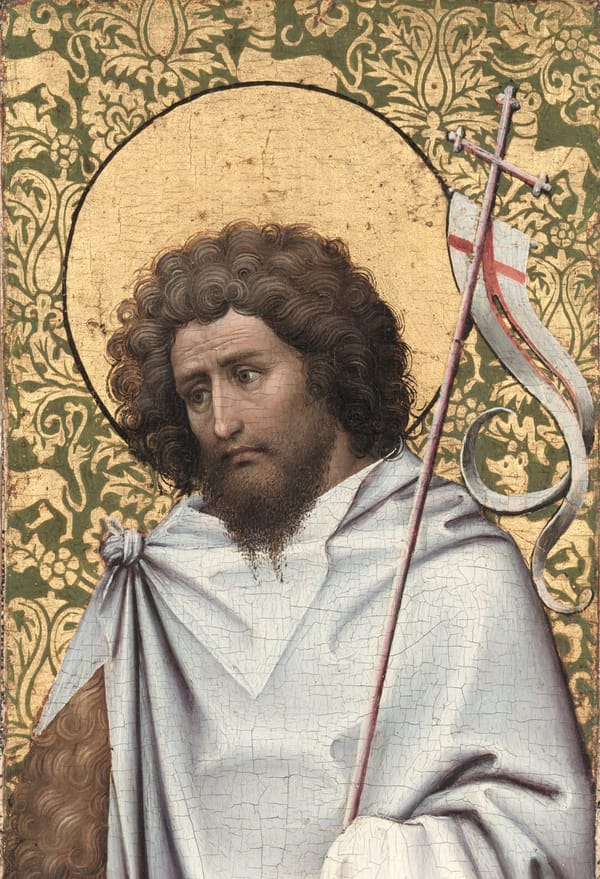
There hath stood One in the midst of you, whom you know not, says Saint John the Baptist to them that were sent by the Jews. So that our Lord may be near, He may even have come, and yet by some be not known! This Lamb of God is the holy Precursor’s consolation: he considers it a singular privilege to be but the voice, which cries out to men to prepare the way of the Redeemer. In this, St. John is the type of the Church, and of all such as seek Jesus. St. John is full of joy because the Saviour has come: but the men around him are as indifferent as though they neither expected nor wanted a Saviour. This is the third week of Advent; and are all hearts excited by the great tidings told them by the Church, that the Messias is near at hand? They that love Him not as their Saviour, do they fear Him as their Judge? Are the crooked ways being made straight, and the hills being brought low? Are Christians seriously engaged in removing from their hearts the love of riches and the love of sensual pleasures? There is no time to lose: the Lord is nigh! If these lines should come under the eye of any of those Christians who are in this state of sinful indifference, we would conjure them to shake off their lethargy, and render themselves worthy of the visit of the divine Infant: such a visit will bring them the greatest consolation here, and give them confidence hereafter, when our Lord will come to judge all mankind. Send Thy grace, O Jesus, still more plentifully into their hearts; 'compel them to go in,’ and permit not that it be said of the children of the Church, as St. John said of the Synagogue: There standeth in the midst of you One, whom you know not.
During the Offertory the faithful should unite in the prayer of the Church, and beg that the captivity in which our sins hold us may be brought to an end, and that the divine Deliverer may come.
Offertory
Secret
The other Secrets are given on page 132.
During the Communion, the Church chants the words of the prophet Isaias, which bid the heart of the sinner take courage. Fear not, Christian people! He that is coming is God; but He comes to save His creatures, and to give Himself to them.
Communion
The Church asks of God, in the following prayer, that the secret visit which she has just been receiving from her divine Spouse, may fit her for that solemn one which she is preparing to receive at the feast of Christmas.
Postcommunion
The other Postcommunions as on the first Sunday, page 134.
Vespers
Listen: recording
Capitulum
Phil. iv. 4.
The hymn Creator alme siderum, and the canticle Magnificat, are given on pages 107 and 109.
Antiphon of the Magnificat
But if the third Sunday of Advent fall on December 17, then, instead of the above, is said the first of the Great Antiphons (O Sapientia), which will be found, with the other six, in the proper of saints, from December 17 to 23 (page 484).
Prayer
December 13 (the Same Day): St. Odilia, Virgin and Abbess
On this same day, we have also the fifth of the wise virgins, whose bright lamps light us, during Advent, to the crib of Jesus their Spouse. Odilia did not shed her blood for Him, as did Bibiana, Barbara, Eulalia, and Lucy; her offering was her tears and her love. Her wreath of lilies blends sweetly with the roses, which form the crowns of her four companions. Her name is held in special veneration in the east of France, and beyond the Rhine. The holy hill whereon her tomb has rested now these thousand years, is still visited by numerous and devout pilgrims. Several kings of the Capetian race, and several emperors of the house of Hapsburg, were descendants of the father of our saint, Adalric or Atticus, Duke of Alsace.
Odilia was born blind. Her father insisted on her being removed from the house, for her presence would have been a continual humiliation to him. It seems as though this affliction was permitted by Providence, in order that the action and power of divine grace might be the more clearly manifested in her regard. The little exile was taken from her mother, and placed in a monastery. God, who designed to show the virtue of the holy Sacrament of regeneration, permitted that her Baptism should be deferred until she had reached her thirteenth year. The time at length came for Odilia to be made a child of God. No sooner was she taken from the baptismal font, than she received her eyesight, which was but a feeble figure of the light which faith had lit up in her soul. This prodigy restored Odilia to her father and to the world; and from that time forward, she had to defend, against unceasing attacks, the virginity which she had vowed to God. Her personal beauty, and her father’s wealth and power, attracted to her many rich suitors. She refused them all; and her father himself built a monastery on the rocks of Hohenburg, wherein she served her divine Lord, governed a large community, and gave relief to every sort of suffering.
After a long life spent in prayer, penance, and works of mercy, the day came which was to reward her for it all. It was this very day, the thirteenth of December, the feast of the holy virgin Lucy. The sisters of Hohenburg, desirous of treasuring up her last words, assembled round their saintly abbess. She was in an ecstasy, and already dead to the things of this life. Fearing lest she should die before she had received that holy Viaticum, which leads the soul to Him who is her last end, the sisters thought it their duty to rouse her from the mystic sleep, which, so it seemed to them, rendered her forgetful of the duties which she had to perform. Being thus brought to herself, she turned to the community, and said to them: ‘Dear sisters, why have you disturbed me? Why would you again oblige me to feel the weight of this corruptible body, when I had once left it? By the favour of His divine Majesty, I was in the company of the virgin Lucy, and the delights I was enjoying were so great that no tongue could tell them, nor ear hear them, nor human eye see them.’ No time was lost in giving her the Bread of life and the Chalice of salvation, which having received, she immediately rejoined her heavenly companion, and the thirteenth day of December thus united into one the feasts of the abbess of Hohenburg and of the martyr of Syracuse.
The Church of Strasburg, which honours Odilia as one of its greatest glories, has the following lessons for this feast. By giving them a place here, we do not adopt the statement they contain with regard to the rule which was followed in the monastery of Hohenburg. Mabillon, who proves that St. Odilia followed the rule of St. Benedict, shows that the Canonical Rule, as it was called, did not exist at that time.
The ways of God in thy regard, O holy virgin, were admirable indeed, and He manifested in thee the riches and power of His grace. He deprived thee of sight, that so thy soul might the more eagerly cling to His own infinite beauty; and when afterwards He bestowed on thee thy bodily vision, thou hadst already made choice of the better part. The harshness of thy father deprived thee of the innocent pleasures of home; but it prepared thee to become the spiritual mother of so many noble virgins, who, following thy example, trampled on all the vanities of the world. Thou didst choose a life of humility, because thy heavenly Spouse Jesus had humbled Himself for our sake. Thou didst imitate Him also in His being our divine Deliverer, and taking upon Himself all our miseries, for thou hadst the tenderest compassion on the poor and the sick. Thou didst take on thyself the care of a poor leper, that had been abandoned by all else; with a mother’s courage thou didst feed him, and affectionately dress his loathsome sores. And is it not this that our Jesus is coming down from heaven to do for us; to heal our wounds by embracing our human nature, and to nourish us with that food, which He is preparing to give us at Bethlehem? Whilst the leper was receiving thy loving care, the frightful disease which excluded him from the society of his fellow-creatures suddenly disappeared; a delicious odour came from his whole person, whereas before, none but a saint like thyself could have borne to approach him. Is it not this which Jesus is coming down to do for us? The leprosy of sin was upon us; His grace heals us, and man regenerated sheds around him the good odour of Christ.1
In the midst of the joys which thou art now sharing with Lucy, remember us, O thou that wast ever so compassionate to the needy! We cannot forget the tears thou didst shed, and the prayers thou didst offer up for the soul of thy father after his death, whereby thou didst deliver him from purgatory, and open the gates of heaven to him that had banished thee from his house. Thou art no longer in the land of tears; thine eyes are opened to the light of heaven, and contemplate God in His glory: pray therefore for us, for thy prayers are now more powerful than heretofore. Think of us who are poor and infirm; obtain the cure of our maladies. The Emmanuel, who is coming to us, tells us that He is the Physician of our souls, for He has said: 'They that are in health need not the Physician, but they that are ill.’2 Ask Him to cure us of the leprosy of sin, and make us become even like unto Himself. Pray for France, thy country, and help her to maintain the purity of the Catholic faith. Watch over the ruins of the holy empire. Heresy has disunited the members of that great body; but it will once more flourish, if our Lord, propitiated by such prayers as thine, vouchsafe to bring Germany back again to the true faith and to submission to the Church. Yes, pray that these glorious things be brought about for the honour and glory of thy divine Spouse, and that nations, now weary of their errors and disunion, may unite together in propagating the kingdom of God upon earth.
Let us consider the ever blessed Mother of God leaving her humble dwelling at Nazareth, in order to visit her cousin, St. Elizabeth. The Church honours this mystery of the Visitation on the Friday in Ember Week of Advent, as we have mentioned above, in the Proper of the Time. We will let St. Bonaventure relate this sublime incident of Mary’s life, convinced that our readers will be pleased to hear the seraphic Doctor revealing to them, with his wonderful unction, these preludes to the birth of Jesus.
‘After, this, our Lady, pondering the words spoken unto her by the angel concerning her cousin Elizabeth, resolved to visit her, that she might congratulate with her and render her service. She, therefore, together with Joseph her spouse, set out from Nazareth for the house of Elizabeth, which might perhaps be fourteen or fifteen miles distant from Jerusalem. Neither the roughness nor the length of the journey discouraged her; but she walked with haste, forasmuch as she wished to be little seen in public. She was not like other mothers, burthened by her Child, nor was it to be thought that the Lord Jesus would be a burthen to His Mother. See, therefore, how the Queen of heaven and earth takes this journey alone, with none but her spouse Joseph; not riding, but walking; neither is she escorted by troops of soldiers and barons, nor attended by handmaids and fine ladies. Her train is poverty, humility, modesty, and the beauty of all virtues. The Lord Himself, too, is with her; and He verily hath a numerous and honourable suite, but it is not that of the world, vain and pompous.
‘Now, when she had entered the house of Elizabeth, she greeted her saying: “ Hail! my sister Elizabeth!” But she, exulting, and all full of joy, and inflamed by the holy Spirit, rises and most tenderly embraces Mary, exclaiming for joy: “Blessed art thou among women, and blessed is the fruit of thy womb! And whence is this to me, that there should come unto me the Mother of my Lord?” For as soon as the Virgin had greeted Elizabeth, John, in his mother’s womb, was filled with the Holy Ghost, as was likewise the mother. Nor was it that the mother was filled and then her child, but contrariwise the child was filled first, and he communicated the Spirit unto the mother. The babe effected nought in Elizabeth’s soul, but he merited that the Holy Ghost should do a work in her soul, because the grace of the divine Spirit had descended into him with greater abundance, and he was the first to receive the grace. And as Elizabeth had perceived the coming of Mary, so did John perceive the coming of Jesus. Therefore was it that he leaped for joy, and she prophesied. See the virtue of our Lady’s words, when by their utterance the Holy Ghost is conferred; for so replenished was Mary with Him, that, by her merits, He filled others also with Himself. Upon this, Mary made answer unto Elizabeth, saying: “My soul doth magnify the Lord, and my spirit hath rejoiced in God my Saviour.”
Sequence in Honor of the Mother of God
(Taken from the ancient Roman-French missals)
Celebris in Matris Dei
Agitur memoria.
Decantemus in hac die
Semper Virginis Mariæ
Landes et præconia.
Omnis homo, omni hora,
Ipsam ora et implora
Ejus patrocinia.
Psalle, psalle, nisu toto,
Cordis, oris, voce, voto:
Ave plena gratia!
Ave, Domina cœlorum,
Inexperta viri torum,
Parens paris nescia.
Fœcundata sine viro,
Genuisti more miro
Genitorem filia.
Florens hortus Austro flante,
Porta clausa post et ante,
Via viris invia.
Fusa cœli rore tellus,
Fusum Gedeonis vellus,
Deitatis pluvia.
Salve, splendor firmamenti:
Tu caliginosae menti
Desuper irradia.
Placa mare, maris stella,
Ne involvat nos procella
Et tempestas obvia.
Amen.
for on it we make commemoration of Mary,
the Mother of God.
Lot us sing to-day
the praises and the dignity of the ever blessed
Virgin Mary.
Whoe’er thou art,
and where’er thou art,
pray to her, beseech her to help thee.
Sing, sing, with all thy heart
and voice’s power;
Hail Mary! full of grace.
Hail, Queen of heaven,
purest of Virgins,
yet incomparable Mother!
Made fruitful by God,
thou, his creature, didst give birth,
O prodigy of prodigies! to thy Creator.
Here was the prophecy fulfilled;
that a garden should flower under the breath of the south wind;
that all its gates were closed, and no man could enter.
Mary is the earth spoken of as enriched with the dew of heaven;
she is as Gedeon’s fleece prefigured her,
filled with the dew of the Godhead.
Hail, Mary, thou brightness of heaven!
bring to our darkness
the light that is from above.
O star of the sea,
calm its storms,
and suffer not that they overwhelm us.
Amen.
Introit of Advent
(Ambrosian missal, sixth Sunday, Ingressa)
| Previous Saturday of the Second Week of Advent | Next December 13 (the Same Day): St. Odilia, Virgin and Abbess |