Daily reading
Advent
Double · December 15 · Sanctoral
December 15, 2026
From Dom Guéranger’s The Liturgical Year.
Octave Day of the Immaculate Conception, Double.Rubrics

|
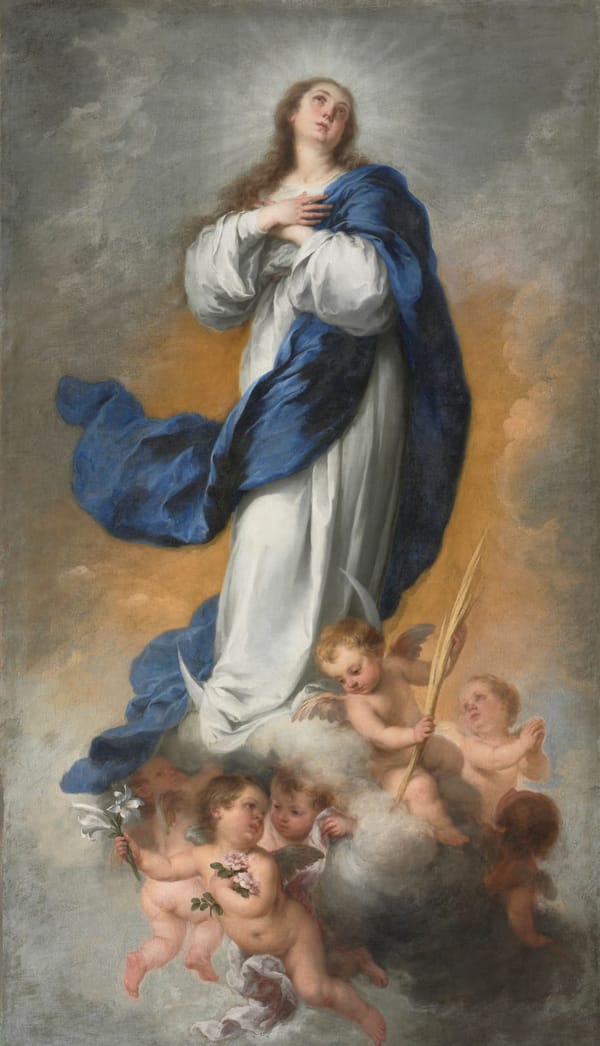
December 15: Octave of the Immaculate Conception of the Most Blessed Virgin
This, the eighth day from that on which we kept the feast of the Immaculate Conception, is the octave properly so called; whereas the other days were simply called days within the octave. The custom of keeping up the principal feasts for a whole week is one of those which the Christian Church adopted from the Synagogue. God had thus spoken in the Book of Leviticus: 'The first day shall be called most solemn and most holy, you shall do no servile work therein. . . . The eighth day also shall be most solemn and most holy, and you shall offer holocausts to the Lord, for it is the day of assembly and congregation: you shall do no servile work therein.'1 We also read in the Book of Kings, that Solomon, having called all Israel to Jerusalem for the dedication of the temple, suffered not the people to return home until the eighth day.
We learn from the Books of the new Testament that this custom was observed in our Saviour’s time, and we find Him authorizing, by His own example, this solemnity of the octave. Thus, we read in Saint John, that Jesus once took part in one of the Jewish festivals, about the midst of the feast;2 and the same Evangelist relating how our Lord cried out to the people: 'If any man thirst, let him come to Me, and drink’: observes, that it was on the last and great day of the festivity.3
In the Christian Church there are three kinds of octaves. Some feasts are celebrated with a privileged octave—that is, one of which the Office is said daily, or at least a commemoration is always made. Other feasts have a common octave, or one whose commemoration may, on greater feasts, be sometimes omitted. And, lastly, some have a simple octave, of which only the Octave Day itself is kept or commemorated. Privileged octaves, whose office is said or commemorated every day, are divided into three Orders. The octaves of the First Order are those of Easter and Pentecost. Those of the Second Order, of which days within the octave exclude all feasts except doubles of the First Class, are the octaves of the Epiphany and of Corpus Christi. The octaves of the Third Order, which must always be commemorated, although days within the octave exclude only the same feasts as do common octaves, are those of Christmas and of the Ascension of Our Lord. The octave of the Immaculate Conception, the first that occurs in the ecclesiastical year, is a common octave.
Let us once more devoutly reverence the mystery of Mary’s Immaculate Conception: our Emmanuel loves to see His Mother honoured. After all, is it not for Him and for His sake that this bright star was prepared from all eternity, and created when the happy time fixed by the divine decree came? When we honour the Immaculate Conception of Mary, it is really to the divine mystery of the Incarnation that we are paying our just homage. Jesus and Mary cannot be separated, for Isaias tells us that she is the branch and He the Flower.4
We give Thee thanks, O Jesus our Emmanuel, because Thou hast granted us to live during the time that the privilege of Thy blessed Mother was proclaimed on this earth; the glorious privilege wherewith Thou didst enrich the first instant of the life of the happy creature, from whom Thou didst take upon Thyself our human nature! This definition of Thy Church has given us a clearer knowledge of Thine infinite holiness. It has taught us to see more distinctly the harmony there is in all Thy divine mysteries. But it has also impressed upon us the great truth that we ourselves, being destined to the most intimate union with Thee here, and to the face to-face vision of Thy infinite Majesty hereafter, must labour without ceasing to purify ourselves from the smallest stains of sin. Thou hast said: 'Blessed are the clean of heart, for they shall see God';5 and Thou showest us, by the dogma of Thy blessed Mother’s Immaculate Conception, what is the purity which Thy sovereign sanctity demands of us. Ah! by the love, which led Thee to preserve her from every stain of sin, have mercy on us who are her devoted children. Thou art so soon to be among us! Before many days are past we shall have yielded to Thy invitations, and have presumed to approach Thy sacred crib. We are not yet ready, dear Jesus! The effects of original sin are still so plainly upon us, and, what is worse, there are so many of our own sins, which we have added to this of our first parent. Oh! prepare our hearts and our senses, for we will not approach to Bethlehem unworthily. The sinless purity of Thy Mother is not for us; we ask not for that; but we ask for forgiveness of our countless sins, for conversion, for hatred of the world and the world’s maxims, and for perseverance in Thy holy love.
O Mary! created mirror of divine justice, and purer than the Cherubim and Seraphim, in return for the homage paid thee by this our generation, on that blissful day when the glory of thy Immaculate Conception was proclaimed throughout the world, give us that abundant richness of thy protecting love, which thou didst reserve till now. The world is shaken to its very foundations: thy hand can help it to rest again. Hell has let loose upon mankind the most terrible of its spirits of wickedness, who breathe but blasphemy and destruction; but, at the same time, the Church of thy Jesus feels that her youth has been renewed within her, and that the seed of the divine word is broadcast and healthy in a thousand fresh portions of the earth. Never was the battle more fierce on both sides: so that we need all our hope to make us feel that hell will not prevail. Is this the great struggle, which is to be followed by the day of judgement?
O blessed Mother of Jesus! O Queen of the universe! can it be that the star of thy Immaculate Conception has shone in the heavens only to light up the ruin and wreck of this earth? The sign foretold by the beloved disciple St. John, of the woman that appeared in the heavens clad with the sun, bearing on her head a crown of twelve stars, and crushing the crescent beneath her feet6—has it not more brightness and power than that other, which appeared in the heavens telling men that God’s anger was appeased, and that the deluge was over? The light which shines upon us is from a Mother. It is our Mother that comes to console and heal us. It is heaven that smiles upon poor guilty earth. We have deserved the chastisement we have received, and more than we have received: but the anger of God will give way, and He will spare us.
The graces which God poured out upon the world on that great day of the Church’s definition of Mary’s Immaculate Conception, were not to be without their effect; a new period then commenced. Mary, on whom heresy had heaped its blasphemies for three hundred years, will again reign in the love of those whom her Son redeemed; countries will abandon those errors which have made them slaves and dupes of men’s doctrines; the old serpent will again writhe under that crushing pressure which God set up from the beginning; and the divine Sun of justice will pour out on the regenerated world the floods of a light more than ever dazzling and resplendent. We may not live to see that time; but we have signs of ite near approach.
It was in the last century that thy devout servant whom the Church has placed upon her altars, Leonard of Porto-Maurizio, predicted that when this dogma of thy Immaculate Conception should be defined, the world would enjoy a long period of peace. The troubles of the present time in which we are living are, we doubt not, a prelude to that happy peace, during which the divine word will traverse the whole world unimpeded, and the Church militant will reap her harvest for the Church in heaven. Sweet Mother of our Jesus! the world was also in agitation in those times which preceded the birth of thy divine Son; but peace reigned throughout the whole earth, when thou didst give it its Saviour in Bethlehem. Until that grand time come when thou wilt show to the world the magnificence of the power which God has given to thee, assist us, each year, to prepare for the glorious solemnity of Christmas: oh! pray for us, that we may be cleansed from all our sins when that splendid night comes, during which will be born of thee Jesus Christ, the Son of God, the light eternal.
Prose in Honour of the Holy Mother of God
(Taken from the ancient Roman-French missals)
Ut devote celebretur
Virginis Conceptio.
Mens amore inflammetur
Et amori copuletur
Laus et jubilatio.
Haec concepta miro more
Est ut rosa cum nitore,
Est ut candens lilium.
Ut fructus exit a flore,
Est producta cum pudore,
Praeventa per Filium.
Sicut ros non corrumpitur,
Quando in terra gignitur,
Elementi rubigine;
Sic Virgo non inficitur.
Quum in matre concipitur,
Originali crimine.
Nos ergo dulci carmine,
Laudemus in hac Virgine
Conceptum Bine nubilo.
Hanc conceptam ex semine,
Et mundam ab origine,
Laudet chorus cum jubilo.
Ut mota dulci modulo,
Nos servet in hoc saeculo
Mundos ab omni crimine.
Et in mortis articulo,
Liberet a periculo
Et inferni voragine.
Amen.
and devoutly celebrate the Conception
of the Virgin ever blessed.
Let the mind be inflamed with love;
and let praise and jubilee
unite with the love.
In her admirable Conception,
she is a rose in its beauty,
she is a lily in its whiteness.
As fruit that comes from the flower,
so was Mary brought forth in her purity,
for her Son had possession of her from the first.
As a dew-drop contracts not a stain
from the earth
whereon ’tis formed,
when she was conceived
in her mother’s womb.
in praise of a cloudless brightness,
the Immaculate Conception.
Put on all your joy, ye choirs of earth,
and sing of her, that was a daughter of Adam,
but not of his sin.
May she be pleased with our hymns,
and defend us from all sin
in this our present life.
And when our last hour comes,
deliver us by her prayers from the abyss of hell,
into which the devil will seek to drag us.
Amen.
A Prayer for the Time of Advent
(The Mozarabic breviary, fourth Sunday of Advent, Oratio)
Tuesday of the Third Week of Advent
Cap. xxx.Exspectat Dominus ut misereatur vestri, et ideo exaltabitur parcens vobis; quia Deus judicii Dominus, beati omnes qui exspectant eum. Populus enim Sion habitabit in Jerusalem: plorans nequaquam plorabis: miserans miserebitur tui: ad vocem clamoris tui statim ut audierit, respondebit tibi. Et dabit vobis Dominus panem arctum, et aquam brevem: et non faciet avolare a te ultra doctorem tuum, et erunt oculi tui videntes præceptorem tuum. Et dabitur pluvia semini tuo, ubicumque seminaveris in terra: et panis frugum terrae erit uberrimus et pinguis. Pascetur in possessione tua in die illo agnus spatiose, et tauri tui, et pulli asinorum, qui operantur terram, commixtum migma comedent sicut in area ventilatum est. Et erunt super omnem montem excelsum, et super omnem collem elevatum rivi currentium aquarum in die interfectionis multorum, cum ceciderint turres. Et erit lux lunæ sicut lux solis, et lux solis erit septempliciter sicut lux septem dierum, in die qua alligaverit Dominus vulnus populi sui, et percussuram plagæ ejus sanaverit. Ecce nomen Domini venit de longinquo, ardens furor ejus, et gravis ad portandum: labia ejus repleta sunt indignatione, et lingua ejus quasi ignis devorans. Spiritus ejus velut torrens inundans usque ad medium colli, ad perdendas Gentes in nihilum, et frenum erroris quod erat in maxillis populorum.
Ch. xxx.The Lord waiteth that he may have mercy on you, and therefore shall he be exalted sparing you: because the Lord is the God of judgement, blessed are all they that wait for him. For the people of Sion shall dwell in Jerusalem: weeping thou shalt not weep: he will surely have pity on thee: at the voice of thy cry, as soon as he shall hear, he will answer thee. And the Lord will give you spare bread and short water: and will not cause thy teacher to flee away from thee any more, and thy eyes shall see thy teacher. And rain shall be given to thy seed, wheresoever thou shalt sow in the land: and the bread of the corn of the land shall be most plentiful and fat. The lamb in that day shall feed at large in thy possession, and thy oxen, and the ass-colts, that till the ground, shall eat mingled provender as it was winnowed in the floor. And there shall be upon every high mountain, and upon every elevated hill, rivers of running waters in the day of the slaughter of many, when the towers shall fall. And the light of the moon shall be as the light of the sun, and the light of the sun shall be sevenfold as the light of seven days, in the day when the Lord shall bind up the wound of his people, and shall heal the stroke of their wound. Behold the name of the Lord cometh from afar, his wrath burneth, and is heavy to bear: his lips are filled with indignation, and his tongue as a devouring fire. His breath as a torrent overflowing even to the midst of the neck, to destroy the nations unto nothing, and the bridle of error that was in the jaws of the people.
And are we then to weep no more, O Jesus? Happy we! How could we be sad now that Thou hast heard our prayers, and our eyes shall behold Thee, our Master, and our Teacher? If Thou yet delayest some days longer, it is only that we may have more time to receive what Thou hast made it Thy glory to give—mercy and the pardon of our sins. Oh, the happiness of Thy kingdom! Oh, the richness of our lands, that is, of our souls, when Thy dew shall have fallen upon them! Oh, the sweetness of our Bread, which is to be Thyself, O living Bread come down from heaven! Oh, the brightness of the light which Thou wilt give us, even on the very day when Thou wilt have bound up our wounds! Blessed day, come quickly! And thou, dear night, when Mary is to give her divine Babe to us, when wilt thou come? So great is our hope in this Thy merciful coming, that we listen with less dread to the awful words of Thy prophet, who, with a rapidity swift as Thine own word, passes over the long ages between the two events, and speaks to us of the approach of the terrible day, when Thou wilt come suddenly in Thy burning wrath, with Thy lips filed with indignation, and Thy tongue as a devouring fire. Our present feeling is hope, for we are looking forward to that coming, in which Thou art the beautiful Prince of peace and love, and we cannot but hope. When that last day comes, have mercy on us! but on this day of Thine amiable visit, permit us to say to Thee the words of one of Thy servants: ‘Yes, dear Jesus, come; come to us! but in swathing-bands, not with Thy hand raised to punish us: in humility, not in Thy greatness: in the crib, not in the clouds of heaven: in the arms of Thy Mother, not on the throne of Thy Majesty: on the colt of the ass, not on the Cherubim: to us, and not against us: to save us, and not to judge: to visit us in Thy peace, not to condemn us in Thy anger. If Thou comest unto us thus, O Jesus! it is not from Thee, but to Thee, that we will flee.’ (The venerable Peter of Celles, First sermon of Advent.)
Hymn Taken from the Anthology of the Greeks
(December 20)
Prayer from the Gallican Missal
(InAdventu Domini, Immolatio)
| Previous Monday of the Third Week of Advent | Next Tuesday of the Third Week of Advent |