Daily reading
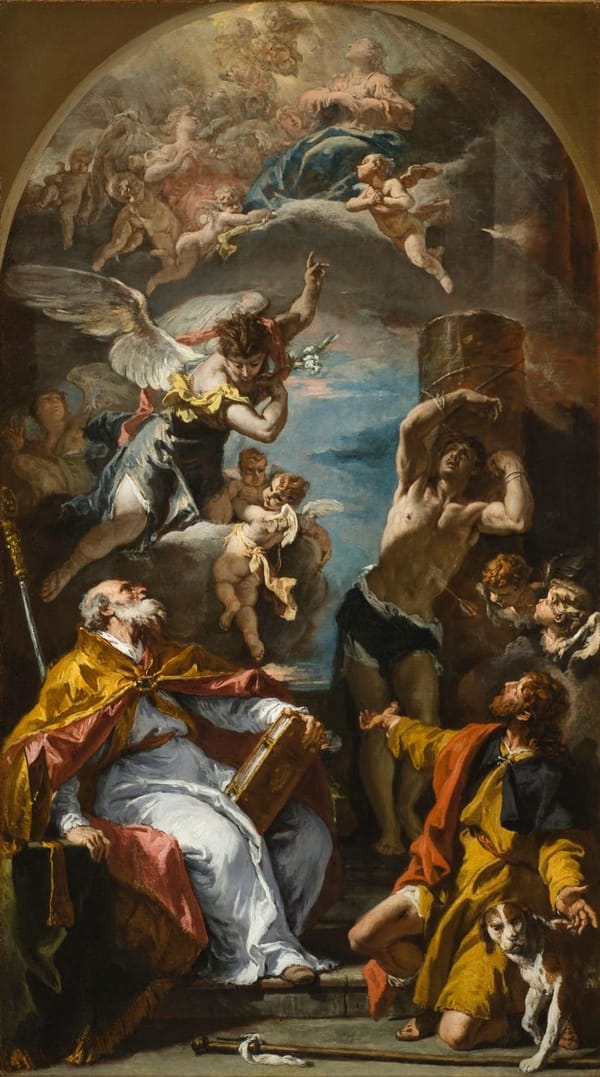
December 16: Saint Eusebius, Bishop of Vercelli and Martyr
When asked to tell the names of the saints who were foremost in defending the dogma of the Incarnation, we think at once of the intrepid Eusebius of Vercelli, as one of the glorious number. The Catholic faith, which was so violently attacked in the fourth century by the Arian heresy, was maintained at that time by the labours and zeal of four sovereign Pontiffs: Sylvester, who confirmed the decrees of the Council of Nicæa: Julius, the supporter of St. Athanasius; Liberius, whose faith failed not, and who, when restored to his liberty, confounded the Arians; and lastly, Damasus, who destroyed the last hopes of the heretics. One of these four Pontiffs appears on our Advent calendar—Damasus, whose feast we kept but a few days since. The four Popes have for their fellow-combatants, in this battle for the Divinity of the Incarnate Word, four great bishops, of whom it may be said that the defence of the dogma of the Consubstantiality of the Son of God was what they lived for, and that to say anathema to them was to say anathema to Christ Himself; all four most powerful in word and work, lights of the Churches of the world, objects of the people’s love, and the dauntless witnesses of Jesus. The first and greatest of the four is the bishop of the second See of Christendom, St. Athanasius, the Patriarch of Alexandria: the second is St. Ambrose of Milan, whose feast we kept on the seventh of this month; the third is the glory of Gaul, St. Hilary, bishop of Poitiers; the fourth is the ornament of Italy, St. Eusebius, bishop of Vercelli, whom we have to honour to-day. Hilary will come to us during Christmastide, and will stand at the crib of the Word, whose Divinity he so bravely confesses; Athanasius will meet us at Easter, and help us to celebrate, in the triumphant Resurrection, Him whom he proclaimed as God in those dark times, when human wisdom hoped to destroy, by fifty years of peace, that Church which had survived the storm of three centuries of persecution. St. Eusebius’ place is Advent; and divine Providence has thus chosen him as one of the patrons of the faithful during this mystic season. His powerful prayers will help us to come devoutly to Bethlehem, and see in the Child, that is lying there, the eternal Word of God. So great were the sufferings which St. Eusebius had to undergo for the Divinity of Jesus, that the Church awards him the honours of a martyr, although he did not actually shed his blood. Let us now listen to the admirable account which the Church gives us of his life.
That Council was held the following year, at Milan; Eusebius was invited by Constantius to be present at it, which was what the legates of Liberius had desired and begged. So far was he from being duped by the synagogue of the malicious Arians to side with them against St. Athanasius, that he openly declared from the first that several of those present were known to him to be heretics, and he therefore proposed that they should subscribe to the Nicene Creed before proceeding any further. This the Arians, infuriated with anger, refused to do; whereupon, he not only refused to subscribe to what was drawn up against Athanasius, but he also, by a most ingenious device, succeeded in having the name of St. Denis the martyr blotted out from the decree, which the craft of the Arians had induced him to sign. Wherefore, they being exceedingly angry against Eusebius, loaded him with injuries, and had him sent into banishment. The holy man, on his side, shaking off the dust from his feet, caring little either for the threats of the emperor, or the sword which was held over him, submitted to banishment as to something which belonged to his episcopal office. Being sent to Scythopolis, he there endured hunger, thirst, blows, and sundry other punishments; he generously despised his life for the true faith, feared not death, and gave up his body to the executioners.
Valiant soldier of Jesus, Eusebius, martyr and pontiff, how much labour and suffering thou didst undergo for the Messias! And yet, they seemed to thee to be little in comparison with what is due to this eternal Word of the Father, who, out of His pure love, has made Himself the Servant of His own creatures, by becoming Man for them in the mystery of the Incarnation. We owe the same debt of gratitude to this divine Saviour. He is born in a stable for our sake, as He was for thine; pray, therefore, for us that we may be ever faithful to Him both in war and in peace; and that we may resist our temptations and evil inclinations with that same firmness, wherewith we would confess His name before tyrants and persecutors. Obtain for the bishops of our holy mother the Church such vigilance, that no false doctrines may surprise them, and such courage that no persecution may make them yield. May they be faithful imitators of the divine Pastor, who gives His life for His sheep; and may they ever feed the flock entrusted to them in the unity and charity of Jesus Christ.
Let us consider how our blessed Lady, having returned to Nazareth, is overwhelmed with joy to feel living within her Him, who gives being to every created thing, and whom she loves with all the intensity of the Mother of God. Joseph, the faithful guardian of her virginity, tenderly loves this his spouse, and blesses God for having entrusted such a treasure to his keeping. The angels crowd round this favoured house wherein dwell their sovereign Lord, and she whom He has chosen to be His Mother. Never was there happiness like that which fills this little dwelling; and yet, God has decreed to visit it with a heavy trial, in order that He may give an occasion to Mary to exercise heroic patience, and to Joseph an occasion of meriting by his exquisite prudence. Let us listen to the Meditation of St. Bonaventure, in which he thus ponders the Gospel narrative:
'But while our Lady and Joseph her spouse were thus dwelling together, the Infant Jesus grew within His Mother’s womb. Then Joseph, perceiving that Mary was with Child, was above all measure grieved. Here give, I pray thee, all thine attention, for thou hast many fair things to learn. If thou wouldst know wherefore it was that our Lord wished that His Mother should have a husband, whereas He always wished that she should be a Virgin, I answer thee that He so wished on three accounts: firstly, that she might not be disgraced when it was seen that she was a Mother: secondly, that she might have Joseph’s aid and company; and thirdly, that the birth of the Son of God might be concealed from the devil.
‘Now, Joseph did look many times on Mary, and grief and trouble of heart fell upon him, and his displeasure was seen in his face, and he turned his eyes away from her as one that was guilty of that which he perforce suspected. See how God permits His servants to be afflicted and sorely tried, that they may so receive their crown. Now Joseph was minded to put her away privately. In very truth may it be said of this holy man, that his praise is in the Gospel, for the Gospel says of him that he was a just man, that is, a man of great virtue. For albeit they say that no shame, nor suffering, nor insult can befall a man so grievous as that of his wife’s unfaithfulness; yet did Joseph restrain himself withal, and would not accuse Mary, but bore this great injury patiently. He sought not how to avenge himself, but, overcome with pity, and wishing to forgive, he was minded to put her away privately. But herein also had our Lady her share of tribulation, for she took notice of Joseph’s trouble, and it sorely grieved her. Yet did she humbly hold her peace, and hide the gift of God. Better did it seem unto her that evil should be thought of her than that she should reveal the divine mystery, and say aught of herself which would come nigh to boasting. Therefore did she beseech our Lord that Himself would right this matter, and make pass this grief from Joseph and herself. Here thou mayst learn what great tribulation and anxiety was theirs. But God came unto their assistance.
‘He therefore sent His angel, who spake unto Joseph in his sleep, and told him that his spouse had conceived of the Holy Ghost, and that he was to abide with her in all surety and joy. Whereupon, the tribulation ceased, and they were both exceedingly comforted. So likewise would it befall us if we would suffer patiently, for after a storm God brings a calm. Neither oughtest thou to doubt this, for God suffereth not His servants to be afflicted save for their good. After this, Joseph requested our Lady to narrate unto him what had happened; and she faithfully narrated all unto him. Whereupon Joseph remains with his blessed spouse, and lives with her in all contentment, and loves her above what words can say, and diligently provides her with whatsoever she needed. So also our Lady continues to remain confidently with Joseph, and they live right joyfully in their poverty.’
Prayer for the Time of Advent
(The Mozarabic breviary, Wednesday of the first week of Advent, Capitula)
Wednesday in Ember Week of Advent
To-day the Church begins the fast of Quatuor Tempora, or, as we call it, of Ember days: it includes also the Friday and Saturday of this same week. This observance is not peculiar to the Advent liturgy; it is one which has been fixed for each of the four seasons of the ecclesiastical year. We may consider it as one of those practices which the Church took from the Synagogue; for the prophet Zacharias speaks of the fasts of the fourth, fifth, seventh, and tenth months.* Its introduction into the Christian Church would seem to have been made in the apostolic times; such, at least, is the opinion of St. Leo, of St. Isidore of Seville, of Rabanus Maurus, and of several other ancient Christian writers. It is remarkable, on the other hand, that the orientals do not observe this fast.
From the first ages the Quatuor Tempora were kept, in the Roman Church, at the same time of the year as at present. As to the expression, which is not unfrequently used in the early writers, of the three times and not the four, we must remember that in the spring, these days always come in the first week of Lent, a period already consecrated to the most rigorous fasting and abstinence, and that consequently they could add nothing to the penitential exercises of that portion of the year.
The intentions, which the Church has in the fast of the Ember days, are the same as those of the Synagogue; namely, to consecrate to God by penance the four seasons of the year. The Ember days of Advent are known, in ecclesiastical antiquity, as the fast of the tenth month; and St. Leo, in one of his sermons on this fast, of which the Church has inserted a passage in the second nocturn of the third Sunday of Advent, tells us that a special fast was fixed for this time of the year, because the fruits of the earth had then all been gathered in, and that it behoved Christians to testify their gratitude to God by a sacrifice of abstinence, thus rendering themselves more worthy to approach to God, the more they were detached from the love of created things. 'For fasting,’ adds the holy doctor, 'has ever been the nourishment of virtue. Abstinence is the source of chaste thoughts, of wise resolutions, and of salutary counsel. By voluntary mortifications, the flesh dies to its concupiscences, and the spirit is renewed in virtue. But since fasting alone is not sufficient whereby to secure the soul’s salvation, let us add to it works of mercy towards the poor. Let us make that which we retrench from indulgence, serve unto the exercise of virtue. Let the abstinence of him that fasts, become the meal of the poor man.’
Let us, the children of the Church, practise what is in our power of these admonitions; and since the actual discipline of Advent is so very mild, let us be so much the more fervent in fulfilling the precept of the fast of the Ember days. By these few exercises which are now required of us, let us keep up within ourselves the zeal of our forefathers for this holy season of Advent. We must never forget that although the interior preparation is what is absolutely essential for our profiting by the coming of our Lord Jesus Christ, yet this preparation could scarcely be real unless it manifested itself by the exterior practices of religion and penance.
The fast of the Ember days has another object besides that of consecrating the four seasons of the year to God by an act of penance: it has also in view the ordination of the ministers of the Church, which takes place on the Saturday, and of which notice was formerly given to the people during the Mass of the Wednesday. In the Roman Church, the ordination held in the month of December was, for a long time, the most solemn of all; and it would appear, from the ancient chronicles of the Popes, that, excepting very extraordinary cases, the tenth month was, for several ages, the only time for conferring Holy Orders in Rome. The faithful should unite with the Church in this her intention, and offer to God their fasting and abstinence for the purpose of obtaining worthy ministers of the word and of the Sacraments, and true pastors of the people.
The Church does not read anything, in the Matins of to-day, from the prophet Isaias: she merely reads a sentence from the chapter of St. Luke, which gives our Lady’s Annunciation, to which she subjoins a passage from St. Ambrose’s Homily on that Gospel. The fact of this Gospel having been chosen for the Office and Mass of to-day, has made the Wednesday of the third week of Advent a very marked day in the calendar. In several ancient Ordinaries, used by many of the larger churches, both cathedral and abbatial, we find it prescribed that feasts falling on this Wednesday should be transferred: that the ferial prayers should not be said kneeling on that day; that the Gospel Missus est, that is, of the Annunciation, should be sung at Matins by the celebrant vested in a white cope, with cross, lights, and incense, the great bell tolling meanwhile; that in abbeys, the abbot should preach a homily to the monks, as on solemn feasts. We are indebted to this custom for the four magnificent sermons of St. Bernard on our blessed Lady, which are entitled: Super Missus est.
As the Mass of the Ember days is seldom sung, excepting in churches where the canonical Office is said, as also that we might not add unnecessarily to this volume, we have thought it advisable to omit the Masses of Ember Wednesday, Friday, and Saturday of Advent. The Station for the Wednesday is at St. Mary Major, on account of the Gospel of the Annunciation, which, as we have just seen, has caused this day to be looked upon as a real feast of the blessed Virgin.
Having to speak, later on, of this mystery, in the proper of saints, we will conclude this Wednesday with a prose of the middle ages, in honour of our blessed Lady’s receiving the angel’s salutation, and with a prayer taken from one of the ancient liturgies.
Prose in Honour of the Blessed Virgin
(Taken from the missal of Cluny of 1523.)
Subintrans in conclavi,
Virginis formidinem
Demulcens, inquit ei:
Cœli terraeque Dominum
Concipies et paries,
Salutem hominum;
Tu porta cœli facta,
Medela criminum
Quæ virum non cognovi?
Qualiter infringerem
Quæ firma mente vovi?
Perficiet haec omnia:
Ne timeas, sed gaudeas,
Quod castimonia
Manebit in te pura,
Dei potentia.
Respondens inquit ei:
Servula sum humilis
Omnipotentis Dei.
Tanti secreti conscio,
Consentiens, et cupiens
Factum quod audio,
Parata sum parere
Dei consilio.
Et statim puellaris
Uterus intumuit,
Vi partus virginalis.
Novem mensium numero,
Hinc exiit et iniit
Affigens humero crucem,
Quæ dedit ictum
Hosti mortifero.
Quæ pacem reddidisti
Angelo et homini,
Quando Christum genuisti;
Ut se nobis propitium
Exhibeat, et deleat
Præstans auxilium
Vita frui beata,
Post hoc exsilium.
entering the Virgin’s chamber,
and gently bidding her not to fear,
says to her:
thou shalt conceive in thy womb
the Lord of heaven and earth;
thou shalt bring forth the salvation of mankind,
O gate of heaven bringing to the world
the remedy of its iniquities!
for I know not man?
How wouldst thou have me
break the vow which I have sworn to keep?
shall accomplish all these things, said the angel.
Fear not, but rejoice.
shall be left intact:
the power of God
shall maintain it.
said to the angel:
I am the lowly handmaid
of the omnipotent God.
O heavenly messenger,
bearer of so great a secret,
what thou announcest,
I am ready to obey
the decree of God.
and in that moment her virginal womb conceived
the Word made flesh
from hers.
for nine months:
then he left it, and began
carrying the cross upon his shoulders,
wherewith he struck the enemy who brought death into the world.
who didst bring peace
to angels and to men
by giving birth to Christ,
that he be merciful to us,
and forgive us
and give us his assistance,
whereby, after this exile,
we may possess the blessed joys of eternal life.
Prayer from the Mozarabic Missal
(Second Sunday of Advent, Illatio)
* Zach. viii. 19. ↩︎
| Previous Tuesday of the Third Week of Advent | Next Wednesday in Ember Week of Advent |