Daily reading
December 17 · Sanctoral
December 17, 2026
From Dom Guéranger’s The Liturgical Year.
The Great Antiphons begin.Rubric
December 17: The Commencement of the Great Antiphons
The Church enters to-day on the seven days which precede the Vigil of Christmas, and which are known in the liturgy under the name of the Greater Ferias. The ordinary of the Advent Office becomes more solemn; the antiphons of the psalms, both for Lauds and the Hours of the day, are proper, and allude expressly to the great coming. Every day, at Vespers, is sung a solemn antiphon, consisting of a fervent prayer to the Messias, whom it addresses by one of the titles given Him in the sacred Scriptures.
In the Roman Church, there are seven of these antiphons, one for each of the greater ferias. They are commonly called the O’s of Advent, because they all begin with that interjection. In other Churches, during the middle ages, two more were added to these seven; one to our blessed Lady, O Virgo virginum; and the other to the angel Gabriel, O Gabriel; or to St. Thomas the apostle, whose feast comes during the greater ferias; it began O Thoma Didyme.1 There were even Churches where twelve great antiphons were sung; that is, besides the nine we have just mentioned, O Rex Pacifice to our Lord, O mundi Domina, to our Lady, and O Hierusalem to the city of the people of God.
The canonical Hour of Vespers has been selected as the most appropriate time for this solemn supplication to our Saviour, because, as the Church sings in one of her hymns, it was in the evening of the world (vergente mundi vespere) that the Messias came amongst us. These antiphons are sung at the Magnificat, to show us that the Saviour whom we expect is to come to us by Mary. They are sung twice, once before and once after the canticle, as on double feasts, and this to show their great solemnity. In some Churches it was formerly the practice to sing them thrice; that is, before the canticle, before the Gloria Patri, and after the Sicut erat. Lastly, these admirable antiphons, which contain the whole pith of the Advent liturgy, are accompanied by a chant replete with melodious gravity, and by ceremonies of great expressiveness, though, in these latter, there is no uniform practice followed. Let us enter into the spirit of the Church; let us reflect on the great day which is coming; that thus we may take our share in these the last and most earnest solicitations of the Church imploring her Spouse to come, to which He at length yields.
First Antiphon
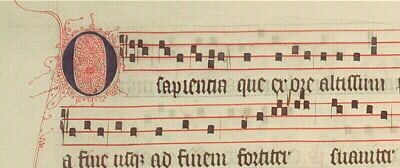
O uncreated Wisdom, who art so soon to make Thyself visible to Thy creatures, truly Thou disposest all things. It is by Thy permission that the emperor Augustus issues a decree ordering the enrolment of the whole world. Each citizen of the vast empire is to have his name enrolled in the city of his birth. This prince has no other object in this order, which sets the world in motion, but his own ambition. Men go to and fro by millions, and an unbroken procession traverses the immense Roman world; men think they are doing the bidding of man, and it is God whom they are obeying. This world-wide agitation has really but one object; it is, to bring to Bethlehem a man and woman who live at Nazareth in Galilee, in order that this woman, who is unknown to the world but dear to heaven, and who is at the close of the ninth month since she conceived her Child, may give birth to this Child in Bethlehem; for the Prophet has said of Him: ‘His going forth is from the beginning, from the days of eternity. And thou, O Bethlehem! art not the least among the thousand cities of Juda, for out of thee He shall come.’2 O divine Wisdom! how strong art Thou in thus reaching Thine ends by means which are infallible, though hidden; and yet, how sweet, offering no constraint to man’s free-will; and withal, how fatherly, in providing for our necessities! Thou choosest Bethlehem for Thy birth-place, because Bethlehem signifies the house of bread. In this, Thou teachest us that Thou art our Bread, the nourishment and support of our life. With God as our food, we cannot die. O Wisdom of the Father, living Bread that hast descended from heaven, come speedily into us, that thus we may approach to Thee and be enlightened3 by Thy light, and by that prudence which leads to salvation.
A Prayer for the Time of Advent
(The Mozarabic breviary, fourth Sunday of Advent, Oratio)
Thursday of the Third Week of Advent
Cap. xxxiii.Domine, miserere nostri: te enim exspectavimus: esto brachium nostrum in mane, et salus nostra in tempore tribulationis. A voce angeli fugerunt populi, et ab exaltatione tua dispersæ sunt Gentes. Et congregabuntur spolia vestra sicut colligitur bruchus, velut cum fossæ plenæ fuerint de eo. Magnifìcatus est Dominus, quoniam habitavit in excelso: implevit Sion judicio et justitia. Et erit fides in temporibus tuis: divitiæ salutis sapientia et scientia: timor Domini ipse est thesaurus ejus. Conterriti sunt in Sion peccatores: possedit tremor hypocritas. Quis poterit habitare de vobis cum igne devorante? quis habitabit ex vobis cum ardoribus sempiternis? Qui ambulat in justitiis, et loquitur veritatem, qui projicit avaritiam ex calumnia, et excutit manus suas ab omni munere, qui obturat aures suas ne audiat sanguinem, et claudit oculos suos ne videat malum. Iste in excelsis habitabit, munimenta saxorum sublimitas ejus: panis ei datus est, aquæ ejus fideles sunt. Regem in decore suo videbunt oculi ejus: cernent terram de longe.
Ch. xxxiii.O Lord, have mercy on us: for we have waited for thee: be thou our arm in the morning, and our salvation in the time of trouble. At the voice of the angel the people fled, and at the lifting up thyself the nations are scattered. And your spoils shall be gathered together as the locusts are gathered, as when the ditches are full of them. The Lord is magnified, for he hath dwelt on high: he hath filled Sion with judgement and justice. And there shall be faith in thy times, riches of salvation, wisdom and knowledge: the fear of the Lord is his treasure. The sinners in Sion are afraid: trembling hath seized upon the hypocrites. Which of you can dwell with devouring fire? which of you shall dwell with everlasting burning? He that walketh in justices, and speaketh truth, that casteth away avarice by oppression, and shaketh his hands from all bribes, that stoppeth his ears lest he hear blood, and shutteth his eyes that he may see no evil. He shall dwell on high, the fortifications of rocks shall be his highness: bread is given him, his waters are sure. His eyes shall see the king in his beauty; they shall see the land far off.
Happy he whose eyes shall thus contemplate the new-born King in the sweet majesty of His love and His humility! He shall be so taken with this His beauty, that the earth, with all its magnificence, shall appear as nothing in his eyes. The only thing he will care to look upon, will be the Child laid in a manger, and wrapped in swaddling clothes. But, that we may have this happiness of closely contemplating the divine King who is coming to us, that we may merit to enter His court, we must do as the prophet bids us: we must walk in justice, and speak truth. Let us listen to the pious Rabanus Maurus, who expresses this, with much unction, in his first sermon on preparation for the feast of Christmas: ‘If at all times it behoves us to be adorned with the comeliness of good works, we should be so, with an especial care, on the day of our Saviour’s birth. Consider within yourselves, my brethren, what you would do, were a king, or prince, to invite you to come to celebrate his birthday. Your garments would be as new, as elegant, even as magnificent, as you could procure them, for you would think it an insult to him who invited you, were you to appear before him with anything upon you that was tom, or poor, or unclean. Show a like solicitude on the occasion of the coming feast: and let your souls, beautified with the several ornaments of virtue, go forth to their King. He loves the pearls of simplicity, and the flowers of chaste sobriety: wear them therefore. Let your consciences be composed in a holy calm, now that the solemn feast of Jesus’ Nativity is so close upon us. Assist at it lovely in your chastity, gorgeous in your charity, beauteous by your almsdeeds, brilliant with justice and humility, and, above all, radiant in the love of God. If the Lord Jesus shall see you thus when you keep His feast, believe me, He will do more than visit your souls; He will treat you with such familiarity, that He will choose them for His favourite abode, and there He will dwell for ever, as it is written: Behold! I will come, and I will dwell with them and they shall be my people, and I will be their God.’ Christians, you have no time to lose: quickly prepare yourselves for this great visit. Let sinners be converted and become just: let the just become more just; let the holy become more holy, for He that is coming is the Lord our God, and none else.
Prose for the Time of Advent
(Composed in the eleventh century, and taken from the ancient Roman-French missals)
Per quem condita sunt sæcula;
Cœlum quod plurima luce coruscat, et diversa sidera;
Sol mundi schema, noctium decus luna, cunctaque splendentia;
Mare, solum, alta, plana, et profunda flumina;
Aeris ampla spatia: quæ discurrunt aves, venti atque pluvia.
Haec simul cuncta tibi soli Deo Patri militant.
Nunc et in ævum, sine fine per sæcula:
Laus eorum tua gloria:
Qui pro salute nostra Prolem unicam,
Pati in terra misisti sine culpa, sed ob nostra delicta.
Te, sancta Trinitas, precamur, ut corpora nostra et corda regas et protegas, et dones peccatorum veniam. Amen.
By whom all ages were made;
The firmament, which shines with much light, and the countless stars;
The sun, the ornament of the world; the moon, which is the night’s beauty; and all shining things;
The sea, the land, the hills, the plains, and the deep rivers;
The wide space of the air, through which float birds, and winds, and rain;
All these obey thee alone, O God, as their Maker and King.
Now and evermore, for endless ages:
Their praise is thy glory;
Who for our salvation didst send thine only-begotten Son,
In whom could be no sin, to suffer on earth for our sins.
We beseech thee, O holy Trinity, to govern and protect our souls and bodies, and grant us forgiveness of cur sins. Amen.
Prayer from the Ambrosian Missal
(Second Sunday of Advent, Præfatio)
| Previous Wednesday in Ember Week of Advent | Next Thursday of the Third Week of Advent |