Daily reading
Advent
Double of the I Class · December 24 · Temporal
December 24, 2026
From Dom Guéranger’s The Liturgical Year.
Christmas Eve leads the afternoon.Rubric

|
December 24: Christmas Eve
At length, says St. Peter Damian, in his sermon for this holy eve,
At length we have come from the stormy sea into the tranquil port; hitherto it was the promise, now it is the prize; hitherto labour, now rest; hitherto despair, now hope; hitherto the way, now our home. The heralds of the divine promise came to us; but they gave us nothing but rich promises. Hence our psalmist himself grew wearied and slept, and, with a seemingly reproachful tone, thus sings his lamentation to God: “But Thou hast rejected and despised us; Thou hast deferred the coming of Thy Christ.”1 At another time he assumes a tone of command and thus prays: “O Thou that sittest upon the Cherubim, show Thyself!”2 Seated on Thy high throne, with myriads of adoring angels around Thee, look down upon the children of men, who are victims of that sin, which was committed indeed by Adam, but permitted by Thy justice. Remember what my substance is;3 Thou didst make it to the likeness of Thine own; for though every living man is vanity, yet inasmuch as he is made to Thy image, he is not a passing vanity.4 Bend Thy heavens and come down, and turn the eyes of Thy mercy upon us Thy miserable suppliants, and forget us not unto the end!
Isaias, also, in the vehemence of his desire, thus spoke: “For Sion’s sake I will not hold my peace, and for the sake of Jerusalem I will not rest, till her Just One come forth as brightness. Oh! that thou wouldst rend the heavens, and wouldst come down!” So, too, all the prophets, tired of the long delay of the coming, have prayed to Thee, now with supplication, now with lamentation, and now with cries of impatience. We have listened to these their prayers; we have made use of them as our own, and now, nothing can give us joy or gladness, till our Saviour come to us, and, kissing us with the kiss of His lips, say to us: “I have heard and granted your prayers.”
But, what is this that has been said to us: “Sanctify yourselves, O ye children of Israel, and be ready; for on the morrow the Lord will come down”? We are, then, but one half day and night from the grand visit, the admirable birth of the Infant God! Hurry on your course, ye fleeting hours, that we may the sooner see the Son of God in His crib, and pay our homage to this world-saving birth. You, brethren, are the children of Israel, that are sanctified, and cleansed from every defilement of soul and body, ready, by your earnest devotion, for to-morrow’s mysteries. Such, indeed, you are, if I may judge from the manner in which you have spent these sacred days of preparation for the coming of your Saviour.
But if, notwithstanding all your care, some drops of the stream of this life’s frailties are still on your hearts, wipe them away and cover them with the snow-white robe of confession. This I can promise you from the mercy of the divine Infant: he that shall confess his sins and be sorry for them, shall have born within him the Light of the world; the darkness that deceived him shall be dispelled; and he shall enjoy the brightness of the true Light. For how can mercy be denied to the miserable this night, in which the merciful and compassionate Lord is so mercifully born? Therefore, drive away from you all haughty looks, and idle words, and unjust works; let your loins be girt, and your feet walk in the right paths; and then come, and accuse the Lord, if this night He rend not the heavens, and come down to you, and throw all your sins into the depths of the sea.
This holy eve is, indeed, a day of grace and hope, and we ought to spend it in spiritual joy. The Church, contrary to her general practice, prescribes that, if Christmas Eve fall on a Sunday, the fasting alone shall be anticipated on the Saturday; but that the Office and Mass of the vigil should take precedence of the Office and Mass of the fourth Sunday of Advent. How solemn, then, in the eyes of the Church, are these few hours, which separate us from the great feast! On all other feasts, no matter how great they may be, the solemnity begins with first Vespers, and until then the Church restrains her joy, and celebrates the Divine Office and Sacrifice according to the lenten rite. Christmas, on the contrary, seems to begin with the vigil; and one would suppose that this morning’s Lauds were the opening of the feast; for the solemn intonation of this portion of the Office is that of a double, and the antiphons are sung before and after each psalm or canticle. The purple vestments are used at the Mass, but all the genuflexions peculiar to the Advent ferias are omitted; and only one Collect is said, instead of the three usually said when the Mass is not that of a solemnity.
Let us enter into the spirit of the Church, and prepare ourselves, in all the joy of our hearts, to meet the Saviour who is coming to us. Let us observe with strictness the fast which is prescribed; it will enable our bodies to aid the promptness of our spirit. Let us delight in the thought that, before we again lie down to rest, we shall have seen Him born, in the solemn midnight, who comes to give light to every creature. For surely it is the duty of every faithful child of the Catholic Church to celebrate with her this happy night, when, in spite of all the coldness of devotion, the whole universe keeps up its watch for the arrival of its Saviour. It is one of the last vestiges of the piety of ancient days, and God forbid it should ever be effaced!
Let us, in a spirit of prayer, look at the principal portions of the Office of this beautiful vigil. First, then, the Church makes a mysterious announcement to her children. It serves as the Invitatory of Matins, and as the Introit and Gradual of the Mass. They are the words which Moses addressed to the people of God when he told them of the heavenly manna, which they would receive on the morrow. We, too, are expecting our Manna, our Jesus, the Bread of life, who is to be born in Bethlehem, which is the house of Bread.
Invitatory
The responsories are full of sublimity and sweetness. Nothing can be more affecting than their lyric melody, sung to us by our mother the Church, on the very night which precedes the night of Jesus’ birth.
℟. Constantes estote; videbitis auxilium Domini super vos; Judæa et Jerusalem, nolite timere: * Cras egrediemini, et Dominus erit vobiscum: ℣. Sanctificamini, filii Israel et estote parati * Cras egrediemini, et Dominus erit vobiscum.
℟. Sanctificamini, filii Israel, dicit Dominus: die enim crastina descendet Dominus: * Et auferet a vobis omnem languorem. ℣. Crastina die delebitur iniquitas terrae, et regnabit super nos Salvator mundi. * Et auferet a vobis omnem languorem.
℟. Be ye constant; ye shall see the help of the Lord upon you: fear not, Judea and Jerusalem: * To-morrow ye shall go forth, and the Lord shall be with you: ℣. Sanctify yourselves, ye children of Israel, and be ye ready. * Tomorrow ye shall go forth, and the Lord shall be with you.
℟. Sanctify yourselves, ye children of Israel, saith the Lord: for on the morrow, the Lord shall come down: * And shall take from you all that is languid. ℣. To-morrow the iniquity of the earth shall be cancelled, and over us shall reign the Saviour of the world. * And he shall take from you all that is languid.
At the Office of Prime, in cathedral chapters and monasteries, the announcement of to-morrow’s feast is made with unusual solemnity. The lector, who frequently is one of the dignitaries of the choir, sings, to a magnificent chant, the following lesson from the martyrology. All the assistants remain standing during it, until the lector comes to the word Bethlehem, at which all genuflect, and continue in that posture until all the glad tidings are told.
Thus have passed before us, in succession, all the generations of the world.5 Each of them is asked if it have seen Him whom we are expecting, and each is silent; until the name of Mary is pronounced, and then is proclaimed the Nativity of Jesus Christ, the Son of God, made Man. St. Bernard, speaking of this announcement, says: 'The voice of joy has gone forth in our land, the voice of rejoicing and of salvation is in the tabernacles of the just. There has been heard a good word, a word that gives consolation, a word that is full of gladsomeness, a word worthy of all acceptance. Resound with praise, ye mountains, and all ye trees of the forests clap your hands before the face of the Lord, for He is coming. Hearken, O ye heavens, and give ear, O earth! be astounded and give praise, O all ye creatures! but thou, O man, more than all they! JESUS CHRIST, THE SON OF GOD, IS BORN IN BETHLEHEM OF JUDA! Who is there that is so hard of heart, that this word does not touch him? Could anything be told us sweeter than this? Could any news delight us like this? Was such a thing ever heard, or anything like it ever told to the world? JESUS CHRIST, THE SON OF GOD, IS BORN IN BETHLEHEM OF JUDA! O brief word of the Word abridged!6 and yet how full of heavenly beauty! The heart, charmed with the honeyed sweetness of the expression, would fain diffuse it and spread it out into more words; but no, it must be given just as it is, or you spoil it: JESUS CHRIST, THE SON OF GOD, IS BORN IN BETHLEHEM OF JUDA!’7
Mass
Introit
In the Collect, the Church makes a last allusion to the coming of Jesus as our Judge at the end of the world. But after this, she can look upon her Jesus only as the Prince of peace, and as the Spouse who comes to her. Her children must imitate her confidence.
Collect
In the Epistle, the apostle St. Paul, addressing himself to the Romans, makes known to them the dignity and holiness of the Gospel, that is, of those good tidings, which the angels are to bring to us this very night. Now, the subject of this Gospel is Jesus, the Son that is born unto God, of the family of David, according to the flesh. This Jesus comes that He may be to His Church the source of grace and apostleship. It is by these two gifts that we are still associated, after so many ages, to the joys of the great mystery of His birth in Bethlehem.
Epistle
Cap. i.Paulus, servus Jesu Christi, vocatus apostolus, segregatus in Evangelium Dei, quod ante promiserat per prophetas suos in Scripturis sanctis, de Fillo suo, qui factus est ei ex semine David secundum carnem, qui prædestinatus est Filius Dei in virtute, secundum Spiritum sanctificationis, ex resurrectione mortuorum Jesu Christi Domini nostri: per quem accepimus gratiam et apostolatum, ad obediendum fidei in omnibus gentibus pro nomine ejus, in quibus estis et vos vocati Jesu Christi Domini nostri
Ch. i.Paul, a servant of Jesus Christ, called to be an apostle separated unto the Gospel of God, which he had promised before by his prophets in the holy Scriptures, concerning his Son, who was made to him of the seed of David according to the flesh, who was predestinated the Son of God in power, according to the spirit of sanctification by the resurrection of our Lord Jesus Christ from the dead: by whom we have received grace and apostleship for obedience to the faith in all nations for his name, among whom are you also the called of Jesus Christ our Lord.
Gradual
If the vigil of Christmas fall on a Sunday, the following is added:
The Gospel of to-day’s Mass is the passage which relates the trouble of St. Joseph and the visit he received from the angel. This incident, which forms one of the preludes to the birth of our Saviour, could not but enter into the liturgy for Advent; and so far, there was no suitable occasion for its insertion. The vigil of Christmas was the right day for this Gospel, for another reason: the angel, in speaking to St. Joseph, tells him that the name to be given to the Child of Mary is Jesus, which signifies that He will save His people from their sins.
Gospel
Cap. i.Quum esset desponsata Mater Jesu Maria Joseph, antequam convenirent, inventa est in utero habens de Spiritu sancto. Joseph autem vir ejus, quum esset justus, et nollet eam traducere, voluit occulte dimittere eam. Hæc autem eo cogitante, ecce angelus Domini apparuit in somnis ei, dicens: Joseph, fili David, noli timere accipere Mariam conjugem tuam: quod enim in ea natum est, de Spiritu sancto est. Pariet autem Filium: et vocabis nomen ejus Jesum: ipse enim salvum faciet populum suum a peccatis eorum.
Ch. i.When Mary, the Mother of Jesus, was espoused to Joseph, before they came together, she was found with child of the Holy Ghost. Whereupon Joseph her husband, being a just man, and not willing publicly to expose her, was minded to put her away privately. But while he thought on these things, behold the angel of the Lora appeared to him in his sleep, saying: Joseph, son of David, fear not to take unto thee Mary thy wife, for that which is conceived in her is of the Holy Ghost. And she shall bring forth a Son: and thou shalt call his name Jesus; for he shall save his people from their sins.
Offertory
Secret
During the Communion, the Church expresses her joy at receiving, in the Eucharistic Sacrament, Him whose flesh purifies and nourishes ours. She is strengthened by the consolation given to her by the divine Food, to wait yet a little longer for that happy moment, in which angels will come and invite her to the crib of the Messias.
Communion
Postcommunion
The Ambrosian and Mozarabic liturgies have nothing in their Office and Mass for this vigil which we deem telling enough for insertion here. In the anthology of the Greeks there is a hymn, which will assist our devotion, and from which we take the following stanzas. It is called: The beginning of the Hours of the Nativity: Tierce, Sext, and None.
Hymn for the Vigil of Christmas
(Taken from the Anthology of the Greeks)
Inscribebatur die quadam cum sene Joseph, tanquam ex semine David, in Bethlehem, Maria, sine semine foetum utero gestans; advenerat pariendi tempus, et nullus erat in diversorio locus, sed pro splendido palatio spelunca Reginæ aderat.
Adimpleri nunc urget propheticum præconium mystice nuncians: Et tu Bethlehem, terra Juda, nequaquam minima es in principibus, prima adornans speluncam. Ex te enim mihi veniet dux gentium, per carnem ex puella Virgine, Christus Detis qui reget populum suum novum Israel. Demus ei omnes magnificentiam.
Iste Deus noster, præter eum non numerabitur alius, natus ex Virgine, et cum hominibus conversatus: in pauperculo jacens præsepio Filius Unigenitus mortalis apparet, et fasciis implicatur gloriae Dominus: stella Magis indicat ut illum adorent, nosque canamus: Trinitas sancta, salva animas nostras.
Venite, fideles: divinitus extollamur, Deumque videamus ex alto in Bethlehem manifeste descendentem, et sursum mentem elevantes, pro myrrha vitæ afferamus virtutes, praeordinantes cum fide natalitium introitum, et dicamus: Gloria in excelsis Deo qui trinus est, cujus erga homines manifestatur benevolentia! qui Adam redimens et plasma tuum elevasti, philanthrope!
Audi, cœlum, et auribus percipe, terra: commoveantur fundamenta orbis, tremorem apprehendant terrestria; quia Deus et auctor carnis plasmatis formam induit, et qui creaturam creatrice corroboravit manu, misericordia motus videtur forma indutus. O divitiarum sapientiæ scientiæque Dei abyssus! quam inscrutabilia illius judicia, et investigabiles viæ ejus!
Venite, Christiferi populi, videamus prodigium omnem stupefaciens et cohibens cogitationem, et pie procumbentes cum fide hymnificemus. Hodie ad Bethlehem puella advenit paritura Dominum; præcurrunt angelorum chori: illamque videns Joseph sponsus ejus clamabat: Quidnam in te prodigiosum mysterium, Virgo? Et quomodo parturire debes, jugi expers juvenca?
Hodie nascitur ex Virgine qui pugillo omnem creaturam continet: panniculis sicut mortalis fasciatur qui essentia intactibilis est; Deus in præsepio reclinatur, qui olim in principio cœlos stabilivit; ex uberibus lacte nutritur per quem in deserto manna pluebat populo; Magos advocat Sponsus Ecclesiæ; dona illorum accipit Virginis Filius. Adoramus tuam Nativitatem, Christe; ostende nobis tuas divinas Theophanias.
On a certain day, there was enrolled at Bethlehem, together with the old man Joseph, as being of the family of David, Mary, who bore in her virginal womb the divine fruit. The time of her delivery was come, and there was no place in the inn; and instead of a splendid palace for the Queen there was but a cave.
The moment has come for the accomplishment of the mystic prophecy: ‘And thou Bethlehem, land of Juda, art not the least among the princes, for thou art the first to adorn the cave. For there shall come to me from thee the leader of the nations, born of a Virgin-Maid according to the flesh; it is Christ, who is God, and he shall rule his new people of Israel.’ Let us all give him highest praise.
This is our God, and there is none other; he was born of a Virgin, and he conversed with men; the only-begotten Son becomes mortal, and is laid in a poor crib; the Lord of glory is wrapped in swaddling clothes; the star invites the Magi to adore him, and let us sing: O holy Trinity, save our souls!
Come, all ye faithful: let us be transported with divine enthusiasm; let us look at God coming in a visible form from on high and descending into Bethlehem; then raising up our minds, let us bring to him our virtues as the myrrh we offer him, thus preparing, with faith, for his birth among us: let us sing, Glory in the highest be to God, one in three Persons, whose good-will to man is thus made manifest! for thou, O Jesus! the Lover of man, hast redeemed Adam and restored the work of thy hands!
Hear, O ye heavens, and give ear, O earth! let the foundations of the earth be moved, and all the earth tremble: for God the maker of man has himself put on a created form, and he whose creative hand upheld his creatures, has, by mercy moved, clothed himself with a body. Oh the depth of the riches of the wisdom and of the knowledge of God! How incomprehensible are his judgements, and how unsearchable his ways!
O come, ye Christian people! let us see the prodigy that stupefies all thought and holds it in suspense; then let us devoutly adore, and sing our hymns with hearts full of faith. This day there hath come to Bethlehem a Maid that is to give birth to God! Choirs of angels are already there! Joseph, her spouse, seeing her, has already received the answer to his question: What is this mystery which I see in thee, pure Virgin? How canst thou bring forth, that never hast borne a mother’s humiliation?
This day, there is bora of a Virgin, he that holds in his hand the whole creation. He whose very essence 'tis to be intangible, has become mortal and is bound in swathing-bands. He who, of old, in the beginning, poised and set the heavens, is laid in a manger. He who rained down manna on his people in the desert, is fed with milk at his Mother’s breast. The Spouse of the Church invites the Magi; the Son of the Virgin accepts their gifts. We adore thy Nativity, O Jesus! show unto us thy divine manifestations.
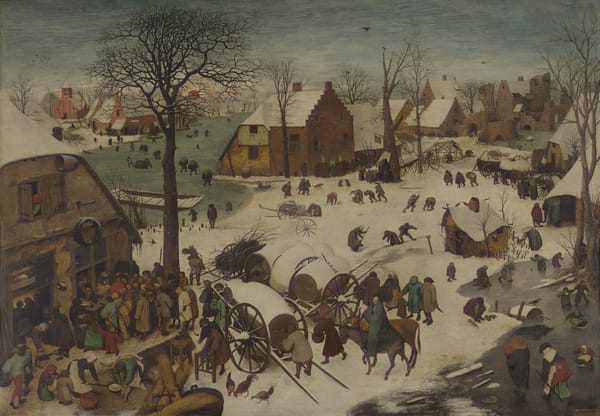
Let us contemplate our blessed Lady, and her faithful spouse Joseph, leaving the city of Jerusalem, and continuing their journey to Bethlehem, which they reach after a few hours. In obedience to the will of heaven, they immediately repair to the place where their names are to be enrolled, as the emperor’s edict requires. There is entered in the public register, Joseph, a carpenter of Nazareth in Galilee. To his name, there is, doubtless, added that of Mary, spouse of the above-named Joseph. Perhaps they enter her as a young woman, in the ninth month of her pregnancy. And this is all! O Incarnate Word! Thou art not yet counted by men! Thou art upon this earth of Thine, and men set Thee down as nothing! And yet, all this excitement of the enrolment of the world is to be for nothing else but this, that Mary, Thy august Mother, may come to Bethlehem, and there give Thee birth!
O ineffable mystery! how grand is this apparent littleness! how mighty this divine weakness! But God has still lower to descend than merely coming on our earth. He goes from house to house of His people: not one will receive Him. He must go and seek a crib in the stable of poor dumb beasts. There, until such time as the angels sing to Him their hymn, and the shepherds and the Magi come with their offerings, He will meet ‘the ox that knoweth its Owner, and the ass that knoweth its Master’s crib!’8 O Saviour of men, Emmanuel, Jesus! we, too, will go to this stable of Bethlehem. Thy new birth, which is to-night, shall not be without loving and devoted hearts to bless it. At this very hour, Thou art knocking at the doors of Bethlehem, and who is there that will take Thee in? Thou sayest to my soul in the words of the Canticle: ‘Open to me, my sister, my beloved! for my head is full of dew, and my locks of the drops of the night!’9 Ah! sweet Jesus! Thou shalt not be refused here! I beseech Thee, enter my house. I have been watching and longing for Thee. Come, then, Lord Jesus! come!10
- Ps. lxxxviii ↩︎
- Ibid. lxxix. ↩︎
- Ibid. lxxxviii. ↩︎
- Ibid. xxxviii. ↩︎
- On this one day alone, and on this single occasion, does the Church adopt the Septuagint chronology, according to which the birth of our Saviour took place five thousand years after the creation; whereas the Vulgate version, and the Hebrew text, place only four thousand between the two events. This is not a fitting place to explain this discrepancy of chronology; we merely allude to it as showing the liberty which the Church allows us on this question. ↩︎
- Rom. ix. 28. ↩︎
- Second sermon for Christmas Eve. ↩︎
- Is. i. 3. ↩︎
- Cant. v. 2. ↩︎
- Apoc. xxii. 20. ↩︎
December 24: Afternoon of the Eve
CHRISTMAS Eve, with its own happy spirit, is drawing to its close. Already has the Church terminated all her Advent Offices, by the celebration of the Holy Sacriftce. In her maternal considerateness, she has permitted her children to break their Fast of preparation for the great Feast, by taking their meal at mid-day. Whilst refreshing their bodies with this repast, to which Abstinence gives merit, the Faithful feel an instinct of gladness which comes as a harbinger, to tell them of that immense joy which this beautiful Night will bring them, by giving them their Emmanuel.
But so great a Solemnity as that of to-morrow could not possibly be an exception to that usage of the Church whereby she anticipates all her Feasts on their Eves. In a few moments the Office of First Vespers, in which is offered to God the evening incense, will call us to the Church, and the splendour of the function, and the magnificence of the chants, will open our hearts to those feelings of love and gratitude which will prepare them to receive the graces of to-night.
Let us spend the interval in endeavouring to gain a clear knowledge of the Mystery of our Feast; and let us absorb well the sentiments and spirit of the Church. We shall be assisted to do both by considering some of the principal traditions which attach to this joyful Solemnity.
Let us begin by listening to the Holy Fathers speaking of Christmas Day with an eloquence worthy of the Feast. And first we have St Gregory the Theologian, Bishop of Nazianzum, who thus opens his thirty-eighth discourse, which is on the Theophania, or Nativity of our Lord.
Christ is born—glorify him! Christ comes down from heaven—go ye forth to meet him! Christ is on the earth—be ye lifted up above it! O sing to the Lord, all thou earth1 and to say all in one word, Let the heavens rejoice, and let the earth be glad,2 because he that is now born is both of heaven and of earth! Christ has assumed our Flesh—exult in fear and in joy; in fear, because of sin; in joy, because of hope! Christ is born of a Virgin: women! honour holy virginity, that you may become Mothers of Christ!
Who would not adore him that is from the beginning? Who would not praise and extol him that is born in time? Darkness is at an end; Light is created; Egypt remains in darkness, and Israel is enlightened by the pillar of fire. The people that sat in the darkness of ignorance, now possess the bright light of knowledge and wisdom. The old things are passed away, and lo! all things are made new. The letter has given way, the spirit has triumphed; shadows have faded, the reality is come. . . . The laws of nature are set aside; the world of Heaven is to be peopled; Christ commands it—let us obey.
O clap your hands, all ye nations!3 for a Child is born unto us, and a Son is given unto us. The emblem of his Government is upon his shoulder, for his exaltation shall come by the Cross; and his name shall be called the Angel of the Great Counsel, that is, of the Counsel of his Father.4
Let the Baptist now cry out: Prepare ye the way of the Lord! I, too, will proclaim the virtues and power of this day. He that is without flesh takes flesh; the Word takes a Body; the Unseen is seen; the Intangible may be touched; the Eternal has a beginning; the Son of God is made the Son of Man—Jesus Christ, yesterday and to-day, and the same for ever.5 Let the Jew take scandal, and the Greek mock, and the heretic prate. They will believe when they shall see him ascending into heaven; and if not even then, at least when they shall see him coming down from heaven, and seated on his judgement-seat.
It is hard to hear such thrilling eloquence as this, and remain cold. But let us now give ear to a Father of the Latin Church, the devout St Bernard, who, in his Sixth Sermon for Christmas Eve, pours forth his heart’s joy in these fervent words:
We have just heard the saying, which is full of grace, and worthy of all acceptation: Jesus Christ, the Son of God, is born in Bethlehem of Juda. At these words my soul melts with love, yea, and my spirit that is within me bums with impatience to tell you, as in other years, of this joy, this thrilling joy. Jesus means Saviour. And what so necessary to them that are lost? what so welcome to them that are in misery? what so precious to them that are in despair? Besides, what salvation, what chance of salvation, was there in the law of sin, in that body of death, in so evil a day, and in such a place of affliction—had not a new and unlooked-for Salvation been born? Say not that thou dost indeed desire salvation, but that, knowing thy delicacy and the grievousness of thy sickness, thou fearest lest the cure be violent. No, fear not: this Jesus is Christ, that is, he is all sweetness; he is meek and plenteous in mercy; he is anointed with the oil of gladness above his fellows, that is, above them who, though they receive not the fulness, yet receive of his fulness. Yet lest thou shouldst think that because this Jesus is the Anointed with sweetness, he is therefore weak in power, it is added, he is the Son of God. . . . Let us, then, be exceeding glad, as we think over within ourselves, or say to each other, this sweet sentence: Jesus Christ—the Son of God—is born in Bethlehem of Juda!
Glorious day, indeed, is this of the Birth of the Saviour!
It had been looked forward to by the human race for four thousand years. The Church had prepared for it by the four weeks of her Advent, a Season which has ever such a charm about it. Nature, too, longs for this day, on which the Sun begins his yearly victory over the dreary reign of wintry darkness. A Holy Doctor of the Syrian Church, St Ephrem, has written the most admirable words on the beauty and fruitful virtue of this mysterious day. Let us borrow some of these from him and say them with his enthusiasm.
Grant, O Lord! that we may now celebrate this the Day of thy Birth, which to-day's Solemnity brings round to us. This Day is like thyself—it is the friend of mankind. It comes to us in its regular course, visiting us each year. It grows old with the old; it is young and fresh with little children. We remember when we were young, how it came and passed away; and here it is again, faithful as ever in its welcome visit. It knows that nature could not do without it; here again like to thee, it comes in search of our fallen race. The whole earth thirsts after thy Birthday, O Jesus! It stands, as it were, between the past and the future, commanding all ages, as thou dost. It is one, and yet it multiplies itself, as thou dost. And since we behold thy past Birthday in this present Feast, make the two resemble each other in this also—that as thy Birthday brought Peace between heaven and earth, when the infinitely High God descended to this low earth; so may this solemnity signify and give us Peace. . . . And truly, if every day of the year be rich in thy gifts, how much more ought not this to overflow with them?
The other days of the year borrow their beauty from this, and the other Feasts owe to this all their solemnity and loveliness. . . . Thy Birthday, O Jesus! is a treasure out of which we all take wherewith to pay our debts. . . . Blessed be the Day which has brought us back the Sun, after we had been wandering in the dark night; which has brought us the Divine Sheaf that enriches us with plentifulness; which has given us the Vine-Branch that is to yield us, in due time, the cup of our salvation. ... In the bosom of that Winter which robs our trees of their fruit, the virgin Vine has given forth its divine growth. In the Season of frost, which strips our plants of their beauty, the Root of Jesse has given us its Bud. It is in December, which hides the seed sown in the earth, that the Wheat of our salvation appears from the Virgin's womb, into which he had entered in that fresh Spring-time, when the lambkins were skipping in our meadows.6
It is not, therefore, to be wondered at, if this day, which, we may say, is an important one even to God himself, has been made a privileged one above those of the rest of the year. We have already seen that the old pagan world paid homage to it, and thus, in their own way, were carrying out the design of God. The Holy Doctors, and the Church herself in her Liturgy, allude continually to the material Sun being the symbol of him who is called the Sun of Justice. Then again, there is the venerable tradition which tells us that the Incarnation of the Son of God having been accomplished on a Friday (March 25), the Birth of Jesus, the Light of the world, must have taken place on December 25, a Sunday. This gives a peculiar sacredness to Christmas Day when it falls on a Sunday, as it was on that day of the week that God began the Creation, and said: Let there he Light! and on the same, also, did our Lord rise from the tomb. St Sophronius of Jerusalem has beautifully treated this mystery in his first homily for Christmas Day.
In order to impress the nations of Europe, that is, of the favoured portion of the Church, with the importance of this ever-blessed day, God, who is the Sovereign Ruler of all things, has willed that on it should happen certain events of intense interest. We will select three of these. To begin with the first in order of time: it was on a Christmas Day that the Kingdom of the Franks was founded; for it was on this glorious Solemnity that King Clovis was baptized at Rheims by St Remigius. The haughty Sicambrian, thus admitted into the Fold of Christ, became a meek and humble Christian, and the founder of the first Catholic monarchy, which is now the nation of France.
A century later, that is in the year 596, our own dearest country was converted to the true faith by the labours of St Augustine, of whom St Gregory the Great, who sent him, says: ‘he was a Monk of my Monastery’7 This holy Missionary had baptized King Ethelbert, and travelled through the land, preaching everywhere the name and Gospel of our Lord Jesus Christ. Having reached York, he preached the word of Eternal Life to the people, and when he had ended, they seek baptism from his hands. Christmas Day is fixed upon for the regeneration of the Catechumens, and the river which flows through the City is chosen as the Baptismal Font. Ten thousand men, not counting women and children, go down into this stream, whose waters were to cleanse their souls. The severity of the season is unheeded by these fervent disciples of the Babe of Bethlehem, who, but a few days before, knew not so much as his name. From the frozen waters there comes, full of joy and innocence, the long line of Neophytes; and the Birthday of Jesus counts, that year, one nation more as belonging to his Kingdom.
Three hundred years after this, God gives us another glorious event in honour of the Birthday of his Son. It was on this divine Anniversary, in the year 800, and at Rome, in the Basilica of St Peter, that the Holy Roman Empire was created, to which God assigned the grand mission of propagating the Kingdom of Christ among the barbarian nations of the North, and of upholding, under the direction of the Sovereign Pontiffs, the confederation and unity of Europe. St Leo III crowned Charlemagne Emperor. Here, then, was a new Cæsar, a new Augustus, on the earth; not, indeed, a successor of those ancient Lords of Pagan Rome, butone who was invested with the title and power by the Vicar of him who is called, in the Sacred Scriptures, King of Kings and Lord of Lords.
Thus has God glorified, in the eyes of men, the Divine Babe who is this day born: thus has he prepared, at various times, worthy anniversaries of that Birth which gave glory to God and Peace to men. Time will reveal in what other ways the Most High still wishes to magnify, upon this twenty-fifth of December, himself and his Christ.
Impressed with the extreme importance of this Feast, and justly looking upon it as the beginning of the Era of the world's regeneration, the nations of the West, for a long time, began their year with Christmas Day, as we find in the ancient Calendars, in the Martyrologies of Usuard and Ado, and in numberless Bulls, Charts and Diplomas. It is evident, from a Council held at Cologne in 1310, that this manner of computing the year was still observed at that time. In several countries of Europe, our own among the rest, the custom has been kept up of wishing a Happy Christmas, which was the ancient salutation when this Feast was the beginning of a new year. Hence too, in these countries, the custom of making presents, of writing letters of good wishes, and other friendly acts. How many of our practices of everyday life have originated from Faith, and yet are looked upon as mere consequences of natural good-feeling, or even compliments which society requires us to pay to each other!
To encourage her children in their Christmas joy, the Church has dispensed with the law of abstinence, if this Feast fall on a Friday. This dispensation was granted by Pope Honorius III, who ascended the Papal Throne in 1216. It is true that we find it mentioned by Pope St Nicholas I, in the ninth century; but the dispensation was not universal; for the Pontiff is replying to the consultations of the Bulgarians, to whom he concedes this indulgence, in order to encourage them to celebrate these Feasts with solemnity and joy: Christmas Day, St Stephen, St John the Evangelist, the Epiphany, the Assumption of our Lady, St John the Baptist, and SS Peter and Paul. When the dispensation for Christmas Day was extended to the whole Church, these other Feasts were not mentioned.
In the Middle Ages, the Civil Law, also, contributed to the people's love of Christmas, by enacting that no creditor could demand any payment from his debtors during the entire week of Christmas, which was called, on that account, the week of remission—a name which it had in common with the weeks of Easter and Pentecost.
But let us interrupt these interesting details regarding the grand Solemnity, whose near approach makes our hearts throb with joy. Let us repair to the House of our Heavenly Father, for the Hour of Vespers is near; and on our way, let our thoughts be at Bethlehem, where Joseph and Mary are already arrived. The sun is rapidly setting; and our Divine Sun of Justice is still hid beneath the Cloud, the Womb of the purest of Virgins. Night is coming on: Joseph and Mary are going through the narrow streets of the City of David, seeking a shelter. Let our hearts be attentive, and united in love with the two holy Pilgrims. Every heart and voice should now be giving forth to our God the tribute of praise and grateful love. Oh! happy we, that have a tribute of Song and Psalmody ready for our use, worthy of the day and of its ineffable Mystery—it is our Mother that offers us her Liturgy. Let us prepare to join her.
First Vespers
After the usual invocation of the divine assistance, the Church intones, in a most solemn chant, the five following Antiphons, which precede as many Psalms:
Psalm, Dixit Dominus, p. 89.
Psalm, Confitebor tibi, p. 90.
Psalm, Beatus vir, p. 91.
Psalm, Laudate pueri, p. 92.
Psalm 116
O! praise the Lord, all ye nations: praise him, all ye people.
After having extolled, in these divine canticles, the eternal generation, the fidelity, the mercy, the greatness, and the truth, of her divine Spouse, who is coming, and in a few short hours will show himself to her, the Church suspends her praise for a moment, and listens, in the Capitulum, to the consoling words of the Apostle of the Gentiles concerning the coming of God our Saviour.
Capitulum (Tit. iii 4)
Encouraged afresh by these beautiful words, the Church resumes her praises, not borrowing, this time, the psalmody of the Royal Prophet, but singing a Hymn to Jesus, her Spouse, on the glory and beauty of his Birthday, which makes all Nature glad, and brings the sweetest joy of heart to such as know how to love the Divine Babe. It was St Ambrose—the Bee of Milan, as he has been called—who composed this Hymn, which is sung to-day in almost every part of the world.
Hymn8
Quem, lucis ante originem,
Parem paternæ gloriæ
Pater supremus edidit;
Tu spes perennis omnium,
Intende quas fundunt preces
Tui per orbem servuli.
Nostri quod olim corporis,
Sacrata ab alvo Virginis
Nascendo, formam sumpseris.
Currens per anni circulum,
Quod solus e sinu Patris
Mundi salus adveneris.
Hunc omne quod cœlo subest,
Salutis auctorem novæ
Novo salutat cantico.
Rigavit unda sanguinis,
Natalis ob diem tui,
Hymni tributum solvimus.
Qui natus es de Virgine,
Cum Patre et almo Spiritu,
In sempiterna sæcula.
Amen.
born before the light was made,
and born of the Eternal Father,
equal to him in infinite glory;
O thou the everlasting hope of all men!
hear the prayers offered thee
by thy servants throughout the world.
that heretofore thou didst assume
a Body like unto ours,
and wast born from the sacred womb of a Virgin.
which the year has brought round to us, tells us of this mystery
—that thou, the one Saviour of the world,
didst come to us from the Father's Bosom.
and all that is under heaven
greet this the Author of their new salvation
with a new canticle.
by the stream of thy precious Blood,
we too pay thee the tribute of this Hymn,
in honour of thy Birthday.
who wast born of the Virgin!
and to the Father, and to the Spirit of love,
for everlasting ages.
Amen.
And now Mary's own words are to resound in the holy place! The sweet Canticle which she sang at her Visitation to Elizabeth, when, holding within herself the divine and secret Treasure, she celebrated the great things of God's power in her—this Canticle, without which the Church never lets the sun go down, is now going to be sung. O Mary! the hour is fast approaching which will manifest to both heaven and earth that divine Maternity of thine which will make all generations call thee Blessed. Suffer us to unite our souls with thine in magnifying the Lord, and to rejoice in our spirit, as thou didst in thine, in God our Saviour, who is thy Son!
Antiphon of the Magnificat
The Canticle Magnificat, p. 96.
Finally, the Church expresses all her desires in the following Prayer, which is to ascend to the Throne of God not only at every Hour of Christmas Day, but several times each day during the Octave:
Collect
During our Vespers, the last rays of day have disappeared, and darkness has covered the earth. The Sacred Ministers, vested in their richest copes, have left the Sanctuary. In a few moments they will reenter the Church, and repair to the Tribunal of Penance, there to administer to penitent sinners the reconciliation they ask of God through the merciful Birth of his Only-begotten Son. All is solemn silence in the Church, which, but a few moments before, echoed with the glad chants of our praise. Let us adore the Majesty of our God, and once more present our prayer to the King of Ages, that he send down the Dew for which our earth is thirsting; and with this prayer of our hope, let us, for a last time, mingle a thought of that salutary fear of the Last Judgement which the Church has nurtured within our souls during the holy Season of Advent.
Let us embody these sentiments in a Prayer taken from the Gothic or Mozarabic Liturgy: it is a beautiful one, and most appropriate.
Prayer from the Mozarabic Breviary
(For the Nativity of our Lord, in the Evening Office, Capitula)
And now we will leave the House of God, and attend to the duties of our state of life at home, until the hour of Matins summons us to return and celebrate the Midnight Birth of our Saviour. In order to prepare ourselves for that most imposing Service, we shall do well to resume the reflections upon the Liturgy of our Feast, which we interrupted in order to assist at Vespers. How few would keep from the Service of Christmas Night, and how still fewer would complain that they never seem to derive that benefit from it, which they are told is so great, if they would but take the pains to ask themselves why it is that the Church attaches such importance to her children's joining her in the celebration of this gay Winter Midnight!
- Ps. xcv 1. ↩︎
- Ibid. xcv 11. ↩︎
- Ibid. xlvi 2. ↩︎
- Isa. ix 6. ↩︎
- Heb. xiii 8. ↩︎
- Third Sermon On our Lord's Nativity. ↩︎
- Lib. 8, Ep. 30. ↩︎
- In the Monastic Breviary, it is as follows: ℟. Breve. Hodie scietis * quia veniet Dominus. Hodie. ℣. Et mane videbitis gloriam ejus. * Quia. Gloria. Hodie. In 2nd Vespers. ℟. Breve. Verbum caro factum est, * Alleluia, Alleluia. Verbum. ℣. Et habitavit in nobis. * Alleluia. Gloria. Verbum. Christe, Redemptor omnium, Ex Patre Patris Unice, Solus ante principium Natus ineffabiliter, Tu lumen, tu splendor Patris, Tu spes perennis omnium, Intende quas fundunt preces Tui per orbem famuli. Memento salutis Auctor Quod nostri quondam corporis Ex illibata Virgine Nascendo formam sumpseris. Sic præsens testatur dies, Currens per anni circulum, Quod solus a sede Patris Mundi salus adveneris. Hunc cœlum, terra, hunc mare, Hunc omne quod in eis est, Auctorem adventus tui Laudans exsultat cantico. Nos quoque qui sancto tuo Redempti Sanguine sumus, Ob diem Natalis tui Hymnum novum concinimus. Gloria tibi Domine, Qui natus es de Virgine, Cum Patre et Sancto Spiritu, In sempiterna sæcula. Amen. ↩︎
Thursday of the Fourth Week of Advent
Cap. lxiv.Utinam dirumperes cœlos, et descenderes; a facie tua montes defluerent; sicut exustio ignis tabescerent: aquæ arderent igni, ut notum fleret nomen tuum inimicis tuis; a facie tua Gentes turbarentur. Quum feceris mirabilia, non sustinebimus: descendisti, et a facie tua montes defluxerunt. A sæculo non audierunt, neque auribus perceperunt: oculus non vidit, Deus, absque te, quae præparasti exspectantibus te. Occurristi lactanti, et facienti justitiam: in viis tuis recordabuntur tui: ecce tu iratus es, et peccavimus; in ipsis fuimus semper, et salvabimur. Et facti sumus ut immundus omnes nos, et quasi pannus menstruatae universae justitiae nostræ: et cecidimus quasi folium universi, et iniquitates nostrae quasi ventus abstulerunt nos. Non est qui invocet nomen tuum; qui consurgat, et teneat te: abscondisti faciem tuam a nobis, et allisisti nos in manu iniquitatis nostrae. Et nunc, Domine, Pater noster es tu, nos vero lutum: et fictor noster tu, et opera manuum tuarum omnes nos. Ne irascaris, Domine, satis, et ne ultra memineris iniquitatis nostræ: ecce, respice, populus tuus omnes nos. Civitas sancti tui facta est deserta, Sion deserta facta est, Jerusalem desolata est. Domus sanctificationis nostræ, et gloriæ nostræ, ubi laudaverunt te patres nostri, facta est in exustionem ignis: et omnia desiderabilia nostra versa sunt in ruinas.
Ch. lxiv.O that thou wouldst rend the heavens, and wouldst come down; the mountains would melt away at thy presence; they would melt as at the burning of fire; the waters would bum with fire; that thy name might be made known to thy enemies: that the nations might tremble at thy presence. When thou shalt do wonderful things, we shall not bear them: thou didst come down, and at thy presence the mountains melted away. From the beginning of the world they have not heard, nor perceived with the ears: the eye hath not seen, O God, besides thee, what things thou hast prepared for them that wait for thee. Thou hast met him that rejoiceth, and doth justice: in thy ways they shall remember thee: behold thou art angry, and we have sinned; in them we have been always, and we shall be saved. And we are all become as one unclean, and all our justices as the rag of a menstruous woman: and we have all fallen as a leaf, and our iniquities, like the wind, have taken us away. There is none that calleth upon thy name, that riseth up and taketh hold of thee: thou hast hid thy face from us, and hast crushed us in the hand of our iniquity. And now, O Lord, thou art our Father, and we are clay: and thou art our maker, and we all are the works of thy hands. Be not very angry, O Lord, and remember no longer our iniquity: behold, see, we are all thy people. The city of thy sanctuary is become a desert, Sion is made a desert, Jerusalem is desolate. The house of our holiness, and of our glory, where our fathers praised thee, is burnt with fire, and all our lovely things are turned into ruins.
O Jesus, Thou Flower of the field, Thou Lily of the valley, Thy visit is to change our barren parched earth into a garden of delights! We had lost Eden and all its lovely magnificence, by our sins; and lo! Eden is restored to us; Thou art coming, that Thou mayst set it in our hearts. O heavenly plant, tree of life, transplanted from heaven to earth, Thou first takest root in Mary, that fruitful soil; and thence Thou wilt come to us, and we must be to Thee a grateful land, cherishing the divine seed and making it fructify. Let it be so, O divine Husbandman! who didst appear to Magdalene under the form of a gardener. Thou knowest how far are our hearts from being ready for Thy working in them. Move, and break, and water this land; the season is come; our hearts long to be fertile, and to have growing within them that exquisite Flower which makes the beauty of all heaven, and comes down to hide its splendour for a time here below. O Jesus! let our souls be fertile; let them be crowned with the flowers of virtue; let them become flowers growing around Thee, O divine Flower, and forming to the heavenly Father a garden, which He may unite with that which He formed from all eternity. O Flower of heaven, Jesus! Thou art also the Dew, refresh us; Thou art the Sun, warm us; Thou art the fragrant Perfume, impart to us Thy sweetness; Thou art the sovereign Beauty, give us of Thy fair and ruddy bloom, and make us cluster round Thee in eternity, as a crown Thou hast wreathed to Thyself.
O God of our fathers! delay not, but show Thyself unto us. The city which Thou lovest is desolate; come and raise up Jerusalem; avenge the glory of her temple. This was the cry of the prophet; Thou hast heard it, and hast come to deliver Sion from her captivity, giving her a new era of glory and holiness. Thou hast come, not to destroy but to fulfil the law; and, by Thy visit, Sion has been changed into the Church, Thy bride. But why, O Thou her beloved Saviour! why hast Thou turned away Thy face? Why is this Church of Thy love left in the wilderness, weeping like Jeremias over the ruins of the sanctuary, and as Rachel over her children that had been taken from her? Why has her inheritance been delivered to the stranger? By Thy power, she had become the mother of countless children; she had nourished them; she had taught them, in Thy name, the things that pertain to the present and the future life; and these ungrateful children have turned against her. She has been driven from nation to nation, bearing away with her the heavenly treasure of faith; her mysteries have ceased to be celebrated where once they were the glory and happiness of the people; and from Thy throne above, O divine Word, Creator of the universe, Thou seest everywhere, throughout the earth, altars overturned and temples profaned. Oh! come, then, and rekindle the smouldering fire of faith.
Remember Thy apostles and Thy martyrs; remember Thy saints who have founded Churches, and honoured them by their virtues and miracles; remember Thy bride the Church, and support her during her earthly pilgrimage, until the number of Thy elect is filled up. She longs to possess Thee in the eternal light of the vision; but Thou hast given her a heart with such mother’s love, that she will not leave her children as long as there is one to save, nor cease to save until that day come when there shall no more be a militant Church, but the one sole triumphant Church, inebriated with the enjoyment of the sight and embraces of her God. But that last day has not yet come, O Jesus! there is yet time for Thee to descend from heaven and visit Thy vineyard. Restore to the branches of the tree the leaves which have fallen in the storm of iniquity. Let this tree of Thy predilection bud forth new branches; and the old ones, which have separated from it, and have seemed to force Thy justice to cast them in the fire, let them be once more grafted on the parent trunk, so torn by their rupture from her. Come, O Jesus, for the sake of Thy Church; she is dearer to Thee than was the Jerusalem of old.
Hymn Taken from the Anthology of the Greeks
(December 21)
Prayer from the Ambrosian Missal
(In the Mass of the first Sunday of Advent)
| Previous Thursday of the Fourth Week of Advent | Next December 24: Afternoon of the Eve |