Daily reading
Christmas
Double of the II Class · December 26 · Sanctoral
December 26: St. Stephen, the First Martyr
From Dom Guéranger’s The Liturgical Year.

|
ST PETER DAMIAN thus begins his Sermon for this Feast:
We are holding in our arms the Son of the Virgin, and are honouring with our caresses this our Infant God. The holy Virgin has led us to the dear Crib. The most beautiful of the Daughters of men has brought us to the most beautiful among the Sons of men,1 and the Blessed among women to him that is Blessed above all. She tells us . . . that now the veils of prophecy are drawn aside, and the counsel of God is accomplished. ... Is there anything capable of distracting us from this sweet Birth? On what else shall we fix our eyes? ... Lo! whilst Jesus is permitting us thus to caress him; whilst he is overwhelming us with the greatness of these mysteries, and our hearts are riveted in admiration; there comes before us Stephen, full of grace and fortitude, doing great wonders and signs among the people.2 Is it right that we turn from our King to look on Stephen, his soldier? No; unless the King himself bid us do so. This our King, who is Son of the King, rises ... to assist at the glorious combat of his servant.... Let us go with him, and contemplate this standard-bearer of the Martyrs.
The Church gives us, in to-day's Office, this opening of a Sermon of St Fulgentius for the Feast of St Stephen:
Yesterday we celebrated the temporal Birth of our eternal King: to-day we celebrate the triumphant passion of his Soldier. Yesterday our King, having put on the garb of our flesh, came from the sanctuary of his Mother's virginal womb, and mercifully visited the earth: to-day his Soldier, quitting his earthly tabernacle, entered triumphantly into heaven. Jesus, whilst still continuing to be the eternal God, assumed to himself the lowly raiment of flesh, and entered the battle-field of this world: Stephen, laying aside the perishable garment of the body, ascended to the palace of heaven, there to reign for ever. Jesus descended veiled in our flesh: Stephen ascended wreathed with a martyr's laurels. Stephen ascended to heaven amidst the shower of stones, because Jesus had descended on earth midst the singing of Angels. Yesterday the holy Angels exultingly sang, Glory be to God in the highest; to-day they joyously received Stephen into their company. . . . Yesterday Jesus was wrapped, for our sakes, in swaddling-clothes: to-day Stephen was clothed with the robe of immortal glory. Yesterday a narrow crib contained the Infant Jesus: to-day the immensity of the heavenly court received the triumphant Stephen.
Thus does the sacred Liturgy blend the joy of our Lord's Nativity with the gladness she feels at the triumph of the first of her Martyrs. Nor will Stephen be the only one admitted to share the honours of this glorious Octave. After him we shall have John, the Beloved Disciple; the Innocents of Bethlehem; Thomas, the Martyr of the Liberties of the Church; and Sylvester, the Pontiff of Peace. But, the place of honour amidst all who stand round the Crib of the new-born King belongs to Stephen, the Protomartyr, who, as the Church sings of him, was 'the first to pay back to the Saviour the death suffered by the Saviour.’ It was just that this honour should be shown to Martyrdom; for Martyrdom is the creature's testimony and return to his Creator for all the favours bestowed on him: it is Man testifying, even by shedding his blood, to the truths which God has revealed to the world.
In order to understand this, let us consider what is the plan of God in the salvation he has given to man. The Son of God is sent to instruct mankind; he sows the seed of his divine word; and his works give testimony to his divinity. But after his sacrifice on the cross, he again ascends to the right hand of his Father; so that his own testimony of himself has need of a second testimony, in order to be received by them that have neither seen nor heard Jesus himself. Now it is the Martyrs who are to provide this second testimony; and this they will do not only by confessing Jesus with their lips, but by shedding their blood for him. The Church, then, is to be founded by the Word and the Blood of Jesus, the Son of God; but she will be upheld, she will continue throughout all ages, she will triumph over all obstacles by the blood of her Martyrs, the members of Christ: this their blood will mingle with that of their Divine Head, and their sacrifice be united to his.
The Martyrs shall bear the closest resemblance to their Lord and King. They shall be, as he said, like lambs among wolves.3 The world shall be strong, and they shall be weak and defenceless: so much the grander will be the victory of the Martyrs, and the greater the glory of God who gives them to conquer. The Apostle tells us that Christ crucified is the power and the wisdom of God;4 the Martyrs, immolated, and yet conquerors of the world, will prove, with a testimony which even the world itself will understand, that the Christ whom they confessed, and who gave them constancy and victory, is in very deed the power and the wisdom of God. We repeat, then: it is just that the Martyrs should share in all the triumphs of the Man-God, and that the liturgical Cycle should glorify them as does the Church herself, who puts their sacred Relics in her altar-stones; for thus the Sacrifice of their glorified Lord and Head is never celebrated without they themselves being offered together with him in the unity of his mystical Body.
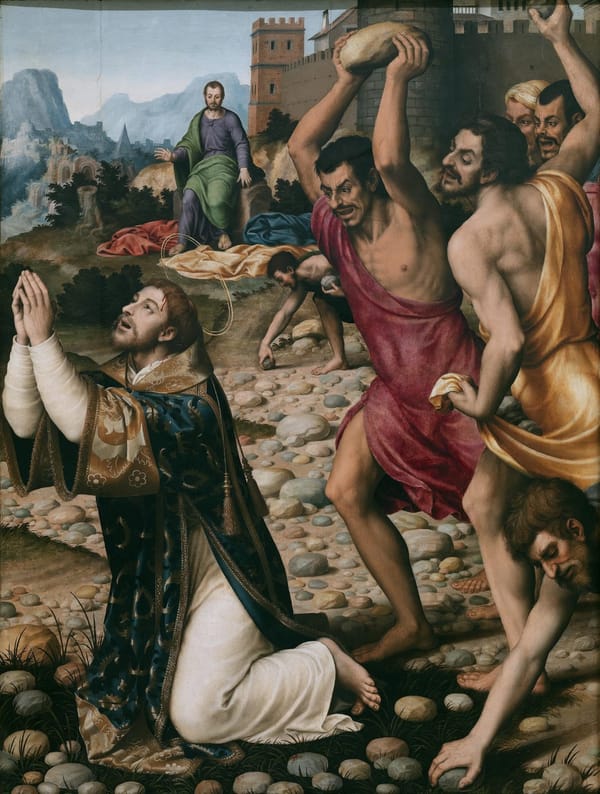
Now the glorious Martyr-band of Christ is headed by St Stephen. His name signifies the Crowned; a conqueror such as he could not be better named. He marshals, in the name of Christ, the white-robed army, as the Church calls the Martyrs; for he was the first, even before the Apostles themselves, to receive the summons, and right nobly did he answer it. Stephen courageously bore witness, in the presence of the Jewish Synagogue, to the divinity of Jesus of Nazareth; by thus proclaiming the Truth, he offended the ears of the unbelievers; the enemies of God became the enemies of Stephen, and rushing upon him, they stoned him to death. Amidst the pelting of the blood-drawing missiles, he, like a true soldier, flinches not, but stands (as St Gregory of Nyssa so beautifully describes it) as though snowflakes were falling on him, or roses were covering him with the shower of their kisses. Through the cloud of stones he sees the glory of God: Jesus, for whom he was laying down his life, showed himself to his Martyr, and the Martyr again rendered testimony to the divinity of Emmanuel, but with all the energy of a last act of love. Then, to make his sacrifice complete, he imitates his divine Master, and prays for his executioners: falling on his knees, he begs that this sin be not laid to their charge. Thus, all is consummated: the glorious type of Martyrdom is created and shown to the world, that it may be imitated by every generation to the end of time, until the number of the Martyrs of Christ shall be filled up. Stephen sleeps in the Lord, and is buried in peace—in pace—until his sacred Tomb shall be discovered, and his glory be celebrated a second time in the whole Church, by that anticipated Resurrection of the miraculous Finding of his Relics.
Stephen, then, deserves to stand near the Crib of his King as leader of those brave champions, the Martyrs, who died for the Divinity of that Babe whom we adore. Let us join the Church in praying to our Saint, that he help us to come to our Sovereign Lord, now lying on his humble throne in Bethlehem. Let us ask him to initiate us into the mystery of that divine Infancy, which we are all bound to know and imitate. It was from the simplicity he had learned from that Mystery that he heeded not the number of the enemies he had to fight against, nor trembled at their angry passion, nor winced under their blows, nor hid from them the Truth and their crimes, nor forgot to pardon them and pray for them. What a faithful imitator of the Babe of Bethlehem! Our Jesus did not send his Angels to chastise those unhappy Bethlehemites who refused a shelter to the Virgin-Mother, who in a few hours was to give birth to him, the Son of David. He stays not the fury of Herod, who plots his Death; but meekly flees into Egypt, like some helpless bondsman, escaping the threats of a tyrant lordling. But it is under such apparent weakness as this that he will show his Divinity to men, and he the Infant-God prove himself the Strong God. Herod will pass away; so will his tyranny; Jesus will live, greater in his Crib, where he makes a King tremble, than, under his borrowed majesty, is this prince-tributary of Rome; nay, than Caesar Augustus himself, whose world-wide empire has no other destiny than this—to serve as handmaid to the Church, which is to be founded by this Babe, whose name stands humbly written in the official registry of Bethlehem.
Mass
The Introit is composed of the words of the holy Martyr, who, in the language of the Royal Psalmist, tells us of the plot formed against him by the wicked, and of his own humble confidence in God, whereby he triumphed over their persecutions. From the murder of the innocent Abel to the future Martyrs who are to shed their blood in the days of Anti-christ, the Church is always under persecution; in some country, she is ever shedding her blood; but her strength lies in her fidelity to Jesus her Spouse, and in the simplicity which the Babe of Bethlehem is come to teach her by his own example.
Introit
In the Collect the Church asks, both for herself and her children, that divine vigour which makes the holy Martyrs forgive their persecutors, and perfects not only their testimony to the truth, but also their imitation of Jesus Christ. It speaks the praise of St Stephen, who was the first to follow our Saviour's example.
Collect
Commemoration of Christmas Day
Epistle
Cap. VI et VII.
In diebus illis, Stephanus, plenus gratia et fortitudine, faciebat prodigia et signa magna in populo. Surrexerunt autem quidam de synagoga quæ appellatur Libertinorum, et Cyrenensium, et Alexandrinorum, et eorum qui erant a Cilicia et Asia, disputantes cum Stephano, et non poterant resistere sapientiæ et Spiritui qui loquebatur. Audientes autem hæc, dissecabantur cordibus suis, et stridebant dentibus in eum. Cum autem esset Stephanus plenus Spiritu Sancto, intendens in cœlum, vidit gloriam Dei, et Jesum stantem a dextris Dei. Et ait: Ecce video cœlos apertos, et Filium hominis stantem a dextris Dei. Exclamantes autem voce magna continueront aures suas, et impetum fecerunt unanimiter in eum. Et ejicientes eum extra civitatem, lapidabant. Et testes deposuerunt vestimenta sua secus pedes adolescentis, qui vocabatur Saulus. Et lapidabant Stephanum invocantem et dicentem: Domine Jesu, suscipe spiritum meum. Positis autem genibus, clamavit voce magna dicens: Domine, ne statuas illis hoc peccatum. Et cum hoc dixisset, obdormivit in Domino.
Ch. VI and VII.
Thus, O glorious Prince of Martyrs! thou wast led outside the gates of the City for thy sacrifice, and thy punishment was that of blasphemers. The Disciple was to be like to his Master in all things. But neither the ignominy of such a death nor its cruelty could daunt thy great soul: thou didst carry Jesus in thy heart, and with him thou wast stronger than all thy enemies. And what was thy joy when thou sawest the heavens open, and this same Jesus in his glorified Humanity standing at the right hand of God, and looking upon thee with love! A God looking complacently on the creature that is going to die for him, and the creature permitted to behold the God for whom he is dying—truly, this was more than enough to encourage thee! Let thine enemies cast their stones against thee, and bruise and tear thy flesh, as they please: nothing can distract thee from this sight of the Eternal King, who raised himself from his throne to applaud thee, and deck thee with the Crown which he had prepared for thee from all eternity! Now that thou art reigning in the kingdom of heaven, pray for us, that we also may be faithful, and faithful even unto death, to this same Jesus, who not only left his throne, but even came down among us as a Little Child.
Gradual
℣. Adjuva me, Domine Deus meus: salvum me fac propter misericordiam tuam.
℣. Help me, O Lord my God: save me for thy mercy's sake.
Gospel
Cap. XXIII.
In illo tempore: dicebat Jesus scribis et Pharisæis: Ecce ego mitto ad vos Prophetas, et sapientes, et scritas; et ex illis occidetis, et crucifigetis, et ex eis flagelabitis in synagogis vestris, et persequemini de civitate in civitatem: ut veniat super vos omnis sanguis justus, qui effusus est super terram, a sanguine Abel justi usque ad sanguinem Zachariæ, filii Barachiæ, quem occidistis inter templum et altare. Amen dico vobis, venient hæc omnia super generationem istam. Jerusalem, Jerusalem, quæ occidis Prophetas, et lapidas eos qui ad te missi sunt, quoties volui congregare filios tuos, quemadmodum gallina congregat pullos suos sub alas, et noluisti! Ecce relinquetur vobis domus vestra deserta. Dico enim vobis, non me videbitis amodo, donec dicatis: Benedictus qui venit in nomine Domini.
Ch. XXIII.
At that time: Jesus said to the Scribes and Pharisees: Behold, I send to you Prophets, and wise men, and scribes; and some of them you will put to death and crucify, and some you will scourge in your synagogues, and persecute from city to city: that upon you may come all the just blood that hath been shed upon the earth, from the blood of Abel the just, even unto the blood of Zacharias, the son of Barachias, whom you killed between the temple and the altar. Amen, I say to you, all these things shall come upon this generation. Jerusalem, Jerusalem, thou that killest the Prophets, and stonest them that are sent unto thee, how often would I have gathered together thy children, as the hen doth gather her chickens under her wings, and thou wouldst not? Behold, your house shall be left to you desolate. For I say to you, you shall not see me henceforth, till you say: Blessed is he that cometh in the name of the Lord.
The Martyrs are given to the world that they may continue the ministry of Christ on the earth by bearing testimony to his word, and by confirming this testimony by their blood. The world has despised them; like their divine Master, they have shone in the darkness, and darkness has not understood their light. Nevertheless many have received their testimony, and the seed of the Martyr's blood has brought forth in them the rich fruit of Faith. The Synagogue was cast off by God for having shed the blood of Stephen, after having imbrued its hands in that of Jesus. Unhappy they who cannot appreciate the Martyrs! Let us who are Christians take in the sublime lessons taught us by their generous sacrifice; and let our respect and love for them testify that we are grateful for the noble ministry they have fulfilled, and are still fulfilling in the Church. The Church is never without Martyrs, just as she is never without Miracles: it is the twofold testimony that she will give to the end of time, by which she evidences the divine life she has received from her almighty Founder.
During the Offertory, the Church once more proclaims the merits and the glorious death of Stephen: and by this she teaches us that the sacrifice of the holy Deacon is united with that of Jesus himself.
Offertory
Secret
Commemoration of Christmas Day
United by Holy Communion to her divine Spouse, the Church, too, sees the heavens opened, and Jesus standing at the right hand of God. She sends up to this Incarnate Word the yearnings of her intense love, and derives from the heavenly Food she has received that meekness which makes her bear with the injuries and insults put upon her by her enemies, in order that she may win them all to the faith and love of Jesus Christ. It was by partaking of this same heavenly Food that Stephen obtained the superhuman strength whereby he won his victory and Crown.
Communion
Postcommunion
Commemoration of Christmas Day
Vespers
The solemnity of the Christmas Octave, from which the Feast of St Stephen has in a manner distracted us, returns at Vespers in all its splendour. The Church sings the Psalms and Antiphons of Christmas Day, and the Martyr’s Feast is, so to speak, suspended until she comes to the Capitulum. In this same way she celebrates the Vespers on all the Feasts which are kept during this Octave.
The Psalms and Antiphons are given above, (p. 89).
Capitulum (Acts vi)
Hymn5
Sors, et corona, præmium,
Laudes canentes Martyris
Absolve nexu criminis.
Et blanda fraudum pabula,
Imbuta felle deputans,
Pervenit ad cœlestia.
Et sustulit viriliter,
Fundensque pro te sanguinem,
Æterna dona possidet.
Te poscimus, Piissime,
In hoc triumpho Martyris,
Dimitte noxam servulis.
Qui natus es de Virgine,
Cum Patre et almo Spiritu,
In sempiterna sæcula.
Crown, and reward of thy Soldiers!
absolve from the bonds of our sins
us who sing the praises of thy Martyr.
and the deceitful bait of its caresses
as things embittered with gall,
thy Martyr obtained the delights of heaven.
and manfully did he bear his pains;
and shedding his blood for thy sake,
he now possesses thy eternal gifts.
we beseech thee, in most suppliant prayer,
forgive us thy unworthy servants our sins,
for it is the feast of thy Martyr’s triumph.
that wast born of the Virgin!
and to the Father, and to the Spirit of Love,
for everlasting ages.
Antiphon of the Magnificat
Commemoration of St John
℣. Valde honorandus est beatus Joannes.
℣. Most worthy of honour is blessed John.
Commemoration of Christmas Day
℣. Notum fecit Dominus, alleluia.
℣. The Lord hath made known, alleluia.
In honour of our Protomartyr, we will now give a selection from the ancient Liturgical Hymns wherein his merits were celebrated by the various Churches. We begin with the Hymn composed by St Ambrose, which is in the Breviary of the Church of Milan.
Hymn
Cantemus novum canticum,
Quod dulce sit psallentibus,
Opem ferat credentibus.
Laudem dicamus Martyri,
Qui primus post Redemptorem
Christi secutus est crucem.
Probatus in laudem Dei,
Vexilla mortis rapuit,
Ut præferretur omnibus.
O beata victoria!
Hoc meruisse Stephanum
Ut sequeretur Dominum.
Amore Christi prædicans.
Sancto repletus Spiritu,
Vultum gerens Angelicum.
Vidit Patrem cum Filio,
Monstrans in cœlis vivere,
Quem plebs quærebat perdere.
Saxaque prensant manibus,
Currebant, ut occiderent
Sacratum Christi militem.
Gaudens suscepit lapides,
Rogans pro eis Dominum,
Gaudens tradidit spiritum.
Gloria Unigenito,
Una cum Sancto Spiritu,
In sempiterna sæcula.
let us sing a new canticle:
may it be sweet to them that sing,
and bring grace to them that believe.
let us give praise to the Martyr,
who was the first after the Redeemer
to follow the cross of Jesus.
to be fervent in God's service,
he outran all others
and bore off the Banner of death.
O blessed victory!
Stephen to be the first
to follow his Lord!
to men for the love of Christ,
with his heart full of the Holy Spirit,
and his face beaming as an Angel’s.
and sees the Father with the Son:
he tells the people how he beholds, living in heaven,
him whom they had sought to destroy.
and, seizing up stones in their hands,
they ran out to kill
the holy Soldier of Christ.
right gladly receives the stones:
he asks God to forgive them,
and joyfully breathes forth his soul.
Glory be to thine Only-Begotten Son,
together with the Holy Ghost,
for everlasting ages.
The Gallican Sacramentary, on the Feast of St Stephen, thus glorifies God for the graces bestowed on this the first of the Martyrs.
Missa S. Stefani
The Gothic Church of Spain has, in her Mozarabic Missal, these magnificent praises to God in his holy Martyr.
In natali S. Stephani, Contestatio
Let us next listen to the Greek Church singing the praises of our Protomartyr. She thus extols him in her Menæa:
XXVI Decembris, in magno Vespertino, et passim
Quasi gradus scalæ, ad cœlestem ingressum tibi fuerunt lapidum flocci, super quos ascendens contemplatus es stantem Dominum ad Patris dexteram, tibi offerentem homonymam coronarci sua vivifica dextera, cui vicinus adstas victor gloriosus, athletarumque primitiæ.
The thickly falling stones were to thee as the steps of a ladder reaching the gate of heaven, by which ascending, thou didst behold our Lord standing on the Father’s right hand, offering thee, with his own life-giving right hand, that which was thy very name—a Crown: and now thou standest near him, thou the glorious conqueror, and the first combatant.
The Western Churches of the Middle Ages have left us an almost endless variety of Liturgical compositions, more particularly of Proses and Sequences, in honour of St Stephen. We have no hesitation in giving our preference to the one composed by Adam of St Victor. We shall always think it a duty to bring into notice the works of this great Liturgical Poet, whose compositions were for a long period so dear to the faithful in England, France, Germany, and in almost all the Churches of northern Europe.
Sequence
Et exsultans celebravit
Christi natalitia.
Prosecutus est cœlorum
Regem cum lætitia.
Clarus fide, clarus vita,
Clarus et miraculis.
Et triumphans insultavit
Stephanus incredulis.
Quia victi defuere
Lucis adversarii.
Et linguas exacuunt
Viperarum filii.
Certa, certus de mercede,
Persevera, Stephane.
Confuta sermonibus
Synagogam Satanæ.
Testis verax et fidelis,
Testis innocentiæ.
Te tormenta decet pati
Pro corona gloriæ.
Perfer brevis vim tormenti:
Te manet victoria.
Tibi poena terminalis
Dat vitæ primordia.
Penetrat intuitu
Stephanus cœlestia.
Crescit ad victoriam,
Suspirat ad præmia.
Jesum pro te dimicantem,
Stephane, considera.
Tibi Christum revelari
Clama, voce libera.
Pro quo dulce ducit mori,
Sub ipsis lapidibus.
Vestes lapidantium,
Lapidans in omnibus.
His a quibus lapidatur,
Genu ponit et precatur
Condolens insaniæ.
Qui Christo sic obedivit!
Et cum Christo semper vivit
Martyrum primitiæ.
Mortuos in Africa,
Augustinus asserit,
Fama refert publica.
Revelato corpore,
Mundo datur pluvia
Siccitatis tempore.
Morbos et dæmonia,
Laude dignus et honore
Jugique memoria.
Nomen in Ecclesia,
Languescentem fove mundum
Cœlesti fragrantia.
and in its exultation
celebrated the Birth of Jesus.
in great joy stood
round the King of heaven.
illustrious for his faith, illustrious for his holy life,
illustrious also for his miracles,
and in his triumph,
vanquished the unbelieving Jews.
rage like savage beasts
at seeing their own defeat.
bring up false witnesses,
and sharpen their tongues.
Thou art sure of thy reward:
fight and persevere, O Stephen!
and confute by thy answers
the synagogue of Satan.
a Witness true and faithful,
and he is Witness of thine innocence.
it behoves thee to suffer,
so to win thy Crown of glory.
what are torments which last but an hour,
and are followed by victory?
thy last pang will introduce
thee into eternal life.
Stephen fixes his gaze
on the heavens above:
he pushes on to victory,
he pants for the crown.
is thy Jesus,
and he is fighting for thee.
that the heavens are opened for thee,
and that Jesus shows himself to thee.
for whom he deems it sweet
to be thus stoned to death.
of the garments of all that cast the stones:
casting thus himself each stone they throw.
falls on his knees, and prays
that this sin be not laid
to the charge of his murderers.
who thus imitated Christ:
and now for ever lives with Christ:
Stephen, first of Martyrs.
and common report assure us
that he raised up
six dead men to life in Africa.
his Relics were discovered,
the earth, which was parched by a drought,
received a plentiful rain.
put diseases and demons to flight.
Truly, then, is he worthy of praise
and honour and eternal remembrance.
whose name is so dear to the Church!
refresh our fainting world
by celestial fragrance.
With these praises which the venerable ages of old offered to thee, O Prince and First of Martyrs! we presume to unite ours. Fervently do we congratulate thee that thou hast had assigned thee by the Church the place of honour at the Crib of our Jesus. How glorious the confession thou didst make of his Divinity whilst thy executioners were stoning thee! How rich and bright the scarlet thou art clad in for thy victory! How honourable the wounds thou didst receive for Christ! How immense and yet how choice that army of Martyrs which follows thee as its leader, and to which fresh recruits will for ever be added, to the end of time.
Holy Martyr! help us by thy prayers to enter into the spirit of the mystery of the Word made Flesh, now that we are celebrating the Birth of our Saviour. Thou art the faithful guardsman of his Crib: who could better lead us to the Divine Babe that lies there? Thou didst bear testimony to his Divinity and Humanity; thou didst preach this Man-God before the blaspheming Synagogue. In vain did the Jews stop their ears; they could not stifle thy voice, which charged them with deicide, in that they had put to death him who is at once the Son of Mary and the Son of God. Show this Redeemer to us also, not, indeed, standing in glory at the right hand of his Father, but the sweet and humble Babe, as he now manifests himself to the world into which he has just been born, wrapped in swaddlingclothes, and laid in a manger. We too wish to bear witness to him, and to tell how his Birth is one of love and mercy; we wish to show by our lives that he has been born in our hearts. Obtain for us that devotedness to the Divine Infant which gave thee such courage on the day of trial: we shall have devotedness if, like thee, we are simple-hearted and fearless in our love of Jesus; for love is stronger than death. May we never forget that every Christian ought to be ready for martyrdom simply because he is a Christian. May the life of Christ, which has again begun within us, so grow within us, by our fidelity and our conduct, that we may come, as the Apostle expresses it, to the fulness of Christ.6
But be mindful, O glorious Martyr! be mindful of the Holy Church in those countries where it is the will of God that she resist even unto blood. May the number of thy fellow-martyrs be thus filled up, and let not one of the combatants grow faint-hearted. May every age and sex be staunch; that so the testimony may be perfect, and the Church, even in her old age, win immortal laurels and crowns, as in the freshness of her infancy, when she had such a champion as thyself. But pray too that the blood of these Martyrs may be fruitful, as it was in times past; pray that it be not wasted, but become the seed of abundant harvests. May infidelity lose ground, and heresy cease to canker those noble hearts who, once in the Truth, would be the glory and consolation of the Church. Our own dear Land has had her Martyrs, who in the hope that God would avenge their blood by restoring her to the Faith, gladly suffered and died: oh! Prince of Martyrs! pray that this their hope may be speedily fulfilled.
We must not end this second day of the Christmas Octave without visiting the Stable of Bethlehem, and adoring the divine Son of Mary. Two days have scarce elapsed since his Blessed Mother placed him in his humble Crib; but these two days are of more value for the salvation of the world than the four thousand years which preceded the Birth of this Babe. The work of our Redemption has made a great step; the cries and tears of the New-Born Child have begun the atonement of our sins. On this Feast of the First Martyr, let us consider how the cheeks of the Infant Jesus are moistened with tears, and how these tears are the first expression of his sufferings. 'Jesus weeps,' say St Bernard, 'but not like other children, certainly not for the same cause as other children. . . . They weep from passion; he from compassion. They weep because they are galled by the yoke that sits heavy on all the children of Adam; Jesus weeps because he sees the sins of the children of Adam.' (Third Sermon for the Nativity.) Oh! how dear to us ought to be these tears of a God who has made himself our Brother! Had we not sinned, God would not have wept. Ought not we too to weep over sin, which thus saddens, by the sufferings it causes to our sweet Infant Jesus, the heavenly joy of his Birth among us?
Mary also sees these tears, and her maternal heart is pained. She feels that her Child is to be the Man of Sorrows; and, before many days are over, the same awful truth will be told her in prophecy. With the consolation she offers to her Babe let us unite ours, by giving him our love. It is the one thing he seeks by all the humiliations he has taken upon himself. It is to gain our love that he has come down from heaven, and been born among us in the midst of the mysteries we are now celebrating. Let us love him, therefore, with all our love, and ask our Lady to present him our humble offering. The Psalmist has said: The Lord is great, and exceedingly to be praised: let us add, with St Bernard: The Lord is a Little Babe, and exceedingly to be loved.
We will honour the Birth of our Jesus to-day by this venerable Sequence of St Gall's Monastery, written by Blessed Notker. It recounts the combat of our Emmanuel against Satan, and his victory. This victory is the source of those won by Stephen and all the Martyrs.
Sequence
Laudibus piis digna,
In quo nobis lux oritur Gratissima.
Pereunt nostri criminis Umbracula.
Maris stella Est enixa Novæ salutis gaudia.
A quo peribit mortua.
Coluber lividus perdit spolia.
Ovis obducta, Revocatur ad aeterna Gaudia.
Agmina Angelorum coelestia,
Et est inventa.
Est natura.
Nascitur ex femina.
Assumens quod non erat, Manens quod erat.
Quis audivit talia, Dic, rogo, facta?
Pastor pius quod perierat.
Certat ut miles armatura.
Ruit hostis spicula.
Divisa sunt illius spolia, Capta præda sua.
Salus nostra est vera,
Duxit post victoriam.
our holy songs
Whereon the much-loved Light rises to the world.
that the dark shadows of our sins are made to disappear.
the joy of its new salvation.
nay, cruel Death is filled with fear at the sight of him who is to be its death.
and the crushed serpent lets go his prey.
is carried back to the eternal joys.
are full of joy to-day;
and is fotind.
by whom mankind was redeemed.
is born of a Woman.
assuming what he was not, and remaining what he had ever been.
I beseech thee, tell me, was aught like this ever heard?
that which was lost.
and as a soldier fights in armour.
and falls upon his own arrows.
his booty is divided, his prey is taken from him.
most glorious battle of Christ;
led us to his own kingdom,
And now, turning towards his Blessed Mother, we will offer her the tribute of this beautiful Sequence, taken from the Cluny Missal of 1523.
Sequence
O dignitatis Domina.
Cœlo regnas per sæcula.
Vere dulcis, vere pia, Vere mitissima.
Tota melliflua.
Culpæ ades propitia.
A fornice
Surgit rea Ægyptia.
O lapsorum spes unica.
Hodie infer cœlo Suspiria.
Tu mundi gloria.
Tu reconcilia,
Fovens dulcia.
Nobis hunc placa.
Tremenda.
Patri tuæ prolis Pignora,
Reos munda,
Tu bona, tu clemens,
Tu spes nostra,
Amen dicat mens devota.
O Queen of the Angel kingdom.
for ever on the heavenly throne.
truly sweet and loving and most gentle!
and as a land flowing with honey.
to obtain the forgiveness of his sin.
the guilty one of Egypt rises
from her abominations.
O singular hope of the fallen!
the prayers and sighs of thy clients.
thou art the glory of the world.
to the favour of our Emmanuel,
thou didst warm.
appease him in our regard,
we beseech thee.
our Father the merits of our Jesus;
obtain forgiveness for the guilty,
Thou art our good, our merciful Mother;
thou art our hope,
Let every devout soul respond: Amen!
- Ps. xliv 3. ↩︎
- Acts vi 8. ↩︎
- St Luke x 3. ↩︎
- 1 Cor. i 24. ↩︎
- In the Monastic Breviary, it is as follows: ℟. breve. Posuisti, Domine, * Super caput ejus. Posuisti. ℣. Coronam de lapide pretioso. * Super. Gloria Patri. Posuisti. Deus, tuorum militum Sors, et corona, præmium, Laudes canentes Martyris Absolve nexu criminis. Hic nempe mundi gaudia Et blandimenta noxia Caduca rite deputans, Pervenit ad cœlestia. Pœnas cucurrit fortiter, Et sustulit viriliter: Pro te effundens sanguinem Æterna dona possidet. Ob hoc precatu supplici Te poscimus, Piissime, In hoc triumpho Martyris Dimitte noxam servulis. Gloria tibi Domine, Qui natus es de Virgine, Cum Patre, et Sancto Spiritu, In sempiterna sæcula. Amen. ↩︎
- Eph. iv 13. ↩︎
| Previous December 25 (the Same Day): The Third Mass of Christmas | Next December 27: St. John, Apostle and Evangelist |