Daily reading
Christmas
Double of the II Class · January 1 · Temporal
January 1: The Circumcision of Our Lord and the Octave Day of Christmas
From Dom Guéranger’s The Liturgical Year.

|
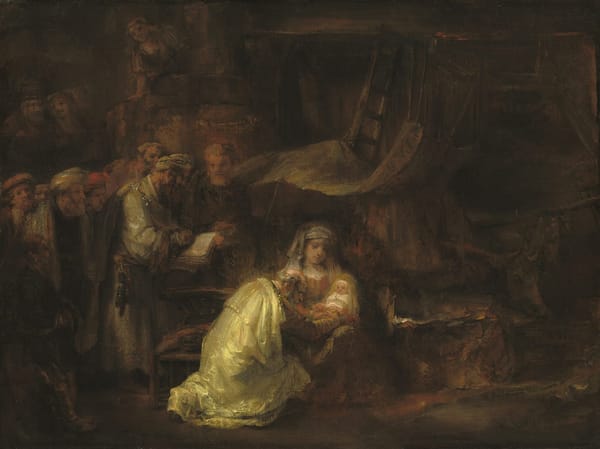
OUR new-born King and Saviour is eight days old to-day; the Star that guides the Magi is advancing towards Bethlehem, and five days hence will be standing over the Stable where our Jesus is being nursed by his Mother. To-day the Son of Man is to be circumcised; this first sacrifice of his innocent Flesh must honour the eighth day of his mortal life. To-day also a Name is to be given him: the Name will be Jesus, and it means Saviour. So that mysteries abound on this day: let us not pass one of them over, but honour them with all possible devotion and love.
But this day is not exclusively devoted to the Circumcision of Jesus. The mystery of this Circumcision forms part of that other great mystery, the Incarnation and Infancy of our Saviour—a mystery on which the Church fixes her heart not only during this Octave, but during the whole forty days of Christmastide. Then, as regards our Lord's receiving the Name of Jesus, a special Feast, which we shall soon be keeping, is set apart in honour of it. There is another object that shares the love and devotion of the Faithful on this great Solemnity. This object is Mary, the Mother of God. The Church celebrates to-day the august prerogative of this divine Maternity which was conferred on a mere creature, and made her the co-operatrix with Jesus in the great work of man's salvation.
The holy Church of Rome used formerly to say two Masses on the first of January; one was for the Octave of Christmas Day, the other was in honour of Mary. She now unites the two intentions in one Sacrifice, in the same manner as, in the rest of this Day’s Office, she unites together the acts of her adoration of the Son, and the expressions of her admiration for and confidence in the Mother.
The Greek Church does not wait for this eighth day, in order to pay her tribute of homage to her who has given us our Emmanuel. She consecrates to Mary the first day after Christmas, that is December 26, and calls it the Synaxis of the Mother of God, making the two days one continued Feast. She is thus obliged to defer the Feast of St Stephen to December 27.
But it is to-day that we, the children of the Roman Church, must pour forth all the love of our hearts for the Virgin-Mother, and rejoice with her in the exceeding happiness she feels at having given birth to her and our Lord. During Advent we contemplated her as pregnant with the world’s salvation; we proclaimed the glory of that Ark of the New Covenant, whose chaste womb was the earthly paradise chosen by the King of Ages for his dwelling-place. Now she has brought him forth, the Infant-God; she adores him, him who is her Son. She has the right to call him her Child; and he, God as he is, calls her in strictest truth his Mother.
Let us not be surprised, therefore, at the enthusiasm and profound respect wherewith the Church extols the Blessed Virgin and her prerogatives. Let us on the contrary be convinced that all the praise the Church can give her, and all the devotion she can ever bear towards her, are far below what is due to her as Mother of the Incarnate God. No mortal will ever be able to describe, or even comprehend, how great a glory accrues to her from this sublime dignity. For, as the glory of Mary comes from her being the Mother of God, one would have first to comprehend God himself in order to measure the greatness of her dignity. It is to God that Mary gave our human nature; it is God whom she had as her Child; it is God who gloried in rendering himself, inasmuch as he is Man, subject to her: hence, the true value of such a dignity, possessed by a mere creature, can only be appreciated in proportion to our knowledge of the sovereign perfections of the great God, who thus deigns to make himself dependent upon that favoured creature. Let us therefore bow down in deepest adoration before the Majesty of our God; let us therefore acknowledge that we cannot respect as it deserves the extraordinary dignity of her whom he chose for his Mother.
The same sublime Mystery overpowers the mind from another point of view: what were the feelings of such a Mother towards such a Son? The Child she holds in her arms and presses to her heart is the Fruit of her virginal womb, and she loves him as her own; she loves him because she is his Mother, and a Mother loves her Child as herself, nay, more than herself: but when she thinks upon the infinite majesty of him who has thus given himself to her to be the object of her love and her fond caresses, she trembles in her humility, and her soul has to turn, in order to bear up against the overwhelming truth, to the other thought of the nine months she held this Babe in her womb, and of the filial smile he gave her when her eyes first met his. These two deep-rooted feelings—of a creature that adores, and of a Mother that loves—are in Mary’s heart. To be Mother of God implies all this: and may we not well say that no pure creature could be exalted more than she? and that in order to comprehend her dignity, we should first have to comprehend God himself? and that only God’s infinite wisdom could plan such a work, and only his infinite power accomplish it?
A Mother of God! It is the mystery whose fulfilment the world, without knowing it, was awaiting for four thousand years. It is the work which, in God’s eyes, was incomparably greater than that of the creation of a million new worlds, for such a creation would cost him nothing; he has but to speak, and all whatsoever he wills is made. But that a creature should become Mother of God, he has had not only to suspend the laws of nature by making a Virgin Mother, but also to put himself in a state of dependence upon the happy creature he chose for his Mother. He had to give her rights over himself, and contract the obligation of certain duties towards her. He had to make her his Mother, and himself her Son.
It follows from all this, that the blessings of the Incarnation, for which we are indebted to the love wherewith the Divine Word loved us, may and ought to be referred, though in an inferior degree, to Mary herself. If she be the Mother of God, it is because she consented to it, for God vouchsafed not only to ask her consent, but moreover to make the coming of his Son into this world depend upon her giving it. As this his Son, the Eternal Word, spoke his Fiat over chaos, and the answer to his word was creation; so did Mary use the same word Fiat: let it be done unto me,1 she said. God heard her word, and immediately the Son of God descended into her virginal womb. After God, then, it is to Mary, his ever Blessed Mother, that we are indebted for our Emmanuel.
The divine plan for the world's salvation included the existence of a Mother of God: and as heresy sought to deny the mystery of the Incarnation, it equally sought to deny the glorious prerogative of Mary. Nestorius asserted that Jesus was only man; Mary consequently was not Mother of God, but merely Mother of a Man called Jesus. This impious doctrine roused the indignation of the Catholic world. The East and West united in proclaiming that Jesus was God and Man, in unity of Person; and that Mary, being his Mother, was, in strict truth, ‘Mother of God.’2 This victory over Nestorianism was won at the Council of Ephesus. It was hailed by the Christians of those times with an enthusiasm of faith which not only proved the tender love they had for the Mother of Jesus, but was sure to result in the setting up of some solemn trophy that would perpetuate the memory of the victory. It was then that the pious custom began, in both the Greek and Latin Churches, of uniting during Christmas the veneration due to the Mother with the supreme worship given to the Son. The day assigned for the united commemoration varied in the several countries, but the sentiment of religion which suggested the Feast was one and the same throughout the entire Church.
The holy Pope Xystus III ordered an immense mosaic to be worked into the chancel-arch of the Church of St Mary Major, in Rome, as a monument to the holy Mother of God. The mosaic still exists, bearing testimony as to what was the faith held in the fifth century. It represents the various scriptural types of our Lady, and the inscription of the holy Pontiff is still legible in its bold letters: Xystus Episcopus plebi Dei (Xystus Bishop to the people of God): for the Saint had dedicated to the faithful this his offering to Mary, the Mother of God.
Special chants were also composed at Rome for the celebration of the great mystery of the Word made Man through Mary. Sublime Responsories and Antiphons, accompanied by appropriate music, were written to serve the Church and her children as the expression of their faith, and they are the ones we now use. The Greek Church makes use of some of these very antiphons for the Christmas Solemnity; so that with regard to the mystery of the Incarnation there is not only unity of faith, there is also oneness of devotional sentiment.
First Vespers
The First Vespers of the Circumcision are made peculiarly solemn by the chanting of the five venerable Antiphons to which we have just alluded. The Psalms are those which are sung at the Vespers of the Feasts of our Lady.
The first of these Psalms celebrates the kingly character, the Priesthood and the sovereign Judgeship of our Emmanuel, and implies, consequently, the wonderful dignity of her who gave him Birth. The second contains the praise of God, who exalts the humble, and gives the joys of maternity where nature has refused them; it announces with an air of triumph the glories and the maternity of Mary, Mother of God and Mother of men. The last three Psalms chant the praises of Jerusalem, the City of God; the symbol of Mary, who is the City of God.
Psalm 109
Donec ponam inimicos tuos: * scabellum pedum tuorum.
Virgam virtutis tuæ emittet Dominus ex Sion: * dominare in medio inimicorum tuorum.
Tecum principium in die virtutis tuæ, in splendoribus Sanctorum: * ex utero ante luciferum genui te.
Juravit Dominus, et non poenitebit eum: * Tu es sacerdos in æternum, secundum ordinem Melchisedech.
Dominus a dextris tuis: * confregit in die iræ suæ reges.
Judicabit in nationibus, implebit ruinas: * conquassabit capita in terra multorum.
De torrente in via bibet; * propterea exaltabit caput.
Until, on the day of thy last coming, I make thy enemies thy footstool.
O Christ! the Lord, thy Father, will send forth the sceptre of thy power out of Sion: from thence rule thou in the midst of thy enemies.
With thee is the principality in the day of thy strength, in the brightness of the Saints: for the Father hath said to thee: From the womb, before the day-star, I begot thee.
The Lord hath sworn, and he will not repent: he hath said, speaking of thee, the God-Man: Thou art a Priest for ever, according to the order of Melchisedech.
Therefore, O Father! the Lord thy Son is at thy right hand: he hath broken kings in the day of his wrath.
He shall also judge among nations; he shall fill the ruins of the world: he shall crush the heads in the land of many.
He cometh now in humility; he shall drink in the way of the torrent of sufferings: therefore shall he lift up the head.
Ant. Quando natus es ineffabiliter ex Virgine, tunc impletæ sunt Scripturæ; sicut pluvia in vellus descendisti, ut salvum faceres genus humanum: te laudamus, Deus noster.
Ant. When thou wast born ineffably of the Virgin, the Scriptures were fulfilled. As dew upon Gedeon’s Fleece, thou camest down to save mankind. O Lord our God! we praise thee.
Psalm 112
Sit nomen Domini benedictum: * ex hoc nunc et usque in sæculum.
A solis ortu usque ad occasum: * laudabile nomen Domini,
Excelsus super omnes gentes Dominus: * et super cœlos gloria ejus.
Quis sicut Dominus Deus noster qui in altis habitat: * et humilia respicit in cœlo et in terra?
Suscitans a terra inopem: * et de stercore erigens pauperem.
Ut collocet eum cum principibus: * cum principibus populi sui.
Qui habitare facit sterilem in domo: * matrem filiorum lætantem.
Praise the Lord, ye children: praise ye the name of the Lord.
Blessed be the name of the Lord: from henceforth now and for ever.
From the rising of the sun unto the going down of the same, the name of the Lord is worthy of praise.
The Lord is high above all nations: and his glory above the heavens.
Who is as the Lord our God, who dwelleth on high: and looketh down on the low things in heaven and on earth?
Raising up the needy from the earth: and lifting up the poor out of the dunghill.
That he may place him with princes: with the princes of his people.
Who maketh a barren woman to dwell in a house, the joyful mother of children.
Ant. In the bush seen by Moses as burning yet unconsumed, we recognize the preservation of thy glorious Virginity. O Mother of God, intercede for us.
Psalm 121
Lætatus sum in his quæ dicta sunt mihi: * In domum Domini ibimus.
Stantes erant pedes nostri: * in atriis tuis Jerusalem.
Jerusalem quæ ædificatur ut civitas: * cujus participatio ejus in idipsum.
Illuc enim ascenderunt tribus, tribus Domini: * testimonium Israel ad confitendum nomini Domini.
Quia illio sederunt sedes in judicio: * sedes super domum David.
Rogate quae ad pacem sunt Jerusalem: * et abundantia diligentibus te.
Fiat pax in virtute tua: * et abundantia in turribus tuis.
Propter fratres meos et proximos meos: * loquebar pacem de te.
Propter domum Domini Dei nostri: * quaesivi bona tibi.
I rejoiced at the things that were said to me: We shall go into the house of the Lord.
Our feet were standing in thy courts, O Jerusalem! Our heart loves and confides in thee, O Mary.
Mary is like to Jerusalem that is built as a city; which is compact together.
For thither did the tribes go up, the tribes of the Lord: the testimony of Israel, to praise the name of the Lord.
Because seats sat there in judgement; seats upon the house of David; and Mary is of a kingly race.
Pray ye, through Mary, for the things that are for the peace of Jerusalem: and may abundance be on them that love thee, O Church of our God!
The voice of Mary: Let peace be in thy strength, O thou new Sion! and abundance in thy towers.
I, a daughter of Israel, for the sake of my brethren and of my neighbours, spoke peace of thee.
Because of the house of the Lord our God, I have sought good things for thee.
Ant. Germinavit radix Jesse; orta est stella ex Jacob; Virgo peperit Salvatorem: te laudamus, Deus noster.
Ant. The Root of Jesse hath budded; the Star hath risen out of Jacob; a Virgin hath brought forth the Saviour. O Lord our God! we praise thee.
Psalm 126
Nisi Dominus ædificaverit domum: * in vanum laboraverunt qui aedificant eam.
Nisi Dominus custodierit civitatem: * frustra vigilat qui custodit eam.
Vanum est vobis ante lucem surgere: * surgite postquam sederitis, qui manducatis panem doloris.
Cum dederit dilectis suis somnum: * ecce hæreditas Domini, filii: merces, fructus ventris.
Sicut sagittæ in manu potentis: * ita filii excussorum.
Beatus vir, qui implevit desiderium suum ex ipsis: * non confundetur cum loquetur inimicis suis in porta.
Unless the Lord build the house, they labour in vain that build it.
Unless the Lord keep the city, he watcheth in vain that keepeth it.
It is vain for you to rise before light; rise ye after you have sitten, you that eat of the bread of sorrow.
When he shall give sleep to his beloved: behold the inheritance of the Lord are children: the reward, the fruit of the womb.
As arrows in the hand of the mighty, so the children of them that have been shaken.
Blessed is the man that hath filled his desire with them; he shall not be confounded when he shall speak to his enemies at the gate.
Ant. Ecce Maria genuit nobis Salvatorem, quem Joannes videns exclamavit, dicens: Ecce Agnus Dei, ecce qui tollit peccata mundi, alleluia.
Ant. Lo! Mary hath brought forth a Saviour unto us, whom John seeing exclaimed: Behold the Lamb of God I Behold him that taketh away the sins of the world, alleluia.
Psalm 147
Quoniam confortavit seras portarum tuarum: * benedixit filiis tuis in te.
Qui posuit fines tuos pacem: * et adipe frumenti satiat te.
Qui emittit eloquium suum terrae: * velociter currit sermo ejus.
Qui dat nivem sicut lanam: * nebulam sicut cinerem spargit.
Mittit crystallum suam sicut buccellas: * ante faciem frigoris ejus quis sustinebit?
Emittet verbum suum, et liquefaciet ea; * flabit spiritus ejus, et fluent aquæ.
Qui annuntiat verbum suum Jacob: * justitias, et judicia sua Israel.
Non fecit taliter omni nationi: * et judicia sua non manifestavit eis.
Because he hath strengthened against sin the bolts of thy gates: he hath blessed thy children within thee.
Who hath placed peace in thy borders, and filleth thee with the fat of com, with Jesus, who is the Bread of life.
Who sendeth forth by thee his Word to the earth; his Word runneth swiftly.
Who giveth snow like wool: scattereth mists like ashes.
He sendeth his crystal like morsels: who shall stand before the face of his cold?
He shall send forth his Word by Mary, and shall melt them: his spirit shall breathe, and the waters shall run.
Who declareth his Word to Jacob: his justices and his judgements to Israel.
He hath not done in like manner to every nation; and his judgements he hath not made manifest to them.
Capitulum (Tit. ii)
Then is sung the Hymn of Christmas Day, Jesu, Redemptor omnium, as on p. 116.
Antiphon of the Magnificat
Mass
This Station is at St Mary's across the Tiber. It was but just that this Basilica should receive such an honour, for it is the most ancient of all the Churches raised by the devotion of the faithful of Rome in honour of our Blessed Lady. It was consecrated in the third century by St Callixtus, on the site of the ancient Taberna Meritoria, celebrated even among the Pagans, for the fountain of oil which sprang up in that spot in the reign of Augustus, and flowed into the Tiber. The piety of the Christians interpreted this as a symbol of the Christ that was afterwards born; and the Basilica is sometimes called, even to this day, Fons Olei.
The Introit is that of the Third Mass of Christmas Day, as are also most of the portions that are chanted by the choir. It celebrates the Birth of the Child who is born unto us, and is to-day eight days old.
Introit
In the Collect the Church celebrates the Fruitful Virginity of the Mother of God, and shows Mary to us as the source whence God poured out upon mankind the blessing of the Incarnation. She expresses to God himself the hopes we have in the intercession of this privileged creature.
Collect
Epistle
Cap. II.Carissime, apparuit gratia Dei Salvatoris nostri omnibus hominibus, erudiens nos, ut abnegantes impietatem et sæcularia desideria, sobrie et juste et pie vivamus in hoc sæculo, exspectantes beatam spem, et adventum gloriæ magni Dei et Salvatoris nostri Jesu Christi: qui dedit semetipsum pro nobis, ut nos redimeret ab omni iniquitate et mundaret sibi populum acceptabilem, sectatorem bonorum operum. Hæc loquere et exhortare: in Christo Jesu Domino nostro.
Ch. II.Dearly beloved: The grace of God our Saviour hath appeared to all men, instructing us that denying ungodliness and worldly desires, we should live soberly and justly and godly in this world, looking for the blessed hope and coming of the glory of the great God and our Saviour Jesus Christ: who gave himself for us, that he might redeem us from all iniquity, and might cleanse to himself a people acceptable, a pursuer of good works. These things speak and exhort: in Christ Jesus our Lord.
These counsels of our great Apostle, who warns -the Faithful of the obligation they are under of making a good use of the present life, are most appropriate to this first day of January, which is now the beginning of the new Civil Year. Let us, therefore, renounce all worldly desires; let us live soberly, justly, and piously, and permit nothing to distract us from the expectation of that blessedness, which is our hope. The great God and Saviour Jesus Christ, who shows himself to us in these days of his mercy in order to instruct us, will come to us in a second coming in order to give us our reward. The beginning of a New Year tells us plainly enough that this last day is fast approaching; let us cleanse ourselves from all iniquity, and become a people acceptable to our Redeemer, a people doing good works.
The Gradual proclaims the grand tidings of the Birth of our Jesus, and invites all nations to give praise to him, as also to the Eternal Father, who had promised him by the Prophets, and at length sent him.
Gradual
Gospel
Cap. II.In illo tempore: Postquam consummati sunt dies octo, ut circumcideretur Puer; vocatum est nomen ejus Jesus, quod vocatum est ab Angelo priusquam in utero conciperetur.
Ch. II. At that time: After eight days were accomplished that the Child should be circumcised, his name was called Jesus, which was called by the Angel before he was conceived in the womb.
The Child is circumcised: he is now not only a member of the human race; he is made to-day a member of God's chosen People. He subjects himself to this painful ceremony, to this symbol of one devoted to the Divine service, in order that he may fulfil all justice. He receives, at the same time, his Name: the Name is Jesus, and it means a Saviour. A Saviour! Then he is to save us? Yes; and he is to save us by his Blood. Such is the divine appointment, and he has bowed down his will to it. The Incarnate Word is upon the earth in order to offer a Sacrifice, and the Sacrifice is begun to-day. This first shedding of the Blood of the Man-God was sufficient to the fulness and perfection of a Sacrifice; but he is come to win the heart of the sinner, and that heart is so hard that all the streams of that Precious Blood, which flow from the Cross on Calvary, will scarcely make it yield. The drops that were shed to-day would have been enough to satisfy the justice of the Eternal Father, but not to cure man's miseries, and the Babe's Heart would not be satisfied to leave us uncured. He came for man's sake, and his love for man will go to what looks like excess—he will carry out the whole meaning of his dear name—he will be our ‘Jesus,’ our Saviour.
The Offertory extols the power of our Emmanuel. Now that he is humbled by the wound of the Circumcision, it must be our delight to proclaim his power, his riches, his independence. Let us also magnify his love for us, for it is in order to cure our wounds that he so humbly condescends to feel their smart himself.
Offertory
Secret
At the Communion, the Church rejoices in the Jesus, the Saviour, who visits her, and acts up to his sweet Name with such perfection by redeeming the inhabitants of the whole earth. In the Post communion she prays that by the intercession of Mary the Holy Communion may cure our hearts of their sins, that thus we may offer to God the homage of that spiritual circumcision of which the Apostle so often speaks.
Communion
Postcommunion
Second Vespers
The Antiphons and Psalms are the same as in First Vespers, p. 376. The Capitulum and Hymn of yesterday are repeated; after which are said the following:
℣. Notum fecit Dominus, alleluia.
℟. Salutare suum, alleluia.
℣. The Lord hath made known, alleluia.
℟. His salvation, alleluia.
Antiphon of the Magnificat
Ant. Magnum hæreditatis mysterium! Templum Dei factus est uterus nesciens virum: non est pollutus ex ea carnem assumens; omnes gentes venient, dicentes: Gloria tibi, Domine.
Let us prayO God, who by the fruitful Virginity of Blessed Mary hast given to mankind the rewards of eternal salvation; grant, we beseech thee, that we may experience her intercession, by whom we received the Author of Life, our Lord Jesus Christ, thy Son. Who liveth, etc.
Ant. Great is the mystery of our inheritance! The womb of a most pure Virgin became the Temple of God. He is not defiled assuming to himself Flesh from her. All nations shall come, saying: Glory be to thee, O Lord!
Oremus Deus, qui salutis æternæ, beatæ Mariæ virginitate fœcunda, humanogeneri præmia præstitisti: tribue, quæsumus, ut ipsam pro nobis intercederesentiamus, per quam meruimus auctorem vitæ suscipere Dominum nostrum Jesum Christum Filium tuum. Qui tecum.
We now give a short selection from the Offices of this Octave of Christmas Day, which will assist the Faithful in their devotion to the Holy Mother of God. We begin with the Roman Breviary, and take from it the following Responsories of the Matins of the Circumcision.
℟. Congratulamini mihi omnes qui diligitis Dominum: * Quia cum essem parvula, placui Altissimo, et de meis visceribus genui Deum et hominem.℣. Beatam me dicent omnes generationes, quia ancillam humilem respexit Deus. * Quia.℟. Confirmatum est cor Virginis, in quo divina mysteria, Angelo nuntiante, concepit: tunc speciosum forma præ filiis hominum castis suscepit visceribus: * Et benedicta in æternum, Deum nobis protulit et hominem.℟. Benedicta et venerabilis es, Virgo Maria, quæ sine tactu pudoris inventa es Mater Salvatoris: * Jacebat in præsepio, et fulgebat in cœlo.℣. Domine, audivi auditionem tuam et timui: consideravi opera tua et expavi: in medio duorum animalium * Jacebat in præsepio, et fulgebat in cœlo.
℟. Nesciens Mater Virgo virum peperit sine dolore * Salvatorem sæculorum; ipsum Regem Angelorum, sola Virgo lactabat ubere de cœlo pleno.℣. Domus pudici pectoris templum repente fit Dei: intacta nesciens virum, verbo concepit Filium; * Salva torem.
℟. Rejoice with me all ye that love the Lord: * For that I, when I was little in my own eyes, pleased the Most High, and gave birth to him that is God and Man.℣. All generations shall call me Blessed, because God hath regarded the humility of his Handmaid. For that I.℟. The heart of the Virgin was strengthened, wherein at the message of the Angel she conceived the divine mysteries. Then did she receive into her chaste womb him that is beautiful above all the children of men: * And she that is Blessed for ever brought forth unto us Jesus, God and Man.℟. Blessed and venerable art thou, O Virgin Mary! that wast found to be Mother of the Saviour, yet still the purest Virgin: * He was laid in the Crib, and yet filled heaven with his brightness.℣. I have heard thy hearing, and I feared; I meditated on thy works, and I trembled: between two animals * He was laid in the Crib, and yet filled heaven with his brightness.
℟. A purest Virgin-Mother brought forth without travail * The Saviour of the world: He that was very King of Angels drank at the breast of the Virgin-Mother the food that heaven gave.℣. This chastest living dwelling becomes, in an instant, God’s own Temple: the purest of Virgins conceives, at the Angel’s word, her Son: * The Saviour.
The Greek Church, on December 26, the day she consecrates to the Mother of Jesus, pours forth to Mary her praises with her wonted profusion. We take from the Menæa the two following strophes, the former of which is also the Benedictus-Antiphon for the Feast of the Circumcision, in the Roman Breviary.
On this the eighth day since the Birth of our Emmanuel, let us consider the great mystery which the Gospel tells us was accomplished in his divine Flesh: the Circumcision. On this day the earth sees the first-fruits of that Blood-shedding which is to be its Redemption, and the first sufferings of that Divine Lamb who is to atone for our sins. Let us compassionate our sweet Jesus, who meekly submits to the knife which is to put upon him the sign of a Servant of God.
Mary, who has watched over him with the most affectionate solicitude, has felt her heart sink within her as each day brought her nearer to this hour of her Child's first suffering. She knows that the justice of God does not necessarily require this first sacrifice, or might accept it, on account of its infinite value, for the world’s salvation: and yet, the innocent Flesh of her Son must, even so early as this, be tom, and his Blood flow down his infant limbs.
What must be her affliction at seeing the preparations for this painful ceremony! She cannot leave her Jesus, and yet how shall she bear to see him writhe under this his first experience of suffering? She must stay, then, and hear his sobs and heartrending cries; she must bear the sight of the tears of her Divine Babe, forced from him by the violence of the pain. We need St Bonaventura to describe this wonderful mystery.
‘And if he weeps, thinkest thou his Mother could keep in her tears? No: she, too, wept, and when the Babe, who was standing on her lap, perceived her tears, he raised his little hand to her mouth and face, as though he would beckon to her not to weep, for it grieved him to see her weeping, whom he so tenderly loved. The Mother, on her side, was touched to the quick at the suffering and tears of the Babe, and she consoled him by caresses and fond words; and as she was quick to see his thoughts, as though he had expressed them in words, she said to him: If thou wishest me to cease weeping, weep not thou, my Child! If thou weepest, I must weep too. Then the Babe, from compassion for the Mother, repressed his sobs, and Mary wiped his eyes and her own, and put his Face to her own, and gave him her Breast, and consoled him in every way she could.’3
And now, what shall we give in return to this Saviour of our souls for the Circumcision which he has deigned to suffer in order to show us how much he loved us? We must, according to the teaching of the Apostle, circumcise our heart from all its evil affections, its sins and its wicked inclinations; we must begin at once to live that new life of which the Infant Jesus is the sublime model. Let us thus show him our compassion for this his earliest suffering for us, and be more attentive than we have hitherto been to the example he sets us.
The following beautiful Sequence will assist us to praise this mystery of the Divine Infancy. We have taken it from the ancient Missal of the Church of Paris.
Sequence
Mira virtus gratiæ,
Quae Deum circumcidit.
Nomen et salvificum,
Quod est Jesus, indidit.
Nomen quod os Domini
Ab æterno nominat.
Hoc et sponso Virginis
Angelus denuntiat.
Tu peccatum sæculi
Nomen sacrum superas.
Jesu, spes mœrentium,
Mentes sana miseras.
Supple tuo nomine,
Quod est salutiferum.
Cordis sit præcisio,
Efficax cauterium.
Lavet, riget aridos,
Mœstis det solatium.
Pro felici xenio
Para, Jesu, præmium.
the wonderful power of grace
in the Circumcision of the Infant-God.
a Name that means Salvation
—and it is ‘Jesus’—is given to him.
it is the Name which the mouth of the Lord
hath uttered from eternity.
to the Mother of God,
and to her holy spouse.
thou conquerest Satan’s wicked power,
and the sins of the world.
‘Jesus,’ hope of the afflicted!
our souls are sick—do thou heal them.
supply by thy Name,
which means and gives salvation.
be the cleansing
and the healing of our heart’s wounds.
refresh our parched hearts,
and give consolation to the sad.
when friends give gifts to friends;
let thine, dear 'Jesus,' be the preparing us our recompense.
Adam of St Victor offers us one of his hymns to help us to speak the praises of the Holy Mother of Jesus, It is an extremely graceful poem, and, for a long period, was to be found in the ancient Roman-French Missals.
Sequence
Vas electum, vas honoris,
Vas cœlestis gratiæ.
Vas insigne, vas excisum
Manu Sapientiæ.
Flos de spinis, spina carens,
Flos spineti gratia.
Spina sumus cruentati,
Sed tu spinæ nescia.
Celia custos unguentorum,
Celia pigmentaria.
Myrrham, thus et balsamum
Superas fragrantia.
Mediatrix hominum,
Salutis puerpera.
Rosa patientiæ,
Nardus odorifera.
Terra non arabilis,
Quæ fructum parturiit.
Singulare lilium:
Christus ex te prodiit.
Libanusque non incisus,
Vaporans dulcedinem.
Tu dulcoris et odoris
Habes plenitudinem.
Cui nullus par in thronis,
Arte vel materia.
Aurum fulvum, charitatis
Præsignant mysteria.
Nec in terris habes parem,
Nec in cœli curia.
Virtutum præ cæteris
Habens privilegia.
Et luna sideribus:
Sic Maria dignior
Creaturis omnibus.
Virginis est castitas;
Ardor indeficiens,
Immortalis charitas.
Et totius Trinitatis
Nobile triclinium.
Speciale majestati
Præparans hospitium.
Dignitate singularis,
Super omnes ordinaris
Ordines cœlcstium.
Nos assigna tuæ Proli,
Ne terrores, sive doli
Nos supplantent hostium.
Te tuente, simus tuti;
Pervicacis et versuti
Tuæ cedat vis virtuti,
Dolus, providentiæ.
Serva servos tuæ Matris,
Solve reos, salva gratis,
Et nos tuæ claritatis
Configura gloriæ.
Vessel elect, Vessel of honour,
Vessel of heavenly grace!
Vessel of singular beauty, Vessel formed
by the hand of the All-Wise One.
the Flower that grew midst thorns, thyself the thornless
Flower that decked the thorny Earth.
bleeding from the prickly thorns of sin:
and thou art free from thorns.
Thou art the Fountain of the gardens,
the Casket of sweet ointments and perfumes.
than that of cinnamon,
or myrrh, or frankincense, or aromatic balm.
Mediatrix of men!
Mother of the Jesus who saved us.
rose of patience,
spikenard most fragrant!
Soil most fruitful,
though untilled!
matchless lily of the valley,
that broughtest forth Christ!
Cedartree untouched,
yet breathing forth such sweetness!
sweetness and fragrance,
are all in thee above measure.
the throne rich above all others
in form and substance.
prefigures thy chastity;
the glittering gold thy charity.
thou hast no equal among creatures
on earth or in heaven.
and art privileged with virtues
above Angels and men.
and the moon is brighter than the stars;
so is Mary exalted above all creatures.
which no eclipse quenches,
is Mary’s virginal purity:
the sun’s unfailing heat is her undying charity.
Thou art the noble dwelling
of the blessed Trinity;
of the Incarnate Word
thou didst prepare a special sanctuary.
Peerless Queen,
set above all
the heavenly choirs!
commend us to thy Son;
nor suffer our enemies
to defeat us by strength or craft.
may we be safely shielded by thy protection.
Our enemy's obstinacy and skill
must needs yield to thy power,
and his treachery to thy watchful care.
save us the devoted servants of thy Mother.
We are guilty, absolve us.
Save us by thy grace,
and make us like to thee in the brightness of thy glory.
| Previous December 31: St. Sylvester, Pope and Confessor | Next January 2: The Octave of St. Stephen the First Martyr |