Daily reading
Christmas
Double · January 4 · Temporal
January 4: The Octave of Holy Innocents
From Dom Guéranger’s The Liturgical Year.

|
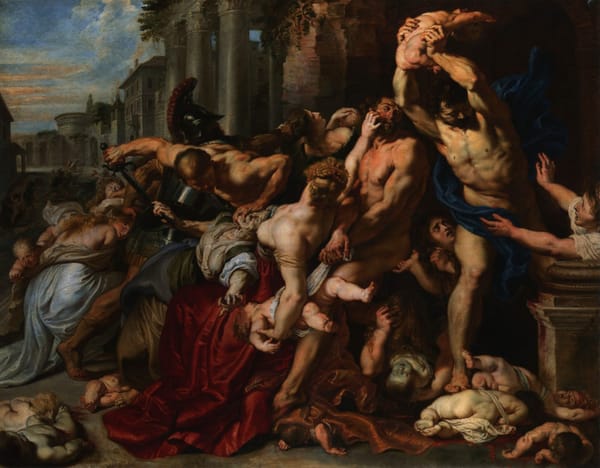
WE finish to-day the Octave consecrated to the memory of the Holy Innocents of Bethlehem. Thanks be to God, who has given them to us to be our intercessors and our models! Their name will not reappear on the Church’s Calendar until the return of the Christmas Solemnity; let us therefore devoutly approach these sweet Infant Saints—venerate them, love them, and address to them our farewell prayers.
The Holy Church, which on the Feast vested in the colour of mourning, and this out of condolence with Rachel’s grief, now on the Octave Day clothes herself in the red of her Martyrs, in order to honour these Babes who shed their Blood for Jesus. Notwithstanding, she is full of tender compassion for those poor Mothers, who suffered such agonies of grief at the sight of the murder of their little ones; she continually alludes to them in to-day’s Liturgy, and reads in the Office of Matins a passage from an ancient Sermon which vividly describes their feelings. We cannot withhold it from our readers. The Sermon from which it is taken was for a long time attributed to St Augustine.
'When our Lord was born, there began lamentation, not indeed in heaven, but on earth! Lamentation for the Mothers, joy for the Angels, heaven for the Babes. He that is born is God: a victim must be offered him, and Innocents must be that offering, for he came to condemn the malice of this world. Tender lambs must be slain, for the Lamb who is come to take away the sins of the world is to be crucified. But the Mothers wail because they lose their lambs, that scarce have voice to make their bleatings heard. O wonderful martyrdom! O sight most cruel! The sword is unsheathed, and there is no enemy; jealousy alone spurs on the band, for he that is born would injure no man.
‘There, then, sit the Mothers, weeping over their lambs. A voice in Rama is heard, lamentation and great mourning. These sweet pledges are not mere things intrusted to their care, they are the children of their own wombs; they are pledges, but they are not given, they are cruelly stolen from them. Nature herself is witness, it betrays the children of whom the tyrant is in search. The Mother tears her hair, for she has lost her beauty in losing her babe. Oh! how she sought to hide him, and the innocent one betrayed himself! He knew not how to be silent, for he had not yet learnt to fear. The Mother struggled with the executioner; he seized her child, resolved to murder him; she clung to him, resolved to hold him to her bosom. "Why," she exclaimed, "why separate me from my child? I gave him birth, and I fed him at my breast untiringly. I bore him in my arms with fondest care, and thy cruel hand has dashed him on the ground! This fresh and lovely fruit—thus trampled on!"
'A second Mother bade the executioner take away her life together with that of her child; he would not, and she cried out to him: “ Why dost thou send me away, having slain my son? If there were any fault, I only could be guilty: if there were no fault, let me die with my babe, and rid me of my wretched life.” A third exclaimed: "What is it that ye seek? Ye are in search of one, and ye slay so many! and him who is One ye cannot find!" And again another cried out: “Come, O come, thou Saviour of the world! How long shalt thou be sought for? Thou fearest no man: let these soldiers see thee, and so not slay our children.” These were the lamentations of the Mothers; and the immolation of their Babes ascended as a sacrifice to heaven.’
Among these Children thus cruelly massacred, from the age of two years and under, there were some belonging to those Shepherds of Bethlehem who had been called on the Night of our Saviour's Birth to go and adore him in his Crib. These, after Mary and Joseph the first worshippers of the Incarnate Word, thus offered to the God who had called them the most precious treasure they possessed. They knew to what Child their children were sacrificed, and a holy pride filled their souls as they thought of this new proof of God's singular mercy to them in preference to so many others of their fellowcreatures.
As to Herod, he was foiled in his schemes, as must ever be the case with those who wage war against Christ and his Church. His edict for the murder of every male child that was two years old or younger, included Bethlehem and its entire neighbourhood; but the Child he alone cared for, and wished to destroy, escaped the sword and fled into Egypt. It was another proof of the world's folly in opposing the designs of God; and, in this instance, the very measure that was intended to effect evil produced good: the tyrant enriched the Church of heaven with Saints, and the Church militant with so many fresh patrons.
Jesus, the new-born King of the Jews,1 who causes Herod to tremble on his throne, is but a Little Child, without so much as one single soldier to defend him. Herod, like all the persecutors of the Church, has an instinctive knowledge which teaches him that this apparent weakness is real and formidable power: what neither he nor his successors knew was that it is worse than useless, and worse than folly, to attempt to crush a spiritual power by the sword. This apparent weakness of the Babe of Bethlehem will increase with his years; now he flees from the tyrant who seeks his life; but later on, when he has grown into Manhood, he will not escape from his enemies; they will fasten him to an infamous gibbet, between two Thieves: but on that very day a Roman Governor will declare this Jesus to be King; he will write with his own hand the inscription to be nailed on the Cross: Jesus of Nazareth, King of the Jews. Pilate will give Jesus with all possible formality that very Title which now makes Herod turn pale: the enemies of Jesus will protest, they will insist on the Title being altered; but Pilate will not change an iota, and will say: What I have written, I have written.2 As on the day of his Crucifixion he will admit one of the two Thieves to share in his triumph; so now that he is laid in the Crib, he will share his glory with the Innocents of Bethlehem.
The Mass is given above, p. 281. The Gloria in excelsis is said, the other prayers are given on pp. 415-417.
Let us once more honour these dear Innocents, by culling their praises from the various Liturgies. We will begin with three Responsories from the Roman Breviary.
Responsories
The two Collects which follow are from the Leonine Sacramentary.
Prayer
Prayer
We take the following beautiful prayer from the Mozarabic Breviary of the Gothic Liturgy of Spain.
Capitula
The Missal of the same Church gives us also this prayer.
Prayer
Prudentius, the Poet of the Mysteries and the Martyrs, from whom the Church has taken her beautiful stanzas for the Feast of the Holy Innocents, Salvete, Flores Martyrum, celebrates the immolation of these lovely Babes of Bethlehem in his exquisite Hymn for the Epiphany. It is to this Hymn that the Roman Liturgy has had recourse for several great Feasts; and we now extract from it the strophes which refer to our dear Innocents.
Hymn
Adesse regum Principem,
Qui nomen Israel regat,
Teneatque David regiam.
Successor instat, pellimur:
Satelles, i, ferrum rape,
Perfunde cunas sanguine.
Scrutare nutricum sinus;
Interque materna ubera
Ensem cruentet pusio.
Puerperarum est omnium
Fraus, ne qua furtim subtrahat
Prolem virilis indolis.
Mucrone districto furens,
Effusa nuper corpora,
Animasque rimatur novas.
Vix interemptor invenit,
Quod plaga descendat patens,
Juguloque major pugio est.
Illisa cervix cautibus
Spargit cerebrum lacteum,
Oculosque per vulnus vomit.
Mersatur infans gurgitem,
Cui subter arctis faucibus
Singultat unda, et halitus.
Quos lucis ipso in limine
Christi insecutor sustulit,
Ceu turbo nascentes rosas.
Grex immolatorum tener,
Aram sub ipsam simplices
Palma et coronis luditis.
Quid crimen Herodem juvat?
Unus tot inter funera
Impune Christus tollitur.
Fluenta, solus integer,
Ferrum, quod orbabat nurus,
Partus fefellitVirginis.
Edicta quondam fugerat,
Christi figuram præferens,
Moses, receptor civium.
that the King of kings is come,
who is to rule over the Jews,
and sit on the throne of David.
and says to him: ‘Our rival is at hand—we are in danger:
go, slave, arm thee with thy sword,
and bathe every cradle with blood.
and every nurse be watched,
and every Babe feel thy sharp-edged blade,
even whilst he sucks his mother's breast.
but I suspect her;
then watch them all,
lest they hide their boys from thee.'
and in his wild cruelty plunges
his naked dagger into the tender flesh
and the but freshly formed hearts of these little ones.
where find space enough to hold
a gaping wound in these infant-bodies
not so big as the dagger in his hand?
Here it is an infant dashed against a rock,
covering its flinty sides, oh! cruel sight!
with blood and brains and eyes.
and thrown into a deep stream,
whose gurgling waters weep
whilst drowning sobs and life so sweet as these.
The enemy of Christ cut you down
in the very threshold of life,
as rose-buds are snapped by a storm.
Tender flock of his Martyrs!
ye, with sweet simplicity, play with palms and your crowns
even at the very altar of your sacrifice!
Does it give him what he sought?
The single One he cared to kill is Jesus,
and he still lives!
and he alone is safe:
the Virgin’s Child has escaped that sword
which robbed all other Mothers of their babes.
the liberator of his people,
and the type of Christ,
escaped the senseless edicts of the wicked Pharaoh.
We will close our selection by this Sequence of Notker, which is given in the collection of St Gall.
Sequence
Sweet Flowers of the Martyrs! your Feast is over in our Church on earth, but your patronage will never leave us. During this new year of the holy Liturgy, which God has given us, you will watch over us, and pray for us to the Lamb, who loves you so tenderly. We entrust to you the fruits of grace which our souls have gathered from the Christmas Feasts. We have become little children together with our Lord; we have begun a new life with him; pray for us, that we may grow with him in wisdom and age before God and man.1 Secure us perseverance by your prayers; and to this end, keep up in our hearts that Christian simplicity which is the special virtue of Children of Christ. You are innocent; we are sinners; still, we are brethren; love us, then, with brotherly love. You were garnered into heaven at the very dawn of the Law of Grace; our lives have fallen on the close of time, and the world has grown cold in charity; be near and help us; cheer and encourage us in our combat, by showing us your lovely palms of victory; pray to our Lord, that we may speedily obtain by repentance the heavenly crown which his infinite mercy allowed you to win, without the fatigues and risks of a battle.
Infant Martyrs! forget not the young generation, which has just entered on the scene of life. You were taken to eternal glory at the age of infancy; these little ones are like you in their innocence; love them, watch over them, pray for them. The grace of their Baptism is upon them in all its freshness, and their pure souls reflect as a mirror the holiness of the God that dwells in them by grace. Alas! these Babes are to go through great trials; many of them will forfeit the grace of God, and their Baptismal garment will lose its unspotted purity. The world will seek to corrupt their heart and mind, and the frightful influence of bad example is almost always successful. Christian mothers will have to weep over the ruin of their children’s souls, and what consolation is there for such a grief as theirs? There is a Christian Rama and a Christian Rachel ever wailing in the Church: do you, sweet Innocents of Bethlehem, comfort these mothers, by praying for their little ones. Pray that our times may grow less evil, and that parents may have less need to fear than they now have that the first step taken by their children in the world will be death to their souls.
| Previous January 3: The Octave of St. John, Apostle and Evangelist | Next January 5: The Vigil of the Epiphany, with a Commemoration of St. Telesphorus, Pope and Martyr |