Daily reading
Semidouble · January 7 · Temporal
January 7: The Second Day within the Octave of the Epiphany
From Dom Guéranger’s The Liturgical Year.
Day within the Octave of the Epiphany, Semidouble.Rubric
A SOLEMNITY of such importance as the Epiphany could not be without an Octave. The only Octaves during the year that are superior to this of the Epiphany, are those of Easter and Pentecost. It has a privilege which the Octave of Christmas has not; for no Feast can be kept during the Octave of the Epiphany, unless it be that of a principal Patron; whereas Feasts of double and semi-double rite are admitted during the Christmas Octave. It would even seem, judging from the ancient Sacramentaries, that anciently the two days immediately following the Epiphany were Days of Obligation, as were the Monday and Tuesday of Easter and Whitsuntide. The names of the Stational Churches are given, where the Clergy and Faithful of Rome assembled on these two days.
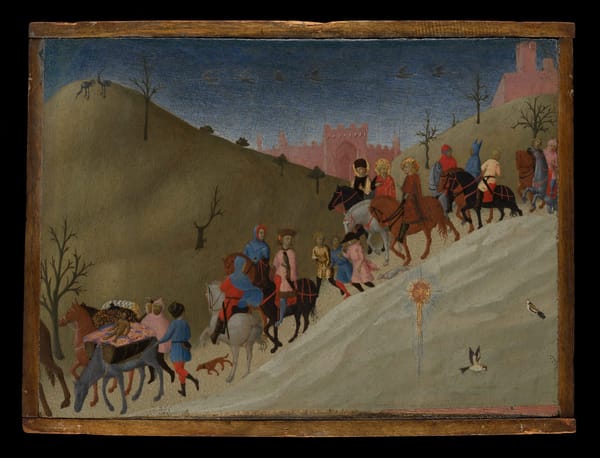
In order that we may the more fully enter into the spirit of the Church during this glorious Octave, we will contemplate, each day, the Mystery of the Vocation of the Magi, and we will enter, together with them, into the holy Cave of Bethlehem, there to offer our gifts to the Divine Infant, to whom the star has led the Wise Men.
These Magi are the harbingers of the conversion of all nations to the Lord their God; they are the Fathers of the Gentiles in the faith of the Redeemer that is come; they are the Patriarchs of the human race regenerated. They arrive at Bethlehem, according to the tradition of the Church, three in number; and this tradition is handed down by St Leo, by St Maximus of Turin, by St Cesarius of Arles, and by the Christian paintings in the Catacombs of Rome, which paintings belong to the period of the Persecutions.
Thus is continued in the Magi the Mystery prefigured by the three just men at the very commencement of the world: Abel, who, by his death, was the figure of Christ; Seth, who was the father of the children of God, as distinct from the family of Cain; and Enos, who had the honour of regulating the ceremonies and solemnity to be observed in man's worship of his Creator.
The Magi also continued, in their own person, that other Mystery of the three new parents of the human family, after the Deluge, and from whom all races have sprung: Sem, Cham, and Japheth, the Sons of Noe.
And, thirdly, we behold in the Magi that third Mystery of the three fathers of God's chosen people: Abraham, the Father of believers; Isaac, another figure of Christ immolated; and Jacob, who was strong against God,1 and was the father of the twelve Patriarchs of Israel.
All these were but the receivers of the Promise, although the hope of mankind, both according to nature and grace, rested on them; they, as the Apostle says of them, saluted the accomplishment of that Promise afar off.2 The nations did not follow them, by serving the true God; nay, the greater the light that shone on Israel, the greater seemed the blindness of the Gentile world. The three Magi, on the contrary, come to Bethlehem, and they are followed by countless generations. In them the figure becomes the grand reality, thanks to the mercy of our Lord, who having come to find what was lost, vouchsafed to stretch out his arms to the whole human race, for the whole was lost.
These happy Magi were also invested with regal power, as we shall see further on; as such, they were prefigured by those three faithful Kings who were the glory of the throne of Juda, the earnest maintainers among the chosen people of the traditions regarding the future Deliverer, and the strenuous opponents of idolatry: David, the sublime type of the Messias; Ezechias, whose courageous zeal destroyed the idols; and Josias, who reestablished the Law of the Lord, which the people had forgotten.
And if we would have another type of these holy pilgrims, who come from a far distant country of the Gentiles to adore the King of Peace, and offer him their rich presents, the sacred Scripture puts before us the Queen of Saba, also a Gentile, who hearing of the fame of the wisdom of Solomon, whose name means the Peaceful, visits Jerusalem, taking with her the most magnificent gifts—camels laden with gold, spices, and precious stones—and venerates, under one of the sublimest of his types, the kingly character of the Messias.
Thus, O Jesus! during the long and dark night, in which the justice of thy Father left this sinful world, did the gleams of grace appear in the heavens, portending the rising of that Sun of thine own Justice, which would dissipate the shadows of death, and establish the reign of Light and Day. But now all these shadows have passed away; we no longer need the imperfect light of types: it is thyself we now possess; and though we wear not royal crowns upon our heads, like the Magi and the Queen of Saba, yet thou receivest us with love. The very first to be invited to thy Crib, there to receive thy teachings, were simple Shepherds. Every member of the human family is called to form part of thy court. Having become a Child, thou hast opened the treasures of thine infinite wisdom to all men. What gratitude do we not owe for this gift of the light of Faith, without which we should know nothing, even whilst flattering ourselves that we know all things! How narrow and uncertain and deceitful is human science, compared with that which has its source in thee! May we ever prize this immense gift of Faith, this Light, O Jesus! which thou makest to shine upon us, after having softened it under the veil of thy humble Infancy. Preserve us from pride, which darkens the soul’s vision and dries up the heart. Confide us to the keeping of thy Blessed Mother; and may our love attach us for ever to thee, and her maternal eye ever watch over us lest we should leave thee, O thou the God of our hearts!
Let us now listen to the Hymns and Prayers of the several Churches in praise of the Mysteries of the glorious Epiphany. We will begin with this of Prudentius, in which he celebrates that never-setting Star, of which the other was but a figure.
Hymn
Oculos in altum tollite:
Illic licebit visere
Signum perennis gloriæ.
Hæc stella, quæ solis rotam
Vincit decore ac lumine,
Venisse terris nuntiat
Cum carne terrestri Deum.
Non illa servit noctibus,
Secuta lunam menstruam:
Sed solam cœlum possidens
Cursum dierum temperat.
Arctoa quamvis sidera
In se retortis motibus
Obire nolint; attamen
Plerumque sub nimbis latent.
Hoc sidus æternum manet:
Hæc stella numquam mergitur:
Nec nubis occursu abdita
Obumbrat obductam facem.
Tristis cometa intercidat,
Et si quod astrum
Sirio Fervet vapore, jam
Dei Sub luce destructum cadet.
raise up your eyes aloft:
there shall you see
the sign of his eternal glory.
This Star, which surpasseth
the sun’s disc in beauty and light,
announces that God has come
upon the earth clothed in human flesh.
It is not a Star that is made to serve the night,
following the monthly changes of the moon;
but it seems to preside over the heavens
and mark the course of the day.
’Tis true, that Polar Stars
are lights that never set;
yet are they often hid
beneath the clouds.
But this Star is never dimmed;
this Star is never extinguished;
nor does a coming cloud
o'ershadow her blaze of light.
Let comet, the harbinger of ill,
and meteors formed by Dogstar’s vaporous heat,
now fade away
before this God’s own light.
We take the three following solemn Prayers from the Gregorian Sacramentary.
Prayers
Omnipotens et sempiterne Deus, fidelium splendor animarum, qui hanc solemnitatem electionis gentium primitiis consecrasti; imple mundum gloria tua, et subditis tibi populis per luminis tui appare claritatem.
Concede nobis, omnipotens Deus, ut Salutare tuum nova cœlorum luce mirabile, quod ad salutem mundi hodierna festivitate processit, nostris semper innovandis cordibus oriatur. Per Christum Dominum nostrum. Amen.
Almighty and eternal God, the light of faithful souls, who hast consecrated this solemnity by the first-fruits of the vocation of the Gentiles; fill this world with thy glory, and manifest thyself to thy devoted people by the brightness of thy light.
Grant unto us, O Almighty God, that the Saviour sent by thee, who was made known by a new light in the heavens, and comes down for the salvation of the world on this day’s solemnity, may arise in our hearts and give them a perpetual renovation. Through Christ our Lord. Amen.
The following Sequence is found in the ancient Roman-French Missals.
Sequence
Qua prolem Dei vere Magi adorant:
Immensam Chaldæi cujus Persæque venerantur potentiam.
Quem cuncti Prophetæ cecinere venturum, gentes ad salvandas:
Cujus Majestas ita est inclinata, ut assumeret servi formam.
Ante sæcula qui Deus, et tempora, homo factus est in Maria:
Balaam de quo vaticinans: Exhibit et Jacob rutilans, inquit, stella,
Et confringet ducum agmina regionis Moab, maxima potentia.
Huic Magi munera deferunt præclara: aurum, simul thus et myrrham.
Thure Deum prsedicant, auro Regem magnum, hominem mortalem myrrha.
In somnis hos monet Angelus, ne redeant ad regem commotum propter regna;
Pavebat etenim nimium Regem natum, verens amittere regni jura.
Magi, stella sibi micante prævia, pergunt alacres itinera, patriam quæ eos ducebat ad propriam, liquentes Herodis mandata.
Qui percussus corde nimium præ ira, extemplo mandat eludia magica non linqui taliter impunita, sed mox privari eos vita.
Omnis nunc caterva tinnulum jungat laudibus organi pneuma,
Mystice offerens Regi regum Christo munera, pretiosa,
Poscens ut per orbem regna omnia protegat in sæcula sempiterna. Amen.
Wherein the Magi adore the true Son of God.
The Chaldeans and Persians offer homage to his infinite power.
All the Prophets had foretold that he would come to save the nations.
His Majesty so far humbled itself, as to assume the form of a servant.
He that was God before all ages and time, was made Man in Mary's womb.
Balaam thus prophesied concerning him: There shall go forth a bright star from Jacob,
And with exceeding power he shall break the armies of the chiefs of Moab.
The Magi bring him rich presents, gold, and frankincense, and myrrh.
By the frankincense they confess him to be God; by the gold, the great King; by the myrrh, a mortal Man.
An Angel warns them in their sleep, that they return not to King Herod, who feared to lose his kingdom.
For he was exceedingly troubled at the birth of the new King, and trembled lest he should be deprived of his throne.
The Magi, guided by a Star that went before them, set out on their journey with joy. The Star guided them to their own country, and Herod's commands were not heeded.
This prince, struck to the heart with exceeding wrath, straightway commands that the disobedience of the Magi be chastised, and that they be speedily put to death.
Now, therefore, let this assembly sing its songs of praise accompanied by the organ's shrill sounding notes.
And offer to Christ, the King of kings, its precious mystic gifts,
Beseeching him that he protect all the kingdoms of the universe for ever and ever. Amen.
St Ephrem gives us the following beautiful Hymn upon the Nativity of our Lord.
Hymn
The Greek Church gives us, in honour of the Virgin-Mother, this beautiful song of Saint Joseph the Hymnographer.
Virgo casta post partum permansisti, O sanctissima: Deum enim Verbum genuisti similem nobis factum sine peccato.
Sana vulnera cordis mei, o puella, et motus animæ meæ recta ac felici tramite dirige, o Virgo, ad Dei voluntatem faciendam.
Salve, o unica Genitrix illius qui carnem emendicavit. Salve collapsi mundi erectio, o immaculatissima: salve, mœroris dissolutio; salve, salus fidelium; salve, throne Dei altissime.
Mente revolventes divineloqui Prophetæ mysterii tui profunditatem, o Virgo, prophetice prænunciaverunt illud divino Spiritu illustrati. Nos vero cum illorum vaticinia opere completa nunc læti intueamur, credimus.
O Puella omnibus miraculis admirabilior; illum genuisti qui est ante omnia sæcula, nobis similem factum propter summam misericordiam suam, ut salvos faceret eos qui canunt: Benedictus es Deus Patrum nostrorum.
Divinis verbis tuis hominum generationes inhærentes, beatam te dicunt, o semper beatissima, suaviter concinentes: Benedicite omnia opera Dominum.
O Virgo bonorum amatrix, bonam effice animam meam, peccati malitia depravatam: tu enim bonum Deum ac Dominum peperisti.
Horrescunt Cherubim atque universa cœlestis natura ob reverentiam venerandæ Prolis tuæ incomprehensibilis, o immaculatissima, quæ similis facta est nobis propterineffabilem misericordiam suam, et secundum carnem baptizata est, cujus divinam Apparitionem nunc omnes exsultantes celebramus.
Thou, O most holy Mary! didst remain a pure Virgin after thy delivery; for thou didst give birth to God the Word, made like unto us in all save sin.
Heal the wounds of my heart, O Virgin! and direct the movements of my soul in a bright and happy path, so that I may fulfil God’s will.
Hail, incomparable Mother of Him who deigned to take our flesh! Hail. O most Immaculate Mary, that didst bring the fallen world its resurrection! Hail, thou dispeller of sorrow! Hail, thou that givest the faithful their Saviour! Hail, most high throne of God!
The divinely-speaking Prophets, revolving in their minds the depth of thy mystery, O Virgin! prophetically foretold it, for they were enlightened by the divine Spirit. We that now joyfully behold their prophecies fulfilled, we believe.
O Virgin! thou that art more admirable than all miracles! thou didst give birth to Him who was before all ages, and who was made like unto us through his great mercy, for he came that he might save them that sing: Blessed art thou, the God of our Fathers!
All generations of men, keeping to thy most sacred words, call thee Blessed, O most Blessed Mother! and sweetly sing in choral hymns: All ye works of the Lord, bless the Lord!
O Virgin, that lovest holy souls! make mine holy, for it is depraved by the evil of sin: make it good, for thou hast given birth to the good God and Lord,
The Cherubim and the whole heavenly kingdom tremble in reverence before the incomprehensible majesty of thy Son, O most Immaculate Mother! He was made like unto us, through his ineffable mercy, and was baptized according to the flesh: and now do we all exultingly celebrate his divine Apparition.
| Previous January 6: The Epiphany of Our Lord | Next January 8: The Third Day within the Octave of the Epiphany |