Daily reading
Semidouble · January 9 · Temporal
January 9: The Fourth Day within the Octave of the Epiphany
From Dom Guéranger’s The Liturgical Year.
Day within the Octave of the Epiphany, Semidouble.Rubric
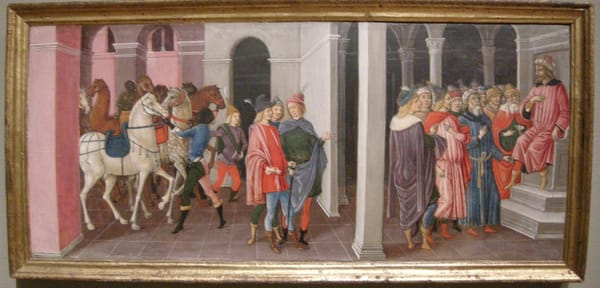
THE star foretold by Balaam having risen in the East, the three Magi, whose hearts were full of the expectation of the promised Redeemer, are immediately inflamed with the desire of going in search of him. The announcement of the glad coming of the King of the Jews is made to these holy Kings in a mysterious and silent manner; and hereby it differs from that made to the Shepherds of Bethlehem, who were invited to Jesus’s Crib by the voice of an Angel. But the mute language of the star was explained to them by God himself, for he revealed his Son to them; and this made their Vocation superior in dignity to that of the Jewish Shepherds, who, according to the dispensation of the Old Law, could know nothing save by the ministry of Angels.
The divine grace which spoke, directly and by itself, to the souls of the Magi, met with a faithful and unhesitating correspondence. St Luke says of the Shepherds, that they came with haste to Bethlehem;1 and the Magi show their simple and fervent eagerness by the words they addressed to Herod: We have seen his star in the East, they say, and we are come to adore him.2
When Abraham received the command from God to go out of the land of Chaldea, which was the land of his fathers and kindred, and go into a strange country, he obeyed with such faithful promptitude as to merit being made the Father of all them that believe.3 so, likewise, the Magi, by reason of their equally docile and admirable faith, have been judged worthy to be called the Fathers of the Gentile Church.
They too, or at least one or more of them, went out from Chaldea, if we are to believe St Justin and Tertullian. Several of the Fathers, among whom are the two just mentioned, assert that one, if not two, of these holy Kings was from Arabia. A popular tradition, now for centuries admitted into Christian Art, tells us that one of the three was from Ethiopia; and certainly, as regards this last opinion, we have David and other Prophets telling us that the coloured inhabitants of the banks of the Nile were to be objects of God's special mercy.
The term Magi implies that they gave themselves to the study of the heavenly bodies, and that, too, for the special intention of finding that glorious star whose rising had been prophesied. They were of the number of those Gentiles who, like the centurion Cornelius, feared God, had not been defiled by the worship of idols, and maintained, in spite of all the ignorance which surrounded them, the sacred traditions of the religion that was practised by Abraham and the Patriarchs.
The Gospel does not say that they were Kings, but the Church applies to them those verses of the Psalm, where David speaks of the Kings of Arabia and Saba, that should hereafter come to the Messias bringing their offerings of gold. The tradition of their being Kings rests on the testimony of St Hilary of Poitiers, of St Jerome, of the poet Juvencus, of St Leo, and several others; and it would be impossible to controvert it by any well-grounded arguments. Of course, we are not to suppose them to have been Monarchs, whose kingdoms were as great as those of the Roman Empire; but we know that the Scripture frequently applies this name of King to petty princes, and even to mere governors of provinces. The Magi, therefore, would be called Kings if they exercised authority over a considerable number of people; and that they were persons of great importance, we have a strong proof in the consideration and attention showed them by Herod, into whose palace they enter, telling him that they are come to pay their homage to the new-born King of the Jews. The city of Jerusalem is thrown into a state of excitement by their arrival, which would scarce have occurred had not the three strangers, who came for a purpose which few heeded, been attended by a numerous retinue, or had they not attracted attention by their imposing appearance.
These Kings, then, docile to the divine inspiration, suddenly leave their country, their riches, their quiet, in order to follow a star: the power of that God, who had called them, unites them in the same path, as they were already one in faith. The star goes on before them, marking out the route they were to follow: the dangers of such a journey, the fatigues of a pilgrimage which might last for weeks or months, the fear of awakening suspicions in the Roman Empire towards which they were evidently tending—all this was nothing to them; they were told to go, and they went.
Their first stay is at Jerusalem, for the star halts there. They, Gentiles, come into this Holy City, which is soon to have God's curse upon it, and they come to announce that Jesus Christ is come! With all the simple courage and all the calm conviction of Apostles and Martyrs, they declare their firm resolution of going to him and adoring him. Their earnest inquiries constrain Israel, who was the guardian of the divine prophecies, to confess one of the chief marks of the Messias—his Birth in Bethlehem. The Jewish Priesthood fulfils, though with a sinful ignorance, its sacred ministry, and Herod sits restlessly on his throne, plotting murder. The Magi leave the faithless City, which has turned the presence of the Magi into a mark of its own reprobation. The Star reappears in the heavens, and invites them to resume their journey. Yet a few hours, and they will be at Bethlehem, at the feet of the King of whom they are in search.
O dear Jesus! we also are following thee; we are walking in thy light, for thou hast said, in the Prophecy of thy beloved Disciple: I am the bright and morning Star.4 The meteor that guides the Magi is but thy symbol, O divine Star! Thou art the morning Star; for thy Birth proclaims that the darkness of error and sin is at an end. Thou art the morning Star; for, after submitting to death and the tomb, thou wilt suddenly arise from that night of humiliation to the bright morning of thy glorious Resurrection. Thou art the morning Star; for by thy Birth and the Mysteries which are to follow, thou announcest unto us the cloudless day of eternity. May thy light ever beam upon us! May we, like the Magi, be obedient to its guidance, and ready to leave all things in order to follow it! We were sitting in darkness when thou didst call us to thy grace, by making this thy light shine upon us. We were fond of our darkness, and thou gavest us a love for the Light! Dear Jesus! keep up this love within us. Let not sin, which is darkness, ever approach us. Preserve us from the delusion of a false conscience. Avert from us that blindness into which fell the City of Jerusalem and her king, and which prevented them from seeing the Star. May thy Star guide us through life, and bring us to thee, our King, our Peace, our Love!
We salute thee, too, O Mary, thou Star of the Sea that shinest on the waters of this life, giving calm and protection to thy tempest-tossed children who invoke thee! Thou didst pray for the Magi as they traversed the desert; guide also our steps, and bring us to Him who is thy Child and thy Light eternal.
Let us close this day with the expressions of divine praise offered us by the ancient Liturgies. Let us begin with the continuation of the Hymn of Prudentius, on the vocation of the Gentiles. The following are the concluding stanzas.
Hymn
Major Bethlem: cui contigit
Ducem salutis cœlitus
Incorporatum gignere.
Altrice te, summo Patri
Hæres creatur unicus.
Homo ex Tonantis Spiritu,
Idemque sub membris Deus.
Hunc et Prophetis testibus,
Iisdemque signatoribus,
Testator et Sator jubet
Adire regnum, et cernere.
Regnum, quod ambit omnia,
Dia, et marina, et terrea,
A solis ortu ad exitum,
Et tartara, et cœlum supra.
Hic Rex priorum judicum,
Rexere qui Jacob genus,
Dominæque Rex ecclesiæ,
Templi et novelli et pristini.
Hunc posteri Ephraim colunt,
Hunc sancta Manasse domus,
Omnesque suscipiunt tribus,
Bissena fratrum semina.
Quin et propago degener,
Ritum secuta inconditum,
Quæcumque dirum fervidis
Baal caminis coxerat:
Fumosa avorum numina,
Saxum, metallum, stipitem,
Rasum, dolatum, sectile,
In Christi honorem deserit.
Gaudete quidquid gentium est,
Judæa, Roma et Græcia,
Ægypte, Thrax, Persa, Scytha,
Rex unus omnes possidet.
Laudate vestrum Principem,
Omnes beati ac perditi,
Vivi, imbecilli, ac mortui:
Jam nemo posthac mortuus.
'Twas thy happy lot to give birth
to the Prince of our salvation,
who had become incarnate by the heavenly mystery.
'Twas thou didst nurse him who is the Only-Begotten Son
and Heir of the eternal Father;
he was made Man by the power of the Spirit of the God who darts the thunderbolts;
and this same Jesus is God under human flesh.
His eternal Father, who bears witness to him,
bids him enter on his kingdom and inherit it.
The Prophets, who are his witnesses and vouchers,
were the proclaimers of the Father’s will.
This kingdom of Jesus includes all things
—the firmament, the sea, the earth
from where the sun rises to where he sets,
and hell and heaven.
He is the King of those ancient judges
who ruled the race of Jacob:
he is the King of the Church, the Mistress of the earth:
he is King of both temples, the new and old.
The children of Ephraim
and the holy family of Manasses worship him;
the tribes of the twelve Brethren,
sons of Jacob, also receive him as their God.
The degenerate race too,
which, observing the rites of idolatrous worship,
had framed in hot furnaces
the statue of the cruel Baal,
Now turns to worship Christ,
leaving for his sake the smokegrimed gods of their fathers,
stones and metals and stocks,
planed, hewn and chiselled by the hands of man.
Rejoice, all ye nations of the earth!
Judea, Rome and Greece,
Egypt, Thrace, Persia, Scythia!
Ye are now all under the one same King!
Praise your King,
O all ye people! just and sinners,
living, weak and dead, give him praise.
None must die henceforth!
The following beautiful prayer from the Mozarabic Missal will assist us to celebrate in a becoming manner the triple Mystery of the Epiphany.
Oratio
The ancient Paris Missal of 1584 contains the following Sequence for one of the days during this Octave. It is full of unction.
Sequence
Quæramus summopere
Regem regum omnium.
Quæramus humiliter,
Non panditur aliter
Cordibus quærentium.
Jacet in præsepio.
Spreto regum solio,
Degens in penuria.
Formam dans quærentibus,
Calcatis terrestribus,
Amare cœlestia.
Herode postposito,
Magos cultu debito
Sequamur celeriter.
Stella duce cursitant
Ad Regem quem prædicant
Regnare perenniter.
Offeramus typice,
Quod illi magnifice
Tulerunt realiter.
Thus superno Numini,
Myrrham vero homini,
Aurum Regi pariter.
His donis, o lilium,
Placa nobis Filium
Repletum dulcedine.
Ut possimus libere
Secum semper vivere
Paradisi culmine.
let us most earnestly seek
the King of kings.
Let us seek him in humility,
for it is to humble hearts alone
that he shows himself.
He lies in a crib,
for he scorns a regal couch,
and lives in poverty.
He thus teaches them that seek him
to despise the things of earth,
and love those of heaven.
Let us turn away from Herod,
and follow without delay, the Magi,
and pay our homage to Jesus.
They are led by the Star,
and hasten to the King, whom they proclaim
as the everlasting Ruler.
Let us mystically offer the gifts,
which they really offered him
so magnificently:
Let us offer Incense to Jesus, as our God;
our Myrrh to him, as Man;
our Gold to him, as King.
Do thou, O Mary, pure Lily!
pray for us to thy Son, who is full of sweetness,
that these our gifts may render him propitious;
That so, being freed from this world,
we may live with him for ever
in the heavenly land above.
We here insert a few stanzas from the exquisite Hymn composed by St Ephrem for the Syrian Church.
Hymn
In sublimi habitat Pater tuus, tua Mater humi jacet; undenam tui notitiam quis capiat? Si quis terrenus homo tuam disquirat naturam ab humanis remotam sensibus, hæc supereminet cœlo in magnum divinitatis retrusa sinum.
Si rursus quispiam corpus cognoscere cupiat oculi expositum, en humi jacet, teque ab angusto Mariæ gremio præbet aspectabilem. Errat incertus animus, neque sibi constat mens tuas, o dives, rationes supputans.
Congeminatis seris clauditur tua divinitas; pelagus es tamen immensum, cedo, qui ejus fundum attingat, etiam postquam magnitudinem tuam ad nostram parvitatem deduxisti. Cum tuum conspectum petimus, hominem videmus, visuros nos Deum sperantes; si hominem videre velimus, inde statim in oculos incurrit hebetatque aciem coruscans divinitatis splendor.
Jam quis credat hæredem te esse Davidici throni, cui ex lauta ejus supellectile præsepe duntaxat relictum est, et ex amplissimis ædibus, spelunca, deque ejus equitatu vix vilem asellum cernere aliquando continget?
Attamen quam benignus es, puer, qui te omnibus indulges, et obviis quibusque arrides! talis nempe tuus amor est, qualem credibile est futurum fuisse ejus, quihomines desideraret, ut panem quilibet esuriens.
Quidistuc quod te movet, ut ad omnes descendas, ad locupletes ac tenues, et ad eos accurras etiam non vocatus? Unde tibi istud inditum, ut homines tantopere cupias?
Quæ hæc tua caritas est, ut si quis te objurgat, non succenseas, si minis terret, non trepides, si duriter tecum agit, frontem non contrahas? Tua nimirum caritas antecellit legem illorum, qui suas persequebantur injurias et vindicabant.
Thy Father dwells in the high heavens; thy Mother stands on the lowly earth; who can understand thee? If the earthly man investigate thy nature, which surpasses the ken of mortals, it is found in the highest heavens, hid in the vast bosom of the divinity.
If, again, one wish to see thy Body made visible to the eye of man, lo! it lies upon the earth: it has issued from the narrow womb of Mary, and all may see it. The soul knows not what to think, and the mind grows bewildered in the calculation of thy ways, O Jesus! rich Lord and God!
Thy divinity is shut beneath a twofold barrier; yet art thou, and I confess it, an immeasurable ocean to him who attempts to fathom thee, even now that thou hast humbled thy greatness to our littleness. When we seek for a sight of thee, we see thee a Man, having hoped to see thee as the great God: and when we wish to look upon thee as Man, then straightway is our eye struck and dazzled by the bright splendour of thy Divinity.
And who would think thee to be the Heir of David’s throne? Instead of costly furniture, thou hast but a Crib: instead of the regal palaces, thou hast but a Cave: instead of the richly caparisoned steeds, there stands near thee one poor ass.
Yet, dear Babe, how lovely art thou! accessible to all, and meeting with thy smile all who come to thee! Thy love is verily the love of one who longeth after men, as a hungry man that longeth after bread.
What is it that induces thee to stoop thus towards all, rich and poor, and run even to them that ask thee not to come? Whence hast thou this inclination to love us men so much?
What charity is this, that if a man insult thee, thou art not indignant? or if he threaten thee, thou fearest not to go to him? or if he treat thee with cruelty, there is not a wrinkle on thy brow? Ah! thy charity is of another sort from theirs who persecute them that do them wrong and who seek revenge upon their enemies.
Let us honour the Virgin-Mother by addressing to her these stanzas of a Hymn composed by St Joseph the Hymnographer. It is in the Menæa of the Greek Church.
Die IV Januarii
Casta ante partum, in partu, et post partum, vere, o Virgo mater, apparuisti: Deum enim peperisti, quem Apostolorum collegium manifeste prædicavit.
Beatissimus olim Prophetarum chorus sacris vaticiniis in Spiritu divinitus te, o castissima, Portam et Montem umbrosum nominavit.
Illumina, o Virgo, oculos cordis mei, effulge super me pœnitentiæ radio; a tenebris perennibus libera me; o Porta lucis, Refugium omnium christianorum te fideliter laudantium.
Laudo te, o sola digna omni laude; glorifico te, o semper a Deo glorificatissima; et beatifico te, o Virgo, divina beatitudine felicissima, quam generationes generationum beatam appellant.
Expiatorium facta es, o purissima, eorum qui assidue delinquunt, supra naturæ ordinem enixa Christum, qui tollit peccata mundi, ad quem clamamus; Dominus ac Deus patrum, benedictus es.
O miraculum, quod omnia miracula transcendit; quomodo paris et permanes virgo, o castissima sponsa Dei! nimirum Verbum Patri coæternum genuisti, cui omnes psallimus: Laudate omnia opera, et superexaltate Dominum in omnia sæcula.
Jubar fulgoris partus tui eflulsit, atque universum terrarum orbem lætissimo lumine perfudit, actenebrarum principem perdidit, o Dei Genitrix castissima, Angelorum gloriatio, atque omnium hominum salus, qui incessantibus vocibus te concelebrant.
Thou, O truly Virgin-Mother, wast pure before thy delivery, and in thy delivery, and after thy delivery; for thou didst give birth to that God whom the Apostolic College made known to the world by their preaching.
The most blessed choir of the Prophets of old, divinely inspired by the Spirit, did, in their sacred prophecies, call thee, O most chaste one, the Gate and the Mountain o’ershadowed.
Enlighten, O Virgin! the eyes of my heart, and send within me the bright ray of compunction; deliver me from eternal darkness; O thou Gate of Light, and Refuge of all Christians faithfully praising thee.
I praise thee, the creature alone worthy of all praise; I glorify thee, O thou that hast ever been glorified by God; and I bless thee, O Virgin, thou most happy in a divine blessedness, who art called Blessed by all generations.
O most pure one! thou hast been made the propitiatory of them that sin often, for thou didst miraculously bring forth Christ, who taketh away the sins of the world, and to whom we cry: Blessed art thou, O Lord and God of our fathers!
O miracle that surpasseth all miracles! How is it, O most chaste Spouse of God, that thou bearest a Child, yet remainest a Virgin? Thou hast given birth to the Word, coeternal with the Father, to whom we all thus sing: Praise him, all ye his works, and magnify the Lord above all for ever.
The bright splendour of thy delivery has shone forth, and has shed a most joyful light over the whole earth, and has destroyed the prince of darkness, O most chaste Mother of God, thou joy of the Angels, and protectress of all who honour thee with their unceasing praises.
| Previous January 8: The Third Day within the Octave of the Epiphany | Next Sunday within the Octave of the Epiphany (or, the Feast of the Holy Family) |