Daily reading
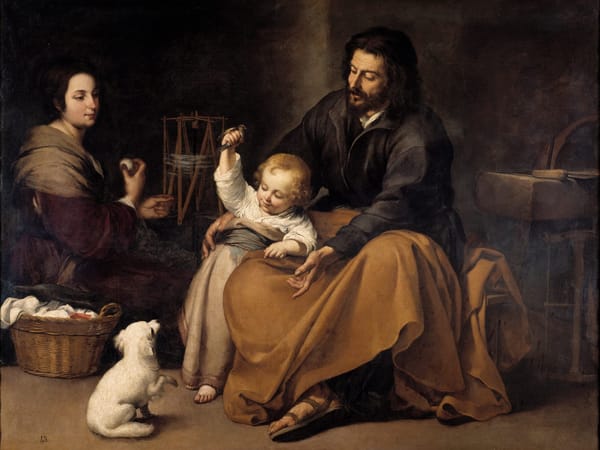
Sunday within the Octave of the Epiphany (or, the Feast of the Holy Family)
THIS Sunday has been chosen by the Church for the celebration of the Feast of the Holy Family; the liturgy of the day, as expressed in the Gospel, harmonizes well with the mystery of the new Feast, for it already carries us forward to the childhood of our Emmanuel and gives us those wonderful words which, after the example of his Blessed Mother, we must ever ponder within our hearts: ‘And he went down with them and came to Nazareth and was subject to them.’
The Feast of the Holy Family is of recent origin. In 1663 Barbara d'Hillehoust founded at Montreal the Association of the Holy Family; this devotion soon spread and in 1893 Leo XIII expressed his approval of a feast under this title and himself composed part of the Office. The Feast was welcomed by succeeding Pontiffs as an efficacious means for bringing home to the Christian people the example of the Holy Family at Nazareth, and by the restoration of the true spirit of family life, stemming, in some measure, the evils of present-day society. These motives led Benedict XV to insert the Feast in the universal Calendar, and from 1921 it has been fixed for this present Sunday.
Mass
The Introit recalls the joy that must have filled the cave of Bethlehem on that Christmas night; let us again rejoice with Mary and Joseph and sing the praises of the resting-place of the Lord of Hosts.
Introit
The Church prays in the Collect that the home life of every Christian family may be sanctified and perfected by the example of that of the Holy Family; this is her unceasing wish for her children.
Collect
Commemoration is made of the Sunday within the Octave:
Then of the Epiphany:
Epistle
Cap. III.Fratres, induite vos, sicut electi Dei, sancti, et dilecti, viscera misericordiæ, benignitatem, humilitatem, modestiam, patientiam, supportantes invicem, et donantes vobismetipsis, si quis adversus aliquem habet querelam: sicut et Dominus donavit vobis, ita et vos. Super omnia autem hæc, caritatem habete, quod est vinculum perfectionis: et pax Christi exsultet in cordibus vestris, in qua et vocati estis in uno corpore; et grati estote. Verbum Christi habitet in vobis abundanter, in omni sapientia, docentes, et commonentes vosmetipsos, psalmis, hymnis, et canticis spiritualibus, in gratia cantantes in cordibus vestris Deo. Omne quodcumque facitis, in verbo aut in opere, omnia in nomine Domini nostri Jesu Christi, gratias agentes Deo et Patri per Jesum Christum Dominum nostrum.
Ch. III.Brethren, put ye on therefore as the elect of God. holy, and beloved, the bowels of mercy, benignity, humility, modesty, patience; bearing with one another, and forgiving one another, if any have a complaint against another; even as the Lord hath forgiven you, so you also. But above all these things have charity, which is the bond of perfection; and let the peace of Christ rejoice in your hearts, wherein also you are called in one body; and be ye thankful. Let the word of Christ dwell in you abundantly in all wisdom, teaching and admonishing one another in psalms, hymns, and spiritual canticles, singing in grace in your hearts to God. All whatsoever you do in word, or in work, all things do ye in the name of the Lord Jesus Christ, giving thanks to God and the Father, through Jesus Christ our Lord.
If we would attain to charity, the bond of perfection which unites all Christians together in the one great family of God, we must pay heed to those virtues which the Epistle puts before us. We must be full of mercy, benignity, humility, modesty and patience; we must bear with one another and forgive one another, after the example of the Incarnate Word. Then the peace of Christ will dwell not only in our hearts, but in those around us, and our homes will truly become like that of Nazareth, where Mary and Joseph were ever singing in grace to the Lord God.
In the Gradual Holy Church again celebrates the praises of the House of the Lord; she proclaims the blessedness of those that obtain lasting fellowship in the heavenly home above; yet in the Alleluia verse she recalls the lowliness of the earthly home of our Emmanuel which made him truly a hidden King.
Gradual (Ps. xxiii)
Alleluia, alleluia. ℣. Isa. 45. Vere tu es Rex absconditus. Deus Isræl Salvator. Alleluia.
Alleluia, alleluia. ℣. Isa. 45. Verily thou art a hidden King, the God of Israel, the Saviour. Alleluia.
Gospel
Cap. II.Cum factus esset Jesus annorum duodecim, ascendentibus illis Jerosolymam secundum consuetudinem diei festi, consummatisque diebus, cum redirent, remansit puer Jesus in Jerusalem, et non cognoveruntparentes ejus. Existimantes autem ilium esse in comitatu, venerunt iter diei, et requirebant eum inter cognatos et notos. Et non invenientes, regressi sunt in Jerusalem, requirentes eum. Et factum est, post triduum invenerunt illum in tempio sedentem in medio doctorum, audientem illos, et interrogantem eos. Stupebant autem omnes, qui eum audiebant, super prudentia et responsis ejus. Et videntes admirati sunt. Et dixit mater ejus ad ilium: Fili, quid fecisti nobis sic? ecce pater tuus et ego dolentes quærebamus te. Et ait ad illos: Quid est quod me quærebatis? Nesciebatis quia in his quæ Patris mei sunt, oportet me esse? Et ipsi non intellexerunt verbum, quod locutus est ad eos. Et descendit cum eis, et venit Nazareth: et erat subditus illis. Et mater ejus conservabat omnia verba hæc in corde suo. Et Jesus proficiebat sapientià, et ætate, et gratia apud Deum et homines.
Ch. II.When Jesus was twelve years old, they went up to Jerusalem, according to the custom of the feast; and having fulfilled the days, when they returned, the Child Jesus remained in Jerusalem, and his parents knew it not. And thinking that he was in the company, they came a day’s journey, and sought him among their kinsfolk and acquaintance. And not finding him, they returned into Jerusalem, seeking him. And it came to pass, that after three days they found him in the temple, sitting in the midst of the doctors, hearing them, and asking them questions. And all that heard him were astonished at his wisdom and his answers. And seeing him, they wondered. And his Mother said to him: Son, why hast thou done so to us? Behold thy father and I have sought thee sorrowing. And he said to them: How is it that you sought me? Did you not know that I must be about my Father’s business? And they understood not the word that he spoke unto them. And he went down with them, and came to Nazareth, and was subject to them. And his Mother kept all these words in her heart. And Jesus advanced in wisdom, and age, and grace with God and men.
Thus, O Jesus! didst thou come down from heaven to teach us. The tender age of Childhood, which thou didst take upon thyself, is no hindrance to the ardour of thy desire that we should know the one only God, who made all things, and thee, his Son, whom he sent to us. When laid in the Crib, thou didst instruct the Shepherds by a mere look; when swathed in thy humble swaddling-clothes, and subjected to the voluntary silence thou hadst imposed on thyself, thou didst reveal to the Magi the light they sought in following the star. When twelve years old, thou explainest to the Doctors of Israel the Scriptures which bear testimony to thee. Thou gradually dispellest the shadows of the Law by thy presence and thy words. In order to fulfil the commands of thy heavenly Father, thou dost not hesitate to occasion sorrow to the heart of thy Mother, by thus going in quest of souls that need enlightening. Thy love of man will pierce that tender Heart of Mary with a still sharper sword, when she shall behold thee hanging on the Cross, and expiring in the midst of crudest pain. Blessed be thou, sweet Jesus, in these first Mysteries of thine Infancy, wherein thou already showest thyself devoted to us, and leavest the company of thy Blessed Mother for that of sinful men, who will one day conspire thy Death.
The Offertory takes us in thought to the Feast of the Purification; let us again offer ourselves to the Lord.
Offertory (Luke ii)
In the Secret the Church again prays that she may be strengthened in peace and grace; these gifts have been purchased for us by our Lord himself; it is through the Holy Mass that we can be more strongly established in them.
Secret
Commemoration of the Sunday
Commemoration of the Epiphany
The Preface is as on the Epiphany, p. 126.
The Communion recalls the subject of to-day's Gospel; let us never cease to meditate on the divine humility shown us in these words.
Communion (Luke ii)
If we have kept before our eyes the example of the holy Family, we may humbly trust that at the hour of our death we shall be helped and consoled and be found worthy to have fellowship with Christ in the eternal dwellings. Such is the last prayer of the Church, and may it be one we love to repeat and dwell on.
Postcommunion
Commemoration of the Sunday
Commemoration of the Epiphany
Vespers
Antiphons
The Psalms are from the Common of the Blessed Virgin Mary, and will be found on the Feast of the Purification, p. 488.
Little Chapter
(Luke ii)
Hymn
Et summa spes mortalium, Jesu,
O cui domestica
Arrisit orto caritas.
O sola quæ casto potes
Fovere Jesum pectore,
Cum lacte donans oscula.
Delecte custos Virginis,
Dulci patris quem nomine
Divina proies invocat.
Nati in salutem gentium,
Audite nos qui supplices
Vestras ad aras sistimus.
Rebus nitorem detrahit,
Nos hic manentes intimo
Ex corde vota fundimus.
Virtutis omnis gratia,
Hanc detur in domesticis
Referre posse moribus.
Qui natus es de Virgine,
Cum Patre, et almo Spiritu,
In sempiterna sæcula.
Sole hope of them that dwell on earth,
The purest love that ever graced
A home, did smile upon thy birth.
Was ever yet so rich in grace?
Didst nourish Christ upon thy knee
And fold him in a sweet embrace?
The Virgin with thy gentle might,
The Infant Jesus smiled on thee
And called thee father as by right.
Were born of David’s noble line,
O hear the humble prayers of all
To-day, who gather round your shrine.
And earth is veiled in shadows gray;
Yet hearts a-fire with joy and love
Still bid us linger on to pray.
Which held the earthly Trinity,
Be shed abroad upon the world
And bless the Christian family.
Immortal glory be to thee;
Praise to the Father infinite
And Holy Ghost eternally.
At the Magnificat
Collect as at Mass, p. 139.
Commemoration of the Epiphany
or—
The Collect as on p. 139.
Commemoration of the Sunday
The Collect as on p. 139.
MASS OF THE SUNDAY WITHIN THE OCTAVE OF THE EPIPHANY
(In some Churches, the Feast of the Holy Family is not observed on this day; the Mass will then be of the Sunday.)
It is the Kingship of the divine Infant that the Church again proclaims in the opening Canticle of the Mass for the Sunday within the Octave of the Epiphany. She sings the praises of her Emmanuel's Throne, and takes her part with the Angels who hymn the glory of Jesus' eternal Empire. Let us do the same, and adore the King of Ages, in his Epiphany.
Introit
The Collect is given on p. 139.
Epistle
Cap. XII.Fratres, obsecro vos per misericordiam Dei, ut exhibeatis corpora vestra hostiamviventem, sanctam, Deo placentem, rationabile obsequium vestrum. Et nolite conformari huic sæculo, sed reformamini in novitate sensus vestii: ut probetis quse sit voluntas Dei bona, et beneplacens, et perfecta. Dico enim per gratiam quæ data est mihi, omnibus qui sunt inter vos: Non plus sapere quam oportet sapere, sed sapere ad sobrietatem: et unicuique sicut Deus divisit mensuram fidei. Sicut enim in uno corpore multa membra habemus, omnia autem membra non eumdem actum habent: ita multi unum corpus sumus in Christo, singuli autem alter alterius membra: in Christo Jesu Domino nostro.
Ch. XII.Brethren, I beseech you, by the mercy of God, that you present your bodies a living sacrifice, holy, pleasing unto God, your reasonable service. And be not conformed to this world, but be reformed in the newness of your mind: that you may prove what is the good, and the acceptable, and the perfect will of God. For I say, by the grace that is given me, to all that are among you, not to be more wise than it behoveth to be wise, but to be wise unto sobriety, and according as God hath divided unto every one the measure of faith. For as in one body we have many members, but all the members have not the same office: so we, being many, are one body in Christ, and every one members of one another, in Jesus Christ our Lord.
The Apostle invites us to make our offering to the new-born King, after the example of the Magi; but the offering which this Lord of all things asks of us is not anything material or lifeless. He that is Life gives his whole self to us; let us, in return, present him our hearts, that is, a living sacrifice, holy, pleasing unto God; whose service may be reasonable, that is, whose obedience to the divine will may be accompanied by a formal intention of offering itself to its Creator. Here again, let us imitate the Magi, who went back another way into their own country—let us not adopt the ideas of this world, for the world is the covert enemy of our beloved King. Let us reform our worldly prudence according to the divine wisdom of Him, who may well be our guide, seeing he is the Eternal Wisdom of the Father. Let us understand, that no man can be wise without Faith, which reveals to us that we must all be united by love, so as to form one body in Christ, partaking of his life, his wisdom, his light, and his kingly character.
In the chant which follows the Epistle, the Church returns to her praise of the ineffable wonders of a God with us: Justice and righteousness have come down from heaven, to take up their abode on our mountains and hills.
Gradual
Alleluia, alleluia. ℣. Jubilate Deo omnis terra: servite Domino in lætitia. Alleluia.
Alleluia, alleluia. ℣. Sing joyfully to the Lord, ail the earth: serve ye the Lord with gladness. Alleluia.
The Gospel is the one for the Feast of the Holy Family, p. 141.
During the Offertory, the Church resumes her canticles of joy; the presence of the Divine Infant fills her with joy.
Offertory
The Secret is given on p. 143.
Whilst distributing the Bread of Life come down from heaven, the Church repeats the words addressed by Mary to her Son: Why hast thou done so to us? I and thy father have sought thee. The Good Shepherd, who feeds his Sheep with his own Flesh, replies, that he must needs do the will of his Father who is in heaven. He is come to be our Life, our light, and our food: he, therefore, leaves everything in order to give himself to us. But, whilst the Doctors in the Temple only saw and heard him, we, in this Living Bread, possess him and are united with him in sweetest union.
Communion
The Postcommunion is given on p. 144.
January 10: The Fifth Day within the Octave of the Epiphany
THE Magi have reached Bethlehem; the humble dwelling of the King of the Jews has been thrown open to them; there, says St Matthew, they found the Child with Mary his Mother.1 Falling down, they adore the divine King they have so fervently sought after, and for whom the whole earth has been longing.
Here we have the commencement of the Christian Church. In this humble stable we have the Son of God made Man, presiding as Head over his mystical body; Mary is present, as the co-operatrix in the world's salvation, and as the Mother of divine Grace; Juda is represented by this holy Queen and her Spouse St Joseph; the Gentiles are adoring, in the person of the Magi, whose faith is perfect now that they have seen the Child. It is not a Prophet that they are honouring, nor is it to an earthly King that they open their treasures; he before whom they prostrate in adoration is their God. ‘See, I pray you,’ says St Bernard, ‘and attentively consider how keen is the eye of faith. It recognizes the Son of God whether feeding at his Mother's breasts, or hanging on the Cross, or dying in the midst of suffering; for the Good Thief recognizes him on the Cross, and the Magi recognize him in the stable; he in spite of the nails which fasten him, and they in spite of the clouts which swathe him.’2
So that all is consummated, Bethlehem is not merely the birthplace of our Redeemer; it is the cradle of the Church. Well did the Prophet say of it: And thou, Bethlehem, art not the least among the princes of Juda.3 We can understand St Jerome leaving all the ambitions and comforts of Rome to go and bury himself in the seclusion of this cave, where all these mysteries were accomplished. Who would not gladly live and die in this privileged place, sanctified as it is by the presence of our Jesus, embalmed with the fragrance of the Queen of Heaven, filled with the lingering echoes of the songs of Angels, and fresh, even yet, with the memory of those ancestors of our faith, the holy Magi!
These happy kings are not scandalized at the sight they behold on entering the humble dwelling. They are not disappointed at finding at the end of their long journey a weak Babe, a poor Mother, and a wretched stable. On the contrary, they rightly understand the mystery. Once believing in the promise that the Infinite God would visit his creature Man, and show him how he loved him, they are not surprised at seeing him humble himself, and take upon himself all our miseries that he might be like us in all save sin. Their own hearts told them that the wound inflicted on man by pride was too deep to be healed by anything short of an extreme remedy; so that to them these strange humiliations at Bethlehem bespeak the design and action of a God. Israel, too, is in expectation of the Messias, but he must be mighty and wealthy and exalted above all other kings in earthly glory; the Magi, on the contrary, see in the humility and poverty of this weak Babe of Bethlehem the indications of the true Messias. The grace of God has triumphed in these faithful men; they fall down before him, and, full of admiration and love, they adore him.
Who could describe the sweet conversations they held with his blessed Mother? for the King himself, of whom they were come in search, broke not, even for their sakes, the voluntary silence he had imposed on himself by becoming an Infant. He accepted their homage, he sweetly smiled upon them, he blessed them; but he would not speak to them; Mary alone was to satisfy, by her sublime communications, the holy curiosity of the three pilgrims, who represented the entire human race. How amply must she not have rewarded their faith and love, by announcing to them the Mystery of that virginal Birth which was to bring salvation to the world; by telling them of the joys of her own maternal heart; and by describing to them the sweet perfections of the divine Child! They themselves would fix their eyes on the blessed Mother, and listen to her every word with devout attention; and oh! how sweetly must not divine grace have penetrated their hearts through the words of her whom God himself has chosen as the means to lead men to the knowledge and the love of his sovereign Majesty! The star which, but an hour ago, had brightly shone for them in the heavens, was replaced by another, of a lovelier light and stronger influence; and it prepared them for the contemplation of that God who calls himself the bright and morning Star!4 The whole world seemed now a mere nothing in their eyes; the stable of Bethlehem held within it all the riches of heaven and earth. They had shared in that long expectation of the human race, the expectation of four thousand years—and now it seemed but as a moment, so full and perfect was their joy at having found the God who alone can satisfy the desires of man's heart.
They understood and entered into the merciful designs of their Emmanuel; they gratefully and humbly contracted with him the alliance he so mercifully made, through them, with the human race; they adored the just judgements of God, who was about to cast off an unbelieving people; they rejoiced at the glories of the Christian Church, which had thus been begun in their persons; they prayed for us, their posterity in that same Church.
We, dear Babe of Bethlehem!—we, the Gentiles, who by our regeneration have become the posterity of these first Christians—we adore thee as they did. Since their entrance into Bethlehem, long ages have passed away; but there has been an unbroken procession of people and nations tending towards thee under the guidance of the Star of Faith. We have been made members of thy Church, and we adore thee with the Magi. In one thing are we happier than these firstborn of the Church; we have heard thy sacred words and teachings, we have contemplated thy sufferings and thy Cross, we have been witnesses of thy Resurrection, we have heard the whole universe, from the rising to the setting of the sun, hymning thy blessed and glorious Name: well may we adore and love thee as King of the earth! The Sacrifice whereby all thy Mysteries are perpetuated and renewed is now offered up daily in every part of the world; the voice of thy Church is heard speaking to all men; and all this light and all these graces are ours! The Church, the ever-enduring Bethlehem, the House of the Bread of Life, gives thee to us; and we are for ever feasting on thy adorable beauty. Yea, sweet Jesus, we adore thee with the Magi.
And thou, O Mary! teach us as thou didst teach the Magi. Unfold to us, and each year more clearly, the sweet Mystery of thy Jesus, and at length win us over unreservedly to his service. Thou art our Mother; watch over us, and suffer us not to lose any of the lessons he teaches us. May Bethlehem, wherein we have entered in company with the holy Magi, work in us the renovation of our whole lives.
Let us close the day by reciting some of the ancient hymns written in honour of the Mystery of our new-born King. Let us begin with these stanzas of one composed by St Ambrose.
Hymn
Referta plena gratia,
Transitque Rex, et permanet
Clausa ut fuit per sæcula.
Genus superni Numinis
Processit aula Virginis,
Sponsus, Redemptor, conditor,
Suæ gigas Ecclesiæ.
Honor Matris et gaudium,
Immensa spes credentium,
Per atra mortis pocula
Resolvit nostra crimina.
Lapis de monte veniens,
Mundumque replens gratia,
Quem non præcisum manibus
Vates vetusti nuntiant.
Qui Verbum caro factus est
Præconio angelico,
De claustris virginalibus
Virginis virgo natus est.
Rorem dederunt æthera,
Nubesque justum fuderunt,
Patens excepit Dominum
Terra salutem generans.
Mirabilis conceptio:
Christum protulit sobolem,
Ut Virgo partum funderet,
Post partum virgo sisteret.
Exsulta omnis anima,
Nunc Redemptorem gentium
Mundi venisse Dominum
Redimere quos condidit.
Creator cuncti generis,
Orbis quem totus non capit,
In tua, sancta Genitrix,
Sese reclusit viscera.
Quem Pater ante tempora
Deus Deumque genuit,
Matris almæ virginitas
Cum tempore partum edidit.
Tollens cuncta facinora.
Et donans sancta munera,
Augmentum lucis afferens,
Tenebris damnum inferens.
—a Gate all filled with grace:
—the King passes, and the Gate remains
shut, as it had for ever been
came forth from the Virgin's womb:
he is the Spouse, Redeemer, Creator,
and (as the Psalm speaks) the Giant of his Church.
he is the immense hope of them that believe in him.
He drank the bitter cup of death,
and so absolved our sins.
filling the world with grace.
The ancient prophets tell us that this Stone is to come,
and is not to be cut by the hand.
as the Angel was speaking;
He was born a Virgin
from the Virgin’s virginal womb.
and the clouds rained down the Just One;
the earth opens
and buds forth its Saviour, our Lord.
the Child it has produced is Christ,
and the Mother that was Virgin in giving him birth
remained a Virgin after she had given him birth.
for the Redeemer of nations,
the Lord of the world,
is come to redeem the creatures he had made.
whom the whole world is too little to hold,
has hid himself, O holy Mother!
in thy womb.
before all ages, God of God,
is now born in time
of his dear Virgin-Mother.
and gives his sacred gifts;
he brings increase of light,
and breaks the power of night.
The following prayer is from the Breviary of the Gothic Church of Spain.
Prayer
The Church of Syria received the following Hymn of the Magi from her admirable Poet, St Ephrem.
Hymn
As our offering to our Lady, we will recite this beautiful Sequence, which our own dear England used to sing in the Middle Ages.
Sequence
Aula munditiæ,
Mater misericordiæ.
Salve, Virgo serena,
Vitæ vena,
Lux amœna,
Rore plena
Septiformis Spiritus,
Virtutibus Ornantibus,
Ac moribus Vernantibus!
Rosa jucunda,
Castitatis lilium,
Prole fœcunda,
Gignis Dei Filium;
Virgoque munda
Tu post puerperium.
Modo miro,
Sine viro,
Prole fœcundaris.
Summi Ducis,
Veræ lucis
Partu decoraris.
Virga, flore,
Rubo, rore
Virgo designaris.
Vellereque
Madenteque
Digna Domini paris.
Virgo prolem,
Stella solem,
Profers, expers paris.
Ob hoc rite,
Via vitæ
Jure prædicaris.
Tu spes, et refugium
Lapsorum humilium:
Tu medela criminum,
Salus pœnitentium.
Tu solamen tristium,
Levamen debilium;
Tu purgatrix sordium,
Confirmatrix cordium.
Tu laus, tu remedium
In te confidentium:
Tu vitale præmium
Tibi servientium.
O pia Maria,
Lapsis advocata,
Tu cunctis miseris
Dulcis spes et grata.
Erige, dirige
Corda tuorum,
Ad pia gaudia
Regni cœlorum.
Quo vere gaudere
Per te possimus,
Cum Natoque tuo,
Regnantes simus.
Sanctuary of chastity!
Mother of mercy!
Source of Life!
Beautiful light!
Full of the dew
of the sevenfold Spirit!
Adorned with all virtues,
and blooming in holiness of life!
Lily of chastity!
Fruitful Mother,
thou givest birth to the Son of God!
And after thy delivery
thou remainest a pure Virgin!
—nature stood aside
to let its God do all.
by giving birth to him
that is the very Light—the great King!
—the Rod, the Flower, the Bush, the Dew
—all were types of thee, sweet Virgin-Mother!
soaked with the dew of heaven, foreshadowed thee,
O Mary, the worthy Mother of our God!
Thou art a Star,
and thou bringest forth a Sun! Dear peerless Queen!
can men be found who deem it wrong to call thee
‘the Way of Life'?
thou healest them
whose hearts are sick from crime,
and thou winnest salvation for them that repent.
and the support of the weak;
the unclean of heart ask thee to pray them pure,
and souls discouraged obtain bravery from thee.
that have confidence in thee;
and by thy prayers thou obtainest the reward
of eternal life for them that serve thee.
thou art the sinner's advocate,
and the sweet consoling hope
of them that are in wretchedness.
of us thy clients,
and turn them to the holy joys
of the heavenly kingdom.
by thy intercession,
truly rejoice,
and reign together with thy Son.
| Previous January 9: The Fourth Day within the Octave of the Epiphany | Next January 10: The Fifth Day within the Octave of the Epiphany |