Daily reading
Epiphanytide
Double · January 13 · Temporal
January 13: The Octave of the Epiphany
From Dom Guéranger’s The Liturgical Year.
Octave Day, Double.Rubric

|
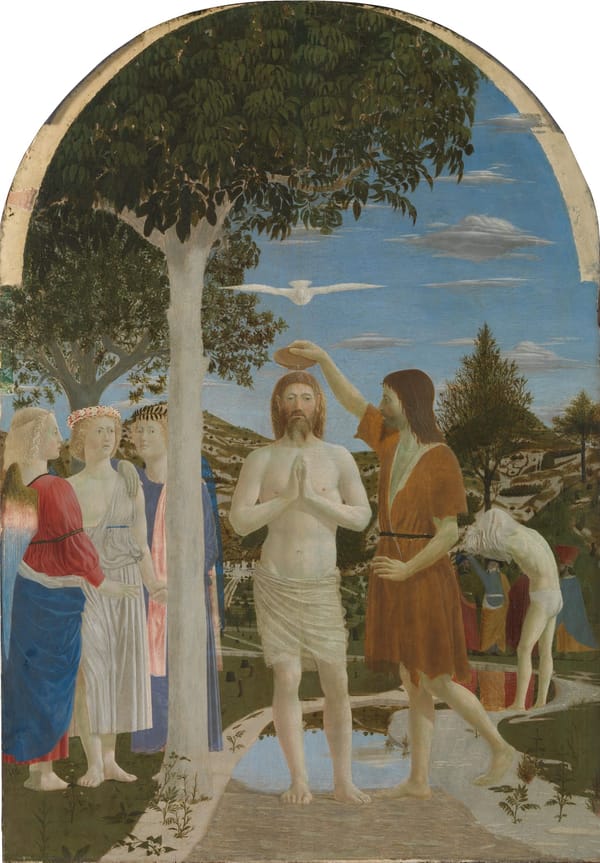
THE thoughts of the Church today are fixed on the Baptism of our Lord in the Jordan, which is the second of the three Mysteries of the Epiphany. The Emmanuel manifested himself to the Magi, after having shown himself to the Shepherds; but this manifestation was made within the narrow space of a stable at Bethlehem, and the world knew nothing of it. In the Mystery of the Jordan, Christ manifested himself with greater publicity. His coming is proclaimed by the Precursor; the crowd that is flocking to the river for Baptism is witness of what happens; Jesus makes this the beginning of his public life. But who could worthily explain the glorious circumstances of this second Epiphany?
It resembles the first in this, that it is for the benefit and salvation of the human race. The star has led the Magi to Christ; they had long waited for his coming, they had hoped for it; now they believe. Faith in the Messias having come into the world is beginning to take root among the Gentiles. But faith is not sufficient for salvation; the stain of sin must be washed away by water. He that believeth and is baptized shall be saved.1 The time is come, then, for a new manifestation of the Son of God, whereby there shall be inaugurated the great remedy, which is to give to Faith the power of producing life eternal.
Now the decrees of divine Wisdom had chosen Water as the instrument of this sublime regeneration of the human race. Hence, in the beginning of the world, we find the Spirit of God moving over the Waters,2 in order that they might ‘even then conceive a principle of sanctifying power,' as the Church expresses it in her Office for Holy Saturday.3 But before being called to fulfil the designs of God’s mercy, this element of Water had to be used by the Divine Justice for the chastisement of a sinful world. With the exception of one family, the whole human race perished, by the terrible judgement of God, in the Waters of the Deluge.
A fresh indication of the future supernatural power of this chosen element was given by the Dove, which Noe sent forth from the Ark; it returned to him, bearing in its beak an Olive-branch, the symbol that peace was given to the earth by its having been buried in Water. But this was only the announcement of the mystery; its accomplishment was not to be for long ages to come.
Meanwhile, God spoke to his people by many events, which were figurative of the future Mystery of Baptism. Thus, for example, it was by passing through the waters of the Red Sea that they entered into the Promised Land, and during the miraculous passage, a pillar of a cloud was seen covering both the Israelites and the Waters to which they owed their deliverance.
But in order that Water should have the power to purify man from his sins, it was necessary that it should be brought in contact with the Sacred Body of the Incarnate God. The Eternal Father had sent his Son into the world, not only that he might be its Lawgiver, and Redeemer, and the Victim of its salvation, but that he might also be the Sanctifier of Water; and it was in this sacred element that he would divinely bear testimony to his being his Son, and manifest him to the world a second time.
Jesus, therefore, being now thirty years of age, comes to the Jordan, a river already celebrated for the prophetic miracles which had been wrought in its waters. The Jewish people, roused by the preaching of John the Baptist, were flocking thither in order to receive a Baptism which could indeed excite a sorrow for sin, but could not effect its forgiveness. Our divine King approaches the river, not, of course, to receive sanctification, for he himself is the author of all Justice—but to impart to Water the power of bringing forth, as the Church expresses the mystery, a new and heavenly progeny.4 He goes down into the stream, not, like Josue, to walk dry-shod through its bed, but to let its waters encompass him, and receive from him, both for itself and for the Waters of the whole earth, the sanctifying power which they would retain for ever. The saintly Baptist places his trembling hand upon the sacred head of the Redeemer, and bends it beneath the water; the Sun of Justice vivifies this his creature; he imparts to it the glow of life-giving fruitfulness; and Water thus becomes the prolific source of supernatural life.
But in this the commencement of a new creation, we look for the intervention of the Three Persons of the Blessed Trinity. All Three are there. The heavens open; the Dove descends, not as a mere symbol, prophetic of some future grace, but as the sign of the actual presence of the Holy Ghost, the Spirit of love, who gives peace to men and changes their hearts. The Dove hovers above the head of Jesus, overshadowing at one and the same time the Humanity of the Incarnate Word and the water which bathed his sacred Body.
The manifestation is not complete; the Father's voice is still to be heard speaking over the Water, and moving by its power the entire element throughout the earth. Then was fulfilled the prophecy of David: The Voice of the Lord is upon the waters; the God of majesty hath thundered. The Voice of the Lord breaketh cedars, that is, the pride of the devils. The Voice of the Lord divideth the flame of fire, that is, the anger of God. The Voice of the Lord shaketh the desert, and maketh the flood to swell, that is, announces a new Deluge, the Deluge of divine Mercy.5 And what says this Voice of the Father? This is my beloved Son, in whom I am well pleased.6
Thus was the Holiness of Emmanuel manifested by the presence of the Dove and by the voice of the Father, as his kingly character had been previously manifested by the mute testimony of the star. The mystery is accomplished, the Waters are invested with a spiritual purifying power, and Jesus comes from the Jordan and ascends the bank, raising up with himself the world, regenerated and sanctified, with all its crimes and defilements drowned in the stream. Such is the interpretation and language of the Holy Fathers of the Church regarding this great event of our Lord's Life.
The Feast of the Epiphany celebrates this wonderful mystery of Jesus' Baptism; and we cannot be surprised at the Eastern Church having selected this day for one of the solemn administrations of the sacrament of Baptism. The same custom was observed, as we learn from ancient documents, in certain Churches in the West. John Mosch tells us that, as regards the Oriental Church, the Font was more than once miraculously filled with water on the Feast of the Epiphany, and that immediately after having administered the Sacrament, the people saw the water disappear. The Roman Church, even so early as the time of St Leo, decreed that Easter and Pentecost should be the only two days for the solemn administration of Baptism; but the custom of blessing the baptismal water with great solemnity on the Epiphany was still retained, and is observed even now in some parts of the West.
The Eastern Church has always religiously observed it. Amidst all the pomp of sacred rites, accompanied by his Priests and Ministers, who are clothed in the richest vestments, and followed by the whole people, the Bishop repairs to the banks of a river. After reciting certain beautiful prayers, which we regret not being able to offer to our readers, the Bishop plunges into the water a Cross richly adorned with precious stones; it represents our Lord being baptized by St John. At St Petersburg, the ceremony takes place on the River Neva, and it is through a hole made on the ice that the Metropolitan dips the Cross into the Water. This same ceremony is observed by those Churches in the West which have retained the custom of blessing the baptismal water on this Feast.
The faithful are very anxious to carry home with them the water of the stream thus sanctified; and St John Chrysostom, in his twenty-fourth Homily, on the Baptism of Christ, speaks to his audience of the circumstance, which was well known by all of them, of this water never turning corrupt. The same has been often seen in the Western Church.
Let us honour our Lord in this second Manifestation of his divinity, and thank him, with the Church, for having given us both the Star of Faith which enlightens us, and the Water of Baptism which cleanses us from our iniquities. Let us lovingly appreciate the humility of our Jesus, who permits himself to be weighed down by the hand of a mortal man, in order, as he says himself, that he might fulfil all justice;7 for having taken on himself the likeness of sin, it was requisite that he should bear its humiliation, that so he might raise us from our debasement. Let us thank him for this grace of Baptism, which has opened to us the gates of the Church both of heaven and earth; and let us renew the engagements we made at the holy Font, for they were the terms on which we were regenerated to our new life in God.
Mass
The Introit, Epistle, Gradual and Alleluia-Verse, Offertory, Preface, and Communion, are the same as on the Feast.
Introit
In the Collect, the Church prays that her children may have the grace of becoming like to Jesus, who appeared in the Jordan, filled, indeed, with the Holy Ghost, and the object of the Heavenly Father's love, but at the same time, truly Man like us, and faithful in the fulfilment of all justice.
Collect
Epistle
Cap. LX.Surge, illuminare, Jerusalem; quia venit lumen tuum, et gloria Domini super te orta est. Quia ecce tenebra operient terram, et caligo populos; super te autem onetur Dominus, et gloria ejus in te videbitur. Et ambulabunt gentes in lumine tuo, et Reges in splendore ortus tui. Leva in circuitu oculos tuos, et vide: omnes isti congregati sunt, venerunt tibi; filli tui de longe venient, et filiæ tuæ de latere surgent. Tunc videbis et afflues, et mirabitur et dilatabitur cor tuum, quando conversa fuerit ad te multitudo maris, fortitudo gentium venerit tibi. Inundatio camelorum operiet te, dromedarii Madian et Epha. Omnes de Saba venient, aurum et thus deferentes, et laudem Domino annuntiantes.
Ch. LX.Arise, be enlightened, O Jerusalem; for thy light is come, and the glory of the Lord is risen upon thee. For behold darkness shall cover the earth, and a mist the people; but the Lord shall arise upon thee, and his glory shall be seen upon thee. And the Gentiles shall walk in thy light, and Kings in the brightness of thy rising. Lift up thine eyes round about, and see: all these are gathered together, they are come to thee; thy sons shall come from afar, and thy daughters shall rise up at thy side. Then shalt thou see and abound, and thy heart shall wonder and be enlarged, when the multitude of the sea shall be converted to thee, the strength of the Gentiles shall come to thee. The multitude of camels shall cover thee, thedromedaries of Madian and Epha; all they from Saba shall come, bringing gold and frankincense, and showing forth praise to the Lord.
Gradual
Gospel
Cap. I.In illo tempore: Vidit Joannes Jesum venientem ad se, et ait: Ecce Agnus Dei, ecce qui tollit peccatum mundi. Hic est de quo dixi: Post me venit vir, qui ante me factus est quia prior me erat. Et ego nesciebam eum; sed ut manifestetur in Isræl, propterea veni ego in aqua baptizans. Et testimonium perhibuit Joannes, dicens: Quia vidi Spiritum descendentem quasi columbam de cœlo, et mansit super eum. Et ego nesciebam eum, sed qui misit me baptizare in aqua, ille mihi dixit: Super quem videris Spiritum descendentem, et manentem super eum, hic est qui baptizat in Spiritu Sancto. Et ego vidi: et testimonium perhibui, quia hic est Filius Dei.
Ch.I.At that time: John saw Jesus coming to him, and he saith: Behold the Lamb of God, behold him who taketh away the sins of the world. This is he of whom I said: After me there cometh a man who is preferred before me; because he was before me. And I knew him not; but that he may be made manifest in Israel, therefore am I come baptizing with water. And John gave testimony, saying: I saw the Spirit coming down as a dove from heaven, and he remained upon him. And I knew him not; but he who sent me to baptize with water said to me: he upon whom thou shalt see the Spirit descending and remaining upon him, he it is that baptizeth with the Holy Ghost. And I saw: and I gave testimony, that this is the Son of God.
O Lamb of God! thou didst enter into the stream to purify it, the Dove came down from heaven, for thy sweet meekness attracted the Spirit of love; and having sanctified the waters, the mystery of thy Baptism was over. But what tongue can express the prodigy of mercy effected by it! Men have gone down after thee into the stream made sacred by contact with thee; they return regenerated; they were wolves, and Baptism has transformed them into lambs. We were defiled by sin, and were unworthy to stand near thee, the spotless Lamb; but the waters of the holy Font have been poured upon us and we are made as the sheep of the Canticle, which come up from the washing fruitful, and none is barren among them;8 or as doves upon the brooks of water, white and spotless as though they had been washed with milk, sitting near the plentiful streams!9 Preserve us, O Jesus, in this white robe which thou hast put upon us. If, alas! we have tarnished its purity, cleanse us by that second Baptism, the Baptism of Penance. Permit us, too, dear Lord, to intercede for those countries to whom thy Gospel has not yet been preached; let this river of peace,10 the waters of Baptism, flow out upon them, and inundate the whole earth. We beseech thee, by the glory of thy manifestation at thy Baptism, forget the crimes of men, which have hitherto caused the Gospel to be kept from those unhappy countries. Thy heavenly Father bids every creature hear thee; speak, dear Jesus! to every creature.
Offertory
In the Secret, the Church once more proclaims the divine Manifestation, and begs that the Lamb, who by his Sacrifice has enabled us to offer God an acceptable oblation, may graciously receive it at our hands.
Secret
Communion
While giving thanks for the heavenly nourishment just received, the holy Church prays for the unceasing help of that divine Light, which has appeared to her, and which will enable her to contemplate the purity of the Lamb, and to love him as he deserves.
Postcommunion
Let us once more sing the praises of the divine Epiphany—the Theophany. Let us make a concert, as it were, of the Liturgies of all the Churches. St Hilary of Poitiers shall be our first chanter, in the Hymn he has written on the three mysteries of this great Octave.
Hymn
Pius Redemptor gentium;
Totum genus fidelium
Laudes celebret dramatum.
Monstrat micans in æthera,
Magosque ducit prævia
Ipsius ad cunabula.
Pannis adorant obsitum
Verum fatentur ut Deum,
Munus ferendo mysticum.
Jam parte vivens temporis,
Lympham petit baptismatis,
Cunctis carens contagiis.
Illum tremiscit flumine,
Potest suo qui sanguine
Peccata cosmi tergere.
Testatur excelsa Patris,
Virtus adestque Pneumatis,
Sancti datrix charismatis.
Omnes, precamur, protege,
Qui præcipis rubescere
Aquas potenter hydriæ.
Honor, potestas omnium,
Perenniter sint omnia
Per sæculorum sæcula.
shone forth on this day;
let the faithful of every race
celebrate him in their songs of praise.
announces his Birth;
it leads the way,
and guides them to his Crib.
wrapped in swaddling clothes;
they confess him to be the true God,
offering him their mystic gifts.
had passed, and he,
the infinitely pure God,
seeks the laver of baptism.
trembles as he bends the head of Jesus beneath the waters
—that Jesus whose Blood was to purify
the whole earth from its sins.
bearing testimony to his Son;
and the Holy Spirit, too, is present,
the giver of holy grace.
O Jesus! protect thy people;
we ask it of thee by the power thou didst show
when thou didst command the water to be changed into wine.
honour, and all power
be to the Trinity
for ever and for ever.
The Ambrosian Church of Milan thus celebrates the Baptism of our Lord in the beautiful Preface we take from its Missal.
Preface
The venerable Antiphons we now give are the precious remnants of the ancient Gallican Liturgy: they are of Oriental origin, and are still preserved in the Cistercian Breviary.
Antiphons
Sequence
Prævisa prophetice,
Nunc lucis deificæ
Monstrat ortum.
Herodes concutitur,
Ad Jesum gens ducitur,
Pacis portum.
Conditorem siderum,
Et ultorem scelerum,
Deum fortem.
Monstrat cuncta regere
Et tandem redimere
Nos per mortem.
Et aquis infunditur
Virtus qua diluitur
Adas noxa.
Vox Patris complectitur
Natum, quo dignoscitur
Ejus doxa.
Profert testimonium,
Et sumit initium
Lex amoris.
Cum facit officium
Vini, liquor fontium,
Melioris.
Sponsæ sine macula,
Dulci nubit copula
Verbum Patris.
Nostra solvat vincuia,
Protegens in sæcula
Prece Matris.
that was foretold by the Prophets:
it tells the rising
of the divine Light.
it terrifies Herod,
it leads the Gentiles to Jesus,
the haven of peace.
the creator of the stars,
the avenger of crime,
the Strong God.
to be the Ruler of all things,
and the Redeemer who saved
us by his death.
and the waters imbibe from him
a virtue whereby they wash away
Adam’s sins.
the voice of the Father speaks
his love of the Son,
therefore making known his glory.
bears also testimony;
and the law of love
is begun.
when the spring-water is made
to do the service
of the better wine.
is espoused in sweet love
in the womb of the Virgin,
the Spouse without stain.
and so loosen our chains,
protecting us for ever,
at his Mother’s prayer.
Die VI Januarii, In Theophania
est: fluenta induit hodie Jordanica, istis ipse ad purificationem non indigens, sed nobis in seipso dispensans regenerationem: o prodigium!
To-day he girds himself with the waters of the Jordan, not needing them for his own purification, but that he might give regeneration to us through himself. O wondrous work!
Sequence
Quo fœcundata Deum peperit Virgo Maria,
Per quem sacrata floret Virginitas in Maria.
Spiritus alme, quo repletur Maria,
Tu rorem sacrum stillasti in Maria.
Amator sancte, quo intacta imprægnatur Maria.
Sub cujus umbra non torretur, dum fovetur Maria.
Tu præservasti ne prima culpa transfusa sit in Maria.
Tu cellam sacrasti sic benedicti ventris in Maria.
Ut tumeret, et Mater fieret Maria,
Sic pareret, nec florem perderet Maria.
Prophetas tu inspirasti, ut præcinerent quod Deum conciperet Maria.
Apostolos confortasti ut astruerent hunc Deum quem edidit Maria.
Quando machinam Deus mundanam fecit, est præfigurata Maria.
Tellus hominem, virgo virginem fudit primum, sic secundum Maria.
Tu animarum spes afflictarum dulcis Maria.
Tu servulorum tuorum nexus solve, Maria;
Tu collisum peccatis mundum ad vitam reparasti, Maria.
Idololatras et leges atras enervasti, Maria.
Ergo nos petimus supplices ut ope benigna subleves, Maria.
Et nato pro nobis supplices, qui tibi psallimus: Ave, Maria.
Tu felicibus felicior, Maria.
Tu sublimibus Angelorum cœtibus es prælata, Maria.
Ipsum hominem induisti, Maria,
Qui sine semine, rigante nemine, te fœcundavit, Maria.
Hunc Deum nobis placa, Maria.
Whereby the Virgin Mary conceived, and brought forth Jesus, our God,
And holy Virginity, in this Mother, brought forth its Flower.
O Spirit of Love! thou didst fill Mary with thyself,
Thou didst infuse the dew of heaven into her.
O Divine Lover! the purest Virgin receives Jesus from Thee.
Under thy shadow, she continues a Virgin, and is made the Mother of God.
Thou didst preserve Mary from contracting the original guilt.
Thou didst consecrate the sanctuary of this so blessed womb,
That it might be the dwelling of Jesus, and Mary be his Mother,
And so bring forth her Son, as to be still the same pure Flower.
Thou it was that didst inspire the Prophets to foretell how Mary should conceive her God.
When God created this world, he gave us a type of Mary.
The virgin-earth produced the first Adam; so did Mary give birth to the second.
Thou art the hope of sorrowing hearts, sweet Mary!
Loosen the fetters of thy devoted servants, O Mary!
Thou didst restore to life the world that was crushed by sin, O Mary!I
Thou didst destroy idolaters and wicked laws, O Mary!
We humbly beseech thee, therefore, that thou mercifully help us, O Mary!
And pray to thy Son for us who sing to thee, Ave Maria!
Thou art Blessed of all the blessed, O Mary!
Thou art raised above the highest choirs of the Angels, O Mary!
Thou didst clothe with the nature of Man, O Mary,
Him who without the aid of man gave thee the fruitfulness of motherhood, O Mary!
He is our God; pray him to have mercy on us, O Mary!
| Previous January 12 (the Same Day): St. Benet Biscop, Bishop | Next January 14: St. Hilary, Bishop, Confessor, and Doctor of the Church |