lyp.network

Daily reading

Semidouble · January 19 · Sanctoral

January 19, 2027

From Dom Guéranger’s The Liturgical Year.

St. Canute (Semidouble) leads; Sts. Marius, Martha, Audifax and Abachum commemorated.Rubrics

January 19 (the Same Day): St. Canute, King and Martyr

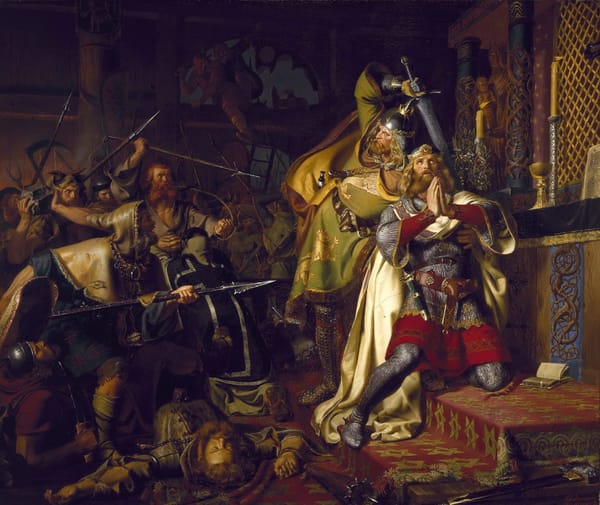
THE Magi Kings, as we have already observed, have been followed to the Crib of Jesus by saintly Christian monarchs; and it was just that these should be represented on the Church's Calendar during the season which is consecrated to the Mystery of his Birth. The eleventh century is one of the most glorious of the Christian era, and gave, both to the Church and the various States of Europe, a great number of saintly Kings. Among them Canute the Fourth of Denmark stands pre-eminent by reason of the aureole of his martyrdom. He had every quality which forms a Christian prince: he was a zealous propagator of the faith of Christ, he was a brave warrior, he was pious, and he was charitable to the poor. His zeal for the Church (and in those days her rights were counted as the rights of the people) was made the pretext for putting him to death: he died in the midst of a sedition as a victim sacrificed for his people's sake. His offering to the new-born King was that of his blood; and in exchange for the perishable crown he lost, he received that which the Church gives to her Martyrs, and which can never be taken away. The history of Denmark in the eleventh century is scarce known by the rest of the world; but the glory of that country's having had one of her kings a Martyr is known throughout the whole Church, and the Church inhabits the whole earth. This power, possessed by the Spouse of Christ, of conferring honour on the name and actions of the servants and friends of God, is one of the grandest spectacles out of heaven; for when she holds up a name as worthy of honour, that name becomes immortalized, whether he who bore it were a powerful king or the poorest peasant.

We find the following life of this holy King given in the Lessons until recently used in the Breviary.

Canutus Quartus, Suenonis Esthritii Danorum regis filius, fide, pietate et morum honestate conspicuus, eximiæ sanctitatis a teneris annis specimen dedit. Paternum sceptmm summa omnium acclamatione adeptus, religioni promovendæ sedulo incumbere, Ecclesias redditibus augere, et pretiosa supellectili ornare cœpit. Tum zelo propagandæ fidei succensus, barbara regna justo certamine aggressus, devictas subditasque nationes Christianæ legi subjugavit. Victoriis autem plurimis gloriosus, et divitiis auctus, regale diadema ad Christi crucifixi pedes abjecit, se et regnum illi subjiciens qui Rex regum est et Dominus dominatium. Corpus suum jejuniis, ciliciis, et flagellis castigavit. In oratione et contemplatione assiduus, erga pauperes profusus, erga omnes beneficus semper fuit, nec unquam a justitiæ, divinæque legis semita deflexit.
His aliisque virtutibus imbutus, ad supremum perfectionis apicem sanctus Rex properabat. Accidit autem, ut Angliæ regnum a Wilhelmo Normannorum duce formidabili exercitu invaderetur; Anglis vero Danorum opem implorantibus, cum succurrere rex decrevisset, belli expeditionem Olao fratri commisit, qui regnandi cupiditate illectus, arma vertit in regis perniciem, militibus et populo contra ilium concitatis. Nec defuerunt rebellioni fomenta; cum enim rex editis legibus decimas Ecclesiis solvi, Dei et Ecclesiæ præcepta servari, transgressores puniri sanxisset; plerique perversi ac scelerati homines exacerbati, primum quidem tumultuari, tum plebem commovere, ac tandem sanctissimo regi necem moliri coeperunt.
Sciens igitur rex futurorum præscius, mortem sibi propter justitiam imminere; ea prænuntiata, ad Ecclesiam sancti Albani martyris Othoniæ tanquam ad locum certaminis profectus est, et Sacramentis munitus, agonem suum Domino commendabat. Mox ibi adveniens conjuratorum multitudo, Ecclesiæ ignem admovere, fores confringere, et in eam irrumpere tentarunt. Quod cum perficere non possent, ad fenestras accedentes, saxa et sagittas in sanctum Regem, flexis genibus pro inimicis orantem, magno impetu jaculari non cessarunt, donec lapidum et telorum ictibus, ac tandem lancea confossus, glorioso martyrio ante altare, extensis brachiis procumbens coronatus est, sedente in Apostolico throno Gregorio Septimo. Multis postea miraculis Martyrern suum illustravit Deus: nam gravi penuria et diversis calamitatibus oppressa Dania, patrati sacrilegii pœnas luit. Plures etiam variis languoribus afflicti, ad ejus tumulum remedium et incolumitatem consecuti sunt; cumque Regina sacrum ejus corpus noctu clam surripere, et alio transferre conaretur, emisso cælitus ingenti splendore perterrita, a proposito cessavit.
Canute the Fourth, son of Sweyn Estrithius, King of Denmark, was conspicuous for his faith, piety, and purity of life, and even from his infancy gave proof of exceeding holiness. Having been elected by the votes of the people to the throne held by his father, he at once began zealously to promote religion, to add to the revenues of the Churches, and to provide the same with costly fittings and furniture. Being also inflamed with zeal for the propagation of the faith, he refused not to enter into just war with barbarous nations, which, when he had conquered and subdued, he subjected to the law of Christ. Having obtained several glorious victories, and increased the riches of his treasury, he laid his regal diadem at the feet of a crucifix, offering himself and his kingdom to him who is the King of kings and Lord of lords. He chastised his body by fasting, hair-shirts and disciplines. He was assiduous in prayer and contemplation, liberal in his alms to the poor, and ever kind to all, never deviating from the path of justice and the divine commandments.
By these and other such virtues the holy King made rapid strides to the summit of perfection. Now it happened that William, Duke of Normandy, invaded the kingdom of England with a formidable army, and the English sought assistance from the Danes. The King resolved to grant them his aid, and intrusted the expedition to his brother Olaf. But he, from the desire he had of getting possession of the throne, turned his forces against the King, and stirred up the soldiers and the people to rebellion. Neither were there wanting motives for this rebellion; for the King had issued laws commanding the payment of ecclesiastical tithes, the observance of the commandments of God and his Church, and the infliction of penalties on defaulters; all which were made a handle of by perverse and wicked malcontents, for spreading discontent, exciting the people to revolt, and at last, to plot the death of the saintly King.
Foreknowing what was to happen, the King saw that he would soon be put to death for justice' sake. Having foretold it, he set out to Odense, where, entering into the Church of St Alban the Martyr, as the place of combat, he fortified himself with the Sacraments, and commended this his last struggle to our Lord. He had not long been there, when a band of conspirators arrived. They endeavoured to set fire to the Church, to burst open the doors, and to force an entrance. But failing in this, they scaled the windows, and with great violence threw a shower of stones and arrows upon the holy King, who was on his knees, praying for his enemies. Wounded by the stones and arrows, and at last pierced through with a spear, he was crowned with a glorious martyrdom, and fell before the altar with his arms stretched out. Gregory the Seventh was the reigning Pontiff. God showed by many miracles how glorious was his Martyr; and Denmark was afflicted with a great famine and sundry calamities, in punishment of the sacrilegious murder which had been perpetrated. Many persons, who were afflicted with various maladies, found aid and health by praying at the tomb of the Martyr. On one occasion, when the Queen endeavoured during the night to take up his body secretly and carry it to another place, she was deterred from her design by being struck with fear at the sight of a most brilliant light, which came down from heaven.

O holy King! the Sun of Justice had risen upon thy country, and all thy ambition was that thy people might enjoy the fulness of its light and warmth. Like the Magi of the East, thou didst lay thy crown at the feet of the Emmanuel, and at length didst offer thy very life in his service and in that of his Church. But thy people were not worthy of thee; they shed thy blood, as the ungrateful Israel shed the Blood of the Just One who is now born unto us, and whose sweet Infancy we are now celebrating. Thou didst offer thy martyrdom for the sins of thy people; offer it now also for them, that they may recover the true faith they have so long lost. Pray for the Rulers of Christian lands, that they may be faithful to their duties, zealous for justice, and may have respect for the liberty of the Church. Ask for us of the Divine Infant a devotedness in his cause like that which glowed in thy breast; and since we have not a crown to lay at his feet, pray for us that we may be generous enough to give our whole heart.


January 19: Sts. Marius, Martha, Audifax, and Abachum, Martyrs

CHRISTIANS from all parts of the world have ever flocked to Rome as to the rock of faith and the foundation of the Church, and honoured with the greatest reverence and piety the spot hallowed by the sepulchre of the Prince of the Apostles.'* These words of Holy Church are exemplified in the Martyrs of to-day. Fired with ambition to have some part and fellowship in the glorious Society of the holy Apostles and Martyrs, they left all things and hastened to the Eternal City, there to receive in fullest measure what they sought. Like the Magi of old they came from the far East. The star of faith had shone for them, and in obedience to its call they set forth in all eagerness to offer their gifts of homage and loyalty to the divine King in the person of his Vicar and his suffering members. Such generosity was not left unrewarded; our Emmanuel crowned it with the laurels of martyrdom, admitting them into that cloud of witnesses that ever stand about him. Let us keep before our minds with our Lord, the author and finisher of their faith, this great and glorious band of martyrs, so that we too may ever run unwearied and with courage and patience in the fight proposed to us.

The following lesson is given in the office:

Marius Persa, nobili loco natus, cum Martha conjuge pari nobilitate, et duobus filiis Audiface et Abachum, Romam venit Claudio imperatore, ut Martyrum sepulchra veneraretur. Ibi Christianos in vincula conjectos fovebant, et opera ac facultatibus suis sustentabant, et Sanctorum corpora sepeliebant. Quam ob rem coniprehensi omnes, cum nec impiorum minis nec terrore commoverentur, ut diis sacrificarent; primum fustibus debilitati, deinde funibus attracti, tum admotis candentibus laminis combusti, et ungulis ferreis excarnificati sunt. Postremo præcisis manibus, et ad collum alligatis, ducti per mediam urbem, via Cornelia ad tertium decimum ab Urbe milliarium, in eum locum, qui Nymphe dicebatur, necantur: ac primum Marthse, quæ virum ac filios ad supplicia prò Jesu Christi fide constanter perferenda, vehementer fuerat cohortata; mox ceteris in eadem arenaria cervices abscinduntur, eorumque corpora conjiciuntur in ignem. Quæsemiusta, Felicitas matrona Romana nobilis colligenda et in suo prædio sepelienda curavit.
Marius, a Persian of noble birth, came to Rome, under the emperor Claudius, to venerate the sepulchres of the martyrs in the company of his wife Martha, a noble lady, and their two sons Audifax and Abachum. There they ministered to the Christians in prison, maintaining them both by their wealth and their own personal service, and buried the bodies of the saints. They were all accordingly arrested, and since they could not be induced by fear or threats to sacrifice to the gods, they were first beaten with clubs, then dragged about with ropes, burnt with hot iron plates and torn with hooks. Lastly their hands were cut off and tied about their necks, and they were led through the city and by the Via Cornelia to the place called Nymphe, thirteen miles from Rome, where they were put to death. The first to die was Martha, who had earnestly exhorted her husband and sons to bear their sufferings with constancy for the faith of Jesus Christ. Then the others were beheaded in the same sandpit, and their bodies were thrown into the fire. Felicitas, a noble Roman matron, took them when they were half burned and buried them in her own estate.

* Lessons for the Dedication Feast of the Basilicas of Ss Peter and Paul. ↩︎


January 19 (the Same Day): St. Wulstan, Bishop and Confessor

SEVERAL dioceses in England celebrate on this day the feast of St Wulstan, Bishop of Worcester. The last of the Anglo-Saxon saints, Wulstan was worthy to close the long line of men and women who had earned for the country the proud title of 'Insula Sanctorum.' His character as sketched by a contemporary is singularly attractive. A simple man, strong in his simplicity, yet kindly and gifted with a merry wit, he held straight on his course in God's service a priest, monk, prior, and bishop, spending himself in the laborious offices of his ministry, much more intent on the burdens of his position than on its emoluments. A love of beauty ran through his life and manifested itself in building fine churches, in his care of books, in his love for the freshness of children.

In his long life of eighty-seven years Wulstan saw the gradual passing of the old order, the reigns of Ethelbert, Canute, Edward the Confessor, and of his friend King Harold, down to the fateful day when power passed into Norman hands. With all his love for his own land and dynasty the Saint gave no time to useless regrets. He had warned the people that for their sins the country would fall under the dominion of strangers, and when the conquest became a fact he threw his great influence into support of the new dynasty. But he was no time-server, and had no hesitation in confronting the Conqueror to demand redress of injustice done to his See. King William learned to admire the sturdy Saxon prelate, and Wulstan, instead of sharing the fate of nearly all the native bishops who were removed and replaced by Normans, remained in his See and was made the King’s lieutenant for the Midlands.

The following are the lessons of Saint Wulstan.

Wolstanus presbyter magnani sibi sanctitatis famam acquisiverat. Postea monachus Wigorniensis factus, ad ejusdem Ecclesiæ regimen brevi assumptus est. Scienti sacularis pene rudi, spirituali disciplina totum se dedit. Sermonis Anglicani inter eloquentissimos habebatur; quo in genere est illud maxime memorandum, quod cives Bristolienses, quos a nefario mancipiorum indigenarum mercatu, nec regia, nec pontificia potestas deterrere potuerat, ipse assiduis prædicationibus ad saniorem mentem reduxerit.
Episcopus factus omnes boni pastoris partes sedulo egit. Continuo diœcesim suam lustrare cœpit, ordinationes facere, ecclesias dedicare, peccantes arguere animassibi commissas et verbo et exemplo ad æternævitæ desiderium excitare. Sæpius evenit ut ab ortu solii ad tenebras pueros undecumque advectos ad duorum vel trium millium numerum sacro chrismate jejunus signaret. In confessionibus excipiendis ea erat mansuetudine, eo animarum zelo, ut ad Wolstanum et tota Anglia conflueretur, ejusque monitis peccatores scelera sua dignis pœnitentiæ operibus emendarent.
Neque vero, dum alienæ saluti invigilaret, negligebat suam. Frequenti Missarum celebratione, oratione assidua, jugi ab esu carnium abstinentia, et effusa in egenoscaritate Deo serviebat. Quanto autem de se demissius sentiret, eo magis ab omnibus virtutes ejus prædicabantur: ut non solum Angli et Normanni, sed exterarum quoque gentium reges et præsules ejus se orationibus commendarent. Senex admodum mortuus est anno ab Incarnatione Domini millesimo nonagesimo quinto et in ecclesia sua Wigomiæ sepultus.
Wulstan whilst a simple priest had acquired to himself a great renown for holiness. Afterwards having become a monk of Worcester Priory, he was in a short time raised to the government of the same church. Almost entirely ignorant of secular learning, he gave himself wholly to spiritual science. He was numbered among the most eloquent speakers of the English language, in proof of which, this is principally to be remembered, that by his assiduous preaching he converted the citizens of Bristol, whom neither the regal nor the pontifical power could withdraw from the infamous slave trade.
Being made bishop, he sedulously fulfilled all the duties of a good shepherd. He began to visit all parts of his diocese, to give ordinations, to dedicate churches, to reprove sinners, and to animate the souls committed to his care, both by word and example, to the desire of eternal life. It frequently happened that he fasted from sunrise till nightfall whilst he was occupied in confirming children to the number of two or three thousand who were brought from all parts. Such was his meekness and zeal for souls in hearing confessions that persons came to him from all parts of England, and by his admonitions sinners amended their crimes by worthy deeds of penance.
Neither did he whilst watching over the salvation of others neglect his own. He served God by the constant celebration of Mass, by assiduous prayer, by continued abstinence from flesh-meat and by overflowing charity to the needy. The more humbly he esteemed himself, by so much the more his virtues were proclaimed by all, so that not only the English and Normans, but the kings and rulers of foreign nations also commended themselves to his prayers. He died, a very old man, in the year from the Incarnation of our Lord one thousand and ninety-five, and was buried in his church of Worcester.

Previous
January 18 (the Same Day): St. Prisca, Virgin and Martyr
Next
January 19: Sts. Marius, Martha, Audifax, and Abachum, Martyrs