Daily reading
Epiphanytide
Double · January 20 · Sanctoral
January 20: Saint Fabian, Pope and Martyr, and Saint Sebastian, Martyr
From Dom Guéranger’s The Liturgical Year.
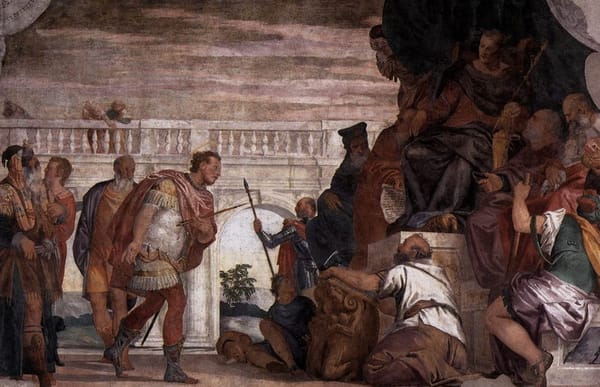 |
TWO great Martyrs divide between them the honours of this twentieth day of January:—one, a Pontiff of the Church of Rome; the other, a member of that Mother-Church. Fabian received the crown of martyrdom, in the year 250, under the persecution of Decius; the persecution of Diocletian crowned Sebastian in the year 288. We will consider the merits of these two champions of Christ separately.
Saint Fabian
St Fabian, like St Clement and St Anthems, two of his predecessors, was extremely zealous in seeing that the Acts of the Martyrs were carefully drawn up. This zeal was no doubt exercised by the clergy in the case of our holy Pontiff himself, and his sufferings and martyrdom were carefully registered; but all these interesting particulars have been lost, in common with an immense number of other precious Acts, which were condemned to the flames, by the Imperial Edicts, during the persecution under Diocletian. Nothing is now known of the life of St Fabian, save a few of his actions as Pope; but we may have some idea of his virtues by the praise given him by St Cyprian, who, in a letter written to St Cornelius, the immediate successor of St Fabian, calls him an incomparable man. The Bishop of Carthage extols the purity and holiness of life of the holy Pontiff, who so peaceably governed the Church amidst all the storms which then assailed her. There is an interesting circumstance related of him by Eusebius. After the death of St Antherus, the people and clergy of Rome assembled together for the election of the new Pontiff. Heaven marked out the successor of St Peter: a dove was seen to rest on the venerable head of Fabian, and he was unanimously chosen. This reminds us of the event in our Lord's Life, which we celebrated a few days back, when, standing in the river Jordan, the Dove came down from heaven, and showed him to the people as the Son of God. Fabian was the depository of the power of regeneration, which Jesus by his baptism gave to the element of water; he zealously propagated the Faith of his Divine Master, and among the Bishops he consecrated for divers places, one or more were sent by him into these western parts of Europe.
We give the short account of the Acts of St Fabian, as recorded in the Liturgy.
Thus didst thou live out the long tempestuous days of thy Pontificate, O Fabian! But thou hadst the presentiment of the peaceful future reserved by God for his Church, and thou didst zealously labour to hand down to the coming generations the great examples of the Martyrs. The flames have robbed us of a great portion of the treasures thou preparedst for us, and have deprived us of knowing the Fabian who so loved the Martyrs, and died one himself. But of thee, Blessed Pontiff! we know enough to make us thank God for having set thee over his Church in those hard times, and keep this day as a feast in celebration of thy glorious triumph. The dove, which marked thee out as the one chosen by heaven, showed thee to men as the visible Christ on earth; it told thee that thou wert destined for heavy responsibilities and martyrdom; it was a warning to the Church that she should recognize and hear thee as her guide and teacher. Honoured thus with a resemblance to Jesus in the mystery of his Epiphany, pray to him for us, that he mercifully manifest himself to our mind and heart. Obtain of him for us that docility to his grace, that loving submissiveness to his will, that detachment from all created things, which were the support of thy life during those fifteen years of thy ever threatened and anxious pontificate. When the angry persecution at length broke on thee, it found thee prepared, and martyrdom carried thee to the bosom of that God who had already welcomed so many of thy martyred children. We too are looking for that last wave which is to break over us, and carry us from the shore of this present life to eternity; oh! pray for us, that it may find us ready! If the love of the Divine Babe, our Jesus, be within us; if, like thee, we imitate the simplicity of the dove; we shall not be lost! Here are our hearts—we wish for nothing but God; help us by thy prayers.
Saint Sebastian
At the head of her list of heroes, after the two glorious Apostles Peter and Paul, who form her chief glory, Rome puts her two most valiant Martyrs, Laurence and Sebastian, and her two most illustrious Virgins, Cecily and Agnes. Of these four, two are given us by the Calendar of Christmastide as attendants in the court of the Infant Jesus at Bethlehem. Laurence and Cecily come later in the year, when other mysteries are brought before us by the Liturgy: but Christmas calls forth Sebastian and Agnes. To-day it is the brave soldier of the pretorian band, Sebastian, who stands by the Crib; to-morrow we shall see Agnes, gentle as a lamb, yet fearless as a lion, inviting us to love the sweet Babe whom she chose for her Spouse.
The chivalrous spirit of Sebastian reminds us of the great Archdeacon; both of them, one in the sanctuary and the other in the world, defied the tortures of death. Burnt on one side, Laurence bids the tyrant roast the other; Sebastian, pierced with his arrows, waits till the gaping wounds are closed, and then runs to his persecutor Diocletian, asking for a second martyrdom. But we must forget Laurence to-day, to think of Sebastian.
We must picture to ourselves a young soldier, who tears himself away from all the ties of his home at Milan, because the persecution there was too tame, whereas at Rome it was at its fiercest. He trembles with anxiety at the thought that perhaps some of the Christians in the Capital may be losing courage. He has been told that at times some of the Emperor's soldiers, who were soldiers also of Christ, have gained admission into the prisons, and have roused up the sinking courage of the confessors. He is resolved to go on the like mission, and hopes that he may also receive the blessing of martyrdom. He reaches Rome, he is admitted into the prisons, and encourages to martyrdom such as had been shaken by the tears of those who were dear to them. Some of the gaolers, converted by witnessing his faith and his miracles, become martyrs themselves; and one of the Roman Magistrates asks to be instructed in a religion which can produce such men as this Sebastian. He has won the esteem of the Emperors Diocletian and Maximian Hercules for his fidelity and courage as a soldier; they have loaded him with favours; and this gives him an influence in Rome which he so zealously turns to the advantage of the Christian religion, that the holy Pope Caius calls him the Defender of the Church.
After sending innumerable martyrs to heaven, Sebastian at length wins the crown he had so ardently desired. He incurs the displeasure of Diocletian by confessing himself a Christian; the heavenly King, for whose sake alone he had put on the helmet and soldier's cloak, was to him above all Emperors and Princes. He is handed over to the archers of Mauritania, who strip him, bind him, and wound him from head to foot with their arrows. They left him for dead, but a pious woman named Irene took care of him, and his wounds were healed. Sebastian again approaches the Emperor, who orders him to be beaten to death in the circus, near the Imperial Palace.
Such are the Soldiers of our new-born King; but oh! how richly does he repay them for their service! Rome, the Capital of his Church, is founded on seven Basilicas, as the ancient City was on its seven hills; and the name and tomb of Sebastian grace one of these seven sanctuaries. The Basilica of Sebastian stands in a sort of solitude, on the Appian Way, outside the walls of the Eternal City; it is enriched with the relics of the holy Pope and Martyr Fabian; but Sebastian, the valiant leader of the pretorian guard, is the Patron, and as it were the Prince of the holy temple. It was here that he wished to be buried, as a faithful guardian, near the well wherein the bodies of the holy Apostles had been concealed, lest they should be desecrated by the persecutors.
In return for the zeal of St Sebastian for the souls of his Christian brethren, whom he preserved from the contagion of paganism, God has made him the Protector of the faithful against pestilence. A signal proof of this power granted to the holy Martyr was given at Rome, in the year 680, under the Pontificate of St Agatho.
Let us now listen to our holy Mother the Church, who thus speaks of her glorious Martyr in the Office of his Feast.
The ancient Liturgical books contain a great many pieces in honour of St Sebastian. We limit ourselves to the following, which belongs to the Ambrosian Breviary.
Hymn
Concivis almi, supplices
Diem sacratam vocibus
Canamus omnes debitis.
Ardens amore prælii,
Linquit tepentem patriam,
Pugnamque Romæ festinat.
Virtute plenus cœlica,
Idola damnans, inclyti
Trophæa sperai martyris.
Qua stipes ingens tollitur,
Vibrata tela suscipit
Umbone nudo pectoris.
Sed ære mens constantior
Ut molle ferrum despicit:
Ferrum precatur, sæviat.
Exsangue corpus nunciat;
Sed casta nocte femina
Plagas tumentes recreat.
Adacta præbent vulnera;
Rursum tyrannum provocans,
Exspirat inter vulnera.
Bellator o fortissime,
Luem fugando, civium
Tuere clemens corpora.
Tibique, Sancte Spiritus,
Sicut fuit, sit jugiter
Sæclum per omne gloria.
and with becoming sweetness of voice,
celebrate in song the feast-day
of our dear fellow-citizen, Sebastian the Martyr.
fired with the love of battle,
leaves his country, where danger too tamely threatened him,
and hastens to the hot battlefield at Rome.
and full of heavenly courage,
he condemns the worship of idols,
and hopes that a martyr's bright trophy may be his.
to the huge trunk of a tree,
and on his naked breast
receives the quivering arrows.
while his soul, more unflinching than brass,
despises the weapons as harmless things,
and bids them do their worst.
leaving but a lifeless body;
but a holy woman comes by night,
and heals the gaping wounds.
gives our soldier heavenly strength;
again he urges the tyrant to his work,
and this time dies under the wounding lash.
now that thou art throned in the high heavens,
drive pestilence away, and mercifully protect
the bodily health of thy fellow-citizens on earth.
and to thee, O Holy Spirit,
may there be, as there ever hath been,
glory for ever and ever.
We find the following Prayer in the Gothic Missal.
Prayer
Brave Soldier of our Emmanuel! thou art now sweetly reposing at the foot of his throne. Thy wounds are closed, and thy rich palm-branch delights all heaven by the freshness of its unfading beauty. Look down upon the Church on earth, that tires not in singing thy praise. Each Christmas, we find thee near the Crib of the Divine Babe, its brave and faithful sentinel. The office thou didst once fill in an earthly prince's court is still thine, but it is in the palace of the King of kings. Into that palace, we beseech thee, lead us by thy prayers, and gain a favourable hearing to our own unworthy petitions.
With what a favourable ear must not Jesus receive all thy requests, who didst love him with such a brave love! Thirsting to shed thy blood in his service, thou didst scorn a battlefield where danger was not sure, and Rome, that Babylon which, as St John says,1 was drunk with the blood of the Martyrs, Rome alone was worthy of thee. And there it was not thy plan to secure the palm of martyrdom only for thyself; the courage of some of thy fellow-Christians had wavered, and the thought of their danger troubled thee. Rushing into their prisons, where they lay mutilated by the tortures they had endured, thou didst give them back the fallen laurel, and teach them how to secure it in the grasp of holy defiance. It seemed as though thou wast commissioned to form a pretorian band for the King of heaven, and that thou couldst not enter heaven unless marshalling thither a troop of veterans for Jesus.
Thy turn came at last; the hour of thy confession was at hand, and thou hadst to think of thine own fair crown. But for such a soldier as thou, Sebastian, one martyrdom is not enough. The archers have faithfully done their work—not an arrow is left in their quivers; and yet their victim lives, ready for a second sacrifice. Such were the Christians of the early times, and we are their children!
Look, then, O Soldier of Christ! upon us, and pity us, as thou didst thy brethren, who once faltered in the combat. Alas! we let everything frighten and discourage us; and oftentimes we are enemies of the Cross, even while professing that we love it. We too easily forget that we cannot be companions of the martyrs unless our hearts have the generosity of the martyrs. We are cowardly in our contest with the world and its pomps; with the evil propensities of our nature, and the tyranny of our senses; and thus we fall. And when we have made an easy peace with God, and sealed it with the sacrament of his love, we behave as though we had now nothing more to do than to go on quietly to heaven, without further trials or self-imposed sacrifices. Rouse us, great Saint! from these illusions, and waken us from our listless life. Our love of God is asleep, and all must needs go wrong.
Preserve us from the contagion of bad example, and of those worldly maxims which gain currency even with Christian minds, because Christian lips call them rules of Christian prudence. Pray for us, that we may be ardent in the pursuit of our sanctification, watchful over our inclinations, zealous for the salvation of others, lovers of the Cross, and detached from earthly things. Oh! by the arrows which pierced thee, we beseech thee shield us from those hidden darts which Satan throws against us.
Pray for us, that we may be clad with the armour of God, described to us by the great Apostle. May we have on the breastplate of justice, which will defend us from sin; the helmet of salvation, that is, the hope of gaining heaven, which will preserve us from both despair and presumption; the shield of faith, which will ward off the darts of the enemy who seeks to corrupt the heart by leading the mind into error; and lastly, the sword of the Spirit, which is the word of God, whereby we may put all false doctrines to flight, and vanquish all our vices; for heaven and earth pass away, but the word of God abides for ever, and is given us as our rule and the pledge of our salvation.2
Defender of the Church, as the Vicar of Christ called thee, lift up thy sword and defend her now. Prostrate her enemies, and frustrate the plots they have laid for her destruction. Let her enjoy one of those rare periods of peace during which she prepares for fresh combats. Obtain for Christian soldiers, engaged in just wars, the blessing of the God of Hosts. Protect the Holy City of Rome, where thy Tomb is honoured. Avert from us, by thy intercession, the scourge of pestilence and contagion. Hear the prayers which each year are addressed to thee for the preservation of the creatures given by God to man to aid him in his daily labour. Secure to us, by thy prayers, peace and happiness in this present life, and the good things of the life to come.
| Previous January 19 (the Same Day): St. Wulstan, Bishop and Confessor | Next January 21: St. Agnes, Virgin and Martyr |