Daily reading
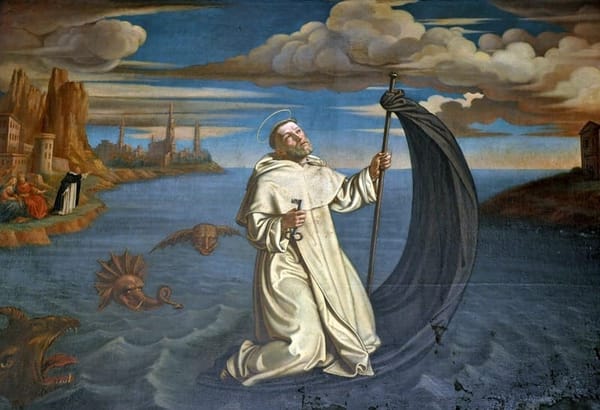
January 23: St. Raymond Pennafort, Confessor
THE glorious choir of martyrs, that stands round our Emmanuel till the day of his Presentation in the Temple, opens its ranks from time to time to give admission to the confessors, whom divine Providence has willed should grace the cycle during this sacred season. The martyrs surpass all the other saints in number; but still, the confessors are well represented. After Hilary, Paul, Maurus, and Antony, comes Raymund of Pennafort, one of the glories of the Order of St Dominic and of the Church, in the thirteenth century.
According to the saying of the Prophets, the Messias is come to be our Lawgiver; nay, he is himself our law. His words are to be the rule of mankind; he will leave with his Church the power of legislation, to the end that she may guide men in holiness and justice, in all ages. As it is his Truth that presides over the teaching of the Faith, so is it his Wisdom that regulates canonical discipline. But the Church, in the compilation and arrangement of her laws, engages the services of men, whom she judges to be the most competent for the work, by their knowledge of Canon Law and the holiness of their lives.
St Raymund has the honour of having been intrusted to draw up the Church's Code of Canon Law. It was he who, in the year 1234, compiled, by order of Pope Gregory the Ninth, the five Books of the Decretals; and his name will ever be associated with this great work which forms the basis of the actual discipline of the Church.
Raymund was a faithful disciple of that God who came down from heaven to save sinners by calling them to receive pardon. He has merited the beautiful title, conferred on him by the Church, of excellent Minister of the Sacrament of Penance. He was the first who collected together into one body of doctrine the maxims of Christian morality, which regulate the duties of the confessor with regard to the faithful who confess their sins to him. The Sum of Penitential Cases opened the series of those important treatises in which learned and holy men have carefully considered the claims of law and the obligations of man, in order to instruct the Priest how to pass judgement, as the Scripture says, between leprosy and leprosy.*
In fine, when the glorious Mother of God, who is also the Mother of men, raised up for the redemption of captives the generous Peter Nolasco—whom we shall meet, a few days hence, at the Crib of our Redeemer—Raymund was an important instrument in this great work of mercy; and it is with good reason that the Order of Mercy looks upon him as one of its Founders, and that so many thousand captives, who were ransomed by the Religious of that Order from the captivity of the Moors, have honoured him as one of the principal authors of their liberty.
Let us now read the account of the actions of this holy man, whose life was indeed a full one, and rich in merit. The Lessons of his Feast thus abridge his history.
We take the following Hymn from the Dominican Breviary.
Hymn
Præsules, Reges, populique terræ:
Cujus æternæ fuit universis Cura salutis.
Exhibet purus, niveusque morum:
Omne virtutum rutilare cernis lumen in illo.
Patrum Colligit mira studiosus arte:
Quæque sunt prisci sacra digna cedro dogmata juris.
Currit invectus stadio patenti:
Veste componens, baculoque cymbam, æquora calcat.
Da vitæ tutum sine clade cursum:
Da perennalis sine fine vitæ Tangere portum.
celebrate the glorious name of Raymund,
to whom the salvation of all mankind was an object of loving care.
reflected all the marvels of the mystic life;
and the light of every virtue shines brightly forth in him.
he collects together the scattered Decrees of the Sovereign Pontiffs,
and all the sacred maxims of the ancient Canons, so worthy to be handed down to all ages.
he spreads his mantle, and his staff the mast,
he rides upon the waves.
with innocence and safety,
and reach at length the port of life eternal.
Faithful dispenser of the Mystery of reconciliation! It was from the Heart of an Incarnate God that thou didst draw the sweet charity which made thee the friend of the sinner. Thou didst love thy fellow-men, and didst labour to supply all their wants, whether of soul or body. Enlightened by the rays of the Sun of Justice, thou hast taught us how to discern between good and evil by giving us those rules whereby our wounds are judged and healed. Rome was the admirer of thy knowledge of her laws, and it is one of her glories that she received from thy hand the sacred Code whereby she governs the Churches of the world.
Excite in our hearts, O Raymund! that sincere compunction which is the condition required of us when we seek our pardon in the Sacrament of Penance. Make us understand both the grievousness of mortal sin, which separates us from our God for all eternity, and the dangers of venial sin, which disposes the tepid soul to fall into mortal sin. Pray, that there may abound in the Church men Med with charity and learning, who may exercise that sublime ministry of healing souls. Preserve them from the two extremes of rigorism, which drives to despair, and of laxity which flatters into sloth. Revive amongst them the study of the holy Canons, which can alone keep disorder and anarchy from the fold of Christ. Oh! thou that hadst such tender love for captives, console all that are pining now in exile or in prison; pray for their deliverance; and pray that we all may be set loose from the ties of sin, which but too often make them slaves in their souls who boast of their outward liberty.
Thou wast the confidant of the Heart of Mary, the Queen of Mercy, and she made thee share with her in the work of the Redemption of Captives. Pray for us to this incomparable Mother of God, that we may have the grace to love the Divine Child she holds in her arms. May she be induced, by thy prayers, to be our Star on the Sea of this world, more stormy by far than that which thou didst pass, when sailing on thy miraculous bark.
Remember, too, thy dear Spain, where thou didst pass thy saintly life. Her Church is in mourning, because she has lost the Religious Orders which made her so grand and so strong: pray that they may be speedily restored to her, and assist her as of old. Protect the Dominican Order, of whose Habit and Rule thou wast so bright an ornament. Thou didst govern it with great prudence whilst on earth; now that thou art in heaven, be a father to it by thy love. May it repair its losses. May it once more flourish in the universal Church, and produce, as in former days, those fruits of holiness and learning which made it one of the chief glories of the Church of God.
* Deut. xvii 8. ↩︎
January 23 (the Same Day): St. Ildephonsus, Bishop and Confessor
The Gothic Church of Spain deputes, today, one of her most glorious Prelates, to represent her at the Crib of the Divine Babe, and to celebrate his ineffable Birth. The praise, which falls from Ildephonsus’ lips, seems, at our first hearing it, to have the Mother’s dear honour for its only theme: but, how can we honour the Mother, without at the same time proclaiming the praise of the Son, to whose Birth she owes all her greatness?
Among the glorious Pontiffs, who honoured the noble episcopate of Spain, during the 7th and 8th centuries—for example: Leander, Isidore, Fulgentius, Braulio, Eugenius, Julian, Helladius—among them, and in the foremost rank, stands Ildephonsus, with his glory of having been the Doctor of the Virginity of the Mother of God, just as Athanasius is the Doctor of the Divinity of the Word, Basil the Doctor of the Divinity of the Holy Ghost, and Augustine the Doctor of Grace. The holy Bishop of Toledo has treated the dogma of Mary’s Virginity in all its completeness. With profound learning and with fervid eloquence, he proves, against the Jews, that Mary conceived without losing her Virginity; against the followers of Jovinian, that she was a Virgin in her Delivery; against the disciples of Helvidius, that she remained a Virgin, after she had given birth to her Divine Son. Other holy Doctors had treated separately on each of these sublime questions, before our Saint: but he brought together all their teachings, and merited that a Virgin-Martyr should rise from her tomb to thank him for having defended the honour of the Queen of Heaven. Nay, Mary herself, with her own pure hand, clothed him with that miraculous Chasuble, which was an image of the robe of light wherewith Ildephonsus shines now in heaven, at the foot of Mary’s Throne.
The Monastic Breviary gives us the following Lessons, in the Office of our holy Bishop.
We salute thee with devout hearts, O holy Pontiff! who standest pre-eminent in thy love of the Mother of God, even in that glorious Spain, where her honour has had such brave defenders. Come, and take thy place near the Crib of Jesus, where this incomparable Mother is watching over this Babe, who, being both her God and her Son, consecrated her virginity, but did not impair it.1 Pray for us to her, and remind her that she is our Mother also. Ask her to receive the hymns we sing in her honour, and to bless the offering we make of our hearts to her divine Son. That our prayer may find a readier welcome from this august Queen, we will make use of thy own words, O holy Doctor of Mary’s Virginity; and thus will we speak to her:
I come to thee, the sole Virgin-Mother of God; I prostrate myself before thee, the sole co-operatrix of the Incarnation of my God; I humble myself before thee, that wast alone found worthy to be the Mother of my Lord; I pray to thee, the Handmaid, unlike all others, of thy Son, that thou obtain for me the forgiveness of my sins, that thou procure for me the being cleansed from my evil deeds, that thou get me a love of thy grand glory, that thou reveal unto me the exceeding sweetness of thy Jesus, that thou grant me to proclaim and defend the purity of our holy Faith. Grant, that I may cling to my God and to thee, and be faithful to thy Son and to thee—to him as my Creator, to thee as Mother of my Creator; to him as the Lord of hosts, to thee as the Handmaid of the Lord of all; to him as God, to thee as Mother of God; to him as my Redeemer, to thee as the instrument of my redemption.
He became the price of my ransom, but he became so by his becoming incarnate from thy flesh. He assumed a mortal Body, but he took it from thine, and with this his sacred Body he blotted out my sins. My own human nature, which he took to his kingdom, and set it, above the Angels, on the right hand of his Father, he took from thy pure flesh and blood, when he humbled himself and was made Man.
I, then, am thy servant, O Mary! because thy Son is my Lord. Thou art our Lady, because thou art the Handmaid of our Lord. I am the servant of the Handmaid of my Lord, because thou, that art our Lady, wast made Mother of my Lord. I pray thee, I fervently pray thee, O Holy Virgin! that I may receive Jesus by that Holy Spirit, by whom thou didst become Mother of Jesus. May I be made to know Jesus by that Holy Spirit, by whom thou didst know, and possess, and bring forth Jesus. May I speak of Jesus in that same Holy Spirit, in whom thou didst confess thyself the Handmaid of the Lord. May I love Jesus in that same Holy Ghost, in whom thou adorest him as thy God, and gazest upon him as thy Son. And may I obey this thy Jesus as faithfully, as he himself, though God, was subject to thee, and to Joseph.2
January 23 (the Same Day): St. Emerentiana, Virgin and Martyr
Commemoration of Saint Emerentiana
Three days have scarcely passed since the martyrdom of St Agnes, when the Liturgy, so jealous of every tradition, invites us to visit the Martyr's tomb. There we shall find a young Virgin named Emerentiana; she was the friend and foster-sister of our dear little heroine, and has come to pray and weep at the spot where lies her loved one, so soon and so cruelly taken from her. Emerentiana has not yet been regenerated in the waters of Baptism; she is going through the exercises of a Catechumen; but her heart already belongs, by faith and desire, to Jesus.
Whilst the young girl is pouring forth her grief over the tomb of her much loved Agnes, she is surprised by the approach of some pagans; they ridicule her tears, and bid her pay no more of this sort of honour to one who was their victim. Upon this, the child, longing as she was to be with Christ, and to be clasped in the embraces of her sweet Agnes, was fired with holy courage—as well she might near such a Martyr's tomb—and turning to the barbarians, she confesses Christ Jesus, and curses the idols, and upbraids them for their vile cruelty to the innocent Saint who lay there.
This was more than enough to rouse the savage nature of men, who were slaves to the worship of Satan; and scarcely had the child spoken, when she falls on the tomb, covered with the heavy stones thrown on her by her murderers. Baptized in her own blood, Emerentiana leaves her bleeding corpse upon the earth, and her soul flies to the bosom of God, where she is to enjoy, for ever, union with him, in the dear company of Agnes.
Let us unite with the Church, which so devoutly honours these touching incidents of her own history. Let us ask Emerentiana to pray that we may have the grace to be united with Jesus and Agnes in heaven; and congratulate her on her triumph, by addressing her in the words of the holy Liturgy.
Saturday before Septuagesima Sunday
Suspension of the Alleluia
The calendar of the liturgical year will soon bring us to the commemoration of the Passion and Resurrection of our Redeemer; we are but nine weeks from these great solemnities. It is time for the Christian to be preparing his soul for a fresh visit from his Saviour; a visit even more sacred and more important than that He so mercifully paid us at His Birth.
Our holy mother the Church knows how necessary it is for her to rouse our hearts from their lethargy, and give them an active tendency towards the things of God. On this day, the eve of Septuagesima, she uses a powerful means for infusing her own spirit into the minds of her children. She takes the song of heaven away from us: she forbids our further uttering that Alleluia, which is so dear to us, as giving us a fellowship with the choirs of angels, who are for ever repeating it. How is it that we poor mortals, sinners, and exiles on earth, have dared to become so familiar with this hymn of a better land? It is true, our Emmanuel, who established peace between God and men, brought it us from heaven on the glad night of His Birth; and we have had the courage to repeat it after the angels, and shall chant it with renewed enthusiasm when we reach our Easter. But to sing the Alleluia worthily, we must have our hearts set on the country whence it came. It is not a mere word, nor a profane unmeaning melody; it is the song that recalls the land we are banished from, it is the sweet sigh of the soul longing to be at home.
The word Alleluia signifies praise God: but it says much more than this, and says it as no other word or words could. The Church is not going to interrupt her giving praise to God during these nine weeks. She will replace this heaven-lent word by a formula also expressive of praise: Laus tibi, Domine, Rex æternæ gloriæ! Praise be to Thee, O Lord, King of eternal glory! But this is the language of earth; whereas Alleluia was sent us from heaven. ‘Alleluia,’ says the devout Abbot Rupert, ‘is like a stranger amidst our other words. Its mysterious beauty is as though a drop of heaven’s overflowing joy had fallen down on our earth. The patriarchs and prophets relished it, and then the Holy Ghost put it on the lips of the apostles, from whom it flowed even to us. It signifies the eternal feast of the angels and saints, which consists in their endless praise of God, and in ceaselessly singing their ever new admiration of the beauty of the God on whose Face they are to gaze for everlasting ages. This mortal life of ours can in no wise attain such bliss as this. But, to know where it is to be found, and to have a foretaste of it by the happiness of hope, and to hunger and thirst for what we thus taste, this is the perfection of saints here below. For this reason, the word Alleluia has not been translated; it has been left in its original Hebrew, as a stranger to tell us that there is a joy in his native land, which could not dwell in ours: he has come among us to signify, rather than to express that joy.'*
During this season of Septuagesima, we have to gain a clear knowledge of the miseries of our banishment, under pain of being left for ever in this tyrant Babylon. It was, therefore, necessary that we should be put on our guard against the allurements of our place of exile. It is with this view that the Church, taking pity on our blindness and our dangers, gives us this solemn warning. By taking from us our Alleluia, she virtually tells us that our lips must first be cleansed, before they again be permitted to utter this word of angels and saints; and that our hearts, defiled as they are by sin and attachment to earthly things, must be purified by repentance. She is going to put before our eyes the sad spectacle of the fall of our first parents, that dire event whence came all our woes, and our need of Redemption. This tender mother weeps over us, and would have us weep with her.
Let us, then, comply with the law she thus imposes upon us. If spiritual joy is thus taken away from us, what are we to think of the frivolous amusements of the world? And if vanities and follies are insults to the spirit of Septuagesima, would not sin be an intolerable outrage on that same spirit? We have been too long the slaves of this tyrant. Our Saviour is soon to appear, bearing His cross; and His sacrifice is to restore fallen man to all his rights. Surely, we can never allow that precious Blood to fall uselessly on our souls, as the morning dew that rains on the parched sands of a desert! Let us with humble hearts confess that we are sinners, and, like the publican of the Gospel, who dared not so much as to raise up his eyes, let us acknowledge that it is only right that we should be forbidden, at least for a few weeks, those divine songs of joy, with which our guilty lips had become too familiar; and that we should interrupt those sentiments of presumptuous confidence which prevented our hearts from having the holy fear of God.
That indifference for the liturgy of the Church, which is the strongest indication of a weak faith, and which now reigns so universally in the world, is the reason why so many, even practical Catholics, can witness this yearly suspension of the Alleluia, without profiting by the lesson it conveys. A passing remark, or a chance thought, is the most they give to it, for they care for no other devotions but such as are private; the spirit of the Church, in her various seasons, is quite beneath their notice. If these lines should meet their eye, we would beg of them to reflect for a moment that the Church is their mother; that her authority is the highest on earth; that her wisdom enables her to know what is best for her children. Why, then, keep aloof from her spirit, as though there were some other to be found, that could better lead them to their God? Why be indifferent in this present instance? Why deem of no interest to piety this suspension of the Alleluia, which she, the Church, considers as one of the principal and most solemn incidents in her liturgical year? Perhaps we shall be doing them a service, by showing them how keenly this interruption of the word of heavenly joy was felt by the Christians of those ages, when faith was the grand ruling principle, not only with society at large, but with each individual.
The farewell to Alleluia, in the Middle Ages, varied in the different Churches. Here, it was an affectionate enthusiasm, speaking the beauty of the celestial word; there, it was a heart-felt regret at the departure of the much-loved companion of all their prayers.
We begin with two antiphons, which would seem to be of Roman origin. We find them in the Antiphonarium of Saint Cornelius of Compiègne, published by Dom Denys de Sainte Marthe. They are a farewell to Alleluia made by our Catholic forefathers in the ninth century; they express, too, the hope of its coming back, as soon as the Resurrection of Jesus shall have brightened up the firmament of the Church.
Ant. Alleluia, mane apud nos hodie, et crastina proficisceris, Alleluia; et dum ortus fuerit dies, ambulabis vias tuas, Alleluia, Alleluia, Alleluia.
Ant. Alleluia, abide with us to-day, and to-morrow thou shalt set forth, Alleluia; and when the day shall have risen, thou shalt proceed on thy way, Alleluia, Alleluia, Alleluia.
The Gothic Church of Spain thus saluted the Alleluia, on the eve of its interruption. We merely make a selection from what is almost a complete Office.
Hymn
Cives ætherei, psallite unanimiter
Alleluia perenne.
Ad summum resonate hymniferis choris
Alleluia perenne.
Quæ lætis resonans cantibus, excitat
Alleluia perenne.
Victores capite, quo canere possitis
Alleluia perenne.
Jocundum reboat carmine perpetim
Alleluia perenne.
Oblectans reduces, haustibus affluens
Alleluia perenne.
Rerum carminibus, laudeque pangimus
Alleluia perenne.
Nostris, omnipotens, ac tibi dicimus
Alleluia perenne: Alleluia perenne.
Reddentes Domino gloriticum melos,
Alleluia perenne.
give forth Alleluia in your holy canticles;
sing with one voice your eternal Alleluia.
as ye sing to the great God, in your hymning choirs,
the eternal Alleluia,
the city which echoes with songs of joy,
and awakens the eternal Alleluia.
wherein ye may chant
the eternal Alleluia.
with sweetest voices singing ever their joyous,
their eternal Alleluia.
to exiles reaching home; and this is their cup of overflowing nectar:
the eternal Alleluia.
in sweetest hymns we praise thee, singing
our eternal Alleluia.
to thee we say:
Eternal Alleluia! Eternal Alleluia!
and return to your Lord with your melody of glory,
the eternal Alleluia.
Capitulum
Anthem
Benediction
The Churches of Germany, in the Middle Ages, expressed their farewell to the Alleluia in the following fine sequence, which is to be found in all their missals up to the fifteenth century.
Sequence
In laudibus æterni regis, hæc plebs resultet Alleluia.
Hoc denique cœlestos chori cantent in altum Alleluia.
Hoc beatorum per prata Paradisiaca psallat concentus Alleluia.
Quin et astrorum micantia luminaria jubilent altum Alleluia.
Nubium cursus, ventorum volatus, fulgurum coruscatio et tonitruum sonitus, dulce consonent simul Alleluia.
Hinc variæ volucres Creatorem laudibus concinite cum Alleluia.
Ast illic respondeant voces altæ diversarum bestiarum Alleluia.
Istinc montium celsi vertices sonent Alleluia.
Hinc vallium profunditates saltent Alleluia.
Tu quoque maris jubilans abysse, dic Alleluia.
Necnon terrarum molis immensitates: Alleluia.
Nunc omne genus humanum laudans exsultet Alleluia.
Et Creatori grates frequentans consonet Alleluia.
Hoc deniqua nomen audire jugiter delecfcatur Alleluia.
Hoc etiam carmen cœleste comprobat ipse Christus Alleluia.
Nunc vos socii cantate lætantes: Alleluia.
Et vos pueruli respóndete semper: Alleluia.
Nunc omnes canite simul, Alleluia Domino, Alleluia Christo, Pneumatique Alleluia.
In praise of the eternal King, let this assembly give forth Alleluia.
And let the heavenly choirs loudly chant Alleluia.
Let the choir of the blessed sing in the land of paradise, Alleluia.
Nay, let the bright stars hymn one loud Alleluia.
Fleet clouds, swift winds, flashing lightning, and pealing thunder, let all unite in a sweet Alleluia.
And ye countless birds, sing the praises of your Maker with an Alleluia.
To which let the loud-voiced beasts respond another Alleluia.
Let the high mountain-tops ring with Alleluia.
And the deep valleys echo Alleluia.
Thou, too, deep jubilant sea, say Alleluia;
And thou, boundless earth, Alleluia!
Now let the whole race of men say its praiseful Alleluia,
And oft to its Creator give this canticle of thanks, Alleluia!
He loves to hear this word eternally repeated, Alleluia;
And Jesus too applauds the song, the heavenly Alleluia.
Do you, then, brethren, be glad, and sing: Alleluia!
And you, little children, never fail to respond: Alleluia!
Let all, then, sing together: Alleluia to the Lord; Alleluia to Christ; and to the Holy Ghost, Alleluia!
The Churches of France, in the thirteenth century, and long even after that, used to sing at Vespers of the Saturday before Septuagesima the following beautiful hymn:
Hymn
Alleluia laus suavis Est choris cœlestibus,
Quam canunt Dei manentes In domo per sæcula.
Alleluia vox tuorum Civium gaudentium:
Exsules nos flere cogunt Babylonis flumina.
Alleluia vox reatus Cogit intermittere;
Tempus instat quo peracta Lugeamus crimina.
Ut tuum nobis videre Pascha des in æthere,
Quo tibi læti canamus Alleluia perpetim.
is the melody of heaven’s choir,
chanted by them that dwell for ever in the house of God.
Alleluia is the language of thy happy citizens.
The rivers of Babylon, where we poor exiles live, force us to weep.
Our sins bid us interrupt our Alleluia.
The time is at hand when it behoves us to bewail our crimes.
that thou grant us to come to that Easter of heaven,
where we shall sing to thee our joyful everlasting Alleluia.
In the present form of the liturgy, the farewell to Alleluia is more simple. The Church, at the conclusion of to-day’s Vespers, repeats the mysterious word four times:
Deo gratias, Alleluia, Alleluia
Thanks be to God, Alleluia, Alleluia.
This song of heaven, then, is taken from us. It will return, when the triumph of Jesus’ Resurrection is proclaimed upon our earth.
* De divinis Officiis, lib. i., cap. xxxv. ↩︎
| Previous January 22: Sts. Vincent and Anastasius, Martyrs | Next January 23 (the Same Day): St. Ildephonsus, Bishop and Confessor |