Daily reading
Septuagesima
Movable from Easter · Temporal
Septuagesima Sunday
From Dom Guéranger’s The Liturgical Year.
St. Timothy impeded by Septuagesima, transferred to Feb 3.Rubric

|
The holy Church calls us together to-day in order that we may hear from her lips the sad history of the fall of our first parents. This awful event implies the Passion and cruel Death of the Son of God made Man, who has mercifully taken upon Himself to expiate this and every subsequent sin committed by Adam and us his children. It is of the utmost importance that we should understand the greatness of the remedy; we must, therefore, consider the grievousness of the wound inflicted. For this purpose, we will spend the present week in meditating on the nature and consequences of the sin of our first parents.
Formerly, the Church used to read in her Matins of to-day that passage of the Book of Genesis, where Moses relates to all future generations, but in words of most impressive and sublime simplicity, how the first sin was brought into the world. In the present form of the liturgy, the reading of this history of the fall is deferred till Wednesday, and the preceding days give us the account of the six days of creation. We will anticipate the great instruction, and begin it at once, inasmuch as it forms the basis of the whole week’s teaching.
Cap. iii.Sed et serpens erat callidior cunctis animantibus terræ, quæ fecerat Dominus Deus. Qui dixit ad mulierem: Cur præcepit vobis Deus ut non comederetis de omni ligno paradisi? Cui respondit mulier: De fructu lignorum quæ sunt in paradiso vescimur: de fructu vero ligni, quod est in medio paradisi, præcepit nobis Deus ne comederemus, et ne tangeremus illud, ne forte moriamur. Dixit autem serpens ad mulierem: Nequaquam morte moriemini; seit enim Deus quod in quocumque die comederitis ex eo, aperientur oculi vestri, et critis sicut dii, scientes bonum et malum. Vidit igitur mulier, quod bonum esset lignum ad vescendum, et pulchrum oculis, aspectuque delectabile: et tulit de fructu illius, et comedit: deditque viro suo, qui comedit. Et aperti sunt oculi amborum.
Ch. iii.Now the serpent was more subtle than any of the beasts of the earth, which the Lord God had made. And he said to the woman: Why hath God commanded you, that you should not eat of every tree of paradise? And the woman answered him, saying: Of the fruit of the trees that are in paradise we do eat; but of the fruit of the tree which is in the midst of paradise, God hath commanded us that we should not eat, and that we should not touch it, lest perhaps we die. And the serpent said to the woman: No, you shall not die the death; for God doth know, that in what day soever you shall eat thereof, your eyes shall be opened, and you shall be as gods, knowing good and evil. And the woman saw that the tree was good to eat, and fair to the eyes, and delightful to behold: and she took of the fruit thereof, and did eat: and gave to her husband, who did eat. And the eyes of them both were opened.
Oh! terrible page of man’s history! It alone explains to us our present position on the earth. It tells us what we are in the eyes of God, and how humbly we should comport ourselves before His divine Majesty. We will make it the subject of this week’s meditation. And now, let us prepare to profit by the liturgy of this Sunday, which we call Septuagesima.
In the Greek Church, it is called Prophoné (Proclamation), because on this day they announce to the people the coming fast of Lent, and the precise day of Easter. It is also called the Sunday of the prodigal son, because that parable is read in their liturgy for this Sunday, as an invitation to sinners to draw nigh to the God of mercy. But it is the last day of the week Prophoné, which, by a strange custom, begins with the preceding Monday, as do also the two following weeks.
Mass
The Station, at Rome, is in the church of Saint Lawrence outside the walls. The ancient liturgists observe the relation between the just Abel (whose being murdered by Cain is the subject of one of the responsories of to-day’s Matins), and the courageous martyr, over whose tomb the Church of Rome commences her Septuagesima.
The Introit describes the fears of death, wherewith Adam and his whole posterity are tormented, in consequence of sin. But in the midst of all this misery there is heard a cry of hope, for man is still permitted to ask mercy from his God. God gave man a promise, on the very day of his condemnation: the sinner needs but to confess his miseries, and the very Lord against whom he sinned will become his deliverer.
Introit
In the Collect, the Church acknowledges that her children justly suffer the chastisements which are the consequences of sin; but she beseeches her divine Lord to send them that mercy which will deliver them.
Collect
Second Collect
The priest adds a third Collect, which is left to his own choice.
Epistle
Cap. ix., x.Fratres, nescitis quod ii qui in stadio currunt, omnes quidem currunt, sed unus accipit bravium? Sic currite, ut comprehendatis. Omnis autem, qui in agone contendit, ab omnibus se abstinet: et illi quidem ut corruptibilem coronam accipiant, nos autem incorruptam. Ego igitur sic curro, non quasi in incertum: sic pugno, non quasi aerem verberans: sed castigo corpus meum et in servitutem redigo: ne forte cum aliis prædicaverim, ipse reprobus efficiar. Nolo enim vos ignorare, fratres, quoniam patres nostri omnes sub nube fuerunt, et omnes mare transierunt, et omnes in Moyse baptizati sunt, in nube et in mari; et omnes eamdem escam spiritalem manducaverunt, et omnes eumdem potum spiritalem biberunt (bibebant autem de spiritali, consequenteeos petra; petra autem erat Christus). Sed non in pluribus eorum beneplacitum est Deo.
Ch. ix., x.Brethren, know you not that they that run in the race, all run indeed, but one receiveth the prize? So run that you may obtain. And every one that striveth for the mastery, refraineth himself from all things; and they indeed that they may receive a corruptible crown, but we an incorruptible one. I therefore so run, not as at an uncertainty: I so fight, not as one beating the air: but I chastise my body and bring it into subjection: lest, perhaps, when I have preached to others, I myself should become a castaway. For I would not have you ignorant, brethren, that our fathers were all under the cloud, and all passed through the sea, and all in Moses were baptized in the cloud, and in the sea: and did all eat the same spiritual food; and all drank the same spiritual drink (and they drank of the spiritual rock that followed them, and the rock was Christ). But with the most of them God was not well pleased.
These stirring words of the apostle deepen the sentiments already produced in us by the sad recollections of which we are this day reminded. He tells us that this world is a race, wherein all must run; but that they alone win the prize, who run well. Let us, therefore, rid ourselves of everything that could impede us, and make us lose our crown. Let us not deceive ourselves: we are never sure, until we reach the goal. Is our conversion more solid than was St. Paul's? Are our good works better done, or more meritorious, than were his? Yet he assures us that he was not without the fear that he might perhaps be lost; for which cause he chastised his body, and kept it in subjection to the spirit. Man, in his present state, has not the same will for all that is right and just, which Adam had before he sinned, and which, notwithstanding, he abused to his own ruin. We have a bias which inclines us to evil; so that our only means of keeping our ground is to sacrifice the flesh to the spirit. To many this is very harsh doctrine; hence, they are sure to fail; they never can win the prize. Like the Israelites spoken of by our apostle, they will be left behind to die in the desert, and so lose the promised land. Yet they saw the same miracles that Josue and Caleb saw! So true is it that nothing can make a salutary impression on a heart which is obstinately bent on fixing all its happiness in the things of this present life; and though it is forced, each day, to own that they are vain, yet each day it returns to them, vainly but determinedly loving them.
The heart, on the contrary, that puts its trust in God, and mans itself to energy by the thought of the divine assistance being abundantly given to him that asks it, will not flag or faint in the race, and will win the heavenly prize. God’s eye is unceasingly on all them that toil and suffer. These are the truths expressed in the Gradual.
Gradual
The Tract sends forth our cry to God, and the cry is from the very depths of our misery. Man is humbled exceedingly by the fall; but he knows that God is full of mercy, and that, in His goodness, He punishes our iniquities less than they deserve: were it not so, none of us could hope for pardon.
Tract
Gospel
Cap. xx.In illo tempore, dixit Jesus discipulis suis parabolani hanc: Simile est regnum cælorum homini patrifamilias, qui exiit primo mane Conducere operarios in vineam suam. Conventione autcm facta cum operariis ex denario diurno, misit eos in vineam suam. Et egressus circa horam tertiam, vidit aliosstantes in foro otiosos, et dixit illis: Ite et vos in vineam meam, et quod justum fuerit, dabo vobis. Illi autem abierunt. Iterum autem exiit circa sextam et nonam horam, et fecit similiter. Circa undecimam vero exiit; et invenit alios stantes, et dicit illis: Quid hic statis tota die otiosi? Dicunt ei: Quia nemo nos conduxit. Dicit illis: Ite et vos in vineam meam. Cum sero autem factum esset, dicit dominus vineæ procuratori suo: Voca operarios, et redde illis mercedem, incipiens a novissimis usque ad primos. Cum venissent ergo qui circa undecimam horam venerant, acceperunt singulos denarios. Venientes autem et primi, arbitrati sunt quod plus essent accepturi: acceperunt autem et ipsi singulos denarios. Et accipientes murmurabant adversus patremfamilias, dicentes: Hi novissimi una hora fecerunt, et pares illos nobis fecisti qui portavimus pondus diei et æstus? At ille respondens uni eorum, dixit: Amice, non facio tibi injuriam; nonne ex denario convenisti mecum? Tolle quod tuum est, et vade: volo autem et huic novissimo dare sicut et tibi. Aut non licet mihi quod volo facere? An oculus tuus nequam est, quia ego bonus sum? Sic erunt novissimi primi, et primi novissimi. Multi enim sunt vocati, pauci vero electi.
Ch. xx.At that time, Jesus spoke to his disciples this parable; The kingdom of heaven is like to a householder who went out early in the morning to hire labourers into his vineyard. And having agreed with the labourers for a penny a day, he sent them into his vineyard. And going out about the third hour, he saw others standing in the market place idle. And he said to them: Go you also into my vineyard, and I will give you what shall be just. And they went their way. And again he went out about the sixth and the ninth hour, and did in like manner. But about the eleventh hour he went out and found others standing, and he saith to them: Why stand you here all the day idle? They say to him: Because no man hath hired us. He saith to them: Go you also into my vineyard. And when evening was come, the lord of the vineyard saith to his steward: Call the labourers and pay them their hire, beginning from the last even to the first. When, therefore, they were come that came about the eleventh hour, they received every man a penny. But when the first also came, they thought that they should receive more: and they also received every man a penny. And receiving it they murmured against the master of the house, saying: These last have worked but one hour, and thou hast made them equal to us that have borne the burden of the day, and the heats. But he answering said to one of them: Friend, I do thee no wrong: Didst thou not agree with me for a penny? Take what is thine, and go thy way: I will also give to this last even as to thee. Or, is it not lawful for me to do what I will? Is thy eye evil, because I am good? So shall the last be first, and the first last. For many are called, but few chosen.
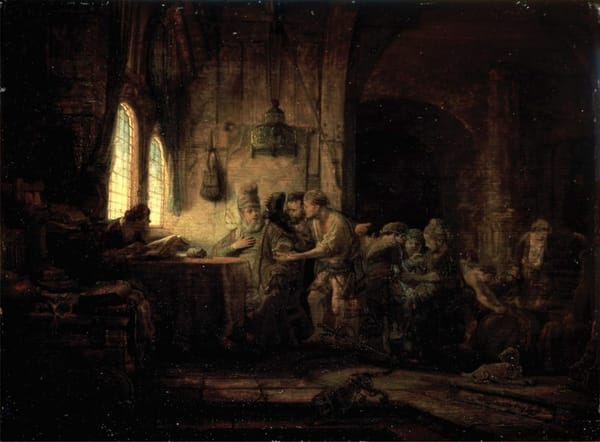
It is of importance that we should well understand this parable of the Gospel, and why the Church inserts it in to-day’s liturgy. Firstly, then, let us recall to mind on what occasion our Saviour spoke this parable, and what instruction He intended to convey by it to the Jews. He wishes to warn them of the fast approach of the day when their Law is to give way to the Christian Law; and He would prepare their minds against the jealousy and prejudice which might arise in them, at the thought that God was about to form a Covenant with the Gentiles. The vineyard is the Church in its several periods, from the beginning of the world to the time when God Himself dwelt among men, and formed all true believers into one visible and permanent society. The morning is the time from Adam to Noah; the third hour begins with Noah and ends with Abraham; the sixth hour includes the period which elapsed between Abraham and Moses; and lastly, the ninth hour opens with the age of the prophets, and closes with the birth of the Saviour. The Messias came at the eleventh hour, when the world seemed to be at the decline of its day. Mercies unprecedented were reserved for this last period, during which salvation was to be given to the Gentiles by the preaching of the apostles. It is by this mystery of mercy that our Saviour rebukes the Jewish pride. By the selfish murmurings made against the master of the house by the early labourers, our Lord signifies the indignation which the scribes and pharisees would show at the Gentiles being adopted as God’s children. Then He shows them how their jealousy would be chastised: Israel, that had laboured before us, shall be rejected for their obduracy of heart, and we Gentiles, the last comers, shall be made for we shall be made members of that Catholic Church, which is the bride of the Son of God.
This is the interpretation of our parable given by St. Augustine and St. Gregory the Great, and by the generality of the holy fathers. But it conveys a second instruction, as we are assured by the two holy doctors just named. It signifies the calling given by God to each of us individually, pressing us to labour, during this life, for the kingdom prepared for us. The morning is our childhood. The third hour, according to the division used by the ancients in counting their day, is sunrise; it is our youth. The sixth hour, by which name they called our midday, is manhood. The eleventh hour, which immediately preceded sunset, is old age. The Master of the house calls His labourers at all these various hours. They must go that very hour. They that are called in the morning may not put off their starting for the vineyard, under pretext of going afterwards, when the Master shall call them later on. Who has told them that they shall live to the eleventh hour? They that are called at the third hour may be dead at the sixth. God will call to the labours of the last hour such as shall be living when that hour comes; but, if we should die at midday, that last call will not avail us. Besides, God has not promised us a second call, if we excuse ourselves from the first.
At the Offertory, the Church invites us to celebrate the praises of God. God has mercifully granted us, that the hymns we sing to the glory of His name should be our consolation in this vale of tears.
Offertory
Secret
Second Secret
The third Secret is left to the priest’s own choice.
In the Communion antiphon, the Church prays that man, having now been regenerated by the Bread of heaven, may regain that likeness to his God which Adam received at his creation. The greater our misery, the stronger should be our hope in Him, who descended to us that we might ascend to Him.
Communion
Postcommunion
Second Postcommunion
The third Postcommunion is left to the priest’s own choice.
Vespers
The psalms and antiphons as on page 72.
Capitulum (1 Cor. ix.)
The hymn and versicle, page 79.
Antiphon of the Magnificat
Mercifully hear, we beseech thee, O Lord, the prayers of thy people; that we who are justly afflicted for our sins, may be mercifully delivered for the glory of thy name. Through, etc.
For each day of this week we select a few stanzas from the hymn, which the Greek liturgy uses in the Office for the Sunday preceding the fast of Lent. It is a lamentation over Adam's fall.
In Dominica Tyrophagi
| Previous Saturday before Septuagesima Sunday | Next January 25: The Conversion of St. Paul |