Daily reading
Septuagesima
Greater Double · January 25 · Sanctoral
January 25, 2027
From Dom Guéranger’s The Liturgical Year.
A Greater Double leads the weekday.Rubric

|
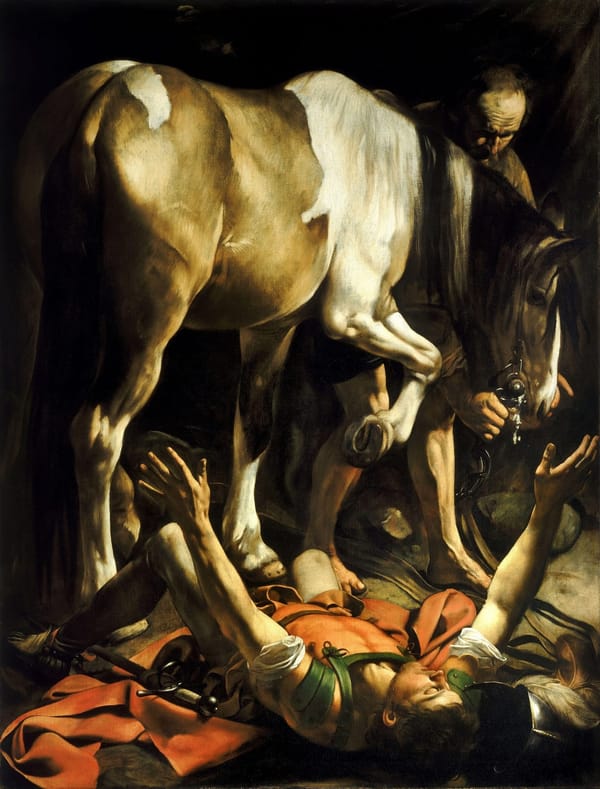
January 25: The Conversion of St. Paul
WE have already seen how the Gentiles, in the person of the Three Magi, offered their mystic gifts to the Divine Child of Bethlehem, and received from him in return the precious gifts of faith, hope and charity. The harvest is ripe; it is time for the reaper to come. But who is to be God's labourer? The Apostles of Christ are still living under the very shadow of Mount Sion. All of them have received the mission to preach the gospel of salvation to the uttermost parts of the world; but not one among them has as yet received the special character of Apostle of the Gentiles. Peter, who had received the Apostleship of Circumcision,1 is sent specially, as was Christ himself, to the sheep that are lost of the house of Israel.2 And yet, as he is the Head and the Foundation, it belongs to him to open the door of Faith to the Gentiles;3 which he solemnly does by conferring Baptism on Cornelius, the Roman Centurion.
But the Church is to have one more Apostle, an Apostle for the Gentiles; and he is to be the fruit of the martyrdom and prayer of St Stephen. Saul, a citizen of Tarsus, has not seen Christ in the flesh, and yet Christ alone can make an Apostle. It is then from heaven, where he reigns impassible and glorified, that Jesus will call Saul to be his disciple, just as, during the period of his active life, he called the fishermen of Genesareth to follow him and hearken to his teachings. The Son of God will raise Saul up to the third heaven, and there will reveal to him all his mysteries: and when Saul, having come down again to this earth, shall have seen Peter,4 and compared his Gospel with that recognized by Peter,5 he can say, in all truth, that he is an Apostle of Christ Jesus,6 and that he has done nothing less than the great Apostles.7
It is on this glorious day of the Conversion of Saul, who is soon to change his name into Paul, that this great work is commenced. It is on this day that there is heard the Almighty voice which breaketh the cedars of Libanus,8 and can make a persecuting Jew become first a Christian and then an Apostle. This admirable transformation had been prophesied by Jacob, when upon his deathbed he unfolded to each of his sons the future of the tribe of which he was to be the father Juda was to have the precedence of honour; from his royal race was to be born the Redeemer, the Expected of nations. Benjamin's turn came; his glory is not to be compared with that of his brother Juda, and yet it was to be very great—for from his tribe is to be born Paul, the Apostle of the Gentile nations.
These are the words of the dying Prophet: Benjamin, a ravenous wolf , in the morning shall eat the prey, and in the evening shall divide the spoil.9 Who, says an ancient writer,10 is he that in the morning of impetuous youth goes like a wolf in pursuit of the sheep of Christ, breathing threatenings and slaughter against them? Is it not Saul on the road to Damascus, the bearer and doer of the high-priest's orders, and stained with the blood of Stephen, whom he has stoned by the hands of all those over whose garments he kept watch? And he who in the evening, not only does not despoil, but with a charitable and peaceful hand breaks to the hungry the bread of life—is it not Paul, of the tribe of Benjamin, the Apostle of Christ, burning with zeal for his brethren, making himself all to all, and wishing even to be an anathema for their sakes?
Oh! the power of our dear Jesus! how wonderful! how irresistible! He wishes that the first worshippers at his Crib should be humble Shepherds—and he invites them by his Angels, whose sweet hymn was enough to lead these simple-hearted men to the Stable, where, in swaddling-clothes, he lies who is the hope of Israel. He would have the Gentile Princes, the Magi, do him homage—and bids a star to arise in the heavens, whose mysterious apparition, joined to the interior speaking of the Holy Ghost, induces these men of desire to come from the far East, and lay at the feet of an humble Babe their riches and their hearts. When the time is come for forming the Apostolic College, he approaches the banks of the sea of Tiberias, and with this single word: Follow me, he draws after him such as he wishes to have as his Disciples. In the midst of all the humiliations of his Passion, he has but to look at the unfaithful Peter, and Peter is a penitent. Today, it is from heaven that he evinces his power: all the mysteries of our redemption have been accomplished, and he wishes to show mankind that he is the sole author and master of the Apostolate, and that his alliance with the Gentiles is now perfect: he speaks; the sound of his reproach bursts like thunder over the head of this hot Pharisee, who is bent on annihilating the Church; he takes this heart of the Jew, and, by his grace, turns it into the heart of the Apostle, the Vessel of election, the Paul who is afterwards to say of himself: I live, not I, bid Christ liveth in me.11
The commemoration of this great event was to be a Feast in the Church, and it had a right to be kept as near as might be to the one which celebrates the martyrdom of St Stephen, for Paul is the Protomartyr's convert. The anniversary of his martyrdom would, of course, have to be solemnized at the summer solstice; where, then, place the feast of his Conversion if not near Christmas, and thus our own Apostle would be at Jesus' Crib, and Stephen's side? Moreover, the Magi could claim him, as being the conqueror of that Gentile world of which they were the first-fruits.
And lastly, it was necessary, in order to give the court of our Infant-King its full beauty, that the two Princes of the Church—the Apostle of the Jews, and the Apostle of the Gentiles—should stand close to the mystic Crib; Peter with his Keys, and Paul with his Sword. Bethlehem thus becomes the perfect figure of the Church, and the riches of this season of the Cycle are abundant beyond measure.
Let us borrow from the ancient Liturgies a suitable expression of our admiration of our Apostle's Conversion. The following Sequence, which belongs to the tenth century, is found in the old Missals of the Churches of Germany. It is full of mysterious allusions, which bear a certain grandeur of thought.
Sequence
The Roman-French Missals give us this beautiful Hymn of Adam of Saint-Victor.
Sequence
Triumphale pange melos,
Gentium Ecclesia.
Consummavit stadium
Triumphans in gloria.
Lupus rapax, præda vescens,
Hostis est fidelium.
Post tenebras lucente sidere,
Docet Evangelium.
Quem vitæ via corripit,
Dum Damascum graditur.
Sed prostratus jam obedit;
Sed jam vinctus ducitur.
Lupus ad ovem trahitur;
Mens resedit effera.
Mutat virus in pigmentum
Unda salutifera.
Vas propinans dulce vinum
Doctrinalis gratiæ.
Christi fidem astruit
Prophetarum serie.
Causa crucis cruciatur:
Mille modis moritur:
Et invicta constantia
Omnis poena vincitur.
Mundi vincit sapientes
Dei sapientia.
Videt Patrem et Filium
In una substantia.
Præbet colla, discit mysteria:
Fides Christi proficit.
Quo docente, fides crevit,
Paulum ense conficit.
Paulus, videt verum
Solem Patris Unigenitum.
Cujus vitemus numine
Gehennalem gemitum.
sing with heart and voice thy hymn of triumph,
and make the heavens echo.
has finished his course,
and triumphs in glory.
the ravenous wolf, the devourer of the prey,
the enemy of the Faithful.
The night was past, the day-star rose,
and he preaches the Gospel.
but was stayed, as he goes to Damascus,
by Him who is the Way of Life.
he prostrates, and obeys;
he is made captive, and goes whither he is led.
—the wolf to the lamb;
his stormy heart is calm.
its saving waters turn the venom of his soul
into the fragrance of love.
a vessel that gives forth to men the sweet wine
of the grace of doctrine.
and proves the Christian faith
by unfolding the prophets.
and for the sake of that Cross himself does bear the cross,
dying a thousand deaths.
conquering every pain
by unconquered courage.
and by the wisdom of God he overcomes
the wise ones of the world.
he sees the Father and Son
in one substance.
—both bow down their heads, and learn the Mysteries,
and embrace the Faith of Christ.
to see this Paul spreading the Faith by his preaching,
and sentences him to die by the sword.
Paul sees the true Sun,
the Only Begotten of the Father.
by whose almighty power
we shun the pains of hell.
The ancient Sacramentaries give us nothing upon the Conversion of St Paul. We take the following Prayer and Preface from the Gallican Missal published by Dom Mabillon, under the title of Missale Gothicum.
Prayer
Preface
We give thee thanks, O Jesus! who hast this day prostrated thine enemy by thy power, and raised him up again by thy mercy. Truly art thou the Mighty God, and thy victories shall be praised by all creatures. How wonderful art thou, in thy plans for the world's salvation! Thou makest men thy associates in the work of the preaching of thy word, and in the dispensing of thy Mysteries; and in order to make Paul worthy of such an honour, thou usest all the resources of thy grace. It pleased thee to make an Apostle of Stephen’s murderer, that so thy sovereign power might be shown to the world, thy love of souls be evinced in its richest gratuitous generosity, and grace abound where sin had so abounded. Sweet Saviour! often visit us with this grace which converts the heart; for we desire to have the life of grace abundantly, and we feel that its very principle is often in danger within us. Convert us, as thou didst thine Apostle; and after having converted us, assist us; for without thee we can do nothing. Go before us, follow us, stand by our side; never leave us, but as thou hast given us the commencement, secure to us our perseverance to the end. Give us that Christian wisdom which will teach us how to acknowledge, with fear and love, that mysterious gift of grace which no creature can merit, and to which, nevertheless, a creature's will may put an obstacle. We are captives: thou alone art master of the instrument, wherewith we can break our chains; thou puttest it into our hands, bidding us make use of it; so that our deliverance is thy work, not ours—but our captivity, if it continue, can only be attributed to our negligence and sloth. Give us, O Lord, this thy grace; and graciously receive the promise we now make, that we will render it fruitful by co operating with it.
Assist us, thou holy Apostle of Jesus! to correspond with the merciful designs of God in our regard; obtain of him for us, that we may be overcome by the sweetness of an Infant-God. His voice does not make itself heard; he does not blind us by the glare of his divine light; but this we know—he often complains that we persecute him! Oh! that we could have the courage to say to him, with a heart honest like thine: Lord! what wilt thou that we do? He would answer, and tell us to be simple, and to become little children like himself—to recognize now, after so many Christmases of indifference, the love he shows us in this mystery of Bethlehem—to declare war against sin—to resist our evil inclinations—and to advance in virtue, by walking in his divine footsteps. Thou hast said, in one of thine Epistles: If any man love not our Lord Jesus Christ, let him be anathema!12 Oh! teach us to know him more and more, so that we may grow in his love; and by thy prayers, preserve us from that ingratitude which turns even the sweet Mysteries of this holy season into our own greater condemnation.
Glorious Vessel of election! pray for the conversion of sinners who have forgotten their God. When on this earth, thou didst spend thyself for the salvation of souls; continue thy ministry, now that thou art reigning in heaven, and draw down, upon them that persecute Jesus, the graces which triumph over the hardest hearts. Apostle of the Gentiles! look with an eye of loving pity on so many nations, that are still sitting in the shadow of death. During thy mortal life, thou wast divided between two ardent desires—one, to be with Christ, the other, to remain longer on earth labouring for the salvation of immortal souls: now that thou art united for ever with the Jesus thou didst preach to men, forget not the poor ones to whom their God is a stranger. Raise up in the Church apostolic men, who may continue thy work. Pray to our Lord that he bless their labours, and the blood of such among them as are martyrs of zeal. Shield with thy protection the See of Peter, thy Brother-Apostle and thy Leader. Support the authority of the Church of Rome, which has inherited thy power, and looks upon thee as her second defence. May thy powerful intercession lead her enemies into humble submission, destroy schisms and heresies, and fill her Pastors with thy spirit, that like thee they may seek not themselves, but solely and in all things the interests of our Lord Jesus Christ.
Monday of Septuagesima Week
The serpent said to the woman: 'Why hath God commanded you, that you should not eat of every tree of paradise?'1 Thus opened the conversation, which our mother Eve so rashly consents to hold with God’s enemy. She ought to refuse all intercourse with Satan; she does not; and thereby she imperils the salvation of the whole human race.
Let us recall to mind the events that have happened up to this fatal hour. God, in His omnipotence and love, has created two beings, upon whom He has lavished all the riches of His goodness. He has destined them for immortality; and this undying life is to have everything that can make it perfectly happy. The whole of nature is made subject to them. A countless posterity is to come from them, and love them with all the tenderness of grateful children. Nay, this God of goodness who has created them, deigns to be on terms of intimacy with them; and such is their simple innocence, that this adorable condescension does not seem strange to them. But there is something far beyond all this. He, whom they have hitherto known by favours of an inferior order, prepares for them a happiness which surpasses all they could picture with every effort of thought. They must first go through a trial; and if faithful, they will receive the great gift as a recompense they have merited. And this is the gift: God will give them to know Him in Himself, make them partakers of His own glory, and make their happiness infinite and eternal. Yes, this is what God has done, and is preparing to do for these two beings, who but a while ago were nothing.
In return for all these gratuitous and magnificent gifts, God asks of them but one thing: that they acknowledge His dominion over them. Nothing, surely, can be sweeter to them than to make such a return; nothing could be more just All they are, and all they have, and all the lovely creation around them, has been produced out of nothing by the lavish munificence of this God; they must, then, live for Him, faithful, loving, and grateful. He asks them to give Him one only proof of this fidelity, love, and gratitude: He bids them not to eat of the fruit of one single tree. The only return He asks for all the favours He has bestowed upon them, is the observance of this easy commandment. His sovereign justice will be satisfied by this act of obedience. They ought to accept such terms with hearty readiness, and comply with them with a holy pride, as being not only the tie which will unite them with their God, but the sole means in their power of paying Him what He asks of them.
But there comes another voice, the voice of a creature, and it speaks to the woman: 'Why hath God commanded you, that you should not eat of every tree?’ And Eve dares, and has the heart, to listen to him that asks why her divine Benefactor has put a command upon her! She can bear to hear the justice of God’s will called in question! Instead of protesting against the sacrilegious words, she tamely answers them! Her God is blasphemed, and she is not indignant! How dearly we shall have to pay for this ungrateful indifference, this indiscretion! 'And the woman answered him, saying: Of the fruit of the trees that are in paradise we do eat; but of the fruit of the tree which is in the midst of paradise, God hath commanded us that we should not eat, and that we should not touch it, lest perhaps we die.’2 Thus Eve not only listens to the serpent’s question, she answers him; she converses with the wicked spirit that tempts her. She exposes herself to danger; her fidelity to her Maker is compromised. True, the words she uses show that she has not forgotten His command; but they imply a certain hesitation, which savours of pride and ingratitude.
The spirit of evil finds that he has excited, in this heart, a love of independence; and that, if he can but persuade her that she will not suffer from her disobedience, she is his victim. He, therefore, further addresses her with these blasphemous and lying words: 'No, you shall not die the death; for God knoweth, that in what day soever you shall eat thereof, your eyes shall be opened, and you shall be as gods, knowing good and evil.'3 What he proposes to Eve is open rebellion. He has enkindled within her that perfidious love of self which is man’s worst evil, and which, if it be indulged, breaks the tie between him and his Creator. Thus the blessings God has bestowed, the obligation of gratitude, personal interest, all are to be disregarded and forgotten. Ungrateful man would become a god; he would imitate the rebel angels: he shall fall as they did.
In Dominica Tyrophagi
| Previous Septuagesima Sunday | Next Monday of Septuagesima Week |