Daily reading
Septuagesima
Double · January 26 · Sanctoral
January 26, 2027
From Dom Guéranger’s The Liturgical Year.
A Double leads the weekday.Rubric
 |
January 26: St. Polycarp, Bishop and Martyr
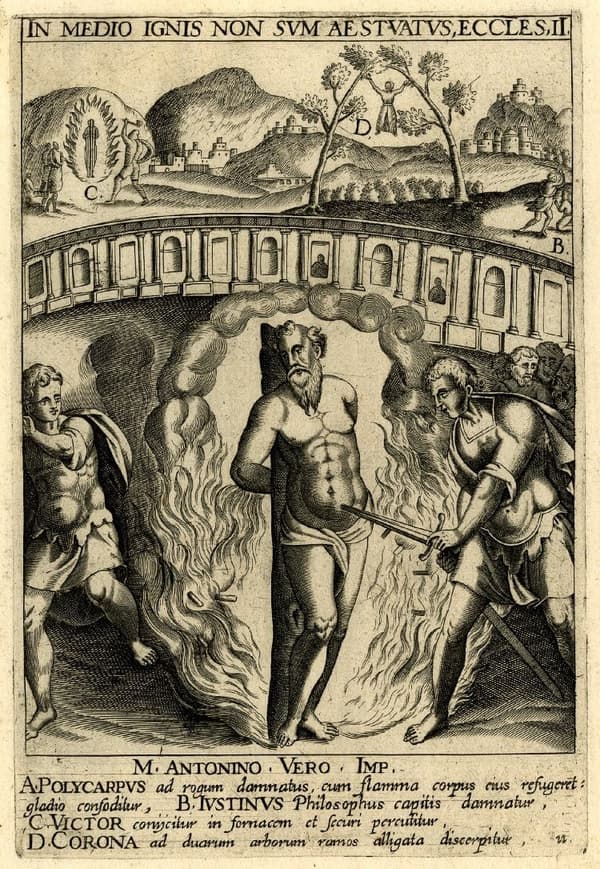
AMIDST the sweetness he is enjoying from the contemplation of the Word made Flesh, John, the Beloved Disciple, beholds coming towards him his dear Polycarp, the Angel of the Church of Smyrna,1 all resplendent with the glory of martyrdom. This venerable Saint has in his soul the fervent love that made him say in the amphitheatre, when asked by the Proconsul to curse his Divine Master: "Six-and-eighty years have I served Him, and he has never done me any wrong; nay, he has laden me with kindness. How could I blaspheme my King, who has saved me?" After having suffered fire and the sword, he was admitted into the presence of this King his Saviour, in reward for the eighty-six years of his faithful service, for the labours he had gone through in order to maintain faith and charity among his flock, and for the cruel death he endured.
He was a disciple of St John the Evangelist, whom he imitated by zealously opposing the heretics, who were then striving to corrupt the faith. In obedience to the command of his holy Master,2 he refused to hold intercourse with Marcion, the heresiarch, whom he called the first-born of Satan. This energetic adversary of the proud sect that denied the mystery of the Incarnation, wrote an admirable Epistle to the Philippians, in which we find these words: Whosoever confesses not that Jesus Christ came in the flesh, is an Antichrist. Polycarp, then, had a right to the honour of standing near the Crib, in which the Son of God shows himself to us in all his loveliness, and clothed in flesh like unto our own. Let us honour this disciple of John, this friend of Ignatius, this Bishop of the Apostolic Age, whose praise was pronounced by Jesus Christ himself in the Revelations of Patmos. Our Saviour said to him by the mouth of Saint John: Be thou faithful unto death, and I will give thee the crown of life.3 Polycarp was faithful even unto death, and has received his crown; and whilst we are celebrating the coming of his King among us, he is one of the Saints who assist us to profit by the holy season.
The Church gives us a passage from St Jerome's book, On Ecclesiastical Writers, in which there is contained the following short notice of our holy Martyr.
The Greek Church sings the praises of St Polycarp in her Menæa, from which we extract the following passages.
Die XXIII Februarii
Supra crucem visus, et hierarchico ornamento digne indutus, Pater, in templum Dei introisti proprio sanguine.
That thou, O holy Pontiff! mightest be presented to Christ, the Prince of Pastors, as the victim elect marked out by him, thou becamest the imitator of his passion, and art now a partaker of his glory, and the coheir of his kingdom.
How well didst thou bear out the full meaning of thy name, O Polycarp! for thou didst produce many fruits for thy Saviour, during thy six-and-eighty years spent in his service. The numerous souls won over to Christ, the virtues which adorned thy life, and thy life itself, which thou didst present to thy Lord in its full maturity—these were thy fruits. And what happiness was thine to have received instruction from the Disciple that leaned upon Jesus' Breast! After being separated from him for more than sixty years, thou art united with him on this the day of thy martyrdom, and thy venerable master receives thee in a transport of joy. Thou adorest, with him, that Divine Babe, whose simplicity thou hadst imitated during life, and who was the single object of thy love. Ask of him for us, that we too may be Faithful unto death.
By thy prayers, now that thou art throned in heaven, make fruitful the vineyard of the Church, which when on earth thou didst cultivate by thy labours, and water with the blood of thy glorious martyrdom. Re-establish faith and unity in the Churches of Asia, which were founded by thy venerable hand. Hasten, by thy prayers, the destruction of that degrading slavery of Mohammedanism which has kept the East in bondage so long, because her once faithful children severed themselves from Rome by the great schism of Byzantium. Pray for the Church of Lyons, which regards thee as its founder, through the ministry of thy disciple Pothinus, and takes itself so glorious a share in the apostolate of the Gentiles, by the Work of the Propagation of the Faith.
Watch over the purity of our holy Faith, and preserve us from being deceived by false teachers. The error which thou didst combat, and which teaches that all the mysteries of the Incarnation are but empty symbols, has risen up again in these our days. There are Marcions, even now, who would reduce all religion to myths; and they find some few followers; may thy powerful prayers rid the world of this remnant of so impious a doctrine. Thou didst pay homage to the Apostolic Chair, for thou, too, wouldst see Peter, and didst journey to Rome, in order to consult its Pontiff on questions regarding the interests of thy Church of Smyrna. Defend the rights of this august See, whence alone are derived both the jurisdiction of our Pastors, and the authoritative teachings of Faith. Pray for us, that we may spend the remaining days of this holy Season in the contemplation and the love of our new-born King. May this love, accompanied with purity of heart, draw down upon us the merciful blessings of God, and at length, after our course is run, obtain for us the Crown of Life.
Tuesday of Septuagesima Week
The serpent’s promises had stifled, in Eve’s heart, every sentiment of love for the God that had created her and loaded her with blessings: she is ambitious to be God like Him! Her faith, too, is wavering; she is not sure that God may not have deceived her, by threatening her with death should she disobey His command. Flushed by pride, she looks up to the forbidden fruit; it seems good to eat, and it is fair to her eyes.* So that her senses too conspire against God, and against her own happiness. The sin is already committed in her heart; it needs but a formal act to make it complete. She cares for nothing but self; God is no more heeded than if He did not exist. She stretches forth her daring hand; she plucks the fruit; she puts it to her mouth, and eats!
God had said that if she broke His commandment she should die; she has eaten, she has sinned, and yet she lives as before! Her pride exults at this triumph, and, convinced that she is too strong for God’s anger to reach her, she resolves on making Adam a partner in her victory. Boldly she hands him the fruit, which she herself has eaten without any evil coming to her. Whether he was emboldened by the impunity of his wife’s sin, or, from a feeling of blind affection, wished to share the lot of her who was the 'flesh of his flesh and bone of his bones,’ our first father, also, forgets all he owes to his Creator, and, as though there had never been aught of love between him and his God, he basely does as Eve suggests: he eats of the fruit, and by that act ruins himself and all his posterity.
No sooner have they broken the tie which united them with God, than they sink into themselves. As long as God dwells in the creature, whom He has raised to the supernatural state, his being is complete; but, let that creature drive his God away from himself by sin, and he finds himself in a state worse than nothing—the state of evil. That soul which, a moment before, was so beautiful and pure, is a hideous wreck. Thus is it with our first parents: they stand alone; creatures without God; and an intolerable shame seizes them. They thought to become gods, they aspired at infinite being; see them now:—sinners, the prey of concupiscence. Hitherto, their innocence was their allsufficient garb; the world was obedient to them; they knew not how to blush, and there was nothing to make them fear; but now, they tremble at their nakedness, and must needs seek a place wherein to hide!
The same self-love that had worked their ruin, had made them forget the greatness and goodness of God, and despise His commandment. Now that they have committed the great sin, the same blindness prevents them from even thinking of confessing it, or asking the forgiveness of the Master they have offended. A sullen fear possesses them. They can think of nothing but how and where to hide!
In Dominica Tyrophagi
* Gen. iii. 6. ↩︎
| Previous Monday of Septuagesima Week | Next Tuesday of Septuagesima Week |