Daily reading
Septuagesima
Double · January 17 · Sanctoral
January 28, 2027
From Dom Guéranger’s The Liturgical Year.
St. Antony transferred from Jan 17.Rubrics
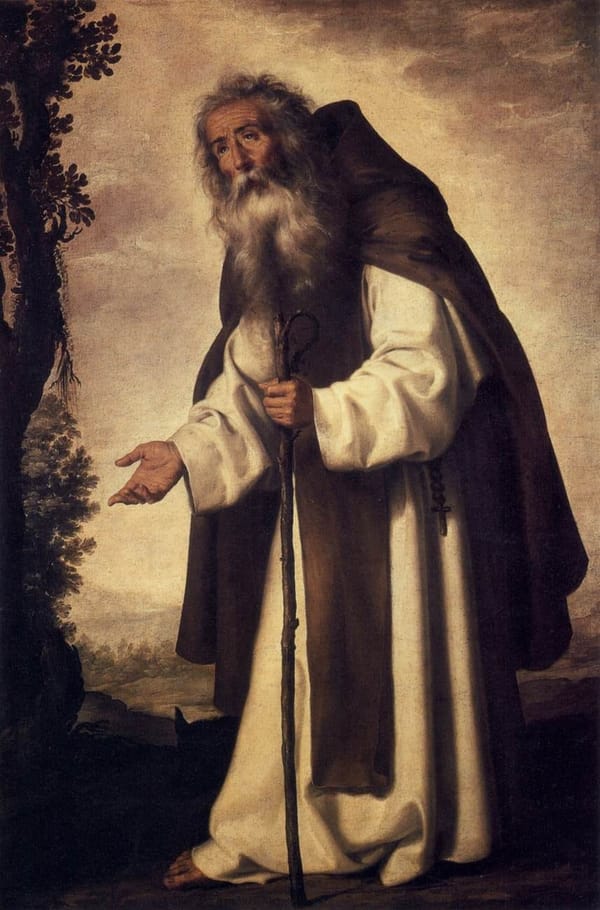 |
January 17: St. Antony, Abbot
THE East and West unite, to-day, in honouring St Antony, the Father of Cenobites. The Monastic Life existed before his time, as we know from indisputable testimony; but he was the first Abbot, because he was the first to bring Monks under the permanent government of one Superior or Father.
Antony began with seeking solely his own sanctification; he was known only as the wonderful Solitary against whom the wicked spirits waged an almost continuous battle: but in course of time, men were attracted to him by his miracles and by the desire of their own perfection; this gave him disciples; he permitted them to cluster round his cell; and monasteries thus began to be built in the desert. The age of the Martyrs was near its close; the persecution under Diocletian, which was to be the last, was over as Antony entered on the second half of his course: and God chose this time for organizing a new force in the Church. The Monastic Life was brought to bear upon the Christian world; the Ascetics, as they were called, not even such of them as were consecrated, were not a sufficient element of power. Monasteries were built in every direction, in solitudes and in the very cities; and the Faithful had but to look at these communities living in the fervent and literal fulfilment of the Counnsels of Christ, and they felt themselves encouraged to obey the Precepts. The apostolic traditions of continual prayer and penance were perpetuated by the monastic system; it secured the study of the Sacred Scriptures and Theology; and the Church herself would soon receive from these arsenals of intellect and piety her bravest defenders, her holiest Prelates, and her most zealous Apostles. Yes, the Monastic Life was to be and give all this to the Christian world, for the example of St Antony had given her a bias to usefulness. If there ever were a monk to whom the charms of solitude and the sweetness of contemplation were dear, it was our Saint; and yet they could not keep him in his desert when he could save souls by a few days spent in a noisy city. Thus, we find him in the streets of Alexandria when the pagan persecution was at its height; he came to encourage the Christians in their martyrdom. Later on, when that still fiercer foe of Arianism was seducing the Faith of the people, we again meet the great Abbot in the same capital, this time preaching to its inhabitants that the Word is consubstantial with the Father, proclaiming the Nicene faith, and keeping up the Catholics in orthodoxy and resolution. There is another incident in the life of St Antony which tells in the same direction, inasmuch as it shows how an intense interest in the Church must ever be where the Monastic Spirit is. We are alluding to our Saint's affection for the great St Athanasius, who on his part reverenced the Patriarch of the Desert, visited him, promoted the Monastic Life to the utmost of his power, used to say that he considered the great hope of the Church to be in the good discipline of monasticism, and wrote the Life of his dear St Antony.
But to whom is the glory of the institution of monasticism due, with which the destinies of the Church were, from that time forward, to be so closely connected, that the period of her glory and power was to be when the monastic element flourished, and the days of her affliction were to be those of its decay? Who was it that put into the heart of Antony and his disciples the love of that poor and unknown, yet ever productive life? It is Jesus, the humble Babe of Bethlehem. To him, then, wrapt in his swaddling-clothes, and yet the omnipotent God, be all the glory!
It is time to hear the account of some of the virtues and actions of the great St Antony, given by the Church in her Office of his Feast.
The Churches of the West, during the Middle Ages, have left us several Sequences in honour of St Antony. They are to be found in the ancient Missals. As they are not by any means remarkable as liturgical pieces, we shall content ourselves with inserting only one, omitting the three which begin Alme Confessor; In hac die lætabunda; Antonins hnmilis.
Sequence
Et devotis celebremus
Laudibus Antonium.
Et in suis honoretur
Sanctis, auctor omnium.
Opes ejus et honorem:
Parens Evangelio.
Ut non currat in incertum
In hoc vitæ stadio.
Clarus fulsit eremita.
Sed mox hostis subdoli
Gravi pugna: verum non vincitur
Insultu diaboli.
Et a sævis laceratur
Immane dæmonibus.
Et clara personuit
Dei vox de nubibus.
Decertasti: regione
Omni nominaberis:
Pro pellendis item morbis
Ignis, invocaberis.
Conspicamur, et repletum
Mundum tuo nomine.
Tibi pia defert vota
Pro tuo munimine.
Mulieris: pretiosæ
Nunc in massæ specie,
Sed, qui tanta, vafer, audes,
Succumbis in acie.
Sunt inanes: illi soli
Cedit orcus ingemens,
Et robustam ejus manum
Horret hostis infremens.
Fultus, inimico tali
Hic athleta restitit.
Illi fuit: his protectus
Armis, victor exstitit.
Palmæ frondes et amictus,
Ac cum bestiis conflictus,
Intra solitudinem.
Operandi crebritate,
Atque somni parcitate
Restinxit libidinem.
Et philosophis profanis,
Paulum visit, nec inanis
Fit via, nec irrita.
Inde sanctam ejus mentem
Cœlos vidit ascendentem,
Carne terræ reddita.
Nunc in regno claritatis
Gloriaris; hie gravatis
Mole camis, pietatis
Tuæ pande viscera.
Mors gehennæ, manum tende.
Nos a morbido defende
Igne, nobis et impende
Gloriam post funera.
the praises of Antony,
and celebrate his name in sacred hymns.
and God, the author of all,
be honoured in his Saints!
the beauty, and riches,
and honours of the world.
that he might not run with uncertainty
in the race of this life.
He was a celebrated hermit.
But soon does the crafty enemy
The combat is fierce and oft renewed;
but he is not vanquished by the devil's attacks.
and his flesh is cruelly torn
by the angry enemy.
and the sweet voice of God was heard
speaking from above:
thy name shall be published
in every country.
Thou shalt be invoked
against the disease of Fire.'
and the world resounds
with thy name.
and fervently pray to thee
for help and protection.
and sometimes under the form
of a piece of gold,
but after all thy daring, O crafty tempter!
thou art defeated in the fight.
and all hell falls back bemoaning
that one man single-handed has repelled them.
before this venerable soldier,
whose hand so roughly deals its blows.
and yet he wears no breast-plate
such as soldiers use.
these were his arms,
and by these he conquered.
the palm-leaf gave him raiment;
and his companions were the wild beasts
of the wilderness.
by assiduous prayer,
frequent manual labour,
and short sleep.
and the profane Philosophers;
he visited Paul the Hermit,
nor was the journey fruitless or vain;
and then saw his holy soul
mounting up to heaven,
and buried his body.
with the Blessed, in the kingdom of light;
show thy affectionate pity on us,
who are here weighed down
by the burden of the flesh.
lest the terrible death of hell seize upon us.
Defend us from the burning distemper,
and assist us to gain heaven
when our life is spent.
The Greek Church is enthusiastic in her praises of St Antony. We extract the following stanzas from her Menæa.
Die XVII Januarii
We unite, great Saint! with the universal Church in offering thee the homage of our affectionate veneration, and in praising our Emmanuel for the gifts he bestowed upon thee. How sublime a life was thine, and how rich in fruit were thy works! Verily thou art the Father of a great people, and one of the most powerful auxiliaries of the Church of God. We beseech thee, therefore, pray for the Monastic Order, that it may reappear in all its ancient fervour; and pray for each member of the great Family. Fevers of the body have been often allayed by thy intercession, and we beg for a continuance of this thy compassionate aid; but the fevers of our soul are more dangerous, and we beg thy pity and prayers that we may be delivered from them. Watch over us in the temptations which the enemy is unceasingly putting in our way; pray for us, that we may be viligant in the combat, prudent in avoiding dangerous occasions, courageous in the trial, and humble in our victory. The angel of darkness appeared to thee in a visible shape; but he hides himself and his plots from us; here again we beg thy prayers that we be not deceived by his craft. May the fear of God's judgements, and the thought of eternity, penetrate into the depth of our souls. May prayer be our refuge in every necessity, and penance our safeguard against sin. But above all, pray that we may have that which thou didst counsel—the Love of Jesus; of that Jesus who, for love of us, deigned to be born into this world, that so he might merit for us the graces wherewith we might triumph—of that Jesus who humbled himself even so far as to suffer temptation, that so he might show us how we were to resist and fight.
January 28 (the Same Day): St. Agnes, Her Second Feast
FIVE days after the martyrdom of the Virgin Emerentiana, the parents of the glorious Saint Agnes visited the tomb of their child, during the night, there to weep and pray. It was the eighth day since her martyrdom. Whilst they were thinking upon the cruel death, which, though it had enriched their child with a Martyr's palm, had deprived them of her society, Agnes suddenly appeared to them: she was encircled with a bright light, and wore a crown on her head, and was surrounded by a choir of virgins of dazzling beauty. On her right hand there stood a beautiful white lamb, the emblem of the Divine Spouse of Agnes.
Turning towards her parents, she said to them: 'Weep not over my death: for I am now in heaven, together with these virgins, living with him whom I loved on earth with my whole soul.'
It is to commemorate this glorious apparition that the holy Church has instituted this Feast, which is called Saint Agnes' Second Feast (Sanctœ Agnetis secundo). Let us pray to this fervent spouse of the Divine Lamb, that she intercede for us with him, and present us to him in this life, until it be given to us to possess him face to face in heaven. Let us unite with the Church in the following Prayer, which she uses in today's Office:
January 28 (the Same Day): The Blessed Charlemagne, Emperor
In many Churches, especially in Germany, there is kept, on the second Feast of the Martyr Agnes, the Feast of the pious Emperor Charlemagne. The Emmanuel, who is come into this world, is to receive the title of King of kings and Lord of lords; he is to gird himself with the sword, and bring all nations into subjection; what could be more fitting than that he should lead to his Crib the greatest of Christian Princes, who ever made it his glory to use his sword in the service of Christ and his Church?
Charlemagne was held as a Saint by the people, and the decree of his canonization was given by the Antipope Paschal the Third, in the year 1165, at the request of Frederic Barbarossa; on which account, the Holy See has permitted this public veneration to be continued in all those places where it prevailed, though it has never given its approbation to the informal procedure of Paschal, nor made it valid by its own sentence, which it would, in all probability, have done had the request been made. At the same time, the many Churches, which, now for seven centuries, have honoured the memory of Charlemagne, keep his Feast under the simple title of Blessed, out of respect to the Roman Martyrology, where his name is not inserted.
Before the Reformation, the name of Blessed Charlemagne was inscribed in the Calendar of a great many of the Churches in France; the Breviaries of Rheims and Rouen are the only ones that have retained it. The Church of Paris ceased to keep his Feast, in order to satisfy the prejudices of several Doctors of the University, in the early part of the 16th century. Protestantism had, naturally enough, an antipathy for a man, who was the noblest type of a Catholic Prince: and they who were tainted with the spirit of Protestantism, defended their blotting out the name of Charlemagne from the Calendar, not so much by the informality of his Canonization, as by the scandal which they affected to find in his life. Public opinion was formed on this, as on so many other matters, with extreme levity; and among those who will be surprised at finding the name of Charlemagne in this volume, we quite expect that they will be the most astonished who have never taken the trouble to inquire into the holiness of his life.
More than thirty Churches in Germany still keep the Feast of the great Emperor. His dear Church of Aix-la-Chapelle possesses his Relics and exposes them to the veneration of the people. The University of Paris, strange to say, chose him for its Patron in 1661; but his Feast, which had been given up for more than a century, was only restored as a national holiday, without the slightest allusion being made to it in the Liturgy.
It does not enter into the plan of this work to discuss the reasons, for which public veneration has been paid to the Saints whose feasts we keep during the year; our readers must not, therefore, expect from us anything in the shape of a formal defence of the saintly life of Charlemagne. Nevertheless, we cannot refrain from making a few remarks, which our subject seems to require. And firstly, we affirm, with the great Bossuet that the morals of Charlemagne were without reproach,* and that the contrary opinion, which is based on certain vague and contradictory expressions of a few writers of the Middle-Ages, has only gained ground by Protestant influence. Dom Mabillon—after having given the history of the Emperor’s repudiation of Hermengarde, and his return to Himiltrude, his first wife—concludes his account of Charlemagne, in his Benedictine Annals, by acknowledging that this Prince’s plurality of wives has never been proved to have been simultaneous. Natalis Alexander and Le Cointe—authors who cannot be taxed with partiality, and who have gone into all the intricacies of the question—prove most clearly, that the only reproach to be laid to Charlemagne’s charge, on the subject of his wives, is his having repudiated Himiltrude, out of complaisance to the mother of Hermengarde, a fault which he repaired the following year, in compliance with the remonstrances of Pope Stephen the Fourth.
We grant, that after the death of Luitgarde, the last of his wives who was treated as Queen, Charlemagne married several others, whom Eginhard calls concubines, because they did not wear the crown, and their children were not considered as princes of the blood; but we say, with Mabillon, that Charlemagne may have had these wives successively, and that it is difficult to believe the contrary, regarding so religious a Prince, and one who had singular respect for the laws of the Church.
But, independently of the opinion of the grave authors whom we have cited, there is an incontestable proof of Charlemagne’s innocence on the score of the simultaneous plurality of wives, at least from the time of his separation from Hermengarde. The Prince was then in his twenty-eighth year. The severity of the Roman Pontiffs relative to the marriages of sovereigns is too well known to require proof. The history of the Middle-Ages abounds with the struggles they had, on this essential point of Christian morals, with the most powerful monarchs, some of whom were most devoted to the Church. How, then, we would ask, would it be possible, that St. Adrian the First, who governed the Church from 772 to 795, and whom Charlemagne treated as a father, asking his advice in everything he undertook—how, we repeat, would this holy Pontiff allow Charlemagne to indulge in the most scandalous crimes, without remonstrating, whilst Stephen the Fourth, who only sat three years, and had not the same influence on this Prince, could induce him to dismiss Hermengarde? Or again, would St. Leo the Third—who reigned as Supreme Pontiff from 795 till after Charlemagne’s death, and who recompensed his virtuous conduct by crowning him Emperor—would he have made no effort to induce him to abandon the concubinage in which some writers would make us believe he lived after the death of his last Queen Luitgarde? Now, we find not the shadow of any such remonstrances made by these two Popes, who governed the Church for more than forty years, and have been placed on her altars. The honour of the Church herself is at stake in this question, and it is the duty of every Catholic to suspect the imputations cast on the name of Charlemagne as calumnies.
It would seem, from the letter of Pope Stephen the Fourth, that the marriage with Himiltrude was suspected, though falsely, of nullity; and it is not improbable that this suspicion may have satisfied Charlemagne’s conscience when he divorced her. However this may be, we find Charlemagne afterwards legislating against public immorality with all the zeal and energy of a man whose own life was not tainted with anything of the kind. We will cite but one example of this Christian firmness in repressing scandal, and we put it to the conviction of any honest heart, if a Prince, whose life had been a series of public scandals, could have dared to express himself, with the simplicity and confidence of an innocent conscience, in an assembly of the Bishops and Abbots of his Empire, and in the presence of the Princes and Barons whose licentiousness he wished to repress, and who might so justly have excused their own disorders, by the lewd example of the very man who exhorted them to virtue and threatened to chastise their vices? In a Capitulary, given during the Pontificate of St. Leo the Third, he thus decrees: “We forbid, under pain of sacrilege, the seizure of the goods of the Church, and injustices of whatsoever sort, adultery, fornication, incest, illicit marriage, unjust homicide, &c., for we know, that by such things kingdoms and kings, yea and private subjects, do perish. And whereas, by God’s help, and the merit and the intercession of the Saints and Servants of God, whom we have at all times honoured, we have gained a goodly number of kingdoms, and won manifold victories, it behoveth us all to be on our guard lest we deserve the forfeiture of these gains by the aforementioned crimes and shameful lewdnesses. We know, of a truth, that sundry countries, wherein have been perpetrated these seizures of the goods of the Church, these injustices, these adulteries, and these prostitutions, have lost their courage in battle, and their firmness in the faith. Any one may learn from history, how the Lord hath permitted the Saracens and other peoples to conquer the workers of such like iniquities; nor doubt we that the like will happen likewise to us, unless we abstain from such misdeeds; for God is wont to punish them. Be it, therefore, known to all our subjects, that he who shall be taken and convicted of any of these crimes, shall be deposed of all his honours, if he have any; that he shall be thrown into prison, till he repent and make amends by a public penitence; and, moreover, that he shall be cut off from all communication with the faithful; for we shall grievously fear the pit whereinto we see others be fallen.” Again, we ask, would Charlemagne have spoken such language as this, if, as has been asserted, his old age was being disgraced with debauchery, at the very time that he passed this Capitulary, that is, after the death of Luitgarde?
Granting, then, that this great Prince had sinned, we must allow that it was only in the early part of his reign, and we ought to remember that the remainder of his life was so holy as to be more than an ample penance. Is it not a sight worthy of our admiration to see this brave warrior, when he had become the mighty Sovereign, unceasingly practising, not only sobriety, which was a rare virtue among his countrymen, but fastings, which would bear comparisons with those of the most fervent anchorets—wearing a hair-shirt even to the day of his death—assisting at the Offices of the Church, day and night, even during his various campaigns, when he had the Divine services performed in his tent—and giving abundant alms, (which, as the Scripture tells us, covereth a multitude of sins,) not only to all the poor of his dominions, who besought his charity, but likewise to the Christians of Africa, Egypt, Syria, and Palestine, for whose sakes he more than once exhausted his royal treasury? But, what is above all this, and, in the absence of every other proof, would testify to Charlemagne’s possessing every virtue that could adorn a Christian Prince, is his making no other use of his sovereign power than that of spreading the Kingdom of Christ on the earth. It is the one single end he proposed to himself in every battle he fought, and every law he made.
This monarch, to whom were subject France, Catalonia, Navarre, and Aragon; Flanders, Holland, and Friesland; the provinces of Westphalia, Saxony, as far as the Elbe; Franconia, Suabia, Thuringia, and Switzerland; the two Pannonias, (that is, Austria and Hungary,) Dacia, Bohemia, Istria, Liburnia, Dalmatia, and even Sclavonia; and finally, the whole of Italy, as far as southern Calabria—this Monarch signs himself, in his glorious Capitularia: “I, Charles, by the grace of God and the giving of his mercy, King and governor of the Kingdom of the French, devoted defender of God’s Holy Church, and her humble Champion.” So many other Kings and Emperors—who are not to be compared with him in power, and yet are objects of men’s admiration in spite of all their crimes, which are artfully palliated by every possible excuse—have made it their one grand aim to enslave the Church. History tells us of even some otherwise pious Kings, who were jealous of her Liberty, and sought to curtail it: Charlemagne ever respected that Liberty, as though it were his own mother’s honour. It was he, that, following the example of Pepin, his father, so nobly secured the independence of the Apostolic See. Never had the Roman Pontiffs a more devoted or a more obedient Son. Scorning petty political jealousies, he restored to the clergy and people the episcopal elections, which were in the hands of the Sovereign, when he began his reign. He waged war mainly with a design to favour the propagation of the faith among infidel nations. He marched into Spain, that he might free the Christians from the yoke of the Moors. He brought the Churches of his Kingdom into closer union with the Apostolic See, by establishing the Roman Liturgy in all the States that were under his sceptre. In the whole of his legislation, which he framed in assemblies where Bishops and Abbots had the preponderance, there is not a single trace of what have been called Gallican Liberties, which consist in the interference of the Sovereign, or civil Magistrate in matters purely ecclesiastical. “So great was Charlemagne’s love for the Roman Church,” says Bossuet, “that the main point of his Last Will was the recommending to his successors the defence of the Church of St. Peter, a defence which was the precious heirloom of his house, handed down to him by his father and his father’s father, and which he was resolved to leave also to his children. It was this love of the Church which prompted him to say, and the saying was afterwards repeated in a full Council, held during the reign of one of his descendants, that if the Church of Rome were, by an impossibility, to put on us a burden which was well nigh insupportable, we ought to bear it.”
What could prompt this spirit of Christian moderation, which made Charlemagne so respectful to the moral power of the Church—what could temper down the risings of pride, which, as a general rule, increases with the increase of power—what save a most saintly tenor of life? Man, unless he be endowed with the help of a powerful grace, cannot attain, much less can he maintain himself his whole life long, in such perfect dispositions as these. Charlemagne, then, has been selected by our Emmanuel himself to be the perfect type of a Christian Prince; and we Catholics should love to celebrate his glory during this Christmas season, during which is born among us the Divine Child, who is come to reign over all nations, and guide them in the path of holiness and justice. Jesus has come from heaven to be the model of Kings, as of the rest of men; and so far, no man has so closely imitated this divine model as "Charles the Victorious, the ever August, the Monarch crowned by God.”
We will borrow from the Breviaries of Germany the liturgical history of her great Apostle. It is true, that there is a want of exactitude, here and there, in the following Lessons; but they are valuable, as being the expression of the devotion of a Catholic people for their glorious and saintly Emperor.
The following Hymn is taken from the same Office as the Lessons we have just read.
Hymn
Regum terræ Imperator,
Inter beatorum coetus,
Nostros audi pie fletus.
Languor cedit, vita datur,
Sitientibus das undas,
Et baptismo gentes mundas.
Sola prece frangis muros,
Regna suave jugum Christi
Ferre doces, quæ vicisti.
Servus prudens, et fidelis,
E castris astra petisti,
Ad locum pacis ivisti.
Fontem vivum nobis prode,
Ora pia prece Deum,
Et fac nobis pium eum.
Laus et honor Unitati,
Quæ virtute principali
Jure regnat coæquali.
Emperor of the kings of the world!
lovingly hear our prayers,
now that thou reignest among the blessed.
the sick are healed, life is restored,
the thirsty obtain fountains of water,
and whole nations are cleansed in the laver of baptism.
yield to the simple power of thy prayers;
and thou teachest the vanquished nations
to bear the sweet yoke of Christ.
and oh! how worthy of heaven!
Thou didst ascend thither from the battlefield,
thou enteredst into the land of peace.
and call forth for us a stream of living water.
By thy holy prayers,
obtain for us the mercy of our God.
Praise and honour to the Holy Unity,
that reigneth co-equally
in infinite power.
The same Liturgy gives us this Antiphon.
Among the Sequences written in honour of the holy Emperor, we find the following, which is taken from an ancient Missal of Aix-la-Chapelle.
Sequence
Regni sedes principalis,
Prima regum curia.
Quæ de magni regis gaudes
Caroli memoria.
Psallat chorus hic sonorus
Vocali concordia.
Bonum, quod cor meditatur,
Dulcis est psalmodia.
Magni Regis magna gesta
Recolat Ecclesia.
Omnes simul plaudant ac singuli
Celebri lætitia.
Hic invictæ dux cohortis
Decem sternit millia.
Atque metit gladio
Ex messe zizania.
Boni fructus bonus sator,
Et prudens agricola.
Fana, Deos, hic evertit,
Et confringit idola.
Hic regnare sacras leges
Facit cum justitia.
Ut et justus, sed nec sine
Sit misericordia.
Unctus dono gratiæ
Cæteris præ regibus.
Majestatis regiæ
Insignitur fascibus.
Jesu Christi conregnator,
Sis pro nobis exorator,
Sancte pater Carole.
Ut in regno claritatis,
Nos plebs tua cum beatis
Cœli simus incolæ.
Mundi salus, vitæ via,
Vacillantum rege gressus,
Et ad Regem des accessus,
In perenni gloria.
Incorruptæ fili Matris,
Per hunc sanctum cujus
Festa Celebramus, nobis præsta
Sempiterna gaudia.
seat of princely power,
and favourite court of kings!
the memory of King Charles the Great,
sing thy praises to the King of kings.
and this sweet choir of music
sing as with one voice of praise.
when the hand achieves
the holy meditation of the heart!
let the Church proclaim
the great deeds of the great King.
let all, and each, praise him
with a holiday of joy.
the leader of the invincible army,
and he prostrates his enemies by tens of thousands.
and with his sword
cleanses the harvest from the tares.
the good sower of the good seed,
the prudent husbandman.
he overthrows the temples,
and the false gods, and breaks the idols.
he establishes the reign
of holy laws and justice.
for he loves justice;
but he tempers justice by mercy.
and with grace,
above all other kings.
he is decked with all the emblems
of kingly majesty.
O King that now reignest with Christ!
O Charles! O sainted father!
pray for us,
being cleansed from our sins,
may be made fellow-citizens
with the blessed in the kingdom of heaven.
that didst give to the world its Saviour and its Life!
guide our faltering steps,
and lead us to Jesus our King,
in everlasting bliss.
Son of the Virgin-Mother!
we beseech thee, by the merits of the Saint
whose Feast we celebrate, grant us to come
to everlasting joy.
We will conclude our selection by giving the Collect said on this feast.
Collect
All hail faithful and beloved servant of God, Apostle of Christ, Defender of his Church, Lover of justice, Guardian of the laws of morality, and Terror of them that hate the Christian name! The hand of the Vicar of Christ purified the diadem of the Cæsars, and put it on thy venerable head. The imperial sceptre and globe are in thy hands. The sword of the victories won for God is girt on thy side. The Supreme Pontiff has anointed thee King and Emperor. Bearing thus in thyself the figure of Christ in his temporal Kingship, thou didst so use thy power as that he reigned in and by thee. And now he recompenses thee for the love thou hadst for him, for the zeal thou hadst for his glory, and for the respect thou didst ever evince to the Church, his Spouse. He has changed thy earthly and perishable royalty into that which is eternal, and in his heavenly kingdom thou art surrounded by those countless souls, whom thou didst convert from idolatry to the service of the one true God.
We are celebrating the Birth of the Son of that Virgin-Mother, in whose honour thou didst build the glorious Church, which still excites the admiration of all nations. It was in that sacred edifice that thou didst place the Swathing-clothes wherewith she clad her Divine Babe; and it is here, too, that our Emmanuel would have thine own Relics enshrined, so to receive the honour they deserve. O admirable imitator of the faith of the three Eastern Kings! present us to him, who deigned to be clothed in these humble garments. Ask him to give us a share of thy humility, which made thee love to kneel near his Crib—of thy devotion for the Feasts of the Church—of thy zeal for the glory of his divine Majesty—and of the courage and earnestness wherewith thou didst labour to spread his Kingdom on earth.
Oh! pray for our Europe, which was once so happy under thy paternal rule, and is now divided against itself. The Empire, which the Church confided to thy care, has now fallen, in just punishment for its treachery to the Church that gave it existence. The nations of that fallen Empire are now restless and unhappy. The Church alone can satisfy their wants, for she alone can give them Faith; she alone has not changed the principles of justice; she alone can control power, and teach subjects obedience. Oh! pray that nations, both people and their governments, may return to what can alone give them liberty and security, and cease to seek these blessings by revolution and discord. Protect France, that fairest gem of thy crown, protect her with an especial love, and show her that thou art ever her King and her Father. Finally, O blessed Charlemagne! ask our God that he arrest the progress of Russia, the Empire of schism and tyranny, and never permit that we become a prey to its intrigue and ambition.
* “Charlemagne was valiant, wise, and moderate; he was a warrior without ambition, and led an exemplary life. This I say, notwithstanding the reproaches heaped upon him by ignorance, in times past. His prodigious conquests caused the kingdom of God to be spread, and, in everything he did, he showed himself to be a perfect Christian.” Sermon on the Unity of the Church. ↩︎
Thursday of Septuagesima Week
Forgiveness is promised; but atonement must be made. Divine justice must be satisfied, and future generations be taught that sin can never pass unpunished. Eve is the guiltier of the two, and her sentence follows that of the serpent. Destined by God to aid man in peopling the earth with happy and faithful children, formed by this God out of man’s own substance 'flesh of his flesh, and bone of his bones,’ woman was to be on an equality with man. But sin has subverted this order, and God’s sentence is this: conjugal union, notwithstanding the humiliation of concupiscence now brought upon it, is to be, as before, holy and sacred; but it is to be inferior in dignity, before both God and man, to the state of virginity, which disdains the ambitions of the flesh.
Secondly, woman shall be mother still, as she would have been in the state of innocence; but her honour shall be a burden. Moreover, she shall give birth to her children amidst cruel pains, and sometimes even death must be the consequence of her infant’s coming into the world. The sin of Eve shall thus be memorialized at every birth, and nature shall violently resist the first claims of him, whom sin has made her unwelcome lord.
Lastly, she who was at first created to enjoy equality of honour with man, is now to forfeit her independence. Man is to be her superior, and she must obey him. For long ages, this obedience will be no better than slavery; and this degradation shall continue till that Virgin comes, whom the world shall have expected for four thousand years, and whose humility shall crush the serpent’s head. She shall restore her sex to its rightful position, and give to Christian woman that influence of gentle persuasiveness, which is compatible with the duty imposed upon her by divine justice, and which can never be remitted: the duty of submission.
In Dominica Tyrophagi
| Previous Wednesday of Septuagesima Week | Next January 28 (the Same Day): St. Agnes, Her Second Feast |