Daily reading
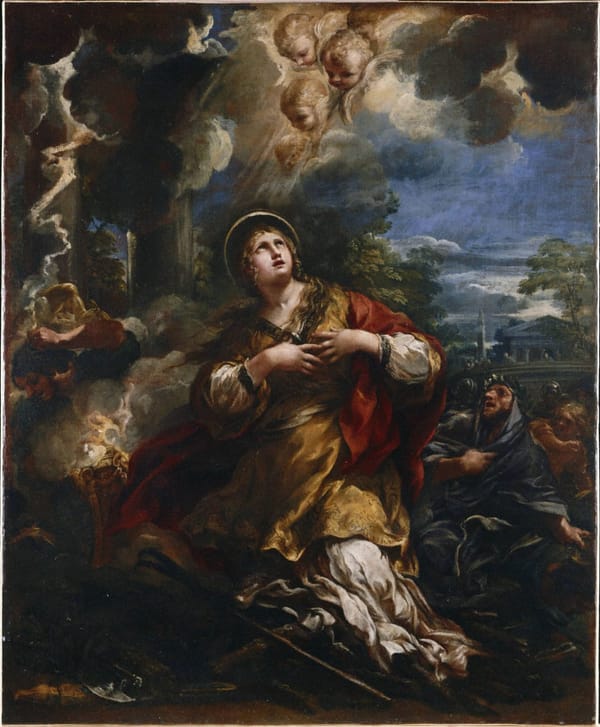
January 30: St. Martina, Virgin and Martyr
A FOURTH Roman Virgin, wearing on her brow a martyr’s crown, comes today to share the honours given to Agnes, Emerentiana, and Prisca, and offer her palm to the Lamb. Her name is Martina, which the pagans were wont to give to their daughters in honour of their god of war. Her sacred relics repose at the foot of the Capitoline hill, in the ancient temple of Mars, which has now become the beautiful Church of Saint Martina. The holy ambition to render herself worthy of him whom she had chosen as her divine Spouse, gave her courage to suffer torments and death for his sake; so that of her, as of the rest of the martyrs, we may say those words of the Liturgy, washed her robes in the Blood of the Lamb. Our Emmanuel is the Mighty God,1 the Lord that is mighty in war,2 not, like the Mars of the pagans, needing the sword to win his battles. He vanquishes his enemies by meekness, patience, and innocence, as in the martyrdom of today’s Saint, whose victory was grander than was ever won by Rome’s boasted warriors.
This illustrious Virgin, who is one of the Patrons of the City of Rome, is honoured by having her praises sung by one of the Popes. It was Urban the Eighth who wrote the Hymns which are recited on her feast, and which we subjoin to the Lessons which recount the glorious combats of our Saint.
We unite into one the three hymns of Urban the Eighth, in which the holy Church prays for the deliverance of Jerusalem. It is the last cry of the Crusades.
Hymn
Cives Romulei, plaudite gloriæ:
Insignem meritis dicite Virginem,
Christi dicite Martyrem.
Inter delicias, inter amabiles
Luxus illecebras, ditibus affluit
Faustæ muneribus domus.
Se rerum Domino, et munifica manu
Christi pauperibus distribuens opes,
Quærit præmia cœlitum.
Non virgæ horribili vulnere commovent :
Hinc lapsi e Superum sedibus Angeli
Cœesti dape recreant.
Se rictu placido projicit ad pedes;
Te, Martina, tamen dans gladius neci
Cœli coetibus inserit.
Quæ fumat, precibus jugiter invocat,
Et falsum perimens auspicium, tui
Delet nominis omine.
Da pacis requiem Christianum plagis;
Armorum strepitus, et fera prælia
In fines age Thracios.
Vexillo, Solymas nexibus exime,
Vindexque innocui sanguinis hosticum
Robur funditus erue.
Nostrarum obsequium respice mentium :
Romæ vota libens excipe, quæ pio
Te ritu canit, et colit.
Tu, qui Martyribus dexter ades, Deus
Une, et Trine, tuis da famulis jubar,
Quo clemens animos beas.
of the glorious Martina.
Sing the praises of this admirable Virgin
and Martyr of Christ.
and was brought up in every delicacy,
surrounded by all that could pamper nature,
and with riches of a princely house at her command.
dedicates herself to the Creator of all things,
and with a liberal hand distributes her riches to the poor of Christ,
that she may gain the riches of heaven.
or the cruel wound-inflicting rods.
Angels descend from heaven,
comforting her with divine food.
and tamely come crouching at her feet.
The sword, Martina! gave thee the wished-for death,
and death united thee to the choirs of heaven.
where clouds of incense shroud devotion's love;
and thy blessed name banishes
that of the false deity Mars.
and give to Christian countries the rest of holy peace,
driving unto Thracian coasts
the din of arms and war.
deliver Jerusalem from her chains.
Avenge innocent blood,
and once for all crush down the Turkish foe,
see this homage of our loving hearts.
Hear the prayers of thy Rome,
which on this festive day offers thee its hymns and reveres thy name.
take from us the pleasures which would make us fall.
O Triune God! give to thy servants the blessed light,
wherewith thy mercy crowns the soul with bliss.
Thus does Christian Rome hymn thy praises, O generous Martyr! and whilst praising, begs thee to protect her with thy loving care. She is safe from danger, if shielded by such watchfulness as thine. Hear her prayers, and drive far from the Holy City the enemies that would plot her ruin. She has foes more to be dreaded than they that attack her walls with the cannon of their fierce artillery; she has them who plot the destruction of her independence. Disconcert these plans of perfidy, and remember, O Martina! that the City which now asks thy aid was the mother that trained thee to be a martyr.
Obtain for us from Jesus, thy Spouse, the courage to destroy those idols of our affections, to which we are so prone to offer the sacrifice of our hearts. The enemies of our salvation are untiring in their attacks upon our frailty; oh! stretch out to us thy helping hand; that hand which made the idols of Rome tremble, is not less powerful now to stay the violence of the world that threatens to destroy our souls. Thy own brave combats have given thee a place of honour near our Redeemer’s Crib: if, like thee, we will but resist and conquer, this Mighty God will welcome us, too, and bless us. He came into this world that he might vanquish our enemies, but he requires of us to share with him the toils of the battle. Pray for us, O Martina! that our confidence in God may ever be accompanied by diffidence in ourselves, and we shall never be cowards in the great contest for heaven!
Saturday of Septuagesima Week
The sentence pronounced by the Almighty upon our first parents was to fall upon their children to the end of time. We have been considering, during this week of Septuagesima, the penalties of the great sin; but the severest and most humiliating of them all remains to be told. It is the transmission to the whole human race of original sin. It is true that the merits of the promised Redeemer will be applied to each individual man, in the manner established by God at various periods of time: still, this spiritual regeneration, whilst cleansing us from the leprosy which covered us, and restoring us to the dignity of children of God, will not remove every scar of the old wound. It will save us from eternal death, and restore us to life; but, as long as our pilgrimage lasts, we shall be weak and sickly. Thus it is that ignorance makes us short-sighted in those great truths, which should engross all our thoughts; and this fills us with illusions, which, by an unhappy inclination of our will, we cling to and love. Concupiscence is ever striving to make our soul a slave to the body; and in order to escape this tyranny, our life has to be one continual struggle. An unruly love for independence is unceasingly making us desire to be our own masters, and forget that we were born to obey. We find pleasure in sin, whereas virtue rewards us with nothing, in this life, save the consciousness of our having done our duty.
Knowing all this, we are filled with admiration and love when we think of thee, O Mary! thou purest of God’s creatures. Thou art our sister in nature; thou art a daughter of Eve; but thou wast conceived without sin, and art therefore the honour of the human race. Thou art of the same flesh and blood as ourselves; and yet thou art immaculate. The divine decree, which condemned us to inherit the disgrace of original sin, could not include thy most pure conception; and the serpent felt, as thy foot crushed his haughty head, that thou hadst never been under his power. In thee, O Mary! we find our nature such as it was when our God first created it. Hail, then, spotless Mirror of justice!
O Mary! beautiful in thine unsullied holiness, pray for us who are weighed down by the consequences of that sin of our first parents, which God would not suffer to approach thee. Thou art the implacable enemy of the serpent; watch over us, lest his sting inflict death on our souls. We were conceived in sin, and born in sorrow; pray for us, that we may so live as to merit blessing. We are condemned to toil, to suffering, and to death; intercede for us, that our atonement may find acceptance with our Lord. We are exposed to the treachery of our evil inclinations; we are in love with this present life; we forget eternity; we are ever striving to deceive our own hearts: how could we escape hell, were the grace of thy divine Son not unceasingly offered to us, enabling us to triumph over all our enemies? Thou, O Immaculate Mother of Jesus, art the Mother of divine grace! Pray for us, that we, who glory in being thy kindred by nature, may be daily more and more enriched with this priceless gift.
Let us salute the blessed Mother of God in the words of the following sequence, taken from the ancient missal of Cluny. Catholic piety has consecrated to Mary the Saturday of each week.
Sequence
Modulemur licet rei,
Poscentes remedia.
Spes mirandæ speciei,
Quæ vernat in gloria.
Spes Solaris, sola laris
Terreni fiducia.
Passus rectos et directos,
Da pacis suffragia.
Fulgens dux in pelago,
Tu præclara.
Stella nitens celebris,
Deo cara.
Residens, hæc mellica
Admitte cantica, Virgo pia.
Trementi pro scelere
Des ausus, Tu plausus, Veri vena.
Mundi medicina,
Munda scelus nostrum,
Piissima.
Nos ad vitam mina,
Placans Deum,
Tu benignissima.
Patria parens, Virgo pia,
Nos in umbræ mortis via
Sedentes illumina!
Tui Nati tuti cruce,
Mereamur cœli luce
Per te frui, Domina.
sing a hymn in praise of the Mother of God;
let us sing our prayer for help.
that beautiful Mother,
whose glory is bright as spring!
and warms our earthly home
with the sunny beam of hope.
direct us, steer us,
get us the calm of peace.
guiding us, as does the friendly star which leads
the shipwrecked into port.
thou art the shining well-known star,
so dear to God.
receive, O Virgin Mother,
these our sweet canticles.
do thou, fount of truth,
give courage and applause.
thou art the solace of the world;
may thy loving prayers
cleanse us from our guilt.
but intercede for us to God,
most merciful Queen!
and so lead us unto life.
Mother of thy Creator!
Virgin ever merciful! enlighten us
that are sitting in the shades of death.
and protected by the cross of thy Son,
we may, through thy intercession,
be brought to the enjoyment of light eternal.
| Previous Friday of Septuagesima Week | Next Saturday of Septuagesima Week |