Daily reading
Septuagesima
Double · February 1 · Sanctoral
February 1, 2027
From Dom Guéranger’s The Liturgical Year.
A Double leads the weekday.Rubric
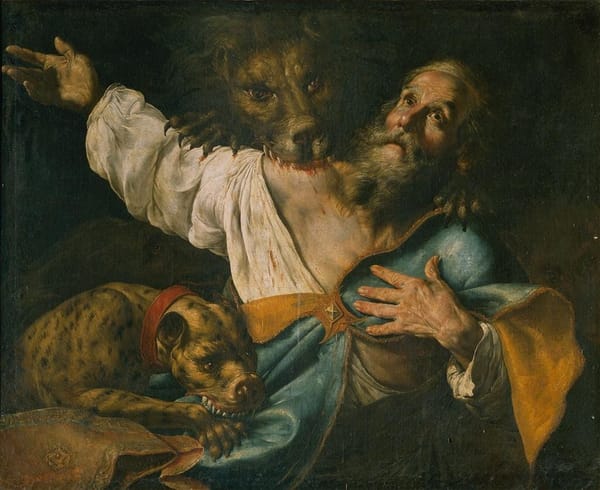 |
February 1: St. Ignatius, Bishop and Martyr
TWO days more, and the happy season of Christmas will be over! This is the vigil of its termination, and lo! there comes to gladden us one of the grandest Martyrs of the year—Ignatius surnamed the Theophorus,1 Bishop of Antioch. A venerable tradition tells us that this old man, who so generously confessed the faith before Trajan, was the child whom Jesus took into his arms, and showed to his Disciples as a model of that simplicity which we must all have if we would enter into the kingdom of heaven. Today he appears before us, standing near the Crib in which this same Jesus gives us his own divine lessons of humility and simplicity.
But, in this the Court of our Emmanuel, Ignatius stands near to Peter, the Feast of whose Chair we kept a few days since; for the Prince of the Apostles made him his second successor in his first See of Antioch. From so honoured a position Ignatius derived that courage which made him resist a powerful Emperor even to his face, defy the wild beasts of the amphitheatre, and triumph by a glorious martyrdom. As it were to show the supremacy of the See of Rome, Divine Providence willed that he, with his chains upon him, should go to see Peter,2 and finish his course in the Holy City, and thus mingle his blood with that of the Apostles. Rome would have been imperfect without the glory of Ignatius’ martyrdom, which is the pride of her Coliseum, rich as it is with the blood of so many thousands of martyrs.
His chief characteristic is impetuous love for God. He has but one fear—it is that the prayers of the Romans will stay the lions from devouring him, and his desire of being united to Christ be thus denied him. Let us admire this superhuman fortitude, which shows itself thus suddenly in the pagan world, and let us acknowledge that so ardent a love of God, and so vehement a longing to possess him, could only have come from the accomplishment of the Mysteries of our Redemption, which showed man how much God loved him. The Crib of Bethlehem, even had there never been the Sacrifice of Calvary, would of itself be sufficient to convince us of all this. God comes down from heaven for the sake of his creature, man; he himself becomes Man, nay, a Child, and is laid in a manger! Such miracles of love would have sufficed to save the guilty world; how then shall they not have power to prompt men to give their whole heart to their loving God? And would it be too much if we made a sacrifice of our very lives to repay Jesus for only that much of his love which he showed us by being born among us?
The Church gives us, in the Lessons of today's Office, the brief account of our Saint given by St Jerome in his Book On Ecclesiastical Writers. The holy Doctor has inserted a few sentences from the Martyr's admirable Epistle, written to the Faithful of Rome. We would have gladly offered the whole of this Epistle to our readers, had it not been for want of space. But the passages quoted by St Jerome are some of the finest.
We find the following stanzas in the Menæa of the Greek Church, for the Feast of St Ignatius.
All thy desires were satisfied, O glorious Martyr! Thou hast died for Jesus—thou art with Jesus. Rome's sons and daughters filled the Coliseum; their savage joy made it tremble with their cheers as they saw thee mangled by the lions. It was the hour thou hadst prayed for; thy sacrifice for him, who had sacrificed himself for thee, is over, and thy soul is buried in his divine embrace! Generous and impetuous lover of Christ! thou wast ambitious to pay thy debt to the Crucified—the debt of suffering. It seemed to thee that thou hadst no right to his kingdom until thou hadst repaid his Passion by some cruel tortures endured for him. O worthy companion of Stephen, Sebastian, Vincent and Agnes I how rich and verdant is the palm thou holdest over the Crib! Canst thou look upon us, weak Christian cowards, and not pity us? Pray for us that we may at least be faithful to our Lord when we are persecuted by the temptations of the world, the flesh and the devil; that we may at least give our hearts to his service, if we are not to be permitted to give our bodies to be tortured for his name. Thou wast chosen, when a little child, as the model of the simplicity which our Saviour was teaching to his Disciples, and this innocence never left thee: ask for us from him, who is the King of Little Children, that one of the graces of the Christmas we have been keeping may be this holy Simplicity of heart.
Successor of Peter in the See of Antioch! pray for the Churches of thy Patriarchate, that they may return to the true Faith and Catholic unity. Intercede for the holy City of Rome, which thou didst water with thy blood, and which is now in possession of thy sacred relics, that were saved from the lions’ jaws. Watch over the maintenance of ecclesiastical discipline and order, of which thou hast left such admirable rules in thy Epistles; and obtain for the Church that all the members of her hierarchy may be united in the bonds of duty and love, that thus she may be beautiful in the strength of her unity and terrible to the enemies of God, as an army set in array.3
Monday of Sexagesima Week
All flesh had corrupted its way upon the earth.1 The terrible lesson, then, which men had received, by being driven out of paradise in the person of our first parents, had been without effect. Neither the certainty of death, when they would have to stand before the divine Judge, nor the humiliations which attend man’s first coming into this world, nor the pains and fatigues and trials which beset the whole path of life, had subdued men’s hearts, or brought them into submission to that sovereign Master whose hand lay thus heavy upon them. They had the divine promise that a Saviour should be given to them, and that this Redeemer (who was to be the Son of her that was to crush the serpent’s head), would not only bring them salvation, but would moreover reinstate them in all the happiness and honours they had lost. But even this was not enough to make them rise above the base passions of corrupt nature. The example of Adam’s nine hundred years’ penance, and the admonitions he could so feelingly give who had received such proofs of God’s love and anger, began to lose their influence upon his children; and when he at last descended into the grave, his posterity grew more and more heedless of what they owed to their Creator. The long life, which had been granted to man in this the first age of the world, was made but a fresh means of offending Him who gave it. When, finally, the sons of Seth took to themselves wives of the family of Cain, the human race reached the height of wickedness, rebelled against the Lord, and made their own passions their god.
Yet, all this while, they had had granted to them the power of resisting the evil propensities of their hearts. God had offered them His grace, whereby they were enabled to conquer pride and concupiscence. The merits of the Redeemer to come were even then present to divine justice, and the Lamb, slain, as St. John tells us, from the beginning of the world,2 applied the merits of His Blood to this as to every generation which existed before the great Sacrifice was really immolated. Each individual of the human family might have been just, as Noah was, and, like him, have found favour with the Most High; but the thought of their heart was bent upon evil, and not upon good, and the earth became peopled with enemies of God. Then it was that it repented God that He had made man,3 as the sacred Scripture forcibly expresses it. He decreed that man’s life on earth should be shortened, in order that the thought of death might be ever before us. He, moreover, resolved to destroy, by a universal deluge, the whole of this perverse generation, saving only one family. The world would thus be renewed, and man would learn from this awful chastisement to serve and love this his sovereign Lord and God.
We find the following liturgical formula in the Mozarabic missal. Nothing could be more appropriate to the season of Septuagesima.
Missa
(Dominica ante carnes tollendas.)
| Previous Sexagesima Sunday | Next Monday of Sexagesima Week |