lyp.network

Daily reading

Septuagesima

Double · February 4 · Sanctoral

February 4, 2027

From Dom Guéranger’s The Liturgical Year.

A Double leads the weekday.Rubric
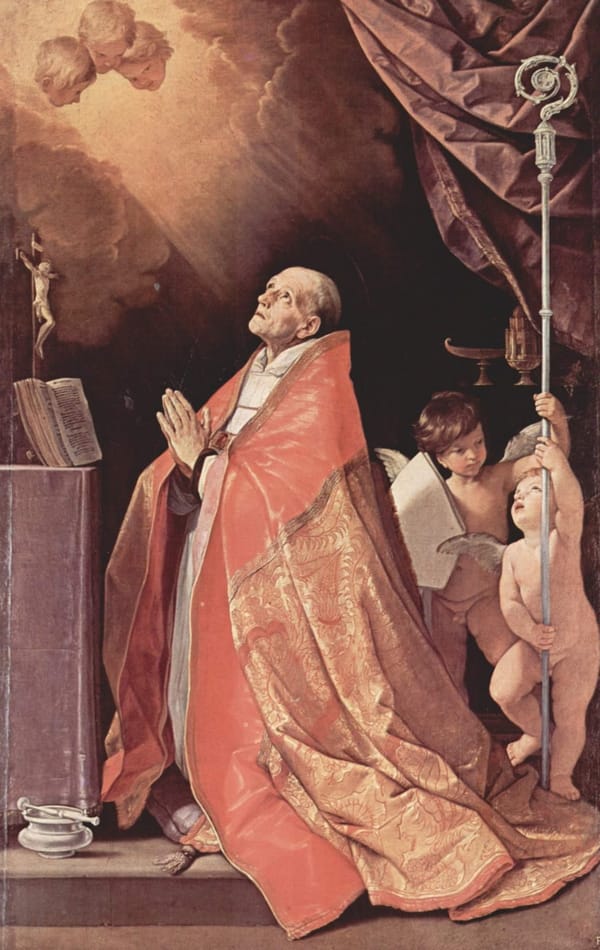
Bishop saint in coral cope praying; putti with crozier and book
St Andrew Corsini in Prayer, Guido Reni (1575–1642), 1630–1635. Credits

February 4: St. Andrew Corsini, Bishop and Confessor

The saintly bishop, whose feast we keep to-day pressingly invites us, by his austere life and his burning zeal for the salvation of souls, to procure, at all costs, our own reconciliation with the divine justice. We are indebted for this feast to a member of the illustrious family of the Corsini, Pope Clement XII., who, however, was but the instrument used by divine Providence. The holy bishop of the little town of Fiesole ever sought to be unknown during his life, and God, who willed that he should be glorified by the whole Church, inspired the sovereign Pontiff to inscribe his name among the saints of the universal calendar. Andrew the saint was once a sinner; his example will encourage us in the work of our conversion.

Let us read the account of his virtues as given us by the Church.

Andream Florentiæ ex nobili Corsinorum familia natura parentes precibus a Deo impetrarunt, et beatæ Virgini spoponderunt. Qualis autem futurus esset, divino præsagio, antequam nasceretur, ostensum est: nam mater gravida sibi visa est per quietem lupum edidisse, qui, ad Carmelitarum ædem pergens, in ipso templi vestibuio statim in agnum conversus est. Adolescens pie et ingenue educatus, cura sensim ad vitia declinaret, sæpe a matre increpatus fuit. Ubi autem cognovit, se parentum voto Deiparæ Virgini dicatum fuisse, Dei amore succensus, deque visu matris admonitus, Carmelitarum institutum amplexus est, in quo variis tentationibus a dæmone vexatus, numquam tamen potuit a religionis proposito dimoveri. Mox Lutetiam missus, emenso studiorum curriculo, et laurea donatus in patriam revocatur, suique Ordinis regimini in Etruria præficitur.
Interea Fesulana Ecclesia suo viduata pastore eum sibi episcopum elegit: quo munere se indignum oestimans, diu latuit iguotus, donec pueri voce mirabiliter loquentis proditus, et extra urbem inventus, ne divinæ contradiceret voluntati episcopatum suscepit. Ea dignitate auctus, humilitate, quam semper coluerat, impensius incubuit et pastorali solicitudini, misericordiam in pauperes, liberalitatem, orationis assiduitatem, vigilias, aliasque virtutes adjunxit, et spiritu etiam prophetico clarus fuit, adeo ut ejus sanctitas ab omnibus celebraretur.
His permotus Urbanus quintus ad sedandas Bononiæ turbas Andream legatum misit: quo in munere multa perpessus, civium odia, quæ ad internecionem exarserant, summa prudentia restinxit; tum restituta tranquillitate ad propria reversus est. Nec multo post assiduis laboribus, et voluntaria carnis maceratione confectus, obitus die a beata Virgine sibi prædicto, ad cœlestia regna migravit, anno Domini millesimo trecentesimo septuagesimo tertio, ætatis suæ septuagesimoprimo. Quem Urbanus octavus multis magnisque miraculis clarum, sanctorum numero adscripsit. Ejus corpus Fiorentiæ in ecclesia sui Ordinis quiescit, et maxima civium veneratione colitur: quibus non semel in præsenti discrimine præsidio fuit.
Andrew was born at Florence, of the noble Corsini family. He was the fruit of his parents’ prayers, and was consecrated by them to the blessed Virgin. His future was thus shown by God to the mother. She dreamt that she had given birth to a wolf, which went to the church of the Carmelites, and, as it crossed the threshold, was suddenly changed into a lamb. Though his early education was calculated to form him to piety, and to everything that suited his high birth, he, by degrees, fell into a vicious manner of life, notwithstanding the frequent reproaches made him by his mother. But as soon as he was told that he had been consecrated by his parents to the Virgin Mother of God, and heard of his mother’s vision, he entered the Order of Carmelites. The devil ceased not to molest him, even then, with manifold temptations; but nothing could make him change his resolution of entering the religious life. Shortly after his profession, he was sent to Paris for a course of study; having completed it, and taken his degrees, he returned to Italy, and was made superior of his Order in the province of Tuscany.
It happened about that time, that the Church of Fiesole lost its bishop, and Andrew was chosen as his successor. But looking on himself as unworthy of such a dignity, he hid himself so that no one knew where he was. But a child, who had not yet received the use of speech, miraculously revealed the place, outside the town, where he was: upon which the saint, fearing that further refusal would be a resistance to the divine will, was consecrated bishop. Thus exalted to so great a dignity, he applied himself more than ever to the practice of humility, which had always been his favourite virtue. To the zeal of a good pastor, he united tender compassion for the poor, abundant almsgiving, a life of prayer, long watchings, and other virtues; all which, together with the gift of prophecy he had received, gained for him a great reputation for sanctity.
Pope Urban V., hearing of his great merits, sent him as his legate to Bologna, that he might quell a sedition that had arisen in that city. The fulfilment of this charge cost him much suffering; but such was his prudence, that he succeeded in restoring peace among the citizens, and so preventing further bloodshed; he then returned to Fiesole. Not long after this, being worn out by ceaseless labours and bodily mortifications, and having been told by the blessed Virgin of the precise day of his death, he passed from this life to the kingdom of heaven, in the year of our Lord thirteen hundred and seventy three, and in the seventy-first year of his age. Great was the reputation of his name on account of the many and wonderful miracles wrought through his intercession, and at length he was canonized by Urban VIII. His body reposes in the church of his Order at Florence, where it is held in great veneration, the citizens having often experienced his protection in times of public calamity.

Hear, O holy pontiff, our prayer: we are sinners, and would learn from thee how we are to return to the God we have offended. His mercy was poured out upon thee; obtain the same for us. Have pity on Christians throughout the world, for the grace of repentance is now being offered to all; pray for us, that we may be filled with the spirit of compunction. We have sinned; we sue for pardon; intercession like thine can win it for us. From wolves, change us into lambs. Strengthen us against our enemies; obtain for us an increase of the virtue of humility, which thou hadst in such perfection; and intercede for us with our Lord, that He crown our efforts with perseverance, as He did thine; that thus we may be enabled to unite with thee in singing, for ever, the praises of our Redeemer.


Thursday of Sexagesima Week

God promised Noah that He would never more punish the earth with a deluge. But, in His justice, He has many times visited the sins of men with a scourge which, in more senses than one, bears a resemblance to a deluge: the invasion of enemies. We meet with these invasions in every age; and each time we see the hand of God. We can trace the crimes that each of them was sent to punish, and in each we find a manifest proof of the infinite justice wherewith God governs the world.

It is not requisite that we should here mention the long list of these revolutions, which we might almost say make up the history of mankind, for in its every page we read of conquests, extinction of races, destruction of nations, and violent amalgamations, which effaced the traditions and character of the several peoples that were thus forced into union. We will confine our considerations to the two great invasions, which the just anger of God has permitted to come upon the world since the commencement of the Christian era.

The Roman Empire had made itself as preeminent in crime as it was in power. It conquered the world, and then corrupted it. Idolatry and immorality were the civilization it gave to the nations which had come under its sway. Christianity could save individuals in the great empire, but the empire itself could not be made Christian. God let loose upon it the deluge of barbarians. The stream of the wild invasion rose to the very dome of the Capitol; the empire was engulfed. The ruthless ministers of divine justice were conscious of their being chosen for this mission of vengeance, and they gave themselves the name of ‘God's scourge.’

When, later on, the Christian nations of the east had lost the faith which they themselves had transmitted to the western world; when they had disfigured the sacred symbol of faith by their blasphemous heresies; the anger of God sent upon them, from Arabia, the deluge of Mahometanism. It swept away the Christian Churches, that had existed from the very times of the apostles. Jerusalem, the favoured Jerusalem, on which Jesus had lavished His tenderest love, even she became a victim to the infidel hordes. Antioch and Alexandria, with their patriarchates, were plunged into the vilest slavery; and at length Constantinople, that had so obstinately provoked the divine indignation, was made the very capital of the Turkish empire.

And we, the western nations, if we return not to the Lord our God, shall we be spared? Shall the flood-gates of heaven's vengeance, the torrent of fresh Vandals, ever be menacing to burst upon us, yet never come? Where is the country of our own Europe, that has not corrupted its way, as in the days of Noah? that has not made conventions against the Lord and against His Christ?1 that has not clamoured out that old cry of revolt: Let us break their bonds asunder, let us cast away their yoke from us?2 Well may we fear lest the time is at hand, when, despite our haughty confidence in our means of defence, Christ our Lord, to whom all nations have been given by the Father, shall rule us with a rod of iron, and break us in pieces like a potter’s vessel.3 Let us propitiate the anger of our offended God, and follow the inspired counsel of the royal prophets Serve ye the Lord with fear; embrace the discipline of His Law; lest, at any time, the Lord be angry, and ye perish from the just way.4

We find the following beautiful words in the Ambrosian liturgy for Septuagesima. They occur in the missal.

Transitorium
(Dominica in Quinquagesima.)

Venite, convertimini ad me, dicit Dominus. Venite flentes, fundamus lacrymas ad Deum: quia nos negleximus, et propter nos terra patitur. Nos iniquitatem fecimus, et propter nos fundamenta commota sunt. Festinemus iram Dei antevertere, flentes, et dicentes: Qui tollis peccata mundi, miserere nobis.
Come, be converted unto me, saith the Lord. Let us come weeping, and pour out our tears before God, for we have been negligent, and because of us is the earth suffering. We have committed iniquity, and because of us are the foundations of the world moved. Let us hasten to avert the wrath of God; let us weep, and say: O thou, that takest away the sins of the world, have mercy upon us!

  1. Ps. ii 2. ↩︎
  2. Ps. ii. 3. ↩︎
  3. Ibid., 9. ↩︎
  4. Ibid., 12. ↩︎
Previous
Wednesday of Sexagesima Week
Next
Thursday of Sexagesima Week