Daily reading
Lent
Major feria · Movable from Easter · Temporal
February 10, 2027
From Dom Guéranger’s The Liturgical Year.

|

Ash Wednesday
Including:
Yesterday, the world was busy in its pleasures, and the very children of God were taking a joyous farewell to mirth: but this morning, all is changed. The solemn announcement, spoken of by the prophet, has been proclaimed in Sion:1 the solemn fast of Lent, the season of expiation, the approach of the great anniversaries of our Redemption. Let us, then, rouse ourselves, and prepare for the spiritual combat.
But in this battling of the spirit against the flesh we need good armour. Our holy mother the Church knows how much we need it; and therefore does she summon us to enter into the house of God, that she may arm us for the holy contest. What this armour is we know from St. Paul, who thus describes it: ‘Have your loins girt about with truth, and having on the breastplate of justice. And your feet shod with the preparation of the Gospel of peace. In all things, taking the shield of faith. Take unto you the helmet of salvation, and the sword of the Spirit, which is the word of God.’2 The very prince of the apostles, too, addresses these solemn words to us: ‘Christ having suffered in the flesh, be ye also armed with the same thought.’3 We are entering, to-day, upon a long campaign of the warfare spoken of by the apostles: forty days of battle, forty days of penance. We shall not turn cowards, if our souls can but be impressed with the conviction, that the battle and the penance must be gone through. Let us listen to the eloquence of the solemn rite which opens our Lent. Let us go whither our mother leads us, that is, to the scene of the fall.
The enemies we have to fight with, are of two kinds: internal, and external. The first are our passions; the second are the devils. Both were brought on us by pride, and man’s pride began when he refused to obey his God. God forgave him his sin, but He punished him. The punishment was death, and this was the form of the divine sentence: ‘Thou art dust, and into dust thou shalt return.’4 Oh that we had remembered this! The recollection of what we are and what we are to be, would have checked that haughty rebellion, which has so often led us to break the law of God. And if, for the time to come, we would persevere in loyalty to Him, we must humble ourselves, accept the sentence, and look on this present life as a path to the grave. The path may be long or short; but to the tomb it must lead us. Remembering this, we shall see all things in their true light. We shall love that God, who has deigned to set His heart on us notwithstanding our being creatures of death: we shall hate, with deepest contrition, the insolence and ingratitude, wherewith we have spent so many of our few days of life, that is, in sinning against our heavenly Father: and we shall be not only willing, but eager, to go through these days of penance, which He so mercifully gives us for making reparation to His offended justice.
This was the motive the Church had in enriching her liturgy with the solemn rite, at which we are to assist this morning. When, upwards of a thousand years ago, she decreed the anticipation of the lenten fast by the last four days of Quinquagesima week, she instituted this impressive ceremony of signing the forehead of her children with ashes, while saying to them those awful words, wherewith God sentenced us to death: ‘Remember, O man, that thou art dust, and into dust thou shalt return!’ But the making use of aBhes as a symbol of humiliation and penance, is of a much earlier date than the institution to which we allude. We find frequent mention of it in the Old Testament. Job, though a Gentile, sprinkled his flesh with ashes, that, thus humbled, he might propitiate the divine mercy:5 and this was two thousand years before the coming of our Saviour. The royal prophet tells us of himself, that he mingled ashes with his bread, because of the divine anger and indignation.6 Many such examples are to be met with in the sacred Scriptures; but so obvious is the analogy between the sinner who thus signifies his grief, and the object whereby he signifies it, that we read such instances without surprise. When fallen man would humble himself before the divine justice, which has sentenced his body to return to dust, how could he more aptly express his contrite acceptance of the sentence, than by sprinkling himself, or his food, with ashes, which is the dust of wood consumed by fire? This earnest acknowledgment of his being himself but dust and ashes, is an act of humility, and humility ever gives him confidence in that God, who resists the proud and pardons the humble.
It is probable that, when this ceremony of the Wednesday in Quinquagesima week was first instituted, it was not intended for all the faithful, but only for such as had committed any of those crimes for which the Church inflicted a public penance. Before the Mass of the day began, they presented themselves at the church, where the people were all assembled. The priests received the confession of their sins, and then clothed them in sackcloth, and sprinkled ashes on their heads. After this ceremony, the clergy and the faithful prostrated, and recited aloud the seven Penitential Psalms. A procession, in which the penitents walked bare-footed, then followed; and on its return, the bishop addressed these words to the penitents: ‘Behold, we drive you from the doors of the church by reason of your sins and crimes, as Adam, the first man, was driven out of paradise because of his transgression.’ The clergy then sang several responsories, taken from the Book of Genesis, in which mention was made of the sentence pronounced by God when He condemned man to eat his bread in the sweat of his brow, for that the earth was cursed on account of sin. The doors were then shut, and the penitents were not to pass the threshold until Maundy Thursday, when they were to come and receive absolution.
Dating from the eleventh century, the discipline of public penance began to fall into disuse, and the holy rite of putting ashes on the heads of all the faithful indiscriminately became so general that, at length, it was considered as forming an essential part of the Roman liturgy. Formerly, it was the practice to approach bare-footed to receive this solemn memento of our nothingness; and in the twelfth century, even the Pope himself, when passing from the church of St. Anastasia to that of St. Sabina, at which the station was held, went the whole distance bare-footed, as also did the Cardinals who accompanied him. The Church no longer requires this exterior penance; but she is as anxious as ever that the holy ceremony, at which we are about to assist, should produce in us the sentiments she intended to convey by it, when she first instituted it.
As we have just mentioned, the station in Rome is at St. Sabina, on the Aventine Hill. It is under the patronage of this holy martyr that we open the penitential season of Lent.
THE BLESSING OF THE ASHES
The function begins with the blessing of the ashes, which are to be put on our foreheads. These ashes are made from the palms, which were blessed the previous Palm Sunday. The blessing they are now to receive in this their new form, is given in order that they may be made more worthy of that mystery of contrition and humility which they are intended to symbolize.
The choir begins by chanting this antiphon, which is a prayer for mercy.
Antiphon
The priest, standing at the altar, and having the ashes near him, begs of God, by the following prayers, that He would make them an instrument of our sanctification.
Oremus
Oremus
Oremus
Let us Pray
Having said the last of these prayers, the priest sprinkles the ashes with holy water, and censes them. The first in order of the priests who are present, marks the celebrant’s forehead with them. Then the ministers at the altar and the clergy receive them from the celebrant, who finally gives them to the faithful, saying:
When the priest puts the holy emblem of penance upon you, accept in a spirit of submission, the sentence of death, which God Himself pronounces against you: ‘Remember, O man, that thou art dust, and into dust thou shalt return!’ Humble yourself, and remember what it was that brought the punishment of death upon us: man wished to be as a god, and preferred his own will to that of his sovereign Master. Reflect, too, on that long list of sins, which you have added to the sin of your first parents, and adore the mercy of your God, who asks only one death for all these your transgressions.
During the time the priest is giving the ashes, the choir sings the following antiphons and responsory.
Anthem
Anthem
Responsory
As soon as all the faithful have received the ashes, the priest sings the following prayer:
Mass
The soul has regained her confidence by the act of humility she has performed. She approaches the God of mercy, and reminds Him of the tender love He bears to His creature man, and of the patience wherewith He waits for his repentance. These are the sentiments expressed in the Introit, which is taken from the Book of Wisdom.
Introit
In the Collect, the Church prays that her children may have the two-fold grace of a fervent commencement and steady perseverance in the salutary fast of Lent.
Collect
Second Collect
Third Collect
Cap. ii.Hæc dicit Dominus: Convertimini ad me in toto corde vestro, in jojunio, et in fletu, et in planctu. Et scindite corda vestra, et non vestimentavestra, et convcrtimini ad Dominum Deum vcstrum: quia benignus et misericors est, patiens et multæ misericordiæ, et præstabilis super malitia. Quis seit si convertatur et ignoscat, et relinquat post se benedictionem, sacrificium et libamen Domino Deo vestro? Canito tuba in Sion, santificate jejunium, vocate cœtum, congregate populum, santificate Ecclesiam, coadunate senes, congregate parvulos et sugentes ubera: egrediatur sponsus de cubili suo, et sponsa de thalamo suo. Inter vestibulum et altare plorabunt sacerdotes ministri Domini, et dicent: Parce, Domine, parce populo tuo: et ne des hæreditatem tuam in opprobrium, ut dominentur eis nationes. Quare dicunt in populis: Ubi est Deus eorum? Zelatus est Dominus terram suam, et pepercit populo suo. Et respond it Dominus, et dixit populo suo: Ecce ego mittam vobis frumentum, et vinum, et oleum, et replebimini eis: et non dabo vos ultra opprobrium in gentibus: dicit Dominus omnipotens.
Ch. ii.Thus saith the Lord: Be converted to me with all your heart, in fasting, and in weeping, and in mourning. And rend your hearts, and not your garments, and turn to the Lord your God: for he is gracious and merciful, patient and rich in mercy, and ready to repent of the evil. Who knoweth but he will return, and forgive, and leave a blessing behind him; sacrifice and libation to the Lord your God? Blow the trumpet in Sion, sanctify a fast, call a solemn assembly, gather together the people, sanctify the Church, assemble the ancients, gather together the little ones, and them that suck at the breasts: let the bridegroom go forth from his bed, and the bride out of the bridechamber. Between the porch and the altar the priests, the Lord’s ministers, shall weep, and shall say: Spare, O Lord, spare thy people; and give not thine inheritance to reproach, that the heathens should rule over them. Why should they say among the nations: Where is their God? The Lord hath been zealous for his land, and hath spared his people. And the Lord answered, and said to his people: Behold, I will send you corn, and wine, and oil; you shall be filled with them, and I will no more make you a reproach among the nations, saith the Lord almighty.
We learn from this magnificent passage of the prophet Joel how acceptable to God is the expiation of fasting. When the penitent sinner inflicts corporal penance upon himself, God’s justice is appeased. We have a proof of it in the Ninivites. If the Almighty pardoned an infidel city, as Ninive was, solely because its inhabitants sought for mercy under the garb of penance; what will He not do in favour of His own people, who offer Him the twofold sacrifice, exterior works of mortification, and true contrition of heart? Let us, then, courageously enter on the path of penance. We are living in an age when, through want of faith and of fear of God, those practices which are as ancient as Christianity itself, and on which we might almost say it was founded, are falling into disuse; it behoves us to be on our guard, lest we, too, should imbibe the false principles, which have so fearfully weakened the Christian spirit. Let us never forget our own personal debt to the divine justice, which will remit neither our sins nor the punishment due to them, except inasmuch as we are ready to make satisfaction. We have just been told that these bodies, which we are so inclined to pamper, are but dust; and as to our souls, which we are so often tempted to sacrifice by indulging the flesh, they have claims upon the body, claims of both restitution and obedience.
In the Gradual, the Church again pours forth the expressions of her confidence in the God of all goodness, for she counts upon her children being faithful to the means she gives them of propitiating His justice.
The Tract is that beautiful prayer of the psalmist, which she repeats thrice during each week of Lent, and which she always uses in times of public calamity, in order to appease the anger of God.
Gradual
Tract
Gospel
Cap. vi.In illo tempore: Dixit Jesus discipulis suis: Cum jejunatis, nolite fieri sicut hypocritæ tristes. Exterminant enim facies suas, ut appareant hominibus jejunantes. Amen dico vobis, quia receperunt mercedem suam. Tu autem cum jejunas, unge caput tuum, et faciem tuam lava, ne videaris hominibus jejunans, sed Patri tuo, qui est in abscondito: et Pater tuus qui videt in abscondito, reddet tibi. Nolite thesaurizare vobis thesauros in terra, ubi ærugo et tinea demolitur, et ubi fures effodiunt, et furantur. Thesaurizate autem vobis thesauros in cœlo: ubi neque ærugo, neque tinea demolitur; et ubi fures non effodiunt, nec furantur. Ubi enim est thesaurus tuus, ibi est et cor tuum.
Ch. vi.At that time, Jesus said to his disciples: When you fast, be not as the hypocrites, sad. For they disfigure their faces, that they may appear unto men to fast. Amen, I say to you, they have received their reward. But thou, when thou fastest, anoint thy head, and wash thy face, that thou appear not to men to fast, but to thy Father, who is in secret: and thy Father, who seeth in secret, will repay thee. Lay not up to yourselves treasures on earth, where the rust and moth consume, and where thieves break through and steal. But lay up to yourselves treasures in heaven, where neither rust nor moth doth consume, and where thieves do not break through, nor steal. For where thy treasure is, there is thy heart also.
Our Redeemer would not have us receive the announcement of the great fast as one of sadness and melancholy. The Christian who understands what a dangerous thing it is to be behindhand with divine justice, welcomes the season of Lent with joy; it consoles him. He knows that if he be faithful in observing what the Church prescribes, his debt will be less heavy upon him. These penances, these satisfactions (which the indulgence of the Church has rendered so easy), being offered to God unitedly with those of our Saviour Himself, and being rendered fruitful by that holy fellowship which blends into one common propitiatory sacrifice the good works of all the members of the Church militant, will purify our souls, and make them worthy to partake in the grand Easter joy. Let us not, then, be sad because we are to fast; let us be sad only because we have sinned and made fasting a necessity. In this same Gospel, our Redeemer gives us a second counsel, which the Church will often bring before us during the whole course of Lent: it is that of joining almsdeeds with our fasting. He bids us to lay up treasures in heaven. For this, we need intercessors; let us seek them amidst the poor.
In the Offertory, the Church rejoices in her children being set free; she foresees that the wounds of our souls will be healed, for she has confidence in us that we shall persevere, and this fills her with gladness.
Offertory
Secret
Second Secret
Third Secret
The Preface
The words of the Church in the Communion antiphon contain an instruction of great importance to us. During this long career of penance, we shall stand in need of something to keep up our courage: let us meditate on the law and the mysteries of our Lord. If we relish the word of God as it is offered us by the Church on each day of this holy season, our hearts will receive an increase of light and love, and when our Lord shall rise from His tomb, the brightness of His Resurrection will shine upon us.
Communion
Postcommunion
Second Postcommunion
Third Postcommunion
Every day during Lent, Sundays excepted, the priest, before dismissing the faithful, here adds a special prayer, which is preceded by these words of admonition:
Prayer
February 10: St. Scholastica, Virgin
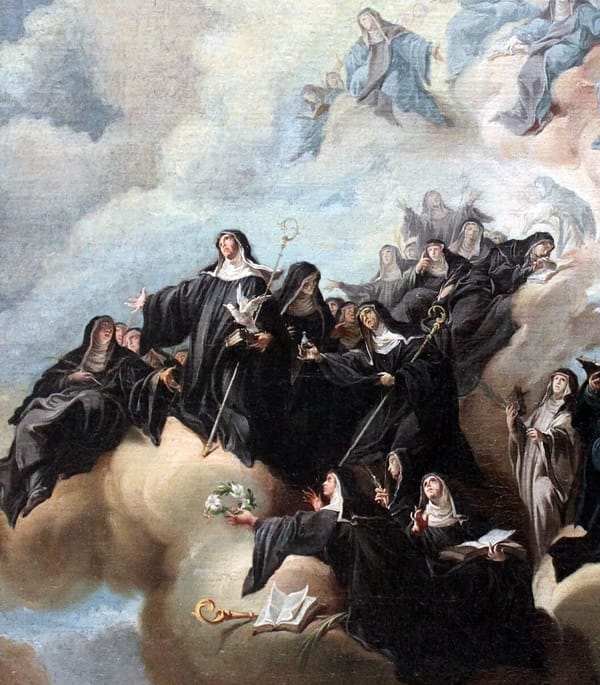 |
The sister of the patriarch St. Benedict comes to us to-day, sweetly inviting us to follow her to heaven. Apollonia the martyr is succeeded by Scholastica, the fervent daughter of the cloister. Both of them are the brides of Jesus, both of them wear crowns, for both of them fought hard, and won the palm. Apollonia’s battle was with cruel persecutors, and in those hard times when one had to die to conquer; Scholastica’s combat was the lifelong struggle, whose only truce is the soldier’s dying breath. The martyr and the nun are sisters now in the Heart of Him they both so bravely loved.
God, in His infinite wisdom, gave to St. Benedict a faithful co-operatrix, a sister of such angelic gentleness of character, that she would be a sort of counterpoise to the brother, whose vocation, as the legislator of monastic life, needed a certain dignity of grave and stern resolve. We continually meet with these contrasts in the lives of the saints; and they show us that there is a link, of which flesh and blood know nothing; a link which binds two souls together, gives them power, harmonizes their differences of character, and renders each complete. Thus it is in heaven with the several hierarchies of the angels; a mutual love, which is founded on God Himself, unites them together, and makes them live in the eternal happiness of the tenderest brotherly affection.
Scholastica’s earthly pilgrimage was not a short one; and yet it has left us but the history of the dove, which told the brother, by its flight to heaven, that his sister had reached the eternal home before him. We have to thank St. Gregory the Great for even this much, which he tells us as a sequel to the holy dispute she had with Benedict, three days previous to her death. But how admirable is the portrait thus drawn in St. Gregory’s best style! We seem to understand the whole character of Scholastica:—an earnest simplicity, and a child-like eagerness for what was worth desiring; an affectionate and unshaken confidence in God; a winning persuasiveness, where there was opposition to God’s will, which, when it met such an opponent as Benedict, called on God to interpose, and gained its cause. The old poets tell us strange things about the swan, how sweetly it can sing when dying; how lovely must have been the last notes of the dove of the Benedictine cloister, as she was soaring from earth to heaven!
But how came Scholastica, the humble retiring nun, by that energy, which could make her resist the will of her brother, whom she revered as her master and guide? What was it told her that her prayer was not a rash one, and that what she asked was a higher good than Benedict’s unflinching fidelity to the rule he had written, and which it was his duty to teach by his own observance of it? Let us hear St. Gregory’s answer: 'It is not to be wondered at, that the sister, who wished to prolong her brother’s stay, should have prevailed over him; for, whereas St. John tells us that God is charity, it happened, by a most just judgment, that she that had the stronger love had the stronger power.’
Our season is appropriate for the beautiful lesson taught us by St. Scholastica, fraternal charity. Her example should excite us to the love of our neighbour, that love for which God bids us labour, now that we are intent on giving Him our undivided service, and our complete conversion. The Easter solemnity for which we are preparing, is to unite us all in the grand banquet, where we are all to feast on the one divine Victim of love. Let us have our nuptial garment ready: for He that invites us insists on our having union of heart when we dwell in His house.1
The Church has inserted in her Office of this feast the account given by St. Gregory of the last interview between St. Scholastica and St. Benedict. It is as follows:
We select the following from the monastic Office for the feast of our saint:
Responsories and Antiphons
The same Benedictine breviary gives us these two hymns for this feast:
Hymn
Te columba virginum,
Siderum tollunt coloni
Laudibus, Scholastica:
Nostra te lætis salutant
Vocibus præcordia.
Docta quondam spernere,
Dogma fratris insecuta
Atque sanctæ regulæ,
Ex odore gratiarum,
Astra nosti quærere.
O decus victoriæ!
Dum fluentis lacrymarum
Cogis imbres currere,
Ore Nursini parentis
Verba cœli suscipis.
In polorum vertice,
Clara flammis charitatis
Cum nitore gratiæ:
Juncta Sponso conquiescis
In decore gloriæ.
Cordibus fidelium,
Ut serena fronte splendens
Sol perennis luminis,
Sempiternæ claritatis
Impleat nos gaudiis.
Unicoque Filio;
Par tributum proferamus
Inclyto Paraclito,
Nutibus cujus creantur,
Et reguntur sæcula.
O dove of the cloister!
the citizens of heaven proclaim thy merits,
and we, too, sing thy praises
with joyful hymns
and loving hearts.
the honours and glory of the world;
thou didst follow the teaching of thy brother
and his holy rule;
and, rich in the fragrance of every grace,
thou caredst for heaven alone.
and how glorious thy victory,
when thy tears drew rain from the skies,
and forced the patriarch of Nursia
to tell thee what he knew
of the land above!
in heaven’s longed for light;
thou art as a seraph in thy burning love,
beautiful in thy bright grace;
and united with thy divine Spouse,
thou art reposing in the splendour of glory.
and drive from us the miseries
which cloud our hearts;
that thus the Sun of light eternal
may sweetly shine upon us,
and fill us with the joys of his everlasting beams.
and to his only Son;
let us give an equal homage of our praise
to the blessed Paraclete:
yea, to God, the Creator and Ruler of all,
be glory without end.
Hymn
Dies cupita nascitur,
Qua virgini Scholasticæ
Sponsus perennis jungitur.
Fugantur imbres nubibus,
Vernantque campi siderum
Æternitatis fiori bus.
Dilecta pennas induit;
Ardens ad oris oscula
Columba velox evolat.
O chara proles Principis!
Nursinus Abbas aspicit,
Grates rependit Nummi.
Metit coronas debitas,
Immersa rivis gloriæ,
Deique pota gaudiis.
Patremque cum Paraclito,
Cunctos per orbis cardines
Adoret omne sæculum.
the longed-for day is come,
when the virgin Scholastica
is united to her God, her Spouse.
the rainy clouds are gone;
and the Spring of the starry land
yields its eternal flowers.
and she, taking the wings of a dove,
flies swiftly to the embrace
so ardently desired.
dear daughter of the King!
Thy brother, the abbot, sees thee,
and fervently thanks his God.
and the crown her works have won;
inebriated with the torrent of glory,
she drinks of the joys of her Lord.
of every age adore thee,
O Jesus, sweet Flower of the vale,
together with the Father and the Holy Ghost.
Dear bride of the Lamb! Innocent and simple dove! How rapid was thy flight to thy Jesus, when called home from thine exile! Thy brother’s eye followed thee for an instant, and then heaven received thee, with a joyous welcome from the choirs of the angels and saints. Thou art now at the very source of that love, which here filled thy soul, and gained thee everything thou askedst of thy divine Master. Drink of this fount of life to thy heart’s eternal content. Satiate the ambition taught thee by thy brother in his rule, when he says that we must ‘desire heaven with all the might of our spirit.’2 Feed on that sovereign Beauty, who Himself feeds, as He tells us, among the lilies.3
But forget not this lower world, which was to thee, what it is to us, a place of trial for winning heavenly honours. During thy sojourn here, thou wast the dove in the clefts of the rock,4 as the Canticle describes a soul like thine own; there was nothing on this earth which tempted thee to spread thy wings in its pursuit, there was nothing worthy of the love which God had put in thy heart. Timid before men, and simple as innocence ever is, thou knewest not that thou hadst wounded the Heart of the Spouse.5 Thy prayers were made to Him with all the humility and confidence of a soul that had never been disloyal; and He granted thee thy petitions with the promptness of tender love: so that thy brother, the venerable saint, who was accustomed to see nature obedient to his command, was overcome by thee in that contest, wherein thy simplicity was more penetrating than his profound wisdom.
And who was it, O Scholastica, that gave thee this sublime knowledge, and made thee, on that day of thy last visit, wiser than the great patriarch, who was raised up in the Church to be the living rule of them that are called to perfection? It was the same God, who chose Benedict to be one of the pillars of the religious state, but who wished to show that a holy and pure and tender charity is dearer to Him than the most scrupulous fidelity to rules, which are only made for leading men to what thou hadst already attained. Benedict, himself such a lover of God, knew all this; the subject so dear to thy heart was renewed, and brother and sister were soon lost in the contemplation of that infinite Beauty, who had just given such a proof that He would have thee neglect all else. Thou wast ripe for heaven, O Scholastica! Creatures could teach thee no more love of thy Creator; He would take thee to Himself. A few short hours more, and the divine Spouse would speak to thee those words of the ineffable Canticle, which the holy Spirit seems to have dictated for a soul like thine: 'Arise, make haste, my love, my dove, my beautiful one, and come! Show me thy face; let thy voice sound in mine ears; for thy voice is sweet, and comely is thy face.’6
Thou hast left us, O Scholastica! but do not forget us. Our souls have not the same beauty in the eyes of our God as thine, and yet they are called to the same heaven. It may be that years are still needed to fit them for the celestial abode, where we shall see thy grand glory. Thy prayer drew down a torrent of rain upon the earth; let it now be offered for us, and obtain for us tears of repentance. Thou couldst endure no conversation which had not eternity for its subject; give us a disgust for useless and dangerous talk, and a relish for hearing of God and of heaven. Thy heart had mastered the secret of fraternal charity, yea of that affectionate charity which is so well-pleasing to our Lord; soften our hearts to the love of our neighbour, banish from them all coldness and indifference, and make us love one another as God would have us love.
Dear dove of holy solitude! remember the tree, whose branches gave thee shelter here on earth. The Benedictine cloister venerates thee, not only as the sister, but also as the daughter of its sainted patriarch. Cast thine eye upon the remnants of that tree, which was once so vigorous in its beauty and its fruits, and under whose shadow the nations of the west found shelter for so many long ages. Alas! the hack and hew of impious persecutions have struck its root and branches. Every land of Europe, as well as our own, sits weeping over the ruins. And yet, root and branches, both must needs revive; for we know that it is the will of thy divine Spouse, O Scholastica, that the destinies of this venerable tree keep pace with those of the Church herself. Pray that its primitive vigour be soon restored; protect, with thy maternal care, the tender buds it is now giving forth; cover them from the storm; bless them; make them worthy of the confidence wherewith the Church deigns to honour them!
| Previous Tuesday of Quinquagesima Week (Fat Tuesday) | Next February 10: St. Scholastica, Virgin |