Daily reading
Lent
Greater Double · February 22 · Sanctoral
February 22, 2027
From Dom Guéranger’s The Liturgical Year.
A Greater Double leads the weekday.Rubric

|
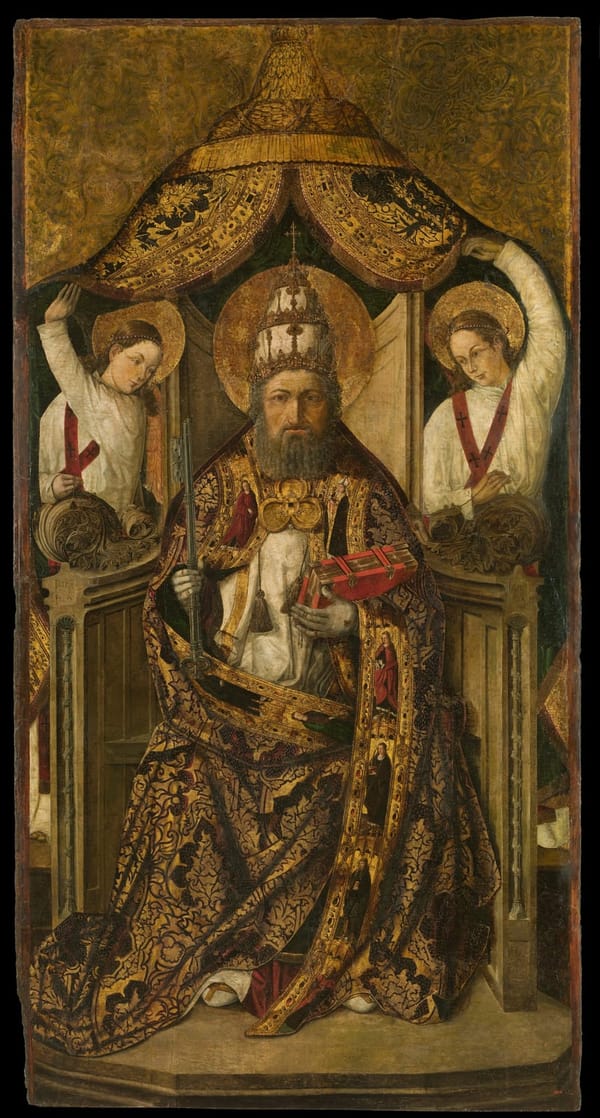
February 22: St. Peter's Chair at Antioch
We are called upon, a second time, to honour St. Peter’s chair: first, it was his pontificate in Rome; to-day, it is his episcopate at Antioch. The seven years spent by the prince of the apostles in the second of these cities, were the grandest glory she ever had; and they are too important a portion of the life of St. Peter to be passed by without being noticed in the Christian cycle.
Three years had elapsed since our Lord’s Ascension. The Church had already been made fruitful by martyrdom, and from Jerusalem she had spread into distant countries. Antioch, the first of the cities of Asia, had received the Gospel; and it was there that those who professed the faith of Jesus were first called Christians. Jerusalem was doomed to destruction for having not only refused to acknowledge, but even crucified, the Messias: it was time for Peter, in whom resided the supreme power, to deprive the faithless city of the honour she had heretofore enjoyed, of possessing within her walls the chair of the apostolate. It was towards the Gentiles that the Holy Spirit drove those clouds, which were shown to Isaias as the symbol of the holy apostles.1 Accordingly, it is in Antioch, the third capital of the Roman Empire, that Peter first places the august throne, on which, as vicegerent of Christ, he presides over the universal Church.
But the progress of the apostles was so rapid; the conquests they made, in spite of every opposition, were so extensive, that the vicar of Christ was inspired to leave Antioch, after he had honoured it with the chair during the space of seven years. Alexandria, the second city of the empire, is also to be made a see of Peter; and Rome, the capital of the world, awaits the grand privilege for which God has long been preparing her. Onwards, then, does the prince advance, bearing with him the destinies of the Church; where he fixes his last abode, and where he dies, there will he have his successor in his sublime dignity of vicar of Christ. He leaves Antioch, making one of his disciples, Evodius, its bishop. Evodius succeeds Peter as bishop of Antioch; but that see is not to inherit the headship of the Church, which goes whithersoever Peter goes. He sends Mark, another of his disciples, to take possession, in his name, of Alexandria; and this Church he would have to be the second in the world, and though he has not ruled it in person, he raises it above that of Antioch. This done, he goes to Rome, where he permanently establishes that chair, on which he will live, and teach, and rule, in his successors, to the end of time.
And here we have the origin of the three great patriarchal sees, which were the object of so much veneration in the early ages: the first is Rome, invested with all the prerogatives of the prince of the apostles, which, when dying, he transmitted to her; the second is Alexandria, which owes her preeminence to Peter’s adopting her as his second see; the third is Antioch, whither he repaired in person, when he left Jerusalem to bring to the Gentiles the grace of adoption. If, therefore, Antioch is below Alexandria in rank, Alexandria never enjoyed the honour granted to Antioch, of having been governed, in person, by him whom Christ appointed to be the supreme pastor of His Church. Nothing, then, could be more just, than that Antioch should be honoured, as having, for seven years, had the privilege of being the centre of Christendom; and this is the object of to-day’s feast.
The children of the Church have a right to feel a special interest in every solemnity that is kept in memory of St. Peter. The father’s feast is a feast for the whole family; for to him it owes its very life. If there be but one fold, it is because there is but one Shepherd. Let us, then, honour Peter’s divine prerogative, to which Christianity owes its preservation; and let us often reflect upon the obligations we are under to the apostolic see. On the feast of the chair at Rome, we saw how faith is taught, and maintained, and propagated by the mother-Church, which has inherited the promises made to Peter. To-day, let us consider the apostolic see as the sole source of the legitimate power, whereby mankind is ruled and governed in all that concerns eternal salvation.
Our Saviour said to Peter: ‘To thee will I give the keys of the kingdom of heaven,’2 that is to say, of the Church. He said to him on another occasion: ‘Feed My lambs, feed My sheep.’3 So that Peter is prince; for, in the language of the sacred Scriptures, keys denote princely power: he is also pastor, and universal pastor; for the whole flock is comprised under the two terms, lambs and sheep. And yet there are other pastors in every portion of the Christian world. The bishops, whom the Holy Ghost hath placed to rule the Church of God,4 govern, in his name, their respective dioceses, and are also pastors. How comes it that the keys, which were given to Peter, are found in other hands than his? The Catholic Church explains the difficulty to us by her tradition. She says to us, by Tertullian: ‘Christ gave the keys to Peter, and through him to the Church.’5 By St. Optatus of Milevis: 'For the sake of unity, Peter was made the first among all the apostles, and he alone received the keys, that he might give them to the rest.’6 By St. Gregory of Nyssa: ‘It is through Peter that Christ gave to bishops the keys of their heavenly prerogative.’7 By St. Leo the Great: 'If our Lord willed that there should be something common to Peter and the rest of the princes of His Church, it was only on this condition, that whatsoever He gave to the rest, He gave it to them through Peter.’8
Yes, the episcopate is most sacred, for it comes from the hands of Jesus Christ through Peter and his successors. Such is the unanimous teaching of Catholic tradition, which is in keeping with the language used by the Roman pontiffs, from the earliest ages, who have always spoken of the dignity of bishops as consisting in their being ‘called to a share of their own solicitude.' Hence St. Cyprian does not hesitate to say that 'our Saviour, wishing to establish the episcopal dignity and constitute His Church, says to Peter: “To thee will I give the keys of the kingdom of heaven and here we have both the institution of bishops, and the constitution of the Church.’9 This same doctrine is clearly stated in a letter written to Pope St. Symmachus by St. Cesarius of Arles, who lived in the fifth century: ‘The episcopate flows from the blessed apostle Peter; and consequently, it belongs to your holiness to prescribe to the several Churches the rules which they are to follow.’10 This fundamental principle, which St. Leo the Great has so ably and eloquently developed (as we have seen on the feast of the chair at Rome, January 18), this principle, which is taught us by universal tradition, is laid down with all possible precision in the magnificent letters, still extant, of Pope St. Innocent I., who preceded St. Leo by several years. Thus he writes to the Council of Carthage, that ‘the episcopate, with all its authority, emanates from the apostolic see’;11 to the Council of Milevis, that 'bishops must look upon Peter as the source whence both their name and their dignity are derived’;12 to St. Victricius, bishop of Rouen, that 'the apostolate and the episcopate both owe their origin to Peter.’13
Controversy is not our object. All we aim at by giving these quotations from the fathers on the prerogatives of Peter’s chair, is to excite the faithful to be devoted to it and venerate it. This we have endeavoured to do, by showing them that this chair is the source of the spiritual authority, which, in its several degrees, rules and sanctifies them. All spiritual authority comes from Peter; all comes from the bishop of Rome, in whom Peter will continue to govern the Church to the end of time. Jesus Christ is the founder of the episcopate; it is the Holy Ghost who establishes bishops to rule the Church; but the mission and the institution, which assign the pastor his flock, and the flock its pastor, these are given by Jesus Christ and the Holy Ghost through the ministry of Peter and his successors.
How sacred, how divine, is this authority of the keys, which is first given by heaven itself to the Roman Pontiff; then is delegated by him to the prelates of the Church; and thus guides and blesses the whole Christian world! The apostolic see has varied its mode of transmitting such an authority according to the circumstances of the several ages; but the one source of the whole power was always the same, the chair of Peter. We have already seen how, at the commencement, there were three chairs: Rome, Alexandria, and Antioch; and all three were sources of the canonical institution of the bishops of their respective provinces; but they were all three chairs of Peter, for they were founded by him that they might preside over their patriarchates, as St. Leo,14 St. Gelasius,15 and St. Gregory the Great,16 expressly teach. But of these three chairs, the Pontiff of Rome had his authority and his institution from heaven; whereas, the two other patriarchs could not exercise their rights, until they were recognized and confirmed by him who was Peter’s successor, as vicar of Christ. Later on, two other sees were added to these first three: but it was only by the consent of the Roman Pontiff that Constantinople and Jerusalem obtained such an honour. Let us notice, too, the difference there is between the accidental honours conferred on four of these Churches, and the divine prerogative of the Church of Rome. By God’s permission, the sees of Alexandria, Antioch, Constantinople, and Jerusalem, were defiled by heresy; they became chairs of pestilence;17 and having corrupted the faith they received from Rome, they could not transmit to others the mission they themselves had forfeited. Sad indeed was the ruin of such pillars as these! Peter’s hand had placed them in the Church. They had merited the love and veneration of men; but they fell; and their fall gave one more proof of the solidity of that edifice, which Christ Himself had built on Peter. The unity of the Church was made more visible. Obliged by the treachery of her own favoured children to deprive them of the privileges they had received from her, Rome was, more evidently than ever, the sole source of pastoral power.
We, then, both priests and people, have a right to know whence our pastors have received their power. From whose hand have they received the keys? If their mission come from the apostolic see, let us honour and obey them, for they are sent to us by Jesus Christ, who has invested them, through Peter, with His own authority. If they claim our obedience without having been sent by the bishop of Rome, we must refuse to receive them, for they are not acknowledged by Christ as His ministers. The holy anointing may have conferred on them the sacred character of the episcopate: it matters not; they must be as aliens to us, for they have not been sent, they are not pastors.
Thus it is that the divine Founder of the Church, who willed that she should be a city seated on a mountain,18 gave her visibility; it was an essential requisite; for since all were called to enter her pale, all must be able to see her. But He was not satisfied with this. He moreover willed that the spiritual power exercised by her pastors should come from a visible source, so that the faithful might have a sure means of verifying the claims of those who were to guide them in His name. Our Lord (we say it reverently) owed this to us; for, on the last day, He will not receive us as His children, unless we shall have been members of His Church, and have lived in union with Him by the ministry of pastors lawfully constituted. Honour, then, and submission to Jesus in His vicar! honour and submission to the vicar of Christ in the pastors he sends!
As a tribute of our devotion to the prince of the apostles, let us recite, in his honour, the following hymn, composed by St. Peter Damian:
Hymn
Princeps, et præco Domini:
Pastor prime fidelium,
Custodi gregem creditum.
Nos verbi fruge recrea:
Refectas oves prævius
Caulis infer cœlestibus.
Tibi, Petre, sunt traditæ:
Tuisque patent legibus
Terrena cum cœlestibus.
Tu basini sedificii
Fundas, in qua Catholica
Fixa surgit Ecclesia.
Fit medicina languidis;
Textrinis usa vestium
Sprevit Tabitha feretrum.
Virtus solvit angelica;
Veste sumpta cum caligis,
Patescunt fores carceris.
Sit decus Unigenito,
Sit utriusque parili
Majestas summa Flamini.
Herald of our Lord!
First pastor of the faithful!
watch over the flock entrusted to thee.
feeding us with the nourishment of the word;
and lead us, thus fed, into the heavenly fold,
whither thou hast already gone.
the keys of heaven’s gate;
and all things, both in heaven and on earth,
acknowledge thy authority.
where is to be established the rock of the true faith,
the foundation of the building,
on which the Catholic Church stands immovable.
heals the sick;
and Tabitha, that made garments for the poor,
was raised to life at thy bidding.
thou wast set free by an angel's power;
he bids thee put on thy garments and thy sandals,
and lo! the prisondoor is opened.
and to the only-begotten Son,
and to the coequal Spirit of them both,
be praise and kingly highest power.
Glory be to thee, O prince of the apostles, on thy chair at Antioch, where thou didst for seven years preside over the universal Church! How magnificent are the stations of thy apostolate! Jerusalem, Antioch, Alexandria (by thy disciple Mark), and Rome, these are the cities which have been honoured by thy august chair. After Rome, Antioch was the longest graced by its presence: justly, therefore, do we honour this Church, which was thus made, by thee, the mother and mistress of all other Churches. Alas! all her beauty has now left her; her faith is dead; she is in bondage to the Saracen. Save her, take her once more under thy power, bring her into allegiance to Rome, where thou hast thy chair, not for seven years only, but for all ages. The gates of hell have let loose the fury of every tempest upon thee, firm rock of the Church! and we ourselves have Been the immortal chair banished for a time from Rome. The words of St. Ambrose then came to our minds: ‘Where Peter is, there is the Church.’ How could we despair? Did we not know, that it was God’s inspiration which made thee choose Rome for the fixed resting-place of thy throne? No human will can put asunder what God has united; the bishop of Rome must ever be the vicar of Christ; and the vicar of Christ, let sacrilege and persecution banish him as they will, must ever be the bishop of Rome. Holy apostle! calm the wildness of the tempest, lest the weak should take scandal. Beseech our Lord that He permit not the residence of thy successor to be disturbed in that holy city, which has been chosen for so great an honour. If it be that her inhabitants deserve punishment for their offences, spare them for the sake of their brethren of the rest of the world; and pray for them, that their faith may once more become what it was when St. Paul praised it, and said to them: ‘Your faith is spoken of in the whole world.’19
- Isa. lx. 8. ↩︎
- St. Matt. xvi. 19. ↩︎
- St. John xxi. 15, 17. ↩︎
- Acts xx. 28. ↩︎
- Scorpiac., cap. x. ↩︎
- Contra Parmenianum, lib. vii. ↩︎
- Opp., tom. iii. ↩︎
- In Anniv. assumpt., serm. iv. ↩︎
- Epist. xxxiii. ↩︎
- Ibid., x. ↩︎
- Ibid., xxix. ↩︎
- Ibid., xxx. ↩︎
- Ibid., ii. ↩︎
- Epist. civ. Ad Anatolium. ↩︎
- Concli. Romanum. Labb., tom. iv. ↩︎
- Epist. Ad Eulogium. ↩︎
- Ps. i. 1. ↩︎
- St. Matt. v. 14. ↩︎
- Rom. i. 8. ↩︎
Monday of the Second Week of Lent
THE Station is in the church of Saint Clement, Pope and Martyr. In this, more than in any other church of the city of Rome, there has been preserved the ancient arrangement of the early Christian basilicas. Under its altar reposes the body of its holy patron, together with the relics of Saint Ignatius of Antioch, and of the consul St. Flavius Clemens.
Collect
Epistle
Cap. ix.In diebus illis: Oravit Daniel Dominum, dicens: Domine, Deus noster, qui eduxisti populum tuum de terra Ægypti in manu forti, et fecisti tibi nornen secundum diem hane: peccavimus, iniquitatem feeimus, Domine, in omnem justitiam tuam. Avertatur, obsecro, ira tua et furor tuus a civitate tua Jerusalem, et a monte eaneto tuo. Propter peccata enim nostra, et iniquitates patnim nostrorum, Jerusalem et populus tuus in opprobrium sunt omnibus per circuitum nostrum. Nano ergo exaudi, Deus noster, orationem servi tui et preces ej us: et ostende faciem tuam super sanctuarium tuum, quod desertum est, propter temetipsum. Inclina, Deus meus, aurem tuam, et audi: aperi oculos tuos, et vide desolationem nostram, et civitatem super quam invocatum est nomen tuum: neque enim in justifiGationibus nostris prostemimus preces ante faciem tuam, sed in miserationibus tuis multis. Exaudi, Domine; placare, Domine: attende et fac: ne moreris, propter temetipsum Deus meus: quia nornen tuum invocatum est super civitatem et super populum tuum, Domine Deus noster.
Ch. ix.In those days: Daniel prayed to the Lord, saying: O Lord our God, who hast brought forth thy people out of the land of Egypt with a strong hand, and hast made thee a name as at this day: we have sinned, we have committed iniquity, O Lord, against all thy justice. Let thy wrath and thy indignation be turned away, I beseech thee, from thy city Jerusalem, and from thy holy mountain. For, by reason of our sins, and the iniquities of our fathers, Jerusalem and thy people are a reproach to all that are round about us. Now, therefore, O our God, hear the supplication of thy servant, and his prayers: and show thy face upon thy sanctuary which is desolate, for thy own sake. Incline, O my God, thy ear and hear: open thine eyes, and see our desolation, and the city upon which thy name is called: for it is not for our justifications that we present our prayers before thy face, but for the multitude of thy tender mercies. O Lord, hear; O Lord, be appeased; hearken, and do; delay not for thy own sake, O my God; because thy name is invocated upon thy city, and upon thy people, O Lord our God.
Such was the prayer and lamentation of Daniel, during the captivity in Babylon. His prayer was heard; and, after seventy years of exile, the Jews returned to their country, rebuilt the temple, and were once more received by the Lord as His chosen people. But what are the Israelites now? What has been their history for the last eighteen hundred years? The words of Daniel’s lamentation but faintly represent the sad reality of their present long chastisement. God’s anger lies heavily on Jerusalem; the very ruins of the temple have perished; the children of Israel are dispersed over the whole earth, a reproach to all nations. A curse hangs over this people; like Cain, it is a wanderer and a fugitive; and God watches over it, that it become not extinct.
The rationalist is at a loss how to explain this problem: whereas the Christian sees in it the punishment of the greatest of crimes. But what is the explanation of this phenomenon? The light shone in darkness; and the darkness did not comprehend it!1 If the darkness had received the light, it would not be darkness now; but it was not so; Israel, therefore, deserved to be abandoned. Several of its children did, indeed, acknowledge the Messias, and they became children of the light; nay, it is through them that the light was made known to the whole world. When will the rest of Israel open its eyes? When will this people address to God the prayer of Daniel? They have it; they frequently read it; and yet, it finds no response in their proud hearts. Let us, the Gentiles, pray for the Jews— the younger for the elder. Every year there are some who are converted, and seek admission into the new Israel of the Church of Christ. Right welcome are they! May God, in His mercy, add to their number; that thus all men may adore the God of Abraham, of Isaac, and of Jacob, together with Jesus Christ, His Son, whom He sent into this world.
Gospel
Cap. viii.In illo tempore: Dixit Jesus turbis Judæorum: Ego vado, et quæretis me, et in peccato vestro moriemini. Quo ego vado, vos non potestis venire. Dicebant ergo Judæi: Numquid interficiet semetipsum, quia dixit: Quo ego vado, vos non potestis venire? Et dicebateis: Vos de deorsum estie; ego de euperme sum. Vos de mundo hoc estis; ego non sum de hoc mundo. Dixi ergo vobis, quia moriemini in pcccatis vestris: si enim non credideritis quia ego sum, moriemini in peccato vestro. Dicebant ergo ei: Tu quis es? Dixit eis Jesus: Principium, qui et loquor vobis. Multa habeo de vobis loqui, et judicare. Sed qui me misit, verax est; et ego quæ audivi ab eo, hæc loquor in mundo. Et non cognoverunt quia Patrem ejus dicebat Deum. Dixit ergo eis Jesus: Cum exaltaveritis Filium hominis, tunc cognoscetis quia ego sum, et a meipso fació nihil, sed sicut docuit me Pater, hæc loquor: et qui me misit, mecum est, et non reliquit me solum: quia ego, quæ placita sunt ei, facio semper.
Ch. viii.At that time: Jesus said to the multitude of the Jews: I go, and you shall seek me, and you shall die in your sin. Whither I go, you cannot come. The Jews, therefore, said: Will he kill himself, because he said: Whither I go, you cannot come? And he said to them: You are from beneath, I am from above. You are of this world, I am not of this world. Therefore I said to you, that you shall die in your sins. For if you believe not that I am he, you shall die in your sin. They said therefore to him: Who art thou? Jesus said to them: The beginning, who also speak unto you. Many things I have to speak and to judge of you. But he that sent me is true; and the things I have heard of him, these same I speak in the world. And they understood not that he called God his Father. Jesus therefore said to them: W’hen you shall have lifted up the Son of man, then shall you know that I am he, and that I do nothing of myself, but as the Father hath taught me, these things I speak: and he that sent me is with me, and he hath not left me alone: for I do always the things that please him.
I go; could Jesus say anything more awful? He has come to save this people; He has given them every possible proof of His love. A few days ago, we heard Him saying to the Canaanite woman, that He was sent not but for the sheep that are lost of the house of Israel. Alas; these lost sheep disown their Shepherd. He tells the Jews that He is soon going to leave them, and that they will not be able to follow Him; but it makes no impression on them. His works testify that He is from above; they, the Jews, are of this world, and they can think of no other. The Messias they hope for, is to be one of great earthly power; he is to be a great conqueror. In vain, then, does Jesus go about doing good;2 in vain is nature obedient to His commands; in vain do His wisdom and teaching exceed all that mankind has ever heard: Israel is deaf and blind. The fiercest passions are raging in his heart; nor will he rest, till the Synagogue shall have imbrued its hands in the blood of Jesus. But then the measure of iniquity will be filled up, and God’s anger will burst upon Israel in one of the most terrible chastisements that the world has ever witnessed. It makes one tremble to read the horrors of the siege of Jerusalem, and the massacre of that people that had clamoured for the death of Jesus. Our Lord assures us that nothing more terrible had ever been from the beginning of the world, or ever would be.3
God is patient; He waits a long time: but when His anger bursts upon a guilty people like the Jews, the chastisement is without mercy, and serves as an example to future generations. O sinners! you who, so far, have turned a deaf ear to the admonitions of the Church, and have refused to be converted to the Lord your God, tremble at these words of Jesus: I go. If this Lent is to be spent like so many others, and to leave you in your present state, are you not afraid of that terrible threat: You shall die in your sin? By remaining in your sins, you number yourselves with those who cried out against Jesus: ‘Crucify Him, crucify Him!’ Oh! if He chastised a whole people—a people that He had loaded with favours, and protected and saved innumerable times—think you, He will spare you? He must triumph; if it be not by mercy, it will be by justice.
We will begin to-day the beautiful hymn of Prudentius on fasting. Its extreme length obliges us to divide it into fragments. We reserve the stanzas which refer to the fast of Ninive for Monday in Passion-week. Formerly, several Churches of the Roman rite introduced this hymn into the Divine Office, but they only made a selection from it; whereas the Mozarabic breviary gives the whole hymn from beginning to end.
Hymn
Quem partus alvi virginalis protulit,
Adesto castis, Christe, parcimoniis,
Festumque nostrum Rex serenus aspice,
Jejuniorum dum litamus victimam.
Quo fibra cordis expiatur vividi:
Intemperata quo domantur viscera,
Arvina putrem ne resudans crapulam,
Obstrangulatæ mentis ingenium premat.
Vini, atque somni degener socordia,
Libido sordens, inverecundus lepos,
Variæque pestes languidorum sensuum
Parcam subactæ disciplinam sentiunt.
Jejuna rite membra non coerceas,
Sequitur, frequenti marcida oblectamine
Scintilla mentis ut tepescat nobilis,
Animusque pigris stertat in præcordiis.
Detersa et intus emicet prudentia:
Sic excitato perspicaz acumine,
Liberque flatu laxiore spiritus
Rerum parentem rectius precabitur.
born to us from a Virgin’s womb,
be thou with us in our chaste abstinence.
Do thou, our King, look with a propitious eye upon our feast,
whereon we offer thee the tribute of our fast.
which purifies the inmost recesses of man’s heart.
By it is tamed the unruly carnal appetite;
that thus the ardent soul may not be choked
by the surfeiting of a pampered body.
The drowsiness that comes of wine and sleep;
lust with its defilements; the impudence of buffoonery;
yea, all the pests that come from our sluggish flesh,
are hereby disciplined into restraint.
and bridlest not thine appetite by fasting, it needs must be
that the noble fire of the spirit, smothered by the frequent indulgence of the body,
should grow dull, and the soul,
like the drowsy flesh it inhabits, fall into heavy sleep.
and follow the clear interior light of prudence.
Thus, the soul having her sight made keener,
will breathe more freely,
and will pray to the Creator with the stronger hope.
| Previous The Second Sunday of Lent | Next Monday of the Second Week of Lent |