Daily reading
Lent
Double · February 23 · Sanctoral
February 23, 2027
From Dom Guéranger’s The Liturgical Year.
A Double leads the weekday.Rubric
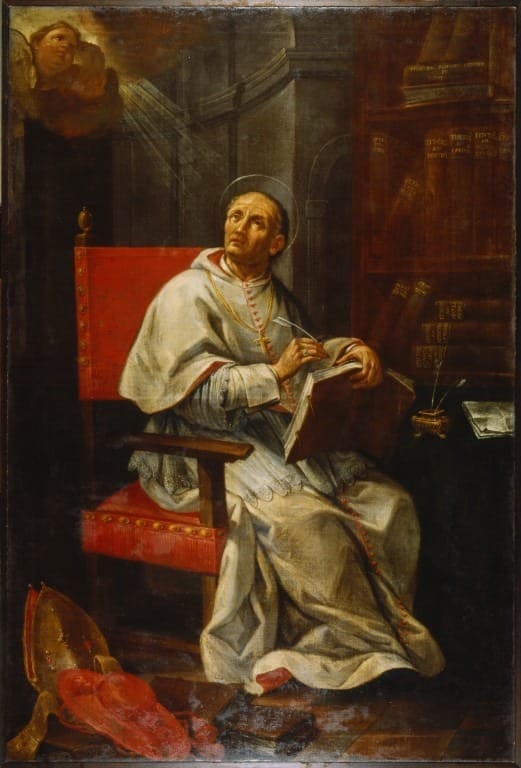 |
February 23: St. Peter Damian, Cardinal and Doctor of the Church
It is the feast of the austere reformer of the eleventh century, Peter Damian, the precursor of the holy pontiff Gregory VII., that we are called upon to celebrate to-day. To him is due in part that glorious regeneration, which was effected at that troubled period when judgment had to begin at the house of God.1 The life he had led under the monastic rule had fitted him for the great contest. So zealously did he withstand the disorders and abuses of his times, that we may attribute to him, at least in great measure, the ardent faith of the two centuries which followed the scandals of the tenth. The Church ranks him among her doctors, on account of his admirable writings: and his penitential life ought to excite us to be fervent in the work we have in hand, the work of our conversion.
The following lessons, read by the Church, on this feast, give us a sketch of our saint’s life:
Thy soul was inflamed by the zeal of God’s house, O Peter! God gave thee to His Church in those sad times when the wickedness of the world had robbed her of well-nigh all her beauty. Thou hadst the spirit of an Elias within thee, and it gave thee courage to waken the servants of the Lord: they had slept, and while they were asleep, the enemy came, and the field was oversown with tares.2 Then did better days dawn for the bride of Christ; the promises made by our Lord were fulfilled; but who was the friend of the bridegroom?3 Who was the chief instrument used by God to bring back to His house its ancient beauty? A saint who bore the glorious name of Peter Damian! In those days, the sanctuary was degraded by secular interference. The princes of the earth said: 'Let us possess the sanctuary of God for an inheritance.’4 The Church, which God intended to be free, was but a slave, in the power of the rulers of this world; and the vices, which are inherent to human weakness, defiled the temple. But God had pity on the bride of Christ, and for her deliverance He would use human agency: He chose thee, Peter, as His principal co-operator in restoring order. Thy example and thy labours prepared the way for Gregory, the faithful and dauntless Hildebrand, into whose hands the keys were no sooner placed, than the work of regeneration was completed. Thou hast fought the good fight; thou art now in thy rest; but thy love of the Church, and thy power to help, are greater than ever. Watch, then, over her interests. Obtain for her pastors that apostolic energy and courage, which alone can cope with enemies so determined as hers are. Obtain for her priests the holiness which God demands from them that are the salt of the earth.5 Obtain for the faithful the respect and obedience they owe to those who direct them in the path of salvation. Thou wast not only the apostle, thou wast moreover the model, of penance in the midst of a corrupt age; pray for us, that we may be eager to atone for our sins by works of mortification. Excite within our souls the remembrance of the sufferings of our Redeemer, that so His Passion may urge us to repentance and hope. Increase our confidence in Mary, the refuge of sinners, and make us, like thyself, full of filial affection towards her, and of zeal that she may be honoured and loved by those who are around us.
Tuesday of the Second Week of Lent
THE Station is in the church of Saint Balbina. This holy virgin of Rome was the daughter of the tribune Quirinus, and suffered martyrdom during the pontificate of Alexander I., in the second century. She consecrated her virginity to God, and led a life rich in good works.
Collect
Epistle
III. Cap. xvii.
The instruction of the catechumens is continued by means of the Gospel facts, which are each day brought before them; and the Church reads to them the prophecies from the old Testament, which are to be fulfilled by the rejection of the Jews, and the vocation of the Gentiles. Elias, who is our faithful companion during Lent, is represented to us to-day as foreshadowing, in his own conduct, the treatment which God is one day to show towards His ungrateful people. A three years’drought had been sent upon the kingdom of Israel; but the people continued obstinate in their sins. Elias goes in search of some one that will provide him with food. It is a great privilege to entertain the prophet; for God is with him. Then, whither will he go? Is it to any family in the kingdom of Israel? Or will he pass into the land of Juda? He neglects them both, and directs his steps towards the land of the Gentiles. He enters the country of Sidon; and coming to the gates of a city called Sarephta, he sees a poor widow; it is to her that he transfers the blessing which Israel had rejected. Our Lord Himself has taken notice of this event in the prophet’s life, which portrays, in such strong colours, the justice of God towards the Jews, and His mercy towards us Gentiles: ‘In truth I say to you, there were many widows in the days of Elias in Israel: and to none of them was he sent, but to Sarephta of Sidon, to a widow woman.’1
So, then, this poor woman is a figure of the Gentiles, who were called to the faith. Let us study the circumstances of this prophetic event. The Woman is a widow; she has no one to defend or protect her: she represents the Gentiles, who were abandoned by all, and had no one that could save them from the enemy of mankind. All the mother and her child have to live upon, is a handful of meal and a little oil: it is an image of the frightful dearth of truth, in which the pagans were living at the time when the Gospel was preached to them. Notwithstanding her extreme poverty, the widow of Sarephta receives the prophet with kindness and confidence; she believes what he tells her, and she and her child are saved: it is thus that the Gentiles welcomed the apostles, when these shook the dust from their feet and left the faithless Jerusalem. But what mean the two pieces of wood, which the widow holds in her hands? St. Augustine, St. Cesarius of Arles, and St. Isidore of Seville (who, after all, are but repeating what was the tradition of the early Church), tell us that this wood is a figure of the cross. With this wood the widow bakes the bread that is to support her; it is from the cross that the Gentiles receive life by Jesus, who is the living Bread. Whilst Israel dies of famine and drought, the Gentile Church feeds abundantly on the heavenly wheat, and on the oil, which is the symbol of strength and charity. Glory then be to Him who hath called us out of darkness into His marvellous light2 of faith! But let us tremble at witnessing the evils which the abuse of grace has brought upon a whole people. If God in His justice has not spared a whole nation, but cast it off; will He spare you or me, if we dare to resist His call?
Gospel
Cap. xxiii.In illo tempore: Locutus est Jesus ad turbas, et ad discipulos suos, dicens: Super cathedram Moysi sederunt scribæ et pharisæi. Omnia ergo quæcumque dixerint vobis, servato et facite: secundum opera vero eorum nolite facere: dicunt enim et non faciunt. Alli· gant enim onera gravia, et importabilia, et imponunt in humeros hominum: digito autem suo nolunt ea movere. Omnia vero opera sua faciunt ut videantur ab hominibus; dilatant enim phylacteria sua, et magnificant fimbrias. Amant autem primos reoubitus in cænis, et primas cathedras dras in synagogis, et salutationes in foro, et vocari ab hominibujB Rabbi. Vos autem nolite vocari Rabbi. Unus est enim Magister vester, omnes autem vos fratres estis. Et patrem nolite vocare vobis super terrain: unus est enim Pater vester qui in cœlis est. Nec vocemini magistri: quia Magister vester unus est, Chris tus. Qui major est vest rum, erit minister vester. Qui autem se exaltaverit, humiliabitur: et qui se humiliaverit, exaltabitur.
Ch. xxiii.At that time: Jesus spoke to the multitudes and to his disciples, saying: The scribes and the pharisees have sitten on the chair of Moses. All things therefore whatsoever they shall say to you, observe and do; but according to their works, do ye not; for they say, and do not. For they bind heavy and insupportable burdens, and lay them on men’s shoulders; but with a finger of theit own they will not move them. And all their works they do to be seen of men: for they make their phylacteries broad, and enlarge their fringes. And they love the first places at feasts, and the first chaira in the synagogues, and salutations in the marketplace, and to be called by men, Rabbi. But be not you called Rabbi; for one is your master, and all you are brethren. And call none your father upon earth; for one is your Father, who is in heaven. Neither be ye called masters; for one is your Master, Christ. He that is the greatest among you, shall be your servant. And whosoever shall exalt himself shall be humbled; and he that shall humble himself shall be exalted.
The doctors of the law were sitting on the chair of Moses; therefore, Jesus bids the people abide by their teachings. But this chair—which, in spite of the unworthiness of them that sit on it, is the chair of truth—is not to remain long in Israel. Caiphas, because he is a high priest for the year, will prophesy; but his crimes have rendered him unworthy of his office; and the chair, on which he sits, is to be taken away and set in the midst of the Gentiles. Jerusalem, which is preparing to deny her Saviour, is to be deprived of her honours; and Rome, the very centre of the pagan world, is to possess within her walls that chair which was the glory of Jerusalem, and from which were proclaimed the prophecies so visibly fulfilled in Jesus. Henceforth, this chair is never to be moved, though all the fury of the gates of hell will seek to prevail against it; it is to be the unfailing source, at which all nations are to receive the teaching of revealed truth. The torch of faith has been removed from Israel, but it has not been extinguished. Let us live in its light, and merit by our humility that its rays ever shine upon us.
What is it that caused Israel’s loss? His pride. The favours he had received from God excited him to self-complacency; he scorned to recognize any one for the Messias, who was not great in this world’s glory; he was indignant at hearing Jesus say that the Gentiles were to participate in the grace of redemption; he sought to imbrue his hands in the Blood of the God-Man, and this because He reproached him for the hardness of his heart. These proud Jews, even when they saw that the day of God’s judgment was close upon them, kept up their stubborn haughtiness. They despised the rest of the world as unclean and sinners. The Son of God became the Son of Man. He is our Master, and yet He ministered to us, as though He were our Servant. Does not this show us how precious a virtue is humility? If our fellow-creatures call us master or father, let us not forget that no one is master or father but by God’s appointment. No one deserves to be called master, but he by whose lips Jesus gives us the lessons of divine wisdom; he alone is truly a father, who acknowledges that his paternal authority comes from God alone; for the apostle says: ‘I bow my knee to the Father of our Lord Jesus Christ, of whom all paternity in heaven and earth is named.’3
Let us continue the hymn which we began yesterday; our readers will remember that it is by Prudentius, the prince of Christian poets.
Hymn
Vetue sacerdos runs hospes aridi:
Fragore ab omni quem remotum et segregem
Sprevisse tradunt crimmum frequentiam?
Cateo fruentem syrtium silentio.
Curruque raptus evolavit præpeti,
Ne de propinquo eordium contagio
Dims quietum mundus afflaret virum,
Olim probatis inclytum jejuniis.
Moses tremendi fidus interpres throni
Potuit viderp, quam decem recursibus
Quater volutis sol peragrans sidera,
Omni carentem cerneret substantia.
Nam flendo pemox irrigatum pulverem,
Humi madentis ore pressit cemuo:
Donee loquentis voce præstrictus Dei
Expavit ignem non ferendum visibus.
Dei perennis præcucurrit Filium,
Curvos viarum qui retorsit tramites,
Et flexuosa corrigens dispendia,
Dedit sequendam calle recto lineam.
Mox affuturo construens iter Deo,
Clivosa planis, confragosa ut lenibus
Converterentur, neve quidquam devium
Illapsa terns in veniret Veritas.
Oblita lactis jam vieto in pectore
Matris tetendit serus infans ubera:
Nec ante partu de senili effusus est,
Quam prædicaret Virginem plenam Deo.
Amictus hirtis bestiarum pellibus,
Setisve tectus, hispida et lanugine,
Secessit,. horrens inquinan ac pollui
Contaminatis oppidorum moribus.
Potum, cibumque vir severæ industriæ
In usque serum respuebat vesperum,
Parvum locustis, et favorum agrestium
Liquore pastum corpori suetus dare.
Fuit salutis: nam sacrato in flumine
Veterum piatas lavit errorum notas:
Sed tincta postquam membra defæcaverat,
Cœlo refulgena influebat Spiritus.
that Elias the venerable priest, the guest of the desert,
received his great glory.
We read that he fled far from the noisy world, and the wickedness of cities,
and lived in the happy innocence of silent deserts.
for so long as he remained nigh this wretched world,
it might breathe something of the contagion of its vices upon the prophet,
though his life was one of retirement,
and his spirit had long been fortified by holy fasts.
was not permitted to see
the King of the seventimes holy heaven,
until the sun had forty times passed over his head
and witnessed him abstaining from every food.
He spent the night in weeping, and lay prostrate on the ground,
which was bedewed with his tears:
till at length, aroused by the voice of God,
he directed his steps towards the fire on which no man could fix his gaze.
He was the precursor of the Son of God,
who was to make the crooked ways straight,
and the rough ways plain,
and was to teach men the right path wherein to walk
of the Lord who was soon to come, exacted this of men:
that every mountain and hill should be made low,
and that all should be in the right path,
when Truth should come down upon the earth.
old as she was, was made to bear this child within her
hitherto barren womb. She fed him, too, at her own breast.
Before his birth, he announced to his mother
the presence of the Virgin that was full of God.
clad in the rough and bristly skins of wild beasts,
and in camels’ hair; for he trembled
lest he might become defiled and contaminated
by the wickedness of them that dwelt in cities.
This man of rigid penance neither ate nor drank
till the evening was far spent;
and then, a few locusts and a little wild honey
were the only refreshment he took.
and the first to invite men to receive it.
In the sacred stream, he washed away the stains of the old errors;
but after he had administered to men this outward baptism,
the heavenly Spirit worked within their souls.
| Previous Monday of the Second Week of Lent | Next Tuesday of the Second Week of Lent |