Daily reading
Semidouble · Movable from Easter · Temporal
March 4, 2027
From Dom Guéranger’s The Liturgical Year.
Thursday of the Third Week of Lent
This day brings us to the middle of Lent, and is called mid-Lent Thursday. It is the twentieth of the forty fasts imposed upon us, at this holy season, by the Church. The Greeks call the Wednesday of this week Mesonestios, that is, the mid-fast. They give this name to the entire week, which, in their liturgy, is the fourth of the seven that form their Lent. But the Wednesday is, with them, a solemn feast, and a day of rejoicing, whereby they animate themselves to courage during the rest of the season. The Catholic nations of the west, though they do not look on this day as a feast, have always kept it with some degree of festivity and joy. The Church of Rome has countenanced the custom by her own observance of it; but, in order not to give a pretext to dissipation, which might interfere with the spirit of fasting, she postpones to the following Sunday the formal expression of this innocent joy, as we shall see further on. Yet, it is not against the spirit of the Church that this mid-day of Lent should be marked by some demonstration of gladness; for example, by sending invitations to friends, as our Catholic forefathers used to do; and serving up to table choicer and more abundant food than on other days of Lent, taking care, however, that the laws of the Church are strictly observed. But alas! how many even of those calling themselves Catholics have been breaking, for the past twenty days, these laws of abstinence and fasting! Whether the dispensations they trust to be lawfully or unlawfully obtained, the joy of mid-Lent Thursday scarcely seems made for them. To experience this joy, one must have earned and merited it, by penance, by privations, by bodily mortifications; which is just what so many, nowadays, cannot think of doing. Let us pray for them, that God would enlighten them, and enable them to see what they are bound to do, consistently with the faith they profess.
At Rome, the Station is at the church of Saints Cosmas and Damian, in the forum. The Christians of the middle ages (as we learn from Durandus, in his Rational of the Divine Offices) were under the impression that this Station was chosen because these two saints were, by profession, physicians. The Church, according to this explanation, would not only offer up her prayers of this day for the souls, but also for the bodies of her children: she would draw down upon them—fatigued as she knew they must be by their observance of abstinence and fasting—the protection of these holy martyrs, who, whilst on earth, devoted their medical skill to relieving the corporal ailments of their brethren. The remarks made by the learned liturgiologist Gavantus, in reference to this interpretation, lead us to conclude that, although it may possibly not give us the real motive of the Church’s selecting this Station, yet it is not to be rejected. It will, at least, suggest to the faithful to recommend themselves to these saints, and to ask of God, through their intercession, that they may have the necessary courage and strength for persevering to the end of the holy season in what they have, so far, faithfully observed.
Collect
Epistle
Cap. vii.In diebus illis: Factum est verbum Domini ad me dicens: Sta in porta domus Domini, et prædica ibi verbum istud, et die: Audite verbum Domini, omnis Juda, qui ingredimini per portas has, ut adoretis Dominum. Hæc dicit Dominus exercituum, Deus Israël: Bonas facite vias vestras, et studia vestra: et habitabo vobiseum in loco isto. Nolite confidere in verbis mendaeii, dicentes: Templum Domini, templum Domini, templum Dominiest. Quoniam si bene direxeritis vias vestras, et studia vestra: ei feceritis judicium inter virum et proximum ejus: ad venae et pupillo, et viduae non foceritis calumniam, nec sanguinem innoeentem effuderitis in loco hoc, et post deos alienos non ambulaveritis in malum vobismetipeis: habitabo vobiscum in loco isto, in terra quam dedi patribus vestris, a sæculo et usque in saeculum, ait Dominus omnipotens.
Ch. viiIn those days: The word of the Lord came to me, saying: Stand in the gate of the house of the Lord, and proclaim there this word, and say: Hear ye the word of the Lord, all ye men of Juda, that enter in at these gates, to adore the Lord. Thus saith the Lord of hosts, the God of Israel: Make your ways and your doings good; and I will dwell with you in this place. Trust not in lying words, saying: The temple of the Lord, the temple of the Lord, it is the temple of the Lord. For if you will order well your ways and your doings; if you will execute judgment between a man and his neighbour; if you oppress not the stranger, the fatherless and the widow, and shed not innocent blood in this place, and walk not after strange gods to your own hurt; I will dwell with you in this place, in the land which I gave to your fathers from the beginning and for ever more, saith the Lord almighty.
There is not a single duty in which the Church does not instruct her children. If, on the one hand, she insists on their fulfilling certain exterior practices of penance, she, on the other, warns them against the false principle of supposing that exterior observances, however carefully complied with, can supply the want of interior virtues. God refuses to accept the homage of the spirit and the heart, if man, through pride or sensuality, refuse that other service which is equally due to his Creator, namely, his bodily service; but to make one’s religion consist of nothing but material works, is little better than mockery; for God bids us serve Him in spirit and in truth.1 The Jews prided themselves on having the temple of Jerusalem, which was the dwelling-place of God’s glory; but this privilege, which exalted them above other nations, was not unfrequently turned against themselves, inasmuch as many of them were satisfied with a mere empty respect for the holy place; they never thought of that higher and better duty, of showing themselves grateful to their divine Benefactor, by observing His Law. Those Christians would be guilty of a like hypocrisy, who, though most scrupulously exact in the exterior duty of fasting and abstinence, were to take no pains to amend their lives, and to follow the rules of justice, charity, and humility. They would deserve that our Lord should say of them what He said of Israel: ‘This people glorify Me with their lips; but their heart is far from Me.’2 This Christian pharisaism is very rare now-a-days. What we have to fear is a disregard for the exterior practices of religion. Those of the faithful who are diligent in the fulfilment of the laws of the Church, are not, generally speaking, behindhand in the practice of other virtues. Still, this false conscience is sometimes to be met with, and is a scandal which does much spiritual injury. Let us, therefore, observe the whole law. Let us offer to God a spiritual service, which consists in the heart's obedience to all His commandments; and to this let us join the homage of our bodies, by practising those things which the Church has prescribed. The body is intended to be an aid to the soul, and is destined to share in her eternal happiness; it is but just that it should share in the service of God.
Gospel
Cap. iv.In illo tempore: Surgens Jesus de synagoga, introivit in domum Simonis. Socrus autem Simonis tenebatur magnis febribus: et rogaverunt ilium pro ea. Et stans super illam, imperavit febri: et dimisit illam. Et continuo surgens, minist ra bat illis. Cum autem sol occidisset, omnes qui habebant infirmos variis languoribus, ducebant illos ad eum. At file singulis manus imponens, curabat eos. Exibant autem dæmonia a multis, clamantia et dicentia: Quia tu ee Filius Dei. Et increpans non sinebat ea loqui, quia sciebant ipsum esse Christum. Facta autem die egreseus ibat in desertum locum, et turbæ requirebant eum, et venerunt usque ad ipsum: et detinebant ilium ne discederet ab eis. Quibus file ait: Quia et aliis eivitatibus oportet me evangelizare regnum Dei, quia ideo missus sum; et erat prædicans in synagogis Galilææ.
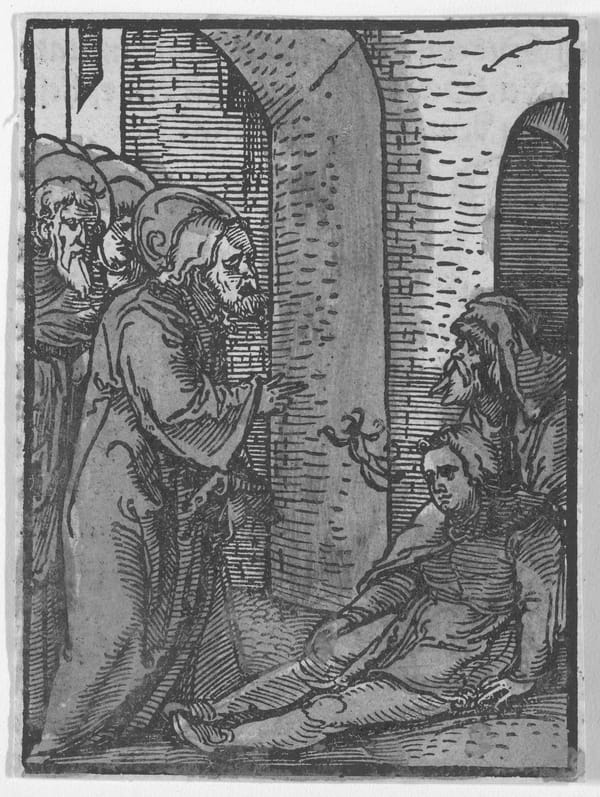
Ch. iv.At that time: Jesus rising up out of the synagogue, went into Simon’s house. And Simon’s wife’s mother was taken with a great fever, and they besought him for her. And standing over her, he commanded the fever, and it left her. And immediately rising, she ministered to them. And when, the sun was down, all they that had any sick with divers diseases, brought them to him. But he, laying his hands on every one of them, healed them. And devils went out from many, crying out and saying: Thou art the Son of God. And rebuking them, he suffered them not to speak, for they knew that he was Christ. And when it was day, going out, he went into a desert place, and the multitude sought him, and came unto him; and they stayed him that he should not depart from them. To whom he said: To other cities also I must preach the kingdom of God; for therefore am I sent. And he was preaching in the synagogues of Galilee.
Let us here admire the goodness of our Redeemer, who deigns to exercise His power for the cure of bodily infirmities. How much more ready will He be to heal our spiritual ailments! Our fever is that of evil passions; Jesus alone can allay it. Let us imitate the eagerness of these people of Galilee, who brought all their sick to Jesus; let us beseech Him to heal us. See with what patience He welcomes each poor sufferer! Let us also go to Him. Let us implore of Him not to depart from us, but abide with us for ever; He will accept our petition, and remain. Let us pray for sinners: the days of the great fast are quickly passing away: we have reached the second half of Lent, and the Passover of our deliverance will soon be here. Look at the thousands that are unmoved, with their souls still blind to the light, and their hearts hardened against every appeal of God’s mercy and justice; they seem resolved on making their eternal perdition lees doubtful than ever, by neglecting both the Lent and the Easter of this year. Let us offer up our penances for them; and beg of Jesus by the merits of His sacred Passion, to redouble His mercies towards them, and to deliver from satan these souls, for whose sake He is about to shed His Blood.
The Mozarabic liturgy offers us this beautiful exhortation. It will inspire us to persevere in our lenten penances and duties.
Missa
(Missale Gothicum. Dominica IV. in Quadragesima)
March 4: St. Casimir, Confessor
It is from a court that we are to be taught to-day the most heroic virtues. Casimir is a prince; he is surrounded by all the allurements of youth and luxury; and yet he passes through the snares of the world with as much safety and prudence, as though he were an angel in human form. His example shows us what we may do. The world has not smiled on us as it did on Casimir; but how much we have loved it! If we have gone so far as to make it our idol, we must now break what we have adored, and give our service to the sovereign Lord, who alone has a right to it. When we read the lives of the saints, and find that persons who were in the ordinary walks of life practised extraordinary virtues, we are inclined to think that they were not exposed to great temptations, or that the misfortunes they met with in the world made them give themselves up unreservedly to God’s service. Such interpretations of the actions of the saints are shallow and false, for they ignore this great fact, that there is no condition or state, however humble, in which man has not to combat the evil inclinations of his heart, and that corrupt nature alone is strong enough to iead him to sin. But in such a saint as Casimir we have no difficulty in recognizing that all his Christian energy was from God, and not from any natural source; and we rightly conclude that we, who have the same good God, may well hope that this season of spiritual regeneration will change and better us. Casimir preferred death to sin. But is not every Christian bound to be thus minded every hour of the day? And yet, such is the infatuation produced by the pleasures or advantages of this present life, that we every day see men plunging themselves into sin, which is the death of the soul; and this, not for the sake of saving the life of the body, but for a vile and transient gratification, which is oftentimes contrary to their temporal interests. What stronger proof could there be than this, of the sad effects produced in us by original sin? The examples of the saints are given us as a light to lead us in the right path, let us follow it, and we shall be saved. Besides, we have a powerful aid in their merits and intercession: let us take courage at the thought that these friends of God have a most affectionate compassion for us their brethren, who are surrounded by so many and great dangers.
The Church, in her liturgy, thus describes to us the virtues of our young prince:
Enjoy thy well-earned rest in heaven, O Casimir! Neither the world with all its riches, nor the court with all its pleasures, could distract thy heart from the eternal joys it alone coveted and loved. Thy life was short, but full of merit. The remembrance of heaven made thee forget the earth. God yielded to the impatience of thy desire to be with Him, and took thee speedily from among men. Thy life, though most innocent, was one of penance, for knowing the evil tendencies of corrupt nature, thou hadst a dread of a life of comfort. When shall we be made to understand that penance is a debt we owe to God, a debt of expiation for the sins we have committed against Him? Thou didst prefer death to sin; obtain for as a fear of sin, that greatest of all the evils that can befall as, because it is an evil which strikes at God Himself. Pray for as daring this holy season, which is intended as a preparation for penance; impress our minds with the truths now put before us. The Christian world is honouring thee to-day; repay its homage by thy blessing. Poland, thy fatherland, once the bulwark of the Church, which kept back the invasion of schism, heresy, and infidelity, beseeches thy prayers.
March 4 (the Same Day): St. Lucius, Pope and Martyr
On this day a commemoration is made of St. Lucius, Pope and Martyr. He was a Roman by birth, and succeeded Pope Cornelius in 252. Shortly after his accession he was sent into exile by the Emperor Gallus, but was soon recalled, to the great joy of the Roman people. St. Cyprian quotes decrees issued by him against the Novatians. He died after a very short pontificate on March 4, 253. His relics were translated to the church of St. Cecilia, where they are exposed to the veneration of the Faithful.
Antiphon
| Previous Wednesday of the Third Week of Lent | Next March 4: St. Casimir, Confessor |