Daily reading
Simple · Movable from Easter · Temporal
March 6, 2027
From Dom Guéranger’s The Liturgical Year.
Saturday of the Third Week of Lent
The Station is in the church of Saint Susanna, virgin and martyr of Rome. The reason of this church having been chosen is that the history of the chaste Susanna, the daughter of Helcias, is read to-day.
Collect
Epistle
Cap. xiii.In diebus illis: Erat vir habitans in Babylone, et nomen ejus Joachim: et accepit uxorem nomine Susannam, filiam Helciæ, pulchram nimis, et timentem Deum: parentes enim illius, cum essent justi, erudierunt filiam suam secundum legem Moysi. Erat autem Joachim dives valde, et erat illi pomarium vicinum domui sues: et ad ipsum confluebant Judæi, eo quod esset honorabilior omnium. Et constituti sunt de populo duo senes judices in illo anno; de quibus locutus est Dominus: Quia egreesa est iniquitas de Babylone a senioribus judicibus, qui videbantur regere populum. Isti frequentabant domum Joachim, et veniebant ad eos omnes qui habebant judicia. Cum autem populus revertisset per meridiem, ingrediebatur Susanna, et deambulabat in pomario viri sui. Et videbant eam senes quotidie ingredientem et deambulantem: et exarserurrt in concupiscentiam ejus: et everterunt sensum suum, et declinaverunt oculos suos ut non viderent cœlum, neque recordarentur judiciorum justorum. Factum est autem, cum observarent diem aptum, ingressa est aliquando sicut heri et nudius tertius, cum duabus solis puellis, voluitque lavari in pomario: æstusquippe erat: et non erat ibi quisquam, præter duos senes absconditos et contemplantes eam. Dixit ergo puellis: Afferte mihi oleum, et smigmata, et ostia pomarii claudite, ut laver. Cum autem egressæ essent puellæ, surrexerunt duo senes, et accurrerunt ad eam, et dixerunt: Ecce ostia pomarii clausa sunt, et nemo nos videt, et nos in concupiscentia tui sumus: quamobrem assentire nobis, et commiscere nobiscum. Quod si nolueris, dicemus contra te testimonium, quod fuerit tecum juvenis, et ob hanc causam emiseris puellas a te. Ingemuit Susanna, et ait: Augustiæ sunt mihi undique: si enim hoc egero, mors mihi est: si autem non egero, non effugiam manus vestras. Sed melius est mihi absque opere incidere in manus vestras, quam peccare in conspectu Domini. Et exclamavit voce magna Susanna; exclamaverunt autem et senes adversus eam. Et cucurrit unus ad ostia pomarii, et aperuit. Cum ergo audissent clamorem famuli domus in pomario, irruerunt per posticum, ut viderent quidnam esset. Postquam autem senes locuti sunt, erubuerunt servi vehementer: quia numquam dictus fuerat sermo hujuscemodi de Susanna. Et facta est dies crastina. Cumque venisset populus ad Joachim virum ejus, venerunt et duo seniores pleni iniqua cogitations adversus Susannam, ut interficerent eam. Et dixerunt coram populo: Mittite ad Susannam filiam Helciæ uxorem Joachim. Et statim miserunt. Et venit cum parentibus, et filiis, et universis cognatis suis. Flebant igitur sui, et omnes qui noverant eam. Consurgentes autem duo seniores in medio populi, posuerunt manus suas super caput ejus. Quæ flens suspexit ad cœlum: erat enim cor ejus fiduciam habens in Domino. Et dixerunt seniores: Cum deambularemus in pomario soli, ingressa est hæc cum duabus puellis: et clausit ostia pomarii, et dimisit a se puellas. Venitque ad eam adolescens, qui erat absconditus, et concubuit cum ea. Porro nos, cum essemus in angulo pomarii, videntes iniquitatem, cucurrimus ad eos, et vidimus eos pariter commisceri. Et ilium quidem non quivimus comprehendere, quia fortior nobis erat, et apertis ostiis exilivit: hanc autem cum apprehendissemus, interrogavimus, quisnam esset adolescens, et noluit indicare nobis: hujus rei testes sumus. Credidit eis multitudo quasi senibus et judicibus populi, et condemnaverunt eam ad mortern. Exclamavit autem voce magna Susanna, et dixit: Deus æterne, qui absconditorum es cognitor, qui nosti omnia antequam fiant, tu scis quoniam falsum testimonium tulerunt contra me: et ecce morior, cum nihil horum fecerim, quæ isti malitiose composuerunt adversum me. Exaudivit autem Dominus vocem ejus. Cumque duceretur ad mortern, suscitavit Dominus spiritum sanctum pueri junioris, cujus nornen Daniel. Et exclama vit voce magna: Mundus ego sum a sanguine hujus. Et conversus omnis populus ad eum, dixit: Quis est iste sermo, quem tu locutus es? Qui cum staret in medio eorum, ait: Sic fatui, filii Israël, non judicantes, neque quod verum est cognoscentes, condemnastis filiam Israël? Revertimini ad judicium, quia falsum testimonium locuti sunt adversus eam. Reversus est ergo populus cum festinatione. Et dixit ad eos Daniel: Separate illos ab invicem procul, et dijudicabo eos. Cum ergo divisi essent alter ab altero, vocavit unum de eis, et dixit ad eum: Inveterate dierum malorum, nunc venerunt peccata tua, quæ operabaris prius, judicans judicia injusta, innocentes opprimens, et dimittens noxios, dicente Domino: Innocentem et justum non interficies. Nunc ergo si vidisti eam, dic sub qua arbore videris eos colloquentes sibi. Qui ait: Sub schino. Dixit autem Daniel: Recte mentitus es in caput tuum. Ecce enim angelus Dei, accepta sententia ab eo, scindet te medium. Et, amoto eo, jussit venire alium, et dixit ei: Semen Chanaan, et non Juda, species decepit te, et concupiscentia subvertit cor tuum: sic faciebatis filiabus Israël, et illæ timentes loquebantur vobis; sed filia Juda non sustinuit iniquitatem vestram. Nunc ergo die mihi, sub qua arbore comprehenderis eos loquentes sibi. Qui ait: Sub prino. Dixit autem ei Daniel: Recte mentitus es et tu in caput tuum: manet enim angelus Domini, gladium habens, ut secet te medium, et interficiat vos. Exclamavit itaque omnis cœtus voce magna, et benedixerunt Deum, qui salvat sperantes in se. Et consurrexerunt adversus duos seniores(convicerat enim eos Daniel ex ore suo falsum dixisse testimonium), feceruntque eis sicut male egerant adversus proximum, et interfecerunt eos; et salvatus est sanguis innoxius in die ilia.
Ch. xiii.In those days: There was a man that dwelt in Babylon, and his name was Joakim; and he took a wife whose name was Susanna, the daughter of Helcias, a very beautiful woman, and one that feared God. For her parents being just, had instructed their daughter according to the law of Moses. Now Joakim was very rich, and had an orchard near his house; and the Jews resorted to him, because he was the most honourable of them all. And there were two of the ancients of the people appointed judges that year, of whom the Lord said: Iniquity came out from Babylon from the ancient judges, that seemed to govern the people. These men frequented the house of Joakim, and all that had any matters of judgment came to them. And when the people departed away at noon, Susanna went in, and walked in her husband’s orchard. And the old men saw her going in every day, and walking; and they were inflamed with lust towards her; and they perverted their own mind, and turned away their eyes, that they might not look unto heaven, nor remember just judgments. And it fell out, as they watched a fit day, she went in on a time, as yesterday and the day before, with two maids only, and was desirous to wash herself in the orchard, for it was hot weather. And there was nobody there but the two old men, that had hid themselves and were beholding her. So she said to the maids: Bring me oil and washing balls, and shut the doors of the orchard, that I may wash me. Now when the maids were gone forth, the two elders arose, and ran to her, and said: Behold the doors of the orchard are shut, and nobody seeth us, and we are in love with thee; wherefore consent to us, and lie with us. But if thou wilt not, we will bear witness against thee, that a young man was with thee, and therefore thou didst send away thy maids from thee. Susanna sighed and said: I am straitened on every side; for if I do this thing, it is death to me, and if I do it not, I shall not escape your hands. But it is better for me to fall into your hands without doing it, than to sin in the sight of the Lord. With that Susanna cried out with a loud voice, and the elders also cried out against her; and one of them ran to the door of the orchard, and opened it. So when the servants of the house heard the cry in the orchard, they rushed in by the back door, to see what was the matter. But after the old men had spoken, the servants were greatly ashamed, for never had there been any such word said of Susanna. And on the next day, when the people were come to Joakim her husband, the two elders also came, full of their wicked device against Susanna, to put her to death. And they said before the people: Send to Susanna, daughter of Helcias, the wife of Joakim. And they presently sent; and she came with her parents, and children, and all her kindred. Therefore her friends and all her acquaintance wept. But the two elders, rising up in the midst of the people, laid their hands upon her head. And she weeping looked up to heaven, for her heart had confidence in the Lord. And the elders said: As we walked in the orchard alone, this woman came in with two maids, and shut the doors of the orchard, and sent away the maids from her. Then a young man that was there hid, came to her, and lay with her. But we that were in the corner of the orchard, seeing this wickedness, ran up to them, and we saw them lie together. And as for him we could not take him, because he was stronger than we, and opening the doors he leaped out; but having taken this woman, we asked who the young man was, but she would not tell us. Of this thing we are witnesses. The multitude believed them as being the elders and judges of the people, and they condemned her to death. Then Susanna cried out with a loud voice, and said: O eternal God, who knowest hidden things, who knowest all things before they come to pass, thou knowest that they have borne false witness against me; and behold I must die, whereas I have done none of these things, which these men have maliciously forged against me. And the Lord heard her voice. And when she was led to be put to death, the Lord raised up the holy spirit of a young boy, whose name was Daniel; and he cried out with a loud voice: I am clear from the blood of this woman. Then all the people turning towards him, said: What meaneth this word that thou hast spoken? But he standing in the midst of them, said: Are ye so foolish, ye children of Israel, that without examination or knowledge of the truth, ye have condemned a daughter of Israel? Return to judgment, for they have borne false witness against her. So all the people turned again in haste. And Daniel said to the people: Separate these two far from one another, and I will examine them. So when they were put asunder one from the other, he called one of them and said to him: O thou that art grown old in evil days, now are thy sins come out which thou hast committed before, in judging unjust judgments, oppressing the innocent, and letting the guilty go free, whereas the Lord saith: The innocent and the just thou shalt not kill. Now then, if thou sawest her, tell me under what tree thou sawest them conversing together. He said: Under a mastick tree. And Daniel said: Well hast thou lied against thy own head; for behold the angel of God, having received the sentence of him, shall cut thee in two. And having put him aside, he commanded that the other should come, and he said to him: O thou seed of Chanaan, and not of Juda, beauty hath deceived thee, and lust hath perverted thy heart; thus did you do to the daughters of Israel, and they for fear conversed with you; but a daughter of Juda would not abide yourwickedness. Now, therefore, tell me under what tree didst thou take them conversing together? And he answered: Under a holm tree. And Daniel said to him: Well hast thou also lied against thy own head; for the angel of the Lord waiteth with a sword to cut thee in two, and to destroy thee. With that all the assembly cried out with a loud voice, and they blessed God, who saveth them that trust in him. And they rose up against the two elders (for Daniel had convicted them of false witness by their own mouth), and they did to them as they had maliciously dealt against their neighbour, and they put them to death, and innocent blood was saved in that day.
Yesterday, we shared in the joy felt by our catechumens, as they listened to the Church describing that limpid and life-giving fountain, which flows from the Saviour; in these waters they were soon to receive a new life. To-day the instruction is for the penitents, whose reconciliation is drawing near. But how can they hope for pardon, who have sullied the white robe of their Baptism, and trampled on the precious Blood that redeemed them? And yet, they are really to be pardoned and saved. If you would understand the mystery, read and meditate upon the sacred Scriptures; for there you will leam that there is a salvation which comes from justice, and a salvation that proceeds from mercy. To-day we have an example of both. Susanna, who is unjustly accused of adultery, receives from God the recompense of her virtue; He avenges and saves her; another woman, who is really guilty of the crime, is saved from death by Jesus Christ Himself. Let the just, therefore, confidently and humbly await the reward they have merited; but let sinners also hope in the mercy of the Redeemer, who has come for them rather than for the just. Thus does the holy Church encourage her penitents, and call them to conversion, by showing them the riches of the Heart of Jesus, and the mercies of the new Covenant, which this same Saviour has signed with His Blood.
In this history of Susanna the early Christians saw a figure of the Church, which, in their time, was solicited by the pagans to evil, but remained faithful to her divine Spouse, even though death was the punishment of her resistance. A holy martyr of the third century, St. Hippolytus, mentions this interpretation.* The carvings on the ancient Christian tombs, and the frescoes of the Roman catacombs, represent this history of Susanna’s fidelity to God’s law in spite of the death that threatened her, as a type of the martyrs preferring death to apostasy; for apostasy, in the language of the sacred Scriptures, is called adultery, which the soul is guilty of by denying her God, to whom she espoused herself when she received Baptism.
Gospel
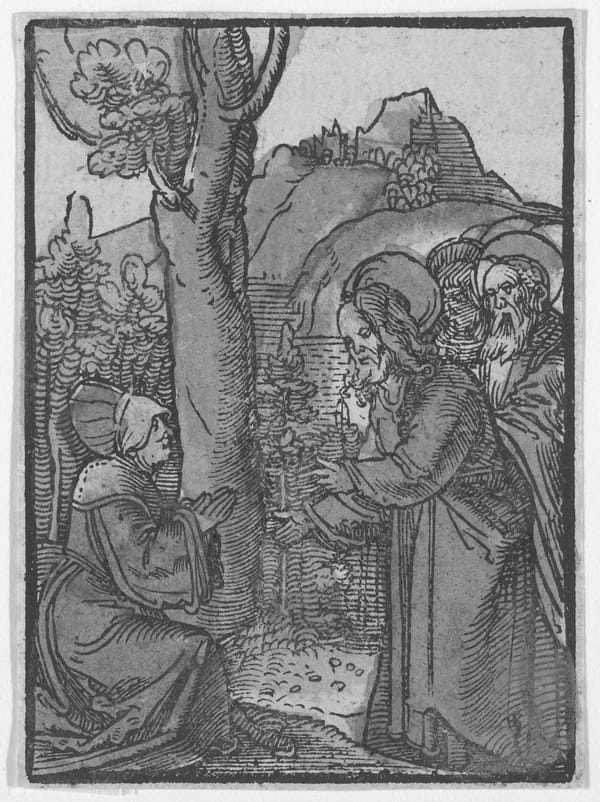
Cap. viii.In illo tempore: Perrexit Jesus in montem Oliveti: et diluculo iterum venit in templum, et omnis populus venit ad eum. Et sedens docebat eos. Adducunt autem scribæ et pharisæi mulierem in adulterio deprehensam: et statuerunt eam in medio, et dixerunt ei: Magister, hæo mulier modo deprehensa est in adulterio. In lege autem Moyses mandavit nobis hujusmodi lapidare. Tu ergo quid dicis? Hoc autem dicebant tentantes eum, ut possent accueare eum. Jesus autem inclinans se deorsum, digito scribebat in terra. Cum ergo perseverarent interrogantes eum, erexit se, et dixit eis: Qui sine peccato est vestrum, primus in illam lapidem mittat. Et iterum se inclinans, scribebat in terra. Audientes autem, unus post unum exibant, incipientes a senioribus: et remansit solus Jesus, et mulier in medio stans. Erigens autem se Jesus, dixit ei: Mulier, ubi sunt, qui te accusabant? Nemo te condemnavit? Quæ dixit: Nemo, Domine. Dixit autem Jesus: Nec ego te condemnabo. Vade, et jam amplius noli peccare.
Ch. viii.At that time: Jesus went to Mount Olivet. And early in the morning he came again into the temple, and all the people came to him, and sitting down he taught them. And the scribes and pharisees bring unto him a woman taken in adultery, and they set her in the midst, and said to him: Master, this woman was even now taken in adultery. Now, Moses in the law commanded us to stone such a one: but what sayest thou? And this they said tempting him, that they might accuse him. But Jesus, bowing himself down, wrote with his finger on the ground. When therefore they continued asking him, he lifted up himself, and said to them: He that is without sin among you, let him first cast a stone at her. And again stooping down, he wrote on the ground. But they hearing this, went out one by one, beginning at the eldest; and Jesus alone remained, and the woman standing in the midst. Then Jesus lifting up himself, said to her: Woman, where are they that accused thee? Hath no man condemned thee? Who said: No man, Lord. And Jesus said: Neither will I condemn thee. Go, and now sin no more.
This is the salvation that proceeds from mercy. The woman is guilty; the Law condemns her to be put to death; her accusers are justified in insisting on her being punished: and yet, she shall not die. Jesus saves her; and all He asks of her is, that she sin no more. What must have been her gratitude! How must she have desired to obey, henceforward, that God, who would not condemn her, and to whom she owed her life! Let us enter into the like dispositions towards our Redeemer, for we, too, are sinners. Is it not He that has stayed the arm of divine justice, when it was raised to strike us? Has He not turned the blow upon Himself? Our salvation, then, has been one of mercy; let us imitate the penitents of the primitive Church, and, during these remaining days of Lent, consolidate the foundations of the new life we have begun.
The answer made by Jesus to the pharisees, who accused this woman, deserves our respectful attention. It not only shows His compassion for the humble sinner, who stood trembling before Him; it contains a practical instruction for us. He that is without sin among you, let him be the first to cast a stone at her. During these days of conversion and repentance, let us recall to mind the detractions we have been guilty of against our neighbour. Alas! these sins of the tongue are looked upon as mere trifles; we forget them almost as soon as we have committed them; nay, so deeply rooted in us is the habit of finding fault with everyone, that we scarcely know ourselves to be detractors. If this saying of our Redeemer had made the impression it ought to have made upon us; if we had thought of our own numberless defects and sins; how could we have dared to criticize our neighbour, publish his faults, and pass judgment upon his very thoughts and intentions? Jesus knew what sort of life these men had led, who accused the woman; He knows what ours has been! Woe to us if, henceforth, we are not indulgent with others!
And lastly, let us consider the malice of Jesus’enemies; what they said, they said, tempting Him, that they might accuse Him. If He pronounce in the woman’s favour, they will accuse Him of despising the Law of Moses, which condemns her to be stoned: if He answer in conformity with the Law, they will hold Him up to the people as a man without mercy or compassion. Jesus, by His divine prudence, eludes their stratagem; but we can foresee what He will have to suffer at their hands, when, having put Himself in their power, that they may do with Him what they please, He will make no other answer to their calumnies and insults than the silence and patience of an innocent Victim condemned to death.
Let us offer to Mary, as we are accustomed to do on the last day of each week, some special expression of our love. Let us say, in her honour, the following sequence, which is taken from the ancient Roman-French missals:
Sequence
Serviat cum gaudio,
Fervens desiderio,
Verus amor.
Præsentetur Filio,
Matris in obsequio,
Cordis clamor.
Virgo decus virginum,
Te decet post Dominum
Laus et honor.
Cujus Dei Filium
Carnis ad connubium
Traxit odor.
Fons misericordiæ,
Vera mentis sauciæ
Medicina.
Tu lucerna gratiae,
Tu supemæ gloriæ
Es regina.
Speculum munditiæ,
Venuatans Ecclesiæ
Sacramentum.
Tu ver es lætitiæ,
Pacis et concordiæ
Condimentum.
Nostra pians scelera,
Jure Matris impera
Redemptori.
Da salutis opera,
Da in vitæ vespera
Bene mori.
joyous praise of Mary:
true and
fervent love.
as it sings in the Mother's honour,
be presented to her Son
as a tribute of love.
O Virgin, and Queen of virgins!
to thee, after God,
are due praise and honour.
whose fragrance drew
the Son of God to assume
our human nature.
fount of mercy!
Hail true balm
of the wounded heart!
the flame richly
fed with grace,
the Queen of matchless glory.
mirror of purity,
that givest beauty
to the holy Church of God!
there can be no sadness,
for thou art the spring-time of joy;
thou art the bond of peace and concord.
use a Mother’s right;
and bid thy Son, our Redeemer,
forgive us our sins.
firmness of faith,
works available to salvation,
and in the evening of life, a happy death.
* In Danielem, page 27. Edit Fabricius. ↩︎
March 6: Sts. Felicitas and Perpetua, Martyrs
The real feast of these two illustrious heroines of the faith is to-morrow, which is the anniversary of their martyrdom and triumph; but the memory of the angel of the schools, St. Thomas of Aquin, shines so brightly on the seventh of March, that it almost eclipses the two glorious stars of Africa. In consequence of this, the Holy See orders the Church to anticipate their feast, and keep it to-day. We at once offer to the Christian reader the glorious spectacle of which Carthage was the scene in the year 203. Nothing could give us a clearer idea of that spirit of the Gospel, according to which we are now studying to conform our whole life. Here are two women, two mothers; God asks great sacrifices from them; He asks them to give Him their lives, nay, more than their lives; and they obey with that simplicity and devotedness which made Abraham merit to be the father of believers.
Their two names, as St. Augustine observes, are a presage of what awaits them in heaven: a perpetual felicity. The example they set of Christian fortitude, is, of itself, a victory, which secures to the true faith a triumph in the land of Africa. St. Cyprian will soon follow them, with his bold and eloquent appeal to the African Christians, inspiring them to die for their faith: but his words, grand as they are, are less touching than the few pages written by the hand of the brave Perpetua, who, though only twenty-two years of age, relates, with all the self-possession of an angel, the trials she had to go through for God; and when she has to hurry off to the amphitheatre, she puts her pen into another’s hand, bidding him go on where she leaves off, and write the rest of the battle. As we read these charming pages, we seem to be in the company of the martyrs; the power of divine grace, which could produce such heroism amidst a people demoralized by paganism, appears so great that even we grow courageous; and the very fact that the instruments employed by God for the destruction of the pagan world were frequently women, induces us to say with St. John Chrysostom: ‘I feel an indescribable pleasure in reading the “Acts of the Martyrs”; but when the martyr is a woman, my enthusiasm is doubled. For the frailer the instrument, the greater is the grace, the brighter the trophy, the grander the victory; and this, not because of her weakness, but because the devil is conquered by her, by whom he once conquered us. He conquered by a woman, and now a woman conquers him. She that was once his weapon, is now his destroyer, brave and invincible. That first one sinned, and died; this one died that she might not sin. Eve was flushed by a lying promise, and broke the law of God; our heroine disdained to live, when her living was to depend on her breaking her faith to Him who was her dearest Lord. What excuse, after this, for men, if they be soft and cowards? Can they hope for pardon, when women fought the holy battle with such brave, and manly, and generous hearts?’1
The lessons appointed to be read on this feast will be found in the Supplement. The following passage from the account written by Perpetua herself, which used to be read at Matins, will make some readers long to read the whole of what she has left us. They will find it in our first volume of the ‘Acts of the Martyrs.’
The Holy See has approved of the three following hymns composed in honour of our two martyrs. We unite them under one conclusion.
Hymn
Binas impavido pectore feminas:
In sexu fragili corda virilia
Hymnis pangat ovantibus.
Nunc ambæ pugiles actibus inclytis
In toto radiant orbe: micantibus
Fulgent tempora laureis.
Sponso connubiis juncta recentibus
Clarescit; sed honor hanc trahit altior:
Christi fœdera prætulit.
Dum servile jugum Felicitas subit;
Ad luctam properans gressibus æmulis,
Palmas ad similes volat.
Impugnai genitor: quæ simul angitur,
Errantem miserans. Oscula filio
Lactenti dedit ultima.
Horum sentit onus Felicitas grave;
Nunc et passa sibi parturiens gemit,
Mox passura Deo libens.
Inspectare datur: jam sibi prælia
Exortura videt; sed requiem Deus
Post certamina conferet.
Ast utrumque latus cuspidibus riget;
Lapsos terribilis faucibus excipit
Hanc infra recubans draco.
Contritumque caput sit tibi pro gradu,
Per quem sidereos incipias pede
Orbes scandere concito.
In quo mulget oves pastor amabilis:
Huc optata venis, filia: sic ait,
Hanc dulci recreans cibo.
Occurrit specie vir gladium vibrans:
Dejectus teritur femineo pede.
Victrix, suscipe præmia.
Athletis Domini. Pergite martyres:
Omnis Perpetuam curia cœlitum,
Et te, Felicitas, cupit.
Elidit sociam bellua. Te soror
Stans, o Felicitas, ad nova prælia
Erectam reparat manu.
Certamen, geminas ad bravium vocat.
Effuso properet sanguine spiritus,
In Christi remeans sinum.
Lictoris gladius: sed trepidam manum
Fortis Perpetuæ dextera dirigit,
Præbens guttura cuspidi.
In Sponsi thalamo carpite jugiter.
Vos exempla dedit: præsidium potens
Vestris ferte clientibus.
Par individuo gloria Flamini;
In cunctis resonet Christiadum choris
Virtus martyribus data.
celebrate in holy praise, the two dauntless women;
and sing, in joyous hymns,
how the weaker sex had here two manly hearts.
and now both shine throughout the whole world
as the two glorious combatants,
wearing bright laurels on their brows.
as being of high birth, and had but recently contracted
an honourable marriage. But there was an honour
far higher, in her eyes, the love and service of Christ.
was free in this, that she was a servant of the great King.
Like Perpetua, she thirsts for battle;
and like her, she culls a palm.
to make her deny her faith. She, on her side was full of grief,
and pity at seeing him a victim of error. Her babe was taken from her;
she kissed him and was content.
our mother, brought upon the earth.
Now, in child-birth, she suffers for herself, and she moans;
but, in her martyrdom, she suffers for her God, and she rejoices.
and she is permitted to look within.
She there learns that a contest awaits her,
but that, after the battle, God will grant her repose.
but both its sides are armed with spikes,
and at its foot lies an angry dragon,
which devours them that fall.
Trample on his head, and make it a steppingstone,
whereby thou mayst quickly mount
to the starry land above.
shepherd caresses his sheep. 'Thou art welcome here, my daughter!’
Thus did he address the martyr,
and then gave her to eat of sweetest food.
There she was met by a man, whose face was swarth and terrible to look at.
He brandished his sword. She encountered him, threw him on the ground, and trampled
on his head. A cry was heard: 'Thou hast conquered! Come, take the prize!’
of victory for the soldiers of Christ.
On, martyrs, to the field! Perpetua and Felicitas!
the court of heaven is longing to receive you!
tearing, and wounding their tender limbs.
See, Felicitas! thy sister’s hand
emboldens thee to renew the fight.
and calls them to the prize.
Their blood streams from the wounds,
and their spirits speed their way to the bosom of Christ.
the martyrs die, all save Perpetua;
bravely she takes the trembling lictor’s hand,
and offering him her neck, tells him his surest aim is there.
and there eternally enjoy the bliss he has in store for you.
He gave you to us as models;
Oh, show your power, and help us your clients.
and to the coequal Spirit!
And let every choir in Christian lands sound forth its praise
to the grace bestowed on the martyrs.
Perpetua! Felicitas! O glorious and prophetic names, which come like two bright stars of March, pouring out upon us your rays of light and life! You are heard in the songs of the angels; and we poor sinners, as we echo them on earth, are told to love and hope. You remind us of that brave woman, who, as the Scripture says, kept up the battle begun by men: The valiant men ceased: who will follow them? A mother in Israel.2 Glory be to that almighty power, which loves to choose the weak things of the world that it may confound the strong!3 Glory to the Church of Africa, the daughter of the Church of Rome; and glory to the Church of Carthage, which had not then heard the preachings of her Cyprian, and yet could produce two such noble hearts!
As to thee, Perpetua, thou art held in veneration by the whole Christian world. Thy name is mentioned by God's priests in the holy Mass, and thus thy memory is associated with the sacrifice of the Man-God, for love of whom thou didst lay down thy life. And those pages written by thine own hand, how they reveal to us the generous character of thy soul! How they comment those words of the Canticle: Love is strong as death!4 It was thy love of God that made thee suffer, and die, and conquer. Even before the water of Baptism had touched thee, thou wast enrolled among the martyrs. When the hard trial came of resisting a father, who wished thee to lay down the palm of martyrdom, how bravely didst thou triumph over thy filial affection, in order to save that which is due to our Father who is in heaven! Nay, when the hardest test came, when the babe that fed at thy breast was taken from thee in thy prison, even then thy love was strong enough for the sacrifice, as was Abraham’s, when he had to immolate his Isaac.
Thy fellow-martyrs deserve our admiration; they are so grand in their courage; but thou, dear saint, surpassest them all. Thy love makes thee more than brave in thy sufferings, it makes thee forget them. ‘Where wast thou,’ we would ask thee in the words of St. Augustine, ‘where wast thou, that thou didst not feel the goading of that furious beast, asking when it was to be, as though it had not been? Where wast thou? What didst thou see, that made thee see not this? On what wast thou feasting, that made thee dead to sense? What was the love that absorbed, what was the sight that distracted, what was the chalice that inebriated thee? And yet the ties of flesh were still holding thee, the claims of death were still upon thee, the corruptible body was still weighing thee down!’5 But our Lord had prepared thee for the final struggle, by asking sacrifice at thy hands. This made thy life wholly spiritual, and gave thy soul to dwell, by love, with Him, who had asked thee for all and received it; and thus living in union with Jesus, thy spirit was all but a stranger to the body it animated.
It was impatient to be wholly with its sovereign Good. Thy eager hand directs the sword that is to set thee free; and as the executioner severs the last tie that holds thee, how voluntary was thy sacrifice, how hearty thy welcome of death! Truly, thou wast the valiant, the strong woman,6 that conqueredst the wicked serpent! Thy greatness of soul has merited for thee a high place among the heroines of our holy faith, and for sixteen hundred years thou hast been honoured by the enthusiastic devotion and love of the servants of God.
And thou, too, Felicitas! receive the homage of our veneration, for thou wast found worthy to be a fellow-martyr with Perpetua. Though she was a rich matron of Carthage, and thou a servant, yet Baptism and martyrdom made you companions and sisters. The lady and the slave embraced, for martyrdom made you equal; and as the spectators saw you hand in hand together, they must have felt that there was a power in the religion they persecuted, which would put an end to slavery. The power and grace of Jesus triumphed in thee, as it did in Perpetua; and thus was fulfilled thy sublime answer to the pagan, who dared to jeer thee: that when the hour of trial came, it would not be thou that wouldst suffer, but Christ who would suffer in thee. Heaven is now the reward of thy sacrifice; well didst thou merit it. And that babe, that was born in thy prison, what a happy child to have for its mother a martyr in heaven! How wouldst thou bless both it and the mother who adopted it! Oh, what fitness, in such a soul as thine, for the kingdom of God!7 Not once looking back, but ever bravely speeding onwards to Him that called thee. Thy felicity is perpetual in heaven; thy glory on earth shall never cease.
And now, dear saints, Perpetua and Felicitas, intercede for us during this season of grace. Go, with your palms in your hands, to the throne of God, and beseech Him to pour down His mercy upon us. It is true, the days of paganism are gone by; and there are no persecutors clamouring for our blood. You, and countless other martyrs, have won victory for faith; and that faith is now ours; we are Christians. But there is a second paganism, which has taken deep root among us. It is the source of that corruption which now pervades every rank of society, and its own two sources are indifference, which chills the heart, and sensuality, which induces cowardice. Holy martyrs! pray for us that we may profit by the example of your virtues, and that the thought of your heroic devotedness may urge us to be courageous in the sacrifices which God claims at our hands. Pray, too, for the Churches which are now being established on that very spot of Africa, which was the scene of your glorious martyrdom: bless them, and obtain for them, by your powerful intercession, firmness of faith and purity of morals.
Appendix
At the recent revision of the Breviary the office of this feast was changed, and the following lessons were appointed to be read at Matins:
| Previous Friday of the Third Week of Lent | Next March 6: Sts. Felicitas and Perpetua, Martyrs |