Daily reading
Lent
Double · Movable from Easter · Temporal
March 7, 2027
From Dom Guéranger’s The Liturgical Year.

|
The Fourth Sunday of Lent
This Sunday, called, from the first word of the Introit, Lætare Sunday, is one of the most solemn of the year. The Church interrupts her lenten mournfulness; the chants of the Mass speak of nothing but joy and consolation; the organ, which has been silent during the preceding three Sundays, now gives forth its melodious voice; the deacon resumes his dalmatic, and the subdeacon his tunic; and instead of purple, rose-coloured vestments are allowed to be used. These same rites were practised in Advent, on the third Sunday, called Gaudete. The Church’s motive for introducing this expression of joy into to-day’s liturgy is to encourage her children to persevere fervently to the end of this holy season. The real mid-Lent was last Thursday, as we have already observed; but the Church, fearing lest the joy might lead to some infringement on the spirit of penance, has deferred her own notice of it to this Sunday, when she not only permits, but even bids, her children to rejoice!
The Station at Rome is in the basilica of Holy Cross in Jerusalem, one of the seven principal churches of the holy city. It was built in the fourth century, by the emperor Constantine, in one of his villas called Sessorius, on which account it goes also under the name of the Sessorian basilica. The emperor’s mother, St. Helen, enriched it with most precious relics, and wished to make it the Jerusalem of Rome. With this intention she ordered a great quantity of earth taken from Mount Calvary to be put on the site. Among the other relics of the instruments of the Passion which she gave to this church was the inscription which was fastened to the cross; it is still there, and is called the Tide of the Cross. The name of Jerusalem, which has been given to this basilica, and which recalls to our minds the heavenly Jerusalem towards which we are tending, suggested the choice of it as to-day’s Station. Up to the fourteenth century, when Avignon became for a time the city of the Popes, the ceremony of the golden rose took place in this church; at present, it is blessed in the palace where the sovereign Pontiff happens to be residing at this season.
The blessing of the golden rose is one of the ceremonies peculiar to the fourth Sunday of Lent, which is called on this account Rose Sunday. The thoughts suggested by this flower harmonize with the sentiments wherewith the Church would now inspire her children. The joyous time of Easter is soon to give them a spiritual spring, of which that of nature is but a feeble image. Hence, we cannot be surprised that the institution of this ceremony is of a very ancient date. We find it observed under the pontificate of St. Leo IX. (eleventh century); and we have a sermon on the golden rose preached by the glorious Pope Innocent III., on this Sunday, and in the basilica of Holy Cross in Jerusalem. In the middle ages, when the Pope resided in the Lateran palace, having first blessed the rose, he went on horseback to the church of the Station. He wore the mitre, was accompanied by all the Cardinals, and held the blessed flower in his hand. Having reached the basilica, he made a discourse on the mysteries symbolized by the beauty, the colour, and the fragrance of the rose. Mass was then celebrated. After the Mass, the Pope returned to the Lateran palace. Surrounded by the sacred college, he rode across the immense plain which separates the two basificas, with the mystic flower still in his hand. We may imagine the joy of the people as they gazed upon the holy symbol. When the procession had reached the palace gates, if there were a prince present, it was his privilege to hold the stirrup, and assist the Pontiff to dismount; for which filial courtesy he received the rose, which had received so much honour and caused such joy.
At present, the ceremony is not quite so solemn; still the principal rites are observed. The Pope blesses the golden rose in the vestiary; he anoints it with holy chrism, over which he sprinkles a scented powder, as formerly; and when the hour for Mass has come, he goes to the palace chapel, holding the flower in his hand. During the holy Sacrifice, it is fastened to a golden rose-branch prepared for it on the altar. After the Mass, it is brought to the Pontiff, who holds it in his hand as he returns from the chapel to the vestiary. It is usual for the Pope to send the rose to some prince or princess, as a mark of honour; sometimes, it is a city or a Church that receives the flower.
We subjoin a free translation of the beautiful prayer used by the sovereign Pontiff when blessing the golden rose. It will give our readers a clearer appreciation of this ceremony, which adds so much solemnity to the fourth Sunday of Lent. ‘O God! by whose word and power all things were created, and by whose will they are all governed! O Thou that art the joy and gladness of all Thy faithful people! we beseech Thy divine Majesty, that Thou vouchsafe to bless and sanctify this rose, so lovely in its beauty and fragrance. We are to bear it, this day, in our hands, as a symbol of spiritual joy; that thus the people that is devoted to Thy service, being set free from the captivity of Babylon by the grace of Thine only-begotten Son who is the glory and the joy of Israel, may show forth, with a sincere heart, the joys of that Jerusalem, which is above, and is our mother. And whereas Thy Church, seeing this symbol, exults with joy for the glory of Thy Name; do Thou, O Lord! give her true and perfect happiness. Accept her devotion, forgive us our sins, increase our faith; heal us by Thy word, protect us by Thy mercy; remove all obstacles; grant us all blessings; that thus this Same Thy Church may offer unto Thee the fruit of good works; and walking in the odour of the fragrance of that Flower, which sprang from the root of Jesse, and is called the Flower of the field, and the Lily of the valley, may she deserve to enjoy an endless joy in the bosom of heavenly glory, in the society of all the saints, together with that divine Flower, who liveth and reigneth with Thee in the unity of the Holy Ghost, world without end. Amen.’
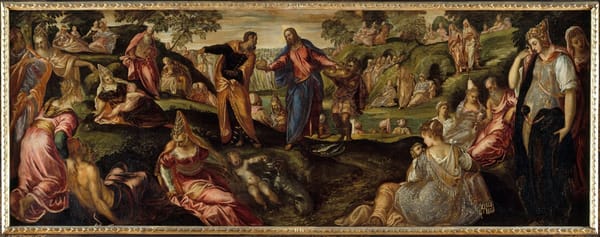
We now come to the explanation of another name given to the fourth Sunday of Lent, which was suggested by the Gospel of the day. We find this Sunday called in several ancient documents, the Sunday of the five loaves. The miracle alluded to in this title not only forms an essential portion of the Church’s instructions during Lent, but it is also an additional element of to-day’s joy. We forget for an instant the coming Passion of the Son of God, to give our attention to the greatest of the benefits He has bestowed on us; for under the figure of these loaves multiplied by the power of Jesus, our faith sees that Bread which came down from heaven, and giveth life to the world.1 ‘The Pasch,’ says our Evangelist, ‘was near at hand’; and, in a few days, our Lord will say to us: ‘With desire I have desired to eat this Pasch with you.’2 Before leaving this world to go to His Father, Jesus desires to feed the multitude that follows Him; and in order to this, He displays His omnipotence. Well may we admire that creative power, which feeds five thousand men with five loaves and two fishes, and in such wise that even after all have partaken of the feast as much as they would, there remain fragments enough to fill twelve baskets. Such a miracle is, indeed, an evident proof of Jesus’ mission; but He intends it as a preparation for something far more wonderful; He intends it as a figure and a pledge of what He is soon to do, not merely once or twice, but every day, even to the end of time; not only for five thousand men, but for the countless multitude of believers. Think of the millions, who, this very year, are to partake of the banquet of the Pasch; and yet, He whom we have seen born in Bethlehem (the house of bread) is to be the nourishment of all these guests; neither will the divine Bread fail. We are to feast as did our fathers before us; and the generations that are to follow us, shall be invited as we now are, to come and taste how sweet is the Lord.3
But observe, it is in a desert place, as we leam from St. Matthew,4 that Jesus feeds these men, who represent us Christians. They have quitted the bustle and noise of cities in order to follow Him. So anxious are they to hear His words, that they fear neither hunger nor fatigue; and their courage is rewarded. A like recompense will crown our labours, our fasting and abstinence, which are now more than half over. Let us, then, rejoice, and spend this day with the light-heartedness of pilgrims who are near the end of their journey. The happy moment is advancing, when our soul, united and filled with her God, will look back with pleasure on the fatigues of the body, which, together with our heart’s compunction, have merited for her a place at the divine banquet.
The primitive Church proposed this miracle of the multiplication of the loaves as a symbol of the Eucharist, the Bread that never fails. We find it frequently represented in the paintings of the catacombs and on the bas-reliefs of the ancient Christian tombs. The fishes, too, that were given together with the loaves, are represented on these venerable monuments of our faith; for the early Christians considered the fish to be the symbol of Christ, because the word ‘fish’ in Greek is made up of five letters, which are the initials of these words: Jesus Christ Son (of) Gody Saviour.
In the Greek Church this is the last day of the week called, as we have already noticed, Mesonestios. Breaking through her rule of never admitting a saint’s feast during Lent, she keeps this mid-Lent Sunday in honour of the celebrated abbot of the monastery of Mount Sinai, St. John Climacus, who lived in the sixth century.
Mass
The seventy years’ captivity will soon be over. Yet a little while, and the captives shall return to Jerusalem. This is the idea expressed by the Church in all the chants of to-day’s Mass. She ventures not to pronounce the heavenly Alleluia; but all her canticles bespeak jubilation; for, in a few days hence, the house of the Lord will lay aside her mourning, and will be keeping the gladdest of her feasts.
Introit
In the Collect, the Church acknowledges that her children deserve the penance they are going through; but she begs that, to-day, the hope of the coming divine consolations may refresh their spirits. The full force of the closing word of her prayer, is that they may breathe awhile.
Collect
The second and third Collects are given on the first Sunday of Lent, page 129.
Epistle
Lectio Epistolæ beati Pauli Apostoli ad Galatas.
Ch. iv.Brethren: It is written that Abraham had two sons; the one by a bond-woman, and the other by a free-woman. But he who was of the bondwoman was born according to the flesh; but he by the free-woman, was by promise. Which things are said by an allegory. For these are the two testaments. The one from Mount Sina, engendering unto bondage, which is Agar; for Sina is a mountain in Arabia, which hath affinity to that Jerusalem which now is, and is in bondage with her children. But that Jerusalem, which is above, is free; which is our mother. For it is written: Rejoice, thou barren, that bearest not: break forth and cry, thou that travailest not; for many are the children of the desolate, more than of her that hath a husband. Now we, brethren, as Isaac was, are the children of promise. But as then he, that was born according to the flesh, persecuted him that was after the spirit, so also is it now. But what saith the Scripture? Cast out the bond-woman and her son; for the son of the bondwoman shall not be heir with the son of the free-woman. So then, brethren, we are not children of the bond-woman, but of the free; by the freedom wherewith Christ hath made us free.
Let us, then, rejoice! We are children, not of Sina, but of Jerusalem. Our mother, the holy Church, is not a bond-woman, but free; and it is unto freedom that she has brought us up. Israel served God in fear; his heart was ever tending to idolatry, and could be kept to duty only by the heavy yoke of chastisement. More happy than he, we serve God through love; our yoke is sweet, and our burden is light!5 We are not citizens of the earth; we are but pilgrims passing through it to our true country, the Jerusalem which is above. We leave the earthly Jerusalem to the Jew, who minds only terrestrial things, is disappointed with Jesus, and is plotting how to crucify Him. We also have too long been grovelling in the goods of this world; we have been slaves to sin; and the more the chains of our bondage weighed upon us, the more we talked of our being free. Now is the favourable time; now are the days of salvation: we have obeyed the Church’s call, and have entered into the practice and spirit of Lent. Sin seems to us, now, to be the heaviest of yokes; the flesh, a dangerous burden; the world, a merciless tyrant. We begin to breathe the fresh air of holy liberty, and the hope of our speedy deliverance fills us with transports of joy. Let us, with all possible affection, thank our divine Liberator, who delivers us from the bondage of Agar, emancipates us from the law of fear, and making us His new people, opens to us the gates of the heavenly Jerusalem, at the price of His Blood.
The Gradual expresses the joy felt by the Gentiles, when invited to enter the house of the Lord, which has now become their own. The Tract shows God protecting His Church, the new Jerusalem, which is not to be conquered and destroyed as was that first one. This holy city communicates her own stability and security to them that are in her, for the Lord watches over both the mother and her children.
Gradual
Tract
Gospel
Cap. vi.In illo tempore: Abiit Jesus trans mare Galilææ, quod est Tiberiadis: et sequebatur cum multitudo magna, quia videbant signa quæ faciebat super his qui infirmabantur. Subiit ergo in montem Jesus: et ibi sedebat cum discipulis suis. Erat autem proximum Pascha, dies festus Judæorum. Cum sublevasset ergo oculos Jesus, et vidisset quia multitudo maxima venit ad eum, dixit ad Philippum: Unde ememus panes, ut manducent hi? Hoc autem dicebat tentans eum: ipse enim soiebat quid esset facturus. Respondit ei Philippus: Ducentorum denariorum panes non sufficiunt eis, ut unusquisque modicum quid accipiat. Dicit ei unus ex discipulis ejus, Andreas, frater Simonis Petri: Est puer unus hie, qui habet quinque panes hordeaceos, et duos pieces: sed hæc quid sunt inter tantos? Dixit ergo Jesus: Facite homines discumbere. Erat autem feenum multum in loco. Discubuerunt ergo viri, numero quasi quinque millia. Accepit ergo Jesus panes: et cum gratias egisset, distribuit discumbentibus: similiter et ex piscibus quantum vole bant. Ut autem impleti sunt, dixit discipulis suls: Colligite quæ superaverunt fragmenta, ne pereant. Collegerunt ergo, et impleverunt duodecim cophinos fragmentorum ex quinque panibus hordeaceis, quæ superfuerunt his qui manducaverant. Illi ergo homines cum vidissent quod Jesus fecerat signum, dicebant: Quia hic est vere propheta, qui venturus est in mundum. Jesus ergo cum cognovisset quia venturi essent ut raperent eum, et facerent cum regem, fugit iterum in monternipse solus.
Ch. vi.At that time: Jesus went over the sea of Galilee, which is that of Tiberias; and a great multitude followed him, because they saw the miracles which he did on them that were diseased. Jesus therefore went up into a mountain, and there he sat with his disciples. Now the Pasch, the festival day of the Jews, was near at hand. When Jesus therefore had lifted up his eyes, and seen that a very great multitude cometh to him, he said to Philip: Whence shall we buy bread that these may eat? And this he said to try him, for he himself knew what he would do. Philip answered him: Two hundred penny-worth of bread is not sufficient for them, that every one may take a little. One of his disciples, Andrew, the brother of Simon Peter, saith to him: There is a boy here that hath five barley loaves, and two fishes; but what are these among so many? Then Jesus said: Make the men sit down. Now there was much grass in the place. The men therefore sat down, in number about five thousand. And Jesus took the loaves; and when he had given thanks, he distributed to them that were sat down. In Like manner also of the fishes, as much as they would; and when they were filled, he said to his disciples: Gather up the fragments that remain, lest they be lost. They gathered up therefore, and filled twelve baskets with the fragments of the five barley loaves, which remained over and above to them that had eaten. Now those men, when they had seen what a miracle Jesus had done, said: This is of a truth the prophet that is to come into the world. Jesus therefore, when he knew that they would come to take him by force and make him king, fled again into the mountain himself alone.
These men, whom Jesus has been feeding by a miracle of love and power,are resolved to make Him their King. They have no hesitation in proclaiming Him worthy to reign over them; for where can they find one worthier? What, then, shall we Christians do, who know the goodness and the power of Jesus incomparably better than these poor Jews? We must beseech Him to reign over us, from this day forward. We have just been reading in the Epistle, that it is He who has made us free, by delivering us from our enemies.Oglorious liberty! But the only way to maintain it, is to live under His Law. Jesus is not a tyrant, as are the world and the flesh; His rule is sweet and peaceful, and we are His children rather than His servants. In the court of such a King ‘to serve is to reign.’ What, then, have we to do with our old slavery? If some of its chains be still upon us, let us lose no time, let us break them, for the Pasch is near at hand; the great feastday begins to dawn. Onwards, then, courageously to the end of our journey! Jesus will refresh us; He will make us sit down as He did the men of the Gospel; and the Bread He has in store for us will make us forget all our past fatigues.
In the Offertory, the Church again borrows the words of David, wherewith to praise the Lord; but, to-day, it is mainly His goodness and power that she celebrates.
Offertory
The Secret is a prayer for the increase of devotion. We ask it by the merits of the Sacrifice at which we are assisting, for it is the source of our salvation.
Secret
The second and third Secrets are given on the first Sunday of Lent, page 136.
In the Communion anthem, the Church sings the praise of the heavenly Jerusalem, which is figured by the basilica of Holy Cross, as we have already explained. She speaks of the joy of the tribes of the Lord, who are assembled in this venerable temple, and are contemplating, under the graceful symbol of the rose, the divine Spouse, Jesus. The fragrance of His perfections draws our hearts after Him.
Communion
The divine mystery of the Bread of life has been brought before us, that we might believe and love it. The Church, therefore, in the Postcommunion, prays that we may have the grace to receive this august mystery with becoming respect and careful preparation.
Postcommunion
The second and third Postcommunions are given on the first Sunday of Lent, page 138.
Vespers
The psalms and antiphons are given on page 99.
Capitulum (Gal . iv.)
For hymn and versicle, see page 106.
Antiphon of the Magnificat
We borrow the following stanzas from the Triodion of the Greek Church. They are in keeping with to-day’s Office, and with the sentiments we should have on mid-Lent Sunday.
Hymn (Dominica IV. Jejuniorum .)
March 7: St. Thomas of Aquin, Doctor of the Church
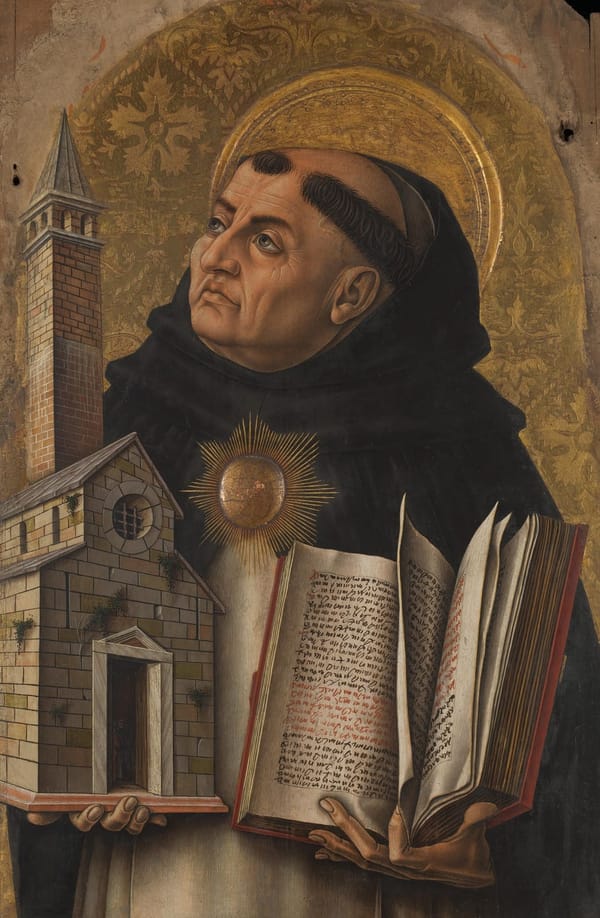 |
The saint we are to honour to-day is one of the sublimest and most lucid interpreters of divine truth. He rose up in the Church many centuries after the apostolic age, nay, long after the four great Latin doctors, Ambrose, Augustine, Jerome, and Gregory. The Church, the ever young and joyful mother, is justly proud of her Thomas, and has honoured him with the splendid title of the angelical doctor, on account of the extraordinary gift of understanding wherewith God had blessed him; just as his contemporary and friend, St. Bonaventure, has been called the seraphic doctor, on account of the wonderful unction which abounds in the writings of this worthy disciple of St. Francis. Thomas of Aquin is an honour to mankind, for perhaps there never existed a man whose intellect surpassed his. He is one of the brightest ornaments of the Church, for not one of her doctors has equalled him in the clearness and precision wherewith he has explained her doctrines. He received the thanks of Christ Himself, for having well written of Him and His mysteries. How welcome ought this feast of such a saint to be to us during this season of the year, when our main study is our return and conversion to God! What greater blessing could we have than to come to the knowledge of God? Has not our ignorance of God, of His claims, and of His perfections, been the greatest misery of our past lives? Here we have a saint whose prayers are most efficacious in procuring for us that knowledge, which is unspotted, and converteth souls, and giveth wisdom to little ones, and gladdeneth the heart, and enlighteneth the eyes.1 Happy we if this spiritual wisdom be granted us! We shall then see the vanity of everything that is not eternal, the righteousness of the divine commandments, the malice of Bin, and the infinite goodness wherewith God treats us when we repent.
Let us learn from the Church the claims of the angelical doctor to our admiration and confidence.
The Dominican Order, of which St. Thomas is one of the greatest ornaments, has inserted the three following hymns in its liturgy of his feast:
Hymn
Laudans turba fidelium,
Errorum pulso nubilo
Per novi solis radium.
Fudit thesauros gratiæ:
Donis pienus ex æthere
Morum et sapientiæ.
Verbi coruscant faculæ,
Scripturæ sacræ Numinis,
Et veritatis regulæ.
Clarus vitæ munditia,
Splendens miris prodigiis,
Dat toti mundo gaudia.
Simulque sancto Flamini,
Qui sancti Thomæ merito
Nos cœli jungat agmini.
and give praise to God,
who has made a new sun to shine in our world,
and disperse the clouds of error.
that Thomas shed his treasures of heavenly light.
Heaven had enriched him
with gifts of virtue and wisdom:
we have derived a brighter knowledge of the Word,
the understanding of the divine Scriptures
and the rules of truth.
the light of his spotless life,
and the splendour of his miracles,
have filled the universe with joy.
and to the Holy Ghost.
And may our God, by the intercession and merits of his saint,
admit us into the choir of the blessed in heaven.
Hymn
Claram ducens originem,
Subit ætatis teneræ
Prædicatorum Ordinem.
Splendens in cœtu nubium,
Plusquam doctores cæteri
Purgans dogma Gentilium.
In lucem pandit abdita,
Dum supra sensus hominum
Obscura facit cognita.
Quadripartite pervius;
Fit Gedeonis gladius,
Tuba, lagena, radius.
Simulque sancto Flamini,
Qui sancti Thomæ merito,
Nos cœli jungat agmini.
Thomas, while in the bloom
of youth, embraced
the Order of Preachers.
brightly does he shine amidst the luminaries of earth,
and, more than any doctor of the Church,
refutes the doctrines of the Gentiles.
and brings to light the hidden gems of truth,
for he teaches us what the mind of man
had else never understood.
like to that four-branched river of paradise.
He made him to be her Gedeon’s sword,
her trumpet, her vase, her torch.
and to the Holy Ghost.
And may our God, by the intercession and merits of his saint,
admit us into the choir of the blessed in heaven.
Hymn
Thomæ felicem exitum,
Qui pervenit ad gaudia
Per Verbi vitæ meritum.
Thecam thesauri gratiæ,
Cum Christus Thomam efficit
Hæredem regni gloriæ.
Et funeris integritas,
Mira fragrans suavitas,
Ægris collata sanitas.
Terræ, ponto, et superis;
Nos juvet suis precibus,
Deo commendet meritis.
Simulque sancto Flamini,
Qui sancti Thomæ merito
Nos cœli jungat agmini.
the happy death of thy Thomas deserves a hymn of praise.
By the merits of him that is the Word of life,
he is now in endless joy.
of grace was welcomed as a guest.
It was there that he received from Christ
the inheritance of eternal glory.
he has loft us his glorious relics
which breathe forth a heavenly fragrance,
and work cures for the suffering sick.
earth, and sea, and heaven, all may give him praise.
May his prayers and merits
intercede for us with God.
and to the Holy Ghost.
And may our God, by the intercession and merits of his saint,
admit us into the choir of the blessed in heaven.
How shall we worthily praise thee, most holy Doctor! How shall we thank thee for what thou hast taught us? The rays of the divine Sun of justice beamed strongly upon thee, and thou hast reflected them upon us. When we picture thee contemplating truth, we think of those words of our Lord: 'Blessed are the clean of heart, for they shall see God.’2 Thy victory over the concupiscence of the flesh merited for thee the highest spiritual delights; and our Redeemer chose thee, because of the purity of thy angelic soul, to compose for His Church the Office whereby she should celebrate the divine Sacrament of His love. Learning did not impair thy humility. Prayer was ever thy guide in thy search after truth; and there was but one reward for which, after all thy labours, thou wast ambitious, the possession of God.
Thy life, alas! was short. The very masterpiece of thy angelical writings was left unfinished. But thou hast not lost thy power of working for the Church. Aid her in her combats against error. She holds thy teachings in the highest estimation, because she feels that none of her saints has ever known so well as thou, the secrets and mysteries of her divine Spouse. Now, perhaps more than in any other age, truths are decayed among the children of men;3 strengthen us in our faith, procure us light. Check the conceit of those shallow self-constituted philosophers, who dare to sit in judgment on the actions and decisions of the Church, and to force their contemptible theories upon a generation that is too ill-instructed to detect their fallacies. The atmosphere around us is gloomy with ignorance; loose principles, and truths spoilt by cowardly compromise, are the fashion of our times; pray for us; bring us back to that bold and simple acceptance of truth, which gives life to the intellect and joy to the heart.
Pray, too, for the grand Order which loves thee so devoutly, and honours thee as one of the most illustrious of its many glorious children. Draw down upon the family of thy patriarch St. Dominic the choicest blessings, for it is one of the most powerful auxiliaries of God’s Church.
We are on the eve of the holy season of Lent, preparing for the great work of earnest conversion of our lives. Thy prayers must gain for us the knowledge both of the God we have offended by our sins, and of the wretched state of a soul that is at enmity with its Maker. Knowing this, we shall hate our sins; we shall desire to purify our souls in the Blood of the spotless Lamb; we shall generously atone for our faults by works of penance
| Previous March 6: Sts. Felicitas and Perpetua, Martyrs | Next March 7: St. Thomas of Aquin, Doctor of the Church |