Daily reading
Lent
Double · March 9 · Sanctoral
March 9, 2027
From Dom Guéranger’s The Liturgical Year.
A Double leads the weekday.Rubric
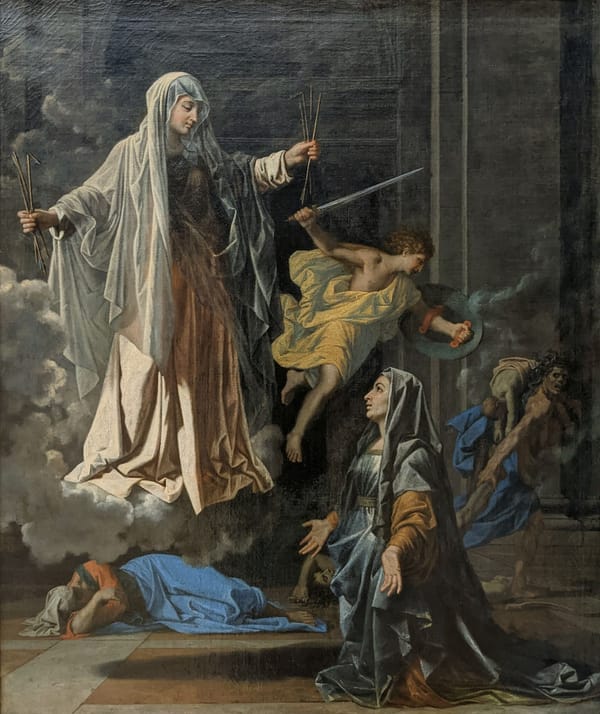 |
March 9: St. Frances of Rome, Widow
The period intervening between the Purification of our blessed Lady and Ash Wednesday (when it occurs at its latest date), gives us thirty-six days; and these offer us feasts of every order of saint. The apostles have given us St. Mathias, and St. Peter’s Chair at Antioch; the martyrs have sent us, from their countless choir, Simeon, Lucius, Blase, Valentine, Faustinus and Jovita, Perpetua and Felicitas, and the forty soldiers of Sebaste, whose feast is kept to-morrow; the holy pontiffs have been represented by Titus, Andrew Corsini, and also by Cyril of Alexandria and Peter Damian, who, like Thomas of Aquin, are doctors of the Church; the confessors have produced Romuald of Camaldoli, John of Matha, John of God, the Seven Founders of the Servites, and the angelic prince Casimir; the virgins have gladdened us with the presence of Agatha, Dorothy, Apollonia, and Scholastica, three wreathed with the red roses of martyrdom, and the fourth with the fair lilies of the enclosed garden* of her Spouse; and lastly, we have had a penitent saint, Margaret of Cortona. The state of Christian marriage is the only one that has not yet deputed a saint during this season, which is less rich in feasts than most of the year. The deficiency is supplied to-day by the admirable Frances of Rome.
Having, for forty years, led a most saintly life in the married state, upon which she entered when but twelve years of age, Frances retired from the world, where she had endured every sort of tribulation. But she had given her heart to her God long before she withdrew to the cloister. Her whole life had been spent in the exercise of the highest Christian perfection, and she had ever received from our Lord the sublimest spiritual favours. Her amiable disposition had won for her the love and admiration of her husband and children: the rich venerated her as their model, the poor respected her as their devoted benefactress and mother.
God recompensed her angelic virtues by these two special graces: the almost uninterrupted sight of her guardian angel, and the most sublime revelations. But there is one trait of her life, which is particularly striking, and reminds us forcibly of St. Elizabeth of Hungary, and of St. Jane Frances Chantal: her austere practices of penance. Such an innocent, and yet such a mortified, life is full of instruction for us. How can we think of murmuring against the obligation of mortification, when we find a saint like this practising it during her whole life? True, we are not bound to imitate her in the manner of her penance; but penance we must do, if we would confidently approach that God who readily pardons the sinner when he repents, but whose justice requires atonement and satisfaction.
The Church thus describes the life, virtues, and miracles of St. Frances.
O Frances, sublime model of every virtue! thou wast the glory of Christian Koine, and the ornament of thy sex. How insignificant are the pagan heroines of old compared with thee! Thy fidelity to the duties of thy state, and all thy saintly actions, had God for their one single end and motive. The world looked on thee with amazement, as though heaven had lent one of its angels to this earth. Humility and penance put such energy into thy soul, that every trial was met and mastered. Thy love for those whom God Himself had given thee, thy calm resignation and interior joy under tribulation, thy simple and generous charity, to every neighbour—all was evidence of God’s dwelling within thy soul. Thy seeing and conversing with thy angel guardian, and the wonderful revelations granted thee of the secrets of the other world, how much these favours tell us of thy merits! Nature suspended her laws at thy bidding; she was subservient to thee, as to one that was already face to face with the sovereign Master, and had the power to command. We admire these privileges and gifts granted thee by our Lord; and now beseech thee to have pity onus, who are so far from being in that path, in which thou didst so perseveringly walk. Pray for us, that we may be Christians, practically and earnestly; that we may cease to love the world and its vanities; that we may courageously take up the yoke of our Lord, and do penance; that we may give up our pride; that we may be patient and firm under temptation. Such was thy influence with our heavenly Father, that thou hadst but to pray, and a vine produced the richest clusters of fruit, even in the midst of winter. Our Jesus calls Himself the true Vine; ask Him to give us of the wine of His divine love, which His cross has so richly prepared for us. When we remember how frequently thou didst ask Him to let thee suffer, and accept thy sufferings for poor sinners, we feel encouraged to ask thee to offer thy merits to Him for us. Pray, too, for Rome, thy native city, that her people may be stanch to the faith, edifying by holiness of life, and loyal to the Church. May thy powerful intercession bring blessings on the faithful throughout the world, add to their number, and make them fervent as were our fathers of old.
* Cant. iv. 12. ↩︎
Tuesday of the Fourth Week of Lent
The Station is in the church of Saint Laurence in Damaso; so called, because it was built, in the fourth century, in honour of the glorious archdeacon of Rome, by Pope St. Damasus, whose body rests here.
Collect
Epistle
Cap. xxxii.In diebus illis, locutus est Dominus ad Moysen, dicens: Descende de monte: peccavit populus tuus, quem eduxisti de terra Ægypti. Recesserunt cito de via, quam ostendisti eis: feceruntque sibi vitulum conflatilem, et adoraverunt, atque immolantes ei hostias, dixerunt: Isti sunt dii tui, Israël, qui te eduxerunt de terra Ægypti. Rursumque ait Dominus ad Moysen: Cemo quod populus iste duræ cervicis sit: dimitte me, ut irascatur furor meus contra eos, et deleam eos, faciamque te in gentem magnam. Moyses autem orabat Dominum Deum suum, dicens: Cur, Domine, irascitur furor tuus contra populum tuum, quem eduxisti de terra Ægypti in fortitudine magna, et in manu robusta? Ne, quæso, dicant Ægyptii: Callide eduxit eos, ut interficeret in montibus, et deleret e terra: quiescat ira tua, et esto placabilis super nequitia populi tui. Recordare Abraham, Isaac, et Israël, servorum tuorum, quibus jurasti per temetipsum, dicens: Multiplicabo semen vestrum sicut Stellas cceli; et universam terram hanc, de qua locutus sum, dabo semini vestro, et possidebitis eam semper. Placatusque est Dominus ne faceret malum, quod locutus fuerat adversus populum suum,
Ch. xxxii.In those days, the Lord spoke to Moses saying: Go, get thee down from the mountain: thy people, which thou hast brought out of the land of Egypt, hath sinned. They have quickly strayed from the way which thou didst show them; and they have made to themselves a molten calf, and have adored it, and sacrificing victims to it, have said: These are thy gods, O Israel, that have brought thee out of the land of Egypt. And again the Lord said to Moses: I see that this people is stiff-necked: let me alone that my wrath may be kindled against them, and that I may destroy them, and I will make of thee a great nation. But Moses besought the Lord his God, saying: Why, O Lord, is thy indignation enkindled against thy people, whom thou hast brought out of the land of Egypt, with great power, and with a mighty hand? Let not the Egyptians say, I beseech thee: He craftily brought them out, that he might kill them in the mountains, and destroy them from the earth; let thy anger cease and be appeased upon the wickedness of thy people. Remember Abraham, Isaac and Israël thy servants, to whom thou swarest by thy own self, saying: I will multiply your seed as the stars ofheaven; and this whole land that I have spoken of, I will give to your seed, and you shall possess it for ever. And the Lord was appeased from doing the evil which he had spoken against his people.
When the world first received the preaching of the Gospel, idolatry was the prevailing crime. For many centuries after, all the catechumens, who were instructed in the true faith, were tainted with it. It was in order to inspire them with a horror of their past lives, that the Church read to them, on this day, the terrible words of God, who, had not Moses interceded, was about to exterminate His people, because they had relapsed into idolatry; and this, after He had worked in their favour the most unheard-of miracles, and had come in person to give them His Law. The worship of false gods is no longer to be found amongst us; but it exists in all those countries, where the Gospel has been preached and rejected. Strange as it may sound, yet it is most true: Europe, with all its civilization, would return to idolatry, were it to lose the faith of our Lord Jesus Christ. Not much more than a centqry ago, an idol was erected to reason; it had its altar, its decorations and its incense; and they who paid homage to it were Europeans! Individuals or peoples, once slaves to Satan, are not their own masters to say, ‘We will go thus far in sin, and no farther’The descendants of Noe, notwithstanding the terrible lesson given to them by the deluge, fell into idolatry; nay, Abraham was called by God from the rest of men, lest he should be led away by the almost universal corruption. Let us be grateful to the Church, who, by her teachings of faith and morals, preserves us from this degrading abomination; and let us resist our passions, which, if the light of faith were taken from us, would lead us to idolatry.
Gospel
Cap. vii.In illo tempore: Jam die festo mediante, ascendit Jesus in templum, et docebat. Et mirabantur Judæi, dicentes: Quomodo hic litteras scit, cum non didicerit? Responds eis Jesus, et dixit: Mea doctrina non est mea, sed ejus qui misit me. Si quis voluerit voluntatem ejus facere, cognoscet de doctrina, utrum ex Deo sit an ego a meipso loquar. Qui a semetipso loquitur, gloriam propriam quærit: qui autem quærit gloriam ejus qui misit eum, hic verax est, et injustitia in illo non est. Nonne Moyses dedit vobis legem? et nemo ex vobis facit legem. Quid me quæritis interficere? Respondit turba, et dixit: Dæmonium habes: quis te quærit interficere? Respondit Jesus, et dixit eis: Unum opus feci, et omnes miramini. Propterea Moyses dedit vobis circumcisionem (non quia ex Moyse est, sed ex patribus): et in Sabbato circumciditis hominem. Si circumcisionem accipit homo in Sabbato, ut non solvatur lex Moysi: mihi indignamini quia totum hominem sanum feci in Sabbato? Nolite judicare secundum faciem, sed justum judicium judicate. Dicebant ergo quidam ex Jerosolymis: Nonne hic est quem quærunt interficere? Et ecce palam loquitur, et nihil ei dicunt. Numquid vere cognoverunt principes quia hic est Christus? Sed hunc scimus unde sit: Christus autem cum venerit, nemo scit unde sit. Clamabat ergo Jesus in templo docens, et dicens: Et me scitis, et unde sim scitis: et a meipso non veni, sed est verus qui misit me, quem vos nescitis. Ego scio eum: quia ab ipso sum, et ipse me misit. Quærebant ergo cum apprehendere: et nemo misit in ilium manus, quia nondum venerat hora ej us. De turba autem multi crediderunt in eum.
Ch. vii.At that time: About the midst of the feast, Jesus went up into the temple and taught. And the Jews wondered, saying: How doth this man know letters, having never leamed? Jesus answered them, and said: My doctrine is not mine, but his that sent me. If any man will do the will of him, he shall know of the doctrine whether it be of God, or whether I speak of myself. He that speaketh of himself, seeketh his own glory; but he that seeketh the glory of him that sent him, he is true, and there is no injustice in him. Did not Moses give you the law? And yet none of you keepeth the law. Why seek you to kill me? The multitude answered and said: Thou hast a devil: who seeketh to kill thee? Jesus answered, and said to them: One work I have done, and you all wonder. Therefore Moses gave you circumcision (not because it is of Moses, but of the fathers); and on the Sabbath-day you circumcise a man. If a man receive circumcision on the Sabbath-day that the law of Moses may not be broken, are you angry at me, because I have healed the whole man on the Sabbath-day? Judge not according to the appearance, but judge just judgment. Some therefore of Jerusalem said: Is not this he whom they seek to kill? And behold he speaketh openly, and they say nothing to him. Have the rulers known for a truth that this is the Christ? But we know this man whence he is. But when the Christ cometh, no man knoweth whence he is. Jesus therefore cried out in the temple, teaching and saying: You both know me, and you know whence I am; and I am not come of myself, but he that sent me is true, whom you know not; I know him because I am from him, and he hath sent me. They sought therefore to apprehend him; and no man laid hands on him, because his hour was not yet come. But of the people many believed in him.
This Gospel carries our thoughts to the sacrifice of ihe divine Lamb, which is to be offered up in Jerusalem. The hour has not yet come, but it is fast approaching. His enemies are already seeking how they may put Him to death. So blinded are they by their passions, that they accuse Him of being a violater of the Sabbath, because He healed the sick, by the simple act of His will, on the Lord’s day! In vain does Jesus refute their prejudices, by reminding them that they themselves have no scruple in fulfilling the law of circumcision on this day, or (as He said to them, on another occasion) in drawing out of the pit an ass or an ox that may have fallen in.1 They are deaf to all He says; they are men of one idea, and it is, that their victim shall not escape death. His miracles are incontestable, and all are wrought out of a motive of mercy and love. The only time He refuses to work one, is when His enemies ask Him to satisfy their curiosity and pride by letting them see a sign. This exercise of His power of working miracles, far from exciting them to admiration and gratitude, only incites them to envy, and in their envy, they declare, not only that He acts by Beelzebub,2 but that He has a devil within Him. We shudder at such a blasphemy. Yet, such is the pride of these Jewish doctors that they care neither for common sense nor for religion, and their hearts thirst more and more for the Blood of Jesus. Whilst some of the people allow themselves to be seduced by their leaders into the same feelings against Jesus, others, who affect to be indifferent, reason about Him, and then declare it to be their opinion that this Jesus does not realize in Himself the character of the promised Messias! They argue that, when the Christ cometh no one will know whence He is. But have not the prophets declared that He is to be of the family of David? Now every Jew knows well enough that Jesus is of that royal race. Besides, they own that there is to be something mysterious about the Messias, and that He is to come from God. Had they listened with docile attention to the teachings of Jesus—teachings which He had confirmed by numerous miracles—they would have been enlightened both as to His temporal birth, and to His being the Son of God. But indifference and the perversity of the human heart keep them in culpable ignorance; and, perhaps, on the day of His death, they will join in the cry: ‘Let His Blood be upon us and upon our children!’3
The Greek liturgy supplies us with the following humble act of contrition. We take it from the hymn composed by St. Andrew of Crete.
Canon Magnus
(Feria V. Hebdomadæ V. Jejuniorum)
| Previous Monday of the Fourth Week of Lent | Next Tuesday of the Fourth Week of Lent |