Daily reading
Movable from Easter · Temporal
Thursday of the Fourth Week of Lent
From Dom Guéranger’s The Liturgical Year.
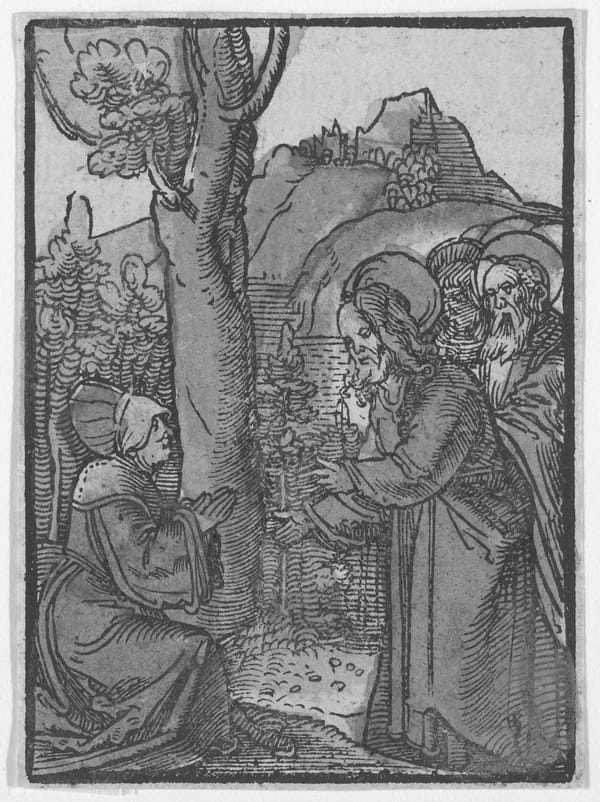
The Station is at the church of Saints Sylvester and Martin, which is one of the most venerable in Rome. It was originally built by Pope St. Sylvester, and still bears his name: but in the sixth century, it was consecrated to St. Martin of Tours. In the seventh century, it was enriched with the relics of Pope Saint Martin, which were brought from Chersonesus, where he had died a martyr a few years before. This church was the first Title of St. Charles Borromeo. It was also that of the learned liturgiologist, the Blessed Joseph-Mary Tommasi, whose body is now venerated in this church, and has been miraculously preserved, even to this day, in a state of incorruption.
Collect
Epistle
4. Cap. iv.
In this mysterious event are clustered together all the wonders of the plan laid down by God for the salvation of man. If the catechumens were instructed in these sublime truths, it would be a disgrace in us to be ignorant of them; therefore, let us be attentive to the teachings of this Epistle. This dead child is the human race; sin has caused its death, but God has resolved to restore it to life. First of all, a servant is sent to the corpse; this servant is Moses. His mission is from God; but, of itself, the Law he brings gives not life. This Law is figured by the staff which Giezi holds in his hand, and which he lays upon the child’s face; but to no purpose. The Law is severe; its rule is one of fear, on account of the hardness of Israel’s heart; yet is it with difficulty that it triumphs over his stubbornness; and they of Israel who would be just must aspire to something more perfect and more filial than the Law of Sinai. The Mediator who is to bring down from heaven the sweet element of charity, has not yet come; He is promised, He is prefigured; but He is not made flesh, He has not yet dwelt among us. The dead child is not risen. The Son of God must Himself come down.
Eliseus is the type of this divine Redeemer. See how he takes on himself the littleness of the child’s body, and bows himself down into closest contact with its members, and this in the silence of a closed chamber. It was thus that the Word of the Father, shrouding His brightness in the womb of a Virgin, united Himself to our nature, and, as the apostle expresses it, emptied Himself, taking the form of a servant, being made in the likeness of men,1 that they may have life, and may have it more abundantly2 than when it was given to them at the beginning Take notice, too, of what happens to the child, and what are the signs of the resurrection wrought in him. He breathes seven times: the Holy Ghost with His seven gifts, is to take possession of man’s soul and make it His temple. The child opens his eyes: the blindness of death is at an end. Neither must we forget the Sunamitess, the mother of the child: she is the type of the Church, who is praying her divine Elieeus to give her the resurrection of her dear catechumens, and of all unbelievers who are dwelling in the region of the shadow of death.3 Let us join our prayers with hers, and beg that the light of the Gospel may be spread more and more, and that the obstacles, opposed by satan and the malice of men to its propagation, may be for ever removed.
Gospel
Cap. vii.In illo tempore: I bat Jesus in civitatem quæ vocatur Naim: et ibant cum eo discipuli ejus, et turba copiosa. Cum autem appropinquaret portae civitatis, ecce defunctus efferebatur, filius unicus matris suae: et hæc vidua erat: etturba civitatis multa cum ilia. Quam cum vidisset Dominus, misericordiamotus super eam, dixit illi: Noli flere. Et accessit, et tetigit loculum (hi autem qui portabant steterunt). Et ait: Adolescens, tibi dico, surge. Et resedit qui erat mortuus, et cœpit loqui. Et dedit ilium matri suæ. Accepit autem omnes timor: et magnificabant Deum, dioentes: Quia Propheta magnus surrexit in nobis: et quia Deus visitavit plebem suam.
Ch. vii.At that time: Jesus went into a city that is called Naim; and there went with him his disciples, and a grea£ multitude. And when he came nigh to the gate of the city, behold a dead man was carried out, the only son of his mother, and she was a widow; and a great multitude of the city was with her. Whom when the Lord had seen, being moved with mercy towards her, he said to her: Weep not. And he came near, and touched the bier. And they that carried it, stood still. And he said: Young man, I say to thee, arise. And he that was dead, sat up, and began to speak. And he gave him to his mother. And there came a fear on them all, and they glorified God, saying: A great prophet is risen up among us, and God hath visited his people.
The Church, both to-day and to-morrow, gives us types of the Resurrection; it is an announcement of the coming Pasch, and an encouragement for sinners to hope that their spiritual death will soon be changed into life. Before entering on the two weeks which are to be devoted to the commemoration of our Saviour’s Passion, the Church shows ter children the tender mercies of Him whose Blood is to purchase our reconciliation with divine Justice. She would have us argue, for our own consolation, that from such a Saviour we may well hope for pardon. Being thus rid of our fears, we shall be the more at liberty to contemplate the Sacrifice of our august Victim, and compassionate His sufferings. Let us attentively consider the Gospel just read to us. A heart-broken mother is following to the grave the corpse of an only son. Jesus has compassion upon her; He stays the bearers; He puts His divine hand on the bier; He commands the young man to arise; and then, as the Evangelist adds, Jesus gave him to his mother. This mother is the Church, who mourns over the death of so many of her children. Jesus is about to comfort her. He, by the ministry of His priests, will stretch forth His hand over these dead children; He will pronounce over them the great word that gives resurrection; and the Church will receive back into her arms these children she had lost, and they will be full of life and gladness.
Let us consider the mystery of the three resurrections wrought by our Saviour: that of the ruler’s daughter,4 that of the young man of to-day’s Gospel, and that of Lazarus, at which we are to assist tomorrow. The daughter of Jaims (for such was the ruler’s name) had been dead only a few hours: she represents the sinner who has but recently fallen, and has not yet contracted the habit of sin, nor grown insensible to the qualms of conscience. The young man of Naim is the figure of a sinner, who makes no effort to return to God, and whose will has lost its energy: he is being carried to the grave; and but for Jesus’ passing that way, he would soon have been of the number of them that are for ever dead. Lazarus is an image of a worse class of sinners. He is already a prey to corruption. The stone that closes his grave seals his doom. Can such a corpse as this ever come back to life? Yes, if Jesus mercifully deign to exercise His power. Now, it is during this holy season of Lent that the Church is praying and fasting, and we with her, to the end that these three classes of sinners may hear the voice of the Son of God, and hearing, rise and live.5 The mystery of Jesus’ Resurrection is to produce this wonderful effect in them all. Let us take our humble share in these merciful designs of God; let us, day and night, offer our supplications to our Redeemer, that, in a few days hence, seeing how He has raised the dead to life, we may cry out, with the people of Naim: A great Prophet is risen up among us, and God hath visited His people!
We offer to our readers this admirable canticle of the Gothic Church of Spain, It is addressed to the catechumens, who are admitted to Baptism; but, here and there, it is applicable to the penitents, who are soon to be reconciled.
Hymn (Sabbato Hebdomadæ V. in Quadragesima)
Creator adsciscens, amat quæ condidit;
Redemptor attrahit benigno spiritu;
Venite, dicit, ves ter unus sum Deus.
Ingens chaos vos pessime concluserat:
Locus beatitudinis jam non erat;
Cruenta terra qua re mors intraverat.
Potens, infirmitatis particeps vestræ
Valenter vos feram, concurrite;
Ut jam receptet vos ovile gaudii.
Aures, et os perfusa signet unctio:
Præbete dictis cordis aurem: vividum
Confessionis personate canticum.
Omnea novæ sortie lovet hæreditas:
Nullus manebit servus hosti subditus:
Eritis unius Dei regnum manens.
Uni Patri, ejusque soli Filio,
Cum Spiritu; quæ Trinitas perenniter
Vivit potens in sæculorum sæcula.
The Creator, loving the works of his hands, invites you:
the Redeemer lovingly draws you,
saying: Come, I am your only God.
you had wretchedly fallen into the great abyss;
there was no longer a heaven for you;
cruel death had come upon the earth.
have come to you in love. I, though a sharer of your weakness,
am the mighty God; I will carry you in my strength;
come unto me, and the fold of joy shall welcome you back.
and your ears and mouth anointed with oil.
Lend the ear of your heart to what you are taught;
and sing the Symbol as a canticle of fervent praise.
You are all made heirs to a new inheritance.
Not one of you shall remain a slave to the enemy.
You shall be the permanent kingdom of the one God.
Glory be to the one Father, and to his only Son,
together with the Holy Ghost: the almighty Trinity,
that liveth unceasingly for ever and ever.
| Previous March 10: The Forty Martyrs | Next March 12: St. Gregory the Great, Pope and Doctor of the Church |