Daily reading
Passiontide
Double · March 17 · Sanctoral
March 17, 2027
From Dom Guéranger’s The Liturgical Year.
A Double leads the weekday.Rubric
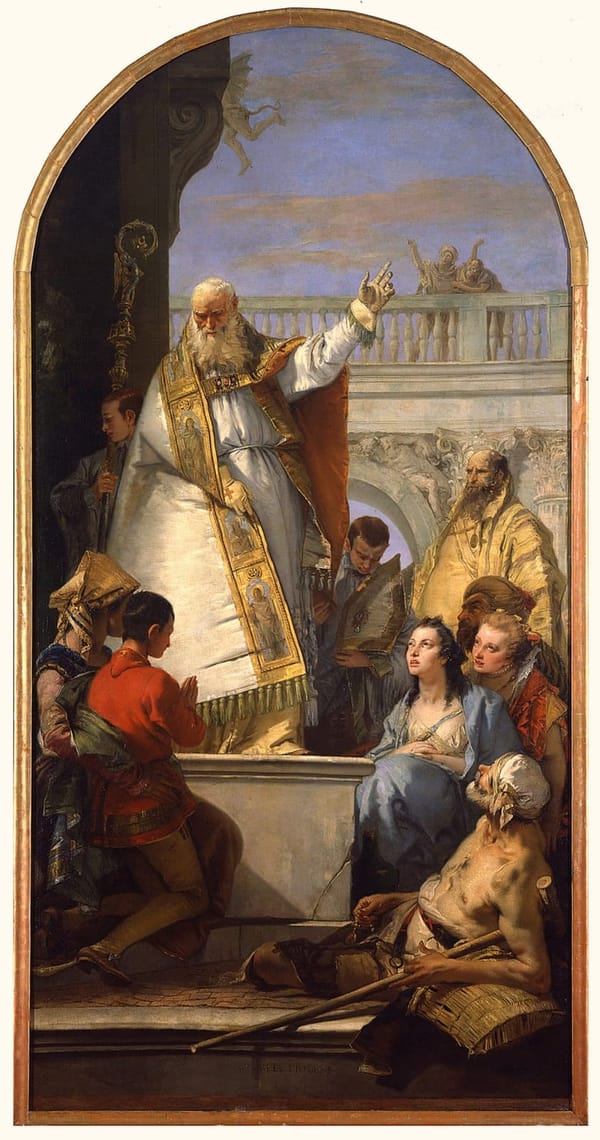 |
March 17: St. Patrick, Apostle of Ireland, Bishop and Confessor
The saint we have to honour to-day is the apostle of that faithful people, whose martyrdom has lasted three hundred years: it is the great St. Patrick, he that gave Erin the faith. There shone most brightly in this saint that gift of the apostolate, which Christ has left to His Church, and which is to remain with her to the end of time. The ambassadors or missioners, sent by our Lord to preach His Gospel, are of two classes. There are some who have been entrusted with a small tract of the Gentile world; they had to sow the divine seed there, and it yielded fruit more or less according to the dispositions of the people that received it: there are others, again, whose mission is like a rapid conquest, that subdues a whole nation, and brings it into subjection to the Gospel. St. Patrick belongs to this second class; and in him we recognize one of the most successful instruments of God's mercy to mankind.
And then, what solidity there is in this great saint’s work! When is it that Ireland received the faith? In the fifth century, when Britain was almost wholly buried in paganism; when the race of the Franks had not as yet heard the name of the true God; when Germany had no knowledge of Christ’s having come upon the earth; when the countries of northern Europe deeply slumbered in infidelity: yes, it was before these several nations had awakened to the Gospel, that Ireland was converted. The faith, brought to her by her glorious apostle, took deep root and flourished and fructified in this isle, more lovely even by grace than she ifl by nature. Her saints are scarcely to be numbered, and went about doing good in almost every country of Europe; her children gave, and are still giving, to other countries, the faith that she herself received from her beloved patron. And when the sixteenth century came with its protestantism; when the apostasy of Germany was imitated by England, Scotland, and the whole north of Europe, Ireland stood firm and staunch; no persecution, however cleverly or however cruelly carried on against her, has been able to detach her from the faith taught her by Saint Patrick.
Let us honour the admirable apostle, chosen by God to sow the seed of His word in this privileged land; and let us listen to the simple account of his labours and virtues, thus given in the lessons of his feast:
The following sequence, in honour of our saint, is taken from an ancient manuscript missal, published by Messingham, in his Florilegiam Insulœ Sanctorum, Paris, 1624:
Sequence
Qua conscendit ad superna
Vir Dei Patricius.
Puer bonus Christi crucem
Veneratur ocyus.
Fons erupit, donum lucis
Cæco nato præbuit.
Quo nutrici, quæ languebat,
Sanitatem tribuit.
Fit cuetos porcorum:
Aurum quo redimitur
Reperit decorum.
Satan hunc vexavit:
Sed Helias artuum
Robur reparavit.
Moribus imbutus,
Corpus abstinentiis,
Moysen secutus;
In montis cacumina
Scandit et jejunat;
Glacierum fragmina
Succendens adunat.
Documentis et doctrina
Studet evangelicis.
Doctor est, nutu divino,
Transmissus Hibemicis.
Fur punitur plagie duris,
Et ejus successio.
Obiit ante, post revectus
Orante Patricio.
Prece congregata
Pellit ab Hibernia,
Mari liberata.
Cœlos aliquoties
Apertos aspexit;
Et Jesum suspiciens
Dominum conspexit.
Transit pater ab hac luce
Signis plenus,
Christo duce,
Lucie ad palatium.
Confer, bone Jesu, tua
Pietate gaudium.
whereon Patrick, the man of God,
ascended to heaven!
the holy youth devoutly venerated
the cross of Christ.
a fount gushed forth upon the spot,
and with its waters he gave sight to one born blind.
and by it restored
his nurse to health.
and was made keeper of swine:
but the saint found a piece of glittering gold,
and with it bought his freedom.
with bodily injuries;
but Elias healed him,
and gave him back his strength.
and, like Moses,
he restrained his body
from vices by fasting.
He ascends a high mountain,
and there he fasts.
He throws ice upon a fire,
and it burns as though it were wood.
and teaching of Germanus,
and studies under him the maxims of the Gospel.
sends him to teach salvation
to the people of Hibernia.
was discovered by its bleating;
and he and his family were punished with a severe scourge.
and asked to be restored to health. He was first punished with real death,
and was then restored to life by Patrick’s prayer.
all venomous reptiles,
and drove them from Hibernia’s shore.
At times, he saw
the heavens opened;
and as he gazed above,
he saw the Lord Jesus.
Our father passed out of this world,
under the guidance of Christ;
and, glorious by his miracles,
he was taken to the courts
of heavenly light.
by his intercession,
that we may enter into joy.
The following antiphons and prayers are taken from the Officium Sancti Patricii, Paris, 1622:
Another favourite antiphon, used in the ancient Proper Office of St. Patrick, was composed of the words spoken to him by the angel:
We conclude these liturgical extracts with a prayer from an ancient manuscript breviary of Armagh.
Prayer
Thy life, great saint, was spent in the arduous toils of an apostle; but how rich was the harvest thou didst reap! Every fatigue seemed to thee light, if only thou couldst give to men the precious gift of faith; and the people to whom thou didst leave it have kept it with a constancy which is one of thy greatest glories. Pray for us, that this faith, without which it is impossible to please God,1 may take possession of our hearts and minds. It is by faith that the just man liveth,2 says the prophet, and it is faith that, during this holy season of Lent, is showing us the justice and mercy of God, in order that we may be converted, and offer to our offended Lord the tribute of our penance. We are afraid of what the Church imposes on us, simply because our faith is weak. If our principles were those of faith, we should soon be mortified men. Thy life, though so innocent, and so rich in good works, was one of extraordinary penance: gain for us thy spirit, and help us to follow thee, at least at a humble distance. Pray for Erin, that dear country of thine, which loves and honours thee so fervently. She is threatened with danger even now, and many of her children have left the faith thou didst teach. An odious system of proselytism has disturbed thy flock; protect it, and suffer not the children of martyrs to be apostates. Let thy fatherly care follow them that have been driven by suffering to emigrate from their native land: may they keep true to the faith, be witnesses of the true religion in the countries to which they have fled, and ever show themselves to be the obedient children of the Church. May their misfortunes thus serve to advance the kingdom of God. Holy pontiff! intercede for England; pardon her the injustice she has shown to thy children; and, by thy powerful prayers, hasten the happy day of her return to Catholic unity. Pray, too, for the whole Church; thy prayer, being that of an apostle, easily finds access to Him that sent thee.
Wednesday in Passion Week
At Rome, the Station is in the church of Saint Marcellus, Pope and Martyr. This church was once the house of the holy lady Lucina, who gave it to the Pontiff, that he might consecrate it to God.
Collect
Epistle
Cap. xix.In diebus illis: Locutus eat Dominus ad Moysen, dicens: Loquere ad omnem cœtum filiorum Israel, et dices ad eos: Ego Dominus Deus vester. Non facietis furtum. Non mentiemini, nec decipiet unuequisque proximum suum. Non perjurabis in nomine meo, nec pollues nomen Dei tui. Ego Dominus. Non facies calumniam proximo tuo, nec vi opprimes eum. Non morabitur opus mercenarii tui apud to usque mane. Non maledices surdo, nec coram cæco pones offendiculum: sed timebis Dominum Deum tuum, quia ego sum Dominus. Non facies quod iniquum est, nec injuste judicabis. Non consideres personam pauperis, nec honores vultum potentis. Juste judica proximo tuo. Non eris criminator, nec susurro in populo. Non stabis contra sanguinem proximi tui. Ego Dominus. Non oderis fratrem tuum in corde tuo, sed publice argue eum, ne habeas super illo peccatum. Non quæras ultionem, nec memor eris injuriæ civium tuorum. Diliges amicum tuum sicut teipsum. Ego Dominas. Leges meas custodite. Ego enim sum Dominus Deus vester.
Ch. xix.In those days: the Lord spake to Moses, saying: Speak to all the assembly of the children of Israel, and thou shalt say to them: I am the Lord your God. You shall not steal. You shall not lie: neither shall any man deceive his neighbour. Thou shalt not swear falsely by my name, nor profane the name of thy God. I am the Lord. Thou shalt not calumniate thy neighbour, nor oppress him by violence. The wages of him that has been hired by thee, shall not abide with thee until the morning. Thou shalt not speak evil of the deaf, nor put a stumbling block before the blind: but thou shalt fear the Lord thy God, because I am the Lord. Thou shalt not do that which is unjust, nor judge unjustly. Respect not the person of the poor, nor honour the countenance of the mighty. Judge thy neighbour according to justice. Thou shalt not be a detractor nor a whisperer among the people. Thou shalt not stand against the blood of thy neighbour. I am the Lord. Thou shalt not hate thy brother in thy heart, but reprove him openly, lest thou incur sin through him. Seek not revenge, nor be mindful of the injury of thy citizens. Thou shalt love thy friend as thyself. I am the Lord. Keep ye my laws, for I am the Lord your God.
This passage from Leviticus, wherein our duties to our neighbour are so dearly and so fully defined, is read to us to-day, in order that we may see how we fulfil these important duties, and correct whatever short-comings we may discover in ourselves. It is God who here speaks; it is God who commands. Observe that phrase: I am the Lord: He repeats it several times, to show us that if we injure our neighbour, He, God Himself, will become the avenger. How strange must this doctrine have seemed to the catechumens, who had been brought up in the selfish and heartless principles of paganism! Here they are told that all men are brethren, and that God is the common Father of all, commanding all to love one another with sincere charity, and without distinction of nation or class. Let us Christians resolve to fulfil this precept to the letter: these are days for good resolutions. Let us remember that the commandments we have been reading were given to the Israelite people, many ages before the preaching of the law of love. If, then, God exacted from the Jew a cordial love of his fellow-men, when the divine law was written on mere tablets of stone; what will He not require from the Christian, who can now read that law in the Heart of the Man-God, who has come down from heaven and made Himself our Brother, in order that we might find it easier and sweeter to fulfil the precept of charity? Human nature united in His Person to the divine, is henceforth sacred; it has become an object of the heavenly Father’s love. It is out of fraternal love for this our nature that Jesus suffered death, teaching us, by His own example, to have such love for our brethren, that, if necessary, we ought to lay down our lives for them.* It is the beloved disciple that teaches us this, and he had it from his divine Master.
Gospel
Cap. x.In illo tempore: Facta sunt encœnia in Jerosolymis: et hiems erat. Et ambulabat Jesus in templo, in porticu Salomonis. Circumdederunt ergo eum Judæi, et dicebant ei: Quousque animam nostram tollis? Si tu es Christus, dic nobis palam. Respondit eis Jesus: Loquor vobis, et non creditis. Opera quæ ego facio in nomine Patris mei, hæc testimonium perhibent de me. Sed vos non creditis, quia non estis ex ovibus meis. Oves meæ vocem meam audiunt: et ego cognosco eas, et sequuntur me: et ego vitam æternam do eis: et non peribunt in æternam, et non rapiet eas quisquam de manu mea. Pater meus quod dedit mihi, majus omnibus est: et nemo potest rapere de manu Patris mei. Ego, et Pater unum sumus. Sustulerunt ergo lapides Judæi, ut lapidarent eum. Respondit eis Jesus: Multa bona opera ostendi vobis ex Patre meo; propter quod eorum opus me lapidatis? Responderunt ei Judæi: De bono opere non lapidamus te, sed de blasphemia, et quia tu homo cum sis, facis teipsum Deum. Respondit eis Jesus: Nonne scriptum est in lege vestra: Quia ego dixi, dii estis? Si illos dixit deos, ad quos sermo Dei factus est, et non potest solvi Scriptura: quem Pater sanctificavit, et misit in mundum, vos dicitis: Quia blasphemas; quia dixi, Filius Dei sum? Si non facio opera Patris mei, nolite credere mihi. Si autem facio, et si mihi non vultis credere, operibus credite, ut cognoscatis, et credatis, quia Pater in me est, et ego in Patre.
Ch. x.At that time: it was the feast of the Dedication at Jerusalem: and it was winter. And Jesus walked in the temple in Solomon’s porch. The Jews therefore came round about him, and said to him: How long dost thou hold our souls in suspense? If thou be the Christ, tell us plainly. Jesus answered them: I speak to you and you believe not. The works that I do in the name of my Father, they give testimony of me. But you do not believe because you are not of my sheep. My sheep hear my voice: and I know them, and they follow me: and I give them eternal life: and they shall not perish for ever, and no man shall pluck them out of my hand. That which my Father hath given me, is greater than all: and no man can snatch it out of the hand of my Father. I and the Father are one. The Jews then took up stones to stone him. Jesus answered them: Many good works I have showed you from my Father; for which of those works do you stone me? The Jews answered him: For a good work we stone thee not, but for blasphemy: and because that thou, being a man, makest thyself God. Jesus answered them: Is it not written in your law: I said you are gods? If he called them gods, to whom the word of God was spoken, and the Scripture cannot be broken; do you say of him whom the Father hath sanctified and sent into the world: Thou blasphemest: because I said I am the Son of God? If I do not the works of my Father, believe me not. But if I do, though you will not believe me believe the works, that you may know, and believe that the Father is in me, and I in the Father.
After the feast of tabernacles came that of the Dedication, and Jesus remained in Jerusalem. The hatred His enemies bore Him is greater than ever. They come round about Him, that they may make Him say He is the Christ, and then accuse Him of claiming a mission which does not belong to Him. Jesus deigns not to reply to their question, but tells them that they have seen His works, and that these give ample testimony of His being Christ, the Son of God. It is by faith, and by faith alone, that man can here know his God. God manifests Himself by His divine works: man sees them, and is bound to believe the truth to which they bear testimony. By thus believing, he has both the certitude of what he believes, and the merit of believing. The proud Jew rebels against this: he would fain dictate to God how He should act, and sees not that such a pretension is impious and absurd.
But, if Jesus openly declare the truth, He will scandalize these evil-minded men! Be it so; the truth must be preached. Our Lord has others to consult besides them; there are the well-intentioned, who will believe what He teaches. He, therefore, utters these sublime words, whereby He declares, not only that He is Christ, but that He is God: I and the Father are one. He knew that this would enrage His enemies; but He had to make Himself known to the world, and to arm the Church against the false doctrines of heretics, who would rise up in future ages. One of these is to be Arius, who will teach that Jesus is not God, but only the most perfect of creatures: the Church will answer, that Jesus is one with the Father, consubstantial with the Father: and then, after causing much trouble and sin, Arianism will die out and be forgotten. The Jews mentioned in to-day’s Gospel are the fore-runners of Arius; they understand what our Lord says: He says He is God, and they seek to stone Him. Jesus gives them a fresh grace; He shows them why they should receive what He here teaches; He reminds them, by the Scriptures they know off by heart, that the name god has sometimes been applied, in a limited sense, to men who had certain high offices put upon them by heaven; and then, He bids them think of all the miracles they have seen Him work, which so plainly testify to His being assisted by His Father, and once more declares Himself to be God, saying: The Father is in Me, and I in the Father. But men hardened in obstinacy, as these are, cannot be convinced: and the sin they have committed against the Holy Ghost is working its effects. How different is it with the sheep of this divine Shepherd! They hear His voice; they follow Him; He gives them eternal life; no man shall pluck them out of His hand. Happy sheep indeed! They believe, because they love; and as it is through the heart that truth gains ascendancy over them, so is it by pride of intellect that darkness gains admission into the soul of the unbeliever, and lasts as long as pride lasts. Alas! poor unbeliever! he loves his darkness; he calls it light; he blasphemes when he thinks he reasons, just as these Jews crucified the Son of God, that, as they said, they might give glory to God.
The Mozarabic breviary gives us the following beautiful prayer, which consists of exclamations to our suffering Jesus.
Prayer (Sabbato Dominicæ V. Quadragesimæ)
Let us now turn towards the holy cross. These words of the Greek Church, in her Triodion, will assist our devotion.
Hymn (Feriæ V. mediæ Septimanæ)
* 1 St. John iii. 16. ↩︎
| Previous Tuesday in Passion Week | Next Wednesday in Passion Week |